A Busy Week at SMBC Group

Sumitomo Mitsui Financial Group (SMFG, or SMBC Group) and its operating subsidiaries, led by Sumitomo Mitsui Banking Corporation (SMBC) and Sumitomo Mitsui Card, have executed a series of strategic initiatives, demonstrating an aggressive balance sheet alignment and operational modernization strategy designed to maximize Return on Equity (ROE), rationalize Risk-Weighted Assets (RWA), and establish technical moats across core retail, wholesale, and transaction banking verticals.
By restructuring equities operations under a dedicated intermediate holding company, expanding credit and deposit acquisition capabilities across unified digital platforms, establishing real-time enterprise AI risk guardrails, offloading non-core U.S. commercial banking assets, and pioneering on-chain trade settlement infrastructure, SMBC Group is actively fortifying its financial and technological architecture.
- Wholesale Equities Restructuring: Execution of a statutory share exchange agreement on September 30, 2026 (effective October 1, 2026) to establish SMBC Nikko Securities Holdings as an intermediate holding company. This entity ring-fences equity underwriting and trading risks while managing governance over SMBC Nikko Securities and the joint venture entity, SMBC Nikko Jefferies Securities.
- Retail Credit Monetization: Introduction of "Money Assist Plus" on September 29, 2026, an embedded credit line within the "Olive" personal finance platform operated by SMCC. The service pairs preferential interest rates (1.0%–15.0%) with dynamic yield boosts under the V Point Up Program to maximize cross-selling margins.
- Omnichannel Bank Agency Integration: Authorization of SMCC by the Kanto Local Finance Bureau (License No. 543, effective October 1, 2026) to conduct bank agency operations for principal bank SMBC. This enables SMCC to convert its expansive retail consumer cardholder and corporate merchant networks (via the "Trunk" platform) into low-cost deposit and loan acquisition engines.
- Enterprise AI Risk Infrastructure: Deployment of Citadel AI’s automated governance and monitoring framework across SMBC on October 1, 2026. Grounded in the Group's 2024 "Responsible AI Policy," the system provides automated pre/post-release audit logging and real-time prompt/response blocking to secure scaling of customer-facing applications like the "SMBC AI Operator."
- Active Balance Sheet Rationalization: Finalized divestment of SMBC MANUBANK’s California-based commercial banking operations to Bank of Hope on October 1, 2026. This transaction optimizes international RWA without altering consolidated full-year earnings forecasts for FY2026 (ending March 31, 2027).
- On-Chain Trade Settlement Leadership: Selection of a multi-bank consortium project under the Financial Services Agency's (FSA) "FinTech Proof of Concept Hub / Payment Innovation Project (PIP)" on September 29, 2026. The project integrates the "TradeWaltz" platform with stablecoin architecture to achieve atomic settlement and reduce exporter working capital cycles.
1. Structural Transformation: Establishment of Intermediate Holding Structure for Securities
Establishing an intermediate holding company structure for securities operations represents a crucial evolution in SMBC Group's institutional governance architecture. By placing wholesale Japanese equities and broking operations under a dedicated intermediate holding entity, SMFG creates a structural barrier that isolates equity underwriting and trading volatility from the primary commercial banking balance sheet. Furthermore, this structural alignment provides centralized strategic oversight to drive the joint venture partnership with Jefferies Financial Group through SMBC Nikko Jefferies Securities.
1.1 Reorganization Mechanics
Following the initial announcement on May 12, 2026, SMFG executed a definitive statutory share exchange agreement on September 30, 2026, taking effect on October 1, 2026. Under this agreement, SMBC Nikko Securities transitioned into a wholly owned subsidiary of an intermediate holding entity, while remaining an indirect sub-subsidiary of SMFG.
The share exchange mechanics and baseline capitalization parameters were executed as follows:
- Parent Holding Entity Dynamics: The entity utilized for the restructuring was the SMBC Nikko Securities Holdings Establishment Preparatory Company. Prior to the exchange, the Preparatory Company held a capital baseline of JPY 10 million, Net Assets of JPY 400 million, and Total Assets of JPY 500 million.
- Corporate Name Change & Capital Adjustment: On the effective date of October 1, 2026, the Preparatory Company changed its corporate name to SMBC Nikko Securities Holdings and increased its capital base to JPY 100 million.
- Statutory Allotment Terms: SMBC Nikko Securities Holdings issued and delivered 1 share of common stock to SMFG in exchange for 200,002 common shares of SMBC Nikko held by SMFG. Consequently, the total issued common shares of the holding company expanded from 10,000 to 10,001 shares, preserving SMFG’s 100% direct equity ownership.
- Ring-Fenced Governance Scope: SMBC Nikko Securities Holdings assumes direct strategic oversight, resource allocation, and risk management over SMBC Nikko Securities and SMBC Nikko Jefferies Securities, establishing a unified governance umbrella over joint venture operations with Jefferies Financial Group.
1.2 Financial and Governance Overview: SMBC Nikko Securities
SMBC Nikko maintains a robust capital base of JPY 135.0 billion (headquartered at 3-3-1 Marunouchi, Chiyoda-ku, Tokyo). Its audited performance metrics over the past three fiscal years show substantial top-line expansion and net profit growth:
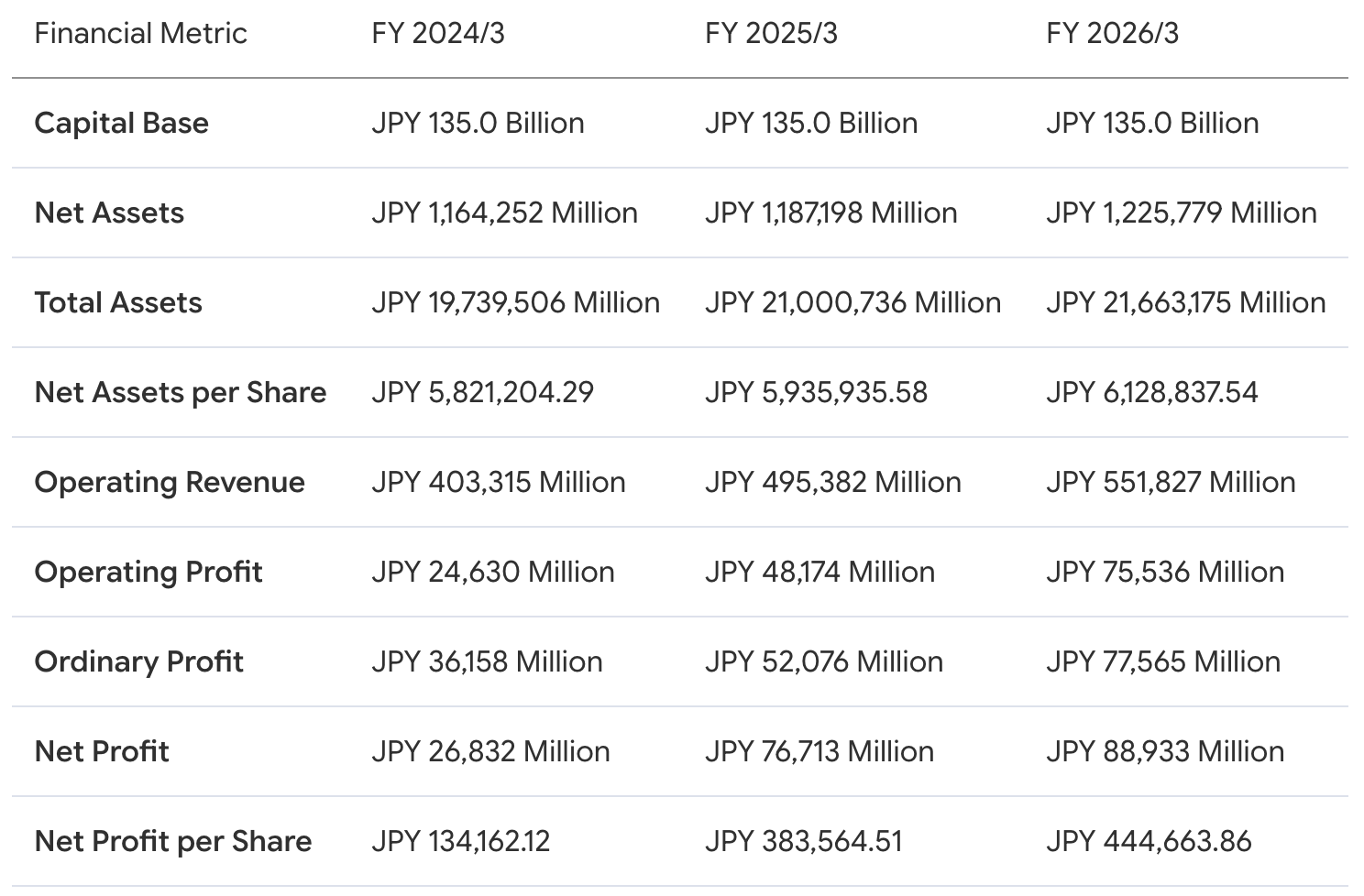
Securing the wholesale capital structure enables SMBC Group to channel capital efficiently into high-margin domestic retail banking products.
2. Retail Ecosystem Expansion: Launch of "Money Assist Plus" via the "Olive" Platform
SMBC Group and Sumitomo Mitsui Card continue to drive consumer monetization through "Olive," their flagship digital retail financial platform. By integrating targeted credit facilities directly into the Olive software application, the Group enhances customer Lifetime Value (LTV) and achieves dual-revenue generation: capture of net interest margin (NIM) on consumer loan drawdowns alongside transaction yield boosts that increase merchant ecosystem stickiness.
On September 29, 2026, SMBC and SMCC launched "Money Assist Plus." This specialized cashing and loan product is directly integrated into the "Olive" personal finance infrastructure.
- Target Demographics & Access Rules: "Money Assist Plus" is available to individuals aged 20 and older who hold an active credit mode account under Olive Flexible Pay, subject to standard credit assessment protocols. Crucially, account holders can apply both during initial Olive account onboarding and post-enrollment.
- Financial Operating Terms:
- Credit Line Allocations: JPY 500,000 to JPY 9,000,000 based on individual creditworthiness.
- Preferential Pricing Structure: Effective interest rates range from 1.0% to 15.0% per annum, providing competitive pricing relative to legacy unsecured credit card loan products.
- Disbursement Mechanics: Approved credit drawdowns are instantly credited to the user's primary Olive deposit account with 24/7/365 execution capability (excluding planned system maintenance).
- V Point Up Program Unit Economics: The loan product acts as an engagement driver by unlocking tiered point yield enhancements for purchases made at designated convenience stores and restaurant merchants:
- Tier 1 Boost: An outstanding monthly loan balance between JPY 10,000 and JPY 299,999 grants a +1.0% additional V Point return.
- Tier 2 Boost: An outstanding monthly loan balance of JPY 300,000 or higher grants a +3.0% additional V Point return.
The rapid scaling of digital retail credit products is matched by an expansion of distribution channels via formal bank agency licensing.
3. Channel Integration: Sumitomo Mitsui Card's Acquisition of Bank Agency License
Securing formal regulatory approval for non-bank operating entities to execute bank agency functions represents an effective asset-light distribution strategy. By obtaining a bank agency license for credit card subsidiary SMCC, SMBC Group can leverage millions of consumer cardholders and corporate merchant touchpoints to drive core bank deposit growth and loan origination without forcing SMCC to operate as a capitalized deposit-taking credit institution.
Effective October 1, 2026, Sumitomo Mitsui Card formally commenced bank agency operations after obtaining official regulatory authorization from the Kanto Local Finance Bureau under License No. 543 (関東財務局長(銀代)第543号). Sumitomo Mitsui Banking Corporation (SMBC) serves as the principal bank under a statutory Bank Agency Business Entrustment Contract.
SMCC is authorized to act as an intermediary for both individual and corporate clients across four core business areas:
- Deposit Contract Intermediation:
- Yen Standard Deposits and Yen Time Deposits.
- Foreign Currency Standard Deposits and Foreign Currency Time Deposits.
- Lending Contract Intermediation:
- Consumer housing purchase loan facilities.
- Housing loan refinancing agreements.
- Foreign Exchange Intermediation:
- Intermediation of foreign exchange transaction contracts and associated international treasury services.
- Account Opening & Platform Integration:
- Active solicitation and account opening guidance across consumer cardholder bases via "Olive" and corporate client networks using the digital integrated business platform "Trunk" (法人向けデジタル総合金融サービス「Trunk」).
- Statutory Compliance Guardrail:
- In strict compliance with Japanese bank agency laws, SMCC is expressly prohibited from receiving, holding, or handling client cash, deposits, or asset funds directly. All cash transfers and asset custody must execute directly within SMBC's balance sheet, protecting regulatory liquidity coverage ratios (LCR).
Expanding cross-platform product solicitation requires robust, automated AI governance infrastructure to maintain regulatory compliance.
4. Enterprise Risk Infrastructure: Deployment of Citadel AI Governance Solution
As generative AI transitions from internal administrative support to high-volume, automated customer interactions, financial institutions require standardized, real-time risk controls. Establishing automated testing and guardrails protects the institution against hallucination risks, confidential data leakage, and compliance violations, ensuring safe operational expansion.
On October 1, 2026, SMBC announced the enterprise-wide deployment of an automated AI governance baseline developed in partnership with Citadel AI. This technology deployment builds directly upon SMBC's "Responsible AI Policy" established in 2024 and reinforces automated operations such as the "SMBC AI Operator." The AI Operator currently handles over 70% of general Olive customer inquiries through straight-through automated processing (STP) without human representative intervention, reducing operational expenditure (OpEx).
The Citadel AI platform introduces three core operational capabilities across SMBC's technology footprint:
- Standardized Benchmark Risk Testing: Replaces fragmented, team-specific manual reviews with standardized evaluation metrics and bank-wide benchmark test data, enabling objective risk scoring prior to production deployment.
- Automated Lifetime Audit Logging: Continuously monitors live AI performance, automatically generating objective risk reports and verifiable audit trails. These logs track legal compliance, ethical alignment, and cybersecurity posture pre- and post-release to satisfy Financial Services Agency (FSA) regulatory reviews.
- Real-Time Guardrail Enforcement: Operates inline with active application programming interfaces (APIs) to inspect inputs and outputs in real time. The engine automatically interrupts harmful prompts, prevents unauthorized disclosure of confidential data, and blocks non-compliant generative responses.
While domestic operational technology is strengthened through AI risk controls, SMBC Group is simultaneously refining its global balance sheet through strategic divestments.
5. Portfolio Optimization: Completion of SMBC MANUBANK Commercial Banking Sale
Disciplined capital allocation requires international banking groups to systematically divest non-core overseas assets. Selling regional retail and commercial banking operations allows management to optimize foreign Risk-Weighted Assets (RWA), improve Return on Equity (ROE), and focus capital on core multinational corporate banking and trade finance relationships.
Following the definitive purchase agreement executed on April 1, 2026, SMBC confirmed the successful closing of the sale of SMBC MANUBANK’s commercial banking business in California to Bank of Hope on October 1, 2026, following receipt of all necessary regulatory approvals.
- Asset & Liability Transfer Parameters: The transaction encompasses the commercial banking assets and client deposit liabilities of SMBC MANUBANK (operating under SMBC Americas Holdings). Select externally purchased loan portfolios were retained by SMBC Group to manage corporate risk exposure.
- Transition & Operational Continuity: SMBC will maintain operational coordination with Bank of Hope to support account migration and preserve client service continuity post-closing.
- Acquiring Entity Profile: Bank of Hope is a wholly owned subsidiary of Hope Bancorp (NASDAQ listed). Bank of Hope operates as an FDIC-insured institution.
- Earnings Guidance Neutrality: SMBC confirms that this foreign asset divestment results in no changes to its full-year consolidated financial performance forecast for the fiscal year ending March 31, 2027 (FY2026).
Offloading legacy overseas regional commercial assets frees up balance sheet capacity to lead international institutional trade finance innovations.
6. Institutional Innovation: Trade Finance Digitization via "TradeWaltz" and Stablecoins
Traditional trade finance operations remain burdened by physical paper documentation, complex manual verification of Letters of Credit (L/C), and delayed handling of Bills of Lading (B/L). Connecting trade digitization platforms with regulated stablecoin infrastructure enables atomic settlement (delivery vs. payment [DvP]), significantly improving cash velocity and lowering working capital burdens for commercial exporters.
On September 29, 2026, a proof-of-concept (PoC) joint initiative was selected for support under the Financial Services Agency’s (FSA) "FinTech Proof of Concept Hub / Payment Innovation Project (PIP)." The project brings together Japan's major banking institutions and technology developers:
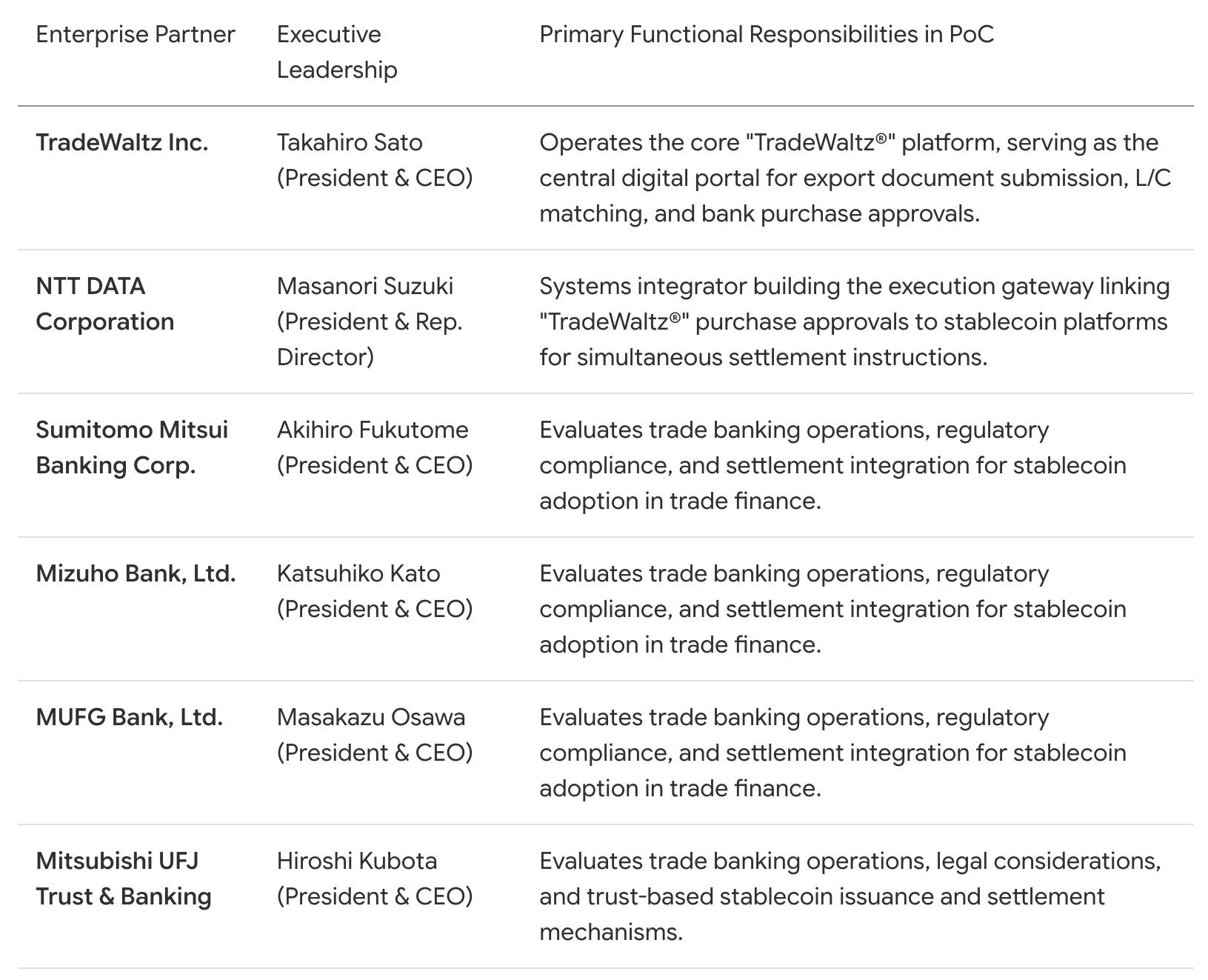
To contextualize the workflow mechanics, key trade finance components within the PoC are defined as follows:
- Letter of Credit (L/C): A financial instrument issued by an importing bank guaranteeing payment to an exporter, provided that strictly compliant trade documents are presented. It protects exporters against buyer credit default and importers against non-shipment of goods.
- Bill of Lading (B/L): A document issued by a freight carrier acknowledging receipt of cargo for shipment. It serves as evidence of the carriage contract and acts as a negotiable document of title required to claim goods at destination.
- Smart Contract Escrow Services: Automated escrow protocols where buyer funds are held in decentralized code or managed accounts, and automatically disbursed or refunded when predefined trade execution parameters are digitally verified.
6.1 Step-by-Step PoC Execution Flow
- The exporting entity submits digital shipping documentation and B/L records via the "TradeWaltz" platform to initiate bill purchasing.
- The participating bank cross-checks the electronic documentation against L/C terms on "TradeWaltz."
- Upon approval, the bank issues a bill purchase authorization directly within the platform.
- The purchase approval instantly triggers a settlement instruction via NTT DATA's integration layer.
- The bank's stablecoin framework executes an instant payment into the exporter's digital wallet, achieving immediate liquidity upon approval
6.2 Strategic Roadmap and Extension Goals
- Import Side Integration: Extending the stablecoin framework to include importing banks and buyers for end-to-end multi-currency trade clearing.
- Electronic Documentation Adoption: Complete transition to electronic Bills of Lading (eB/L) to eliminate physical paper transit delays.
- Smart Contract Escrow Infrastructure: Deployment of smart contract escrow services that automatically lock importer funds and disburse stablecoin payments upon verified delivery milestones, eliminating payment latency and counterparty risk.
 Norbert Gehrke