Fund Manager HiJoJo Partners' IPO

HiJoJo Partners, a Tokyo-based asset manager specializing in late-stage private equity funds, listed its shares on the Tokyo Stock Exchange Growth Market on November 20, 2026. On a day the Nikkei dropped 5%, the book building price JPY 560 was impossible to defend, and the stock closed the day at JPY 469, down from an opening quote of JPY 517.
Founded in November 2017 under the mission of "democratizing startup investment," the firm provides Japanese high-net-worth and mass-affluent investors with access to global private technology companies—primarily U.S. "unicorns" valued at $1 billion or more. As of September 30, 2026, HiJoJo had amassed cumulative contracted fund commitments exceeding ¥75.1 billion across 11,153 registered members. The reference market value of its active portfolio stood at approximately ¥107.0 billion as of June 30, 2026, anchored by stakes in SpaceX and OpenAI.
1. Financial Surge Driven by Unicorn Exits and AI Demand
HiJoJo’s financial filing (completed on October 26, 2026) highlights rapid top- and bottom-line expansion fueled by performance fees (carried interest) from portfolio exits and strong retail demand for artificial intelligence and space-sector funds.
In its eighth fiscal year ended October 31, 2025 (non-consolidated), HiJoJo launched 12 new funds that raised ¥8.92 billion (¥8,923 million), including ¥3.15 billion (¥3,153 million) for SpaceX-linked vehicles. Full-year revenue jumped 161.6% from the prior year to ¥1.76 billion (¥1,758,175 thousand), up from ¥672.02 million (¥672,018 thousand) in fiscal 2024. Performance fees accounted for ¥853.83 million of fiscal 2025 revenue—up sharply from ¥3.24 million a year earlier—alongside ¥475.48 million in ongoing management and administrative fees and ¥379.41 million in upfront subscription fees. Operating profit swung to ¥674.93 million from an operating loss of ¥6.42 million in fiscal 2024, while net income surged to ¥513.48 million from ¥15.28 million, even after booking a ¥41.87 million impairment loss on unlisted investment securities.
Momentum accelerated in the ninth fiscal term beginning November 1, 2025, when the company began reporting consolidated results following the establishment of U.S. subsidiaries. For the nine months ended July 31, 2026, HiJoJo formed 12 funds and raised ¥15.90 billion (¥15,898 million). Key raises included an online-distributed Anthropic fund that collected ¥1.50 billion (¥1,498 million) in January, three SpaceX funds that drew ¥7.71 billion (¥7,710 million) across March and May, and three OpenAI funds that raised ¥2.29 billion (¥2,290 million) in June and July.
Consolidated revenue for the nine-month period reached ¥2.91 billion (¥2,905,591 thousand), driven by ¥2.01 billion (¥2,013,001 thousand) in performance fees—primarily ¥2.03 billion (¥2,029,146 thousand) generated from Space Fund 2 Investment LPS—plus ¥856.24 million in fund management and subscription fees and ¥36.35 million in other consulting fees. Consolidated operating profit totaled ¥1.68 billion (¥1,680,251 thousand), ordinary profit reached ¥1.69 billion (¥1,688,605 thousand), and net income attributable to owners of the parent came in at ¥1.15 billion (¥1,145,771 thousand).
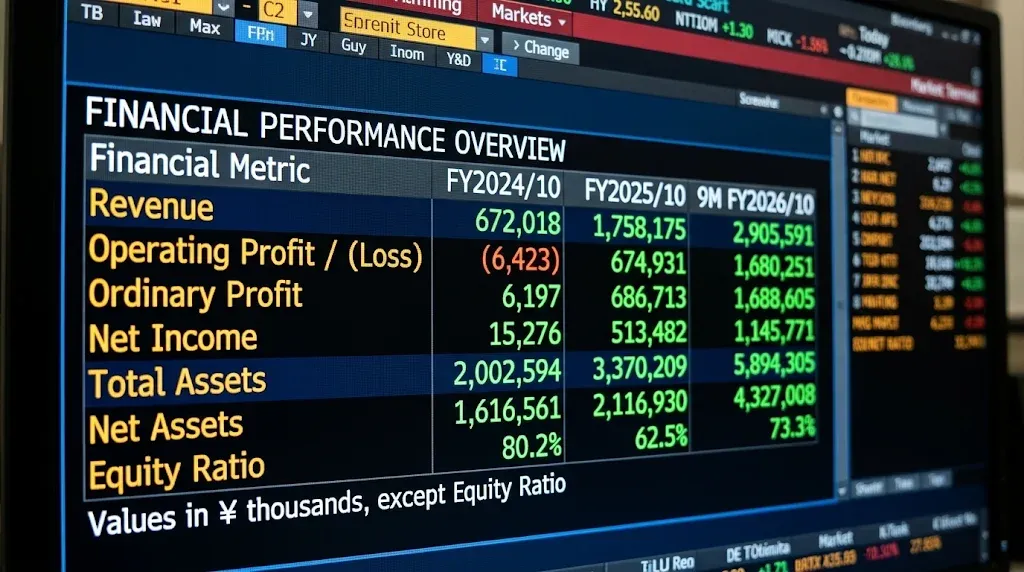
On the balance sheet, consolidated total assets stood at ¥5.89 billion as of July 31, 2026, including ¥3.48 billion in cash and deposits and ¥1.88 billion in investment securities—up from ¥181.54 million three months earlier as U.S. subsidiaries deployed capital to acquire private shares. The group carries zero interest-bearing debt and maintained an equity ratio of 73.3%.
2. Portfolio Concentration and Valuation Benchmarks
HiJoJo primarily structures single-stock, closed-end investment funds using Japanese silent partnerships (Tokumei Kumiai) and investment business limited partnerships, allowing domestic investors to invest in smaller lot sizes while sparing portfolio companies the administrative burden of managing individual shareholders.
Citing May 2026 rankings from PitchBook Data, HiJoJo reported having secured investment access to five of the world’s 10 most valuable private companies: SpaceX (valued at $1.75 trillion), OpenAI ($852 billion), Anthropic ($380 billion), Stripe ($159 billion), and Databricks ($134 billion).
Across active funds as of June 30, 2026, total contracted capital stood at approximately ¥46.2 billion, while total reference valuation reached approximately ¥107.0 billion—calculated using valuation data from Nasdaq Private Market’s "NPM Price" platform at exchange rates of ¥162.39 per U.S. dollar and ¥215.05 per British pound. SpaceX represented 36% of active contracted capital and 65% of total reference valuation, while OpenAI accounted for 10% of contracted capital and 15% of reference valuation. Other portfolio holdings include Epic Games, Axiom Space, Gojo and Company, Anthropic, SmartHR, Crusoe, Stripe, Databricks, and Neuralink.
Based on those June 30, 2026 reference prices, active funds held approximately ¥70.2 billion in unrealized gains against ¥9.4 billion in unrealized losses. HiJoJo estimated its unrealized performance fees—calculated at 22.0% (tax-included) on funds with unrealized gains—at roughly ¥15.4 billion.
Domestically, HiJoJo distributes funds through two channels:
- Face-to-Face Channel: Targets individuals and corporations with ¥100 million or more in financial assets via partnerships with over 80 securities firms and independent financial advisors (IFAs), reaching 1,418 members by September 30, 2026. Investors pay a 4.4% upfront subscription fee, a 1.1% annual management and administrative fee, and a 22.0% carried interest fee on excess profits.
- Online Channel: Targets individuals with ¥30 million or more in financial assets through two online brokerages and digital marketing, reaching 9,735 members by September 30, 2026. Online investors pay a 1.0% subscription fee, a 2.8% annual management fee, and a 22.0% performance fee.
3. Three-Pronged Expansion: U.S. Warehousing, Listed PEIT, and Private Brokerage
Alongside its core domestic fund distribution business, HiJoJo is deploying capital—including proceeds from its planned IPO—into three new business lines anchored by strategic partnerships with U.S.-based Nasdaq Private Market (NPM) and U.K.-based Venturebeam. HiJoJo became the first Asian financial institution to invest in NPM in July 2024 and made a follow-on investment in January 2026, holding 1,131,221 Series C preferred shares.
1. U.S. Operations and Warehousing: In February 2026, HiJoJo established three wholly owned Delaware subsidiaries—HiJoJo Holding Company Inc., HiJoJo Management Company Inc., and HiJoJo Investing Company LLC—followed in March by its first U.S. fund, HiJoJo US Fund1 LLC. The U.S. unit performs "warehousing," using its own balance sheet to acquire sought-after private shares ahead of fund formation before transferring them to domestic funds. It also markets stakes directly to overseas institutional and accredited investors in the U.S., Hong Kong, and Singapore at a 5% to 10% markup or with carried interest, and is negotiating to manage the unlisted equity allocation (up to 15% of total assets) for Japanese public investment trusts.
2. Private Equity Investment Trust (PEIT): Capitalizing on 2025 regulatory reforms in Japan that permitted investment corporations to hold 100% foreign unlisted equities and outsource asset management, HiJoJo established the HiJoJo Global Unicorn Investment Corporation (HiJoJo PEIT) on June 1, 2026. Operating initially as a private placement vehicle, HiJoJo plans to eventually list the closed-end trust on the Tokyo Stock Exchange Venture Fund Market. Under a sub-advisory arrangement with fund manager JAMP Fund Management Co., Ltd., HiJoJo will earn net management and administrative fees of 1.7% to 1.85% of net assets, a 20% performance fee on pre-tax profit, and a 1.5% acquisition fee post-listing.
3. Private Market Solution (PMS): On August 24, 2026, HiJoJo completed registration as a Type I Financial Instruments Business Operator for special brokerage of unlisted securities. Working with NPM's network of over 1,200 institutional investors and Venturebeam’s network of more than 200 institutions, HiJoJo plans to broker primary private placements and secondary block trades for startups and institutional investors.
4. Pre-IPO Capital Restructuring and Governance
Ahead of its listing application, HiJoJo completed a series of equity financings and balance sheet restructurings. Between December 2025 and February 2026, the company raised ¥1.02 billion in a Series B1 round at ¥413 per share, issuing 2,300,235 shares to 28 investors—including i-nest Capital, CBC Co., ALHD Pegasus Tech Ventures, and travel agency H.I.S. Co.—and 169,491 shares to SMBC Venture Capital’s fund and two individuals.
On June 30, 2026, HiJoJo simplified its capital structure by acquiring and canceling all 16,550,140 outstanding preferred shares (10,737,394 Series A, 3,343,020 Series B, and 2,469,726 Series B1) in exchange for an equal number of common shares, abolishing class share provisions, and reducing stated capital from ¥822.01 million to ¥100.00 million by transferring ¥722.01 million to other capital surplus. As of September 30, 2026, total issued common stock stood at 46,780,140 shares, alongside 5,327,500 potential shares tied to employee and executive stock options (representing 11.4% potential dilution).
On October 20, 2026, U.S. subsidiary HiJoJo Holding Company Inc. approved a $10 million Post-Money Simple Agreement for Future Equity (SAFE) with Japanese financial services group Credit Saison Co., Ltd., scheduled for execution and payment on October 26, 2026, to expand U.S. warehousing capacity. Credit Saison is already a major shareholder in HiJoJo Partners, having converted 2,564,102 Series A shares into common stock in June. Other notable institutional shareholders include Mizuho Securities, MTI Ltd., Finatext Holdings, SBI Ventures Two, and Mitsubishi UFJ Innovation Partners.
HiJoJo is led by Co-CEOs Spyridon Mentzas—the company's founder, a former Salomon Brothers Asia and Mizuho Securities banker who holds 21,000,000 shares—and Norifumi Akiyama, former global head of syndicate at Mizuho Securities, who holds 200,000 shares. Director Tomohiko Hamada holds 4,500,000 shares. The board includes independent outside directors Kotaro Yamazawa, a former Bank of Japan and Japan Exchange Group executive, and Hiroshi Motoyama, former president of Mizuho Securities. Its three-member audit board comprises full-time statutory auditor Takahiro Sugimoto, formerly of the Tokyo Stock Exchange, alongside certified public accountant Takeshi Tei and Mori Hamada & Matsumoto partner Masakazu Masujima, a former Financial Services Agency official. The group employed 40 people on a consolidated basis as of September 30, 2026, with parent-company staff averaging 43.5 years of age and ¥14.51 million in annual compensation.
5. Risk Profile: Fee Volatility and Private Market Illiquidity
In its risk disclosures, HiJoJo flagged high earnings volatility stemming from its reliance on carried interest, which generated 48.6% of total revenue in fiscal 2025 and 75.8% in the first half of fiscal 2026. Because performance fees are recognized only upon portfolio exits via IPOs, mergers, or secondary sales, delays in liquidity events could cause sharp swings in quarterly and annual earnings. The company noted specifically that a potential exit from its SpaceX holdings during the fiscal year ending October 2027 could materially impact results for that period, though it emphasized that carried interest is derived from multiple portfolio companies.
Other highlighted risks include:
- Illiquidity and Valuation Uncertainty: Private shares lack public market liquidity and rely on model-based valuations such as NPM Price, creating potential write-down or principal loss risks for both client funds and HiJoJo's own U.S. warehousing inventory.
- Foreign Exchange Exposure: With most underlying investments denominated in U.S. dollars and U.S. subsidiaries operating in dollars, yen appreciation directly reduces the translated value of carried interest and consolidated subsidiary assets.
- Key-Person and Conflict-of-Interest Risks: Deal sourcing remains heavily reliant on Co-CEO Spyridon Mentzas's industry network, while warehousing shares on the U.S. subsidiary's balance sheet before selling them to domestic HiJoJo funds introduces potential conflicts of interest. HiJoJo stated it mitigates pricing conflicts by benchmarking transfers to NPM Price data and subjecting transactions to compliance and investment committee review.
HiJoJo has paid no dividends since fiscal 2021 and stated it currently plans to retain earnings to fund U.S. expansion, system investments, and hiring rather than initiate near-term payouts.
 Norbert Gehrke