Hitachi-Led Consortium Successfully Pilots AI-Driven Compliance Infrastructure for Digital Assets


The successful completion of the "FinTech Proof-of-Concept (PoC) Hub" Experiment No. 13 represents a significant step forward in Japan’s oversight of the digital asset ecosystem. Backed by the Financial Services Agency (FSA), this initiative confronts the systemic risk of blockchain anonymity—the fundamental inability to identify asset owners through addresses alone. The project arrives as a critical response to the June 2026 enforcement of the "Revised Cabinet Office Ordinance on Stablecoins," which has accelerated the need for robust compliance infrastructure capable of meeting heightened surveillance standards for electronic payment instruments.
Conducted from March to May 2026, the experiment verified a unified framework for cross-industry data sharing and joint analysis. Led by Hitachi, the consortium utilized a multi-layered defense strategy to detect illicit activities that evade traditional "list-matching" protocols. By synthesizing data from 18 participating entities, the pilot proved that collective intelligence is the only viable strategic imperative for addressing the sophisticated fund-flow patterns characteristic of modern financial crime.
1. The Power of the Consortium: 18 Entities Under the FSA Umbrella
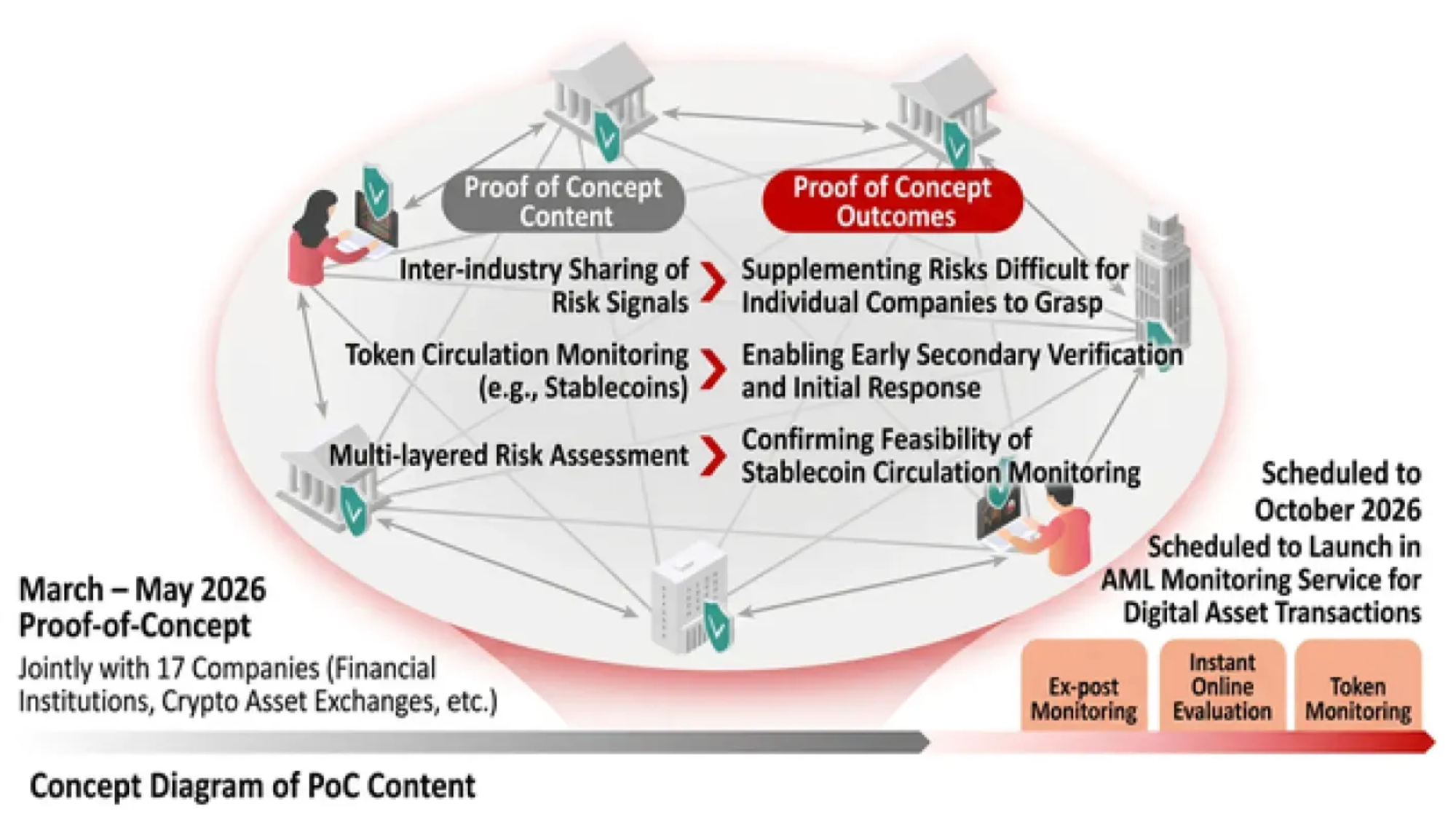
The "FinTech Hub" framework serves as a government-sanctioned sandbox designed to mitigate the legal and operational hesitation private firms face when exploring "unprecedented" compliance models. This experiment represents the second major PoC in a progression that began in 2025, moving the industry closer to a commercialized "AML Joint Center." By providing a safe environment for data exchange, the FSA has enabled a coalition of traditional and crypto-native firms to test the technical interoperability of a shared monitoring system.
The consortium involved a mix of 18 entities (including three undisclosed participants):
- Technology Providers: Hitachi (Lead), NEC Corporation, and Chainalysis Japan.
- Traditional Banking & Audit: Aozora Bank and KPMG AZSA.
- Crypto Asset Exchanges & Electronic Payment Instrument Issuers: JPYC, GMO Coin, bitbank, Rakuten Wallet, and Digital Asset Markets.
- Specialized FinTech & Infrastructure: Laser Digital Japan, Digital Platformer, DCP, Japan Blockchain Foundation, and finoject.
This diverse membership was essential for validating a system that must eventually bridge the information gap between established banking protocols and decentralized ledger technologies.
2. Technical Architecture: Multi-Layered Risk Assessment and AI Integration
A primary technical objective of the PoC was shifting the industry from static "blacklists" to dynamic "behavioral analysis." The architecture leverages Machine Learning to identify "unknown" suspicious addresses by detecting transaction patterns—such as behavioral similarity to known fraudulent actors—that static lists miss.
The PoC evaluated a "Monitoring Triad" of core functions designed to cover the entire transaction lifecycle:
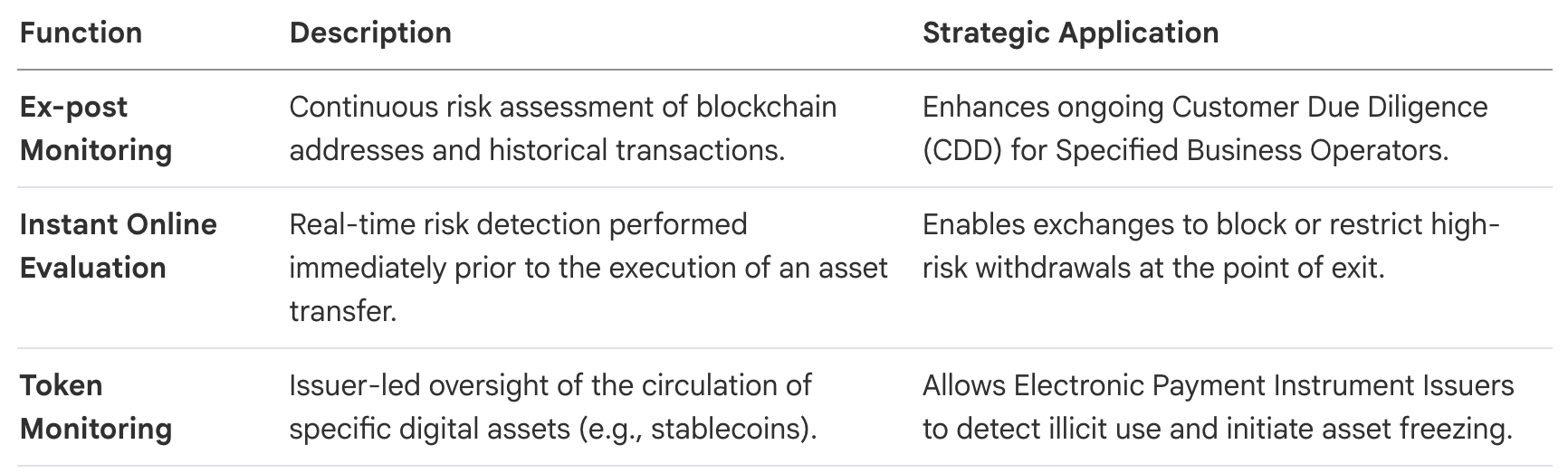
This multi-layered approach ensures that risks are captured not just at the gateway, but throughout the circulation of assets across the digital economy.
3. Regulatory Advisory: Navigating Privacy and Accountability
The FSA provided rigorous legal guidance during the pilot to ensure that enhanced financial surveillance does not conflict with Japanese civil liberties. The central "legal bridge" identified for this initiative is the Personal Information Protection Act, specifically Article 27, Paragraph 1, Item 2. This "Protection of Property" exception permits the sharing of suspicious addresses without explicit user consent, provided the necessity of preventing fraud outweighs potential disadvantages to the individual.
The FSA’s guidance established four pillars of compliance for participating firms:
- The Accountability Mandate: Specified Business Operators (exchanges and banks) retain sole legal responsibility for Suspicious Transaction Reports (STR/SAR). They cannot delegate final judgment to AI; they must be able to explain the "basis" and logical evidence behind every filing.
- The Privacy Exception: Data sharing is permissible without consent when it is difficult to obtain or would "tip off" a criminal, effectively preventing the concealment of criminal proceeds.
- Data Quality Standards: To mitigate the risk of "rights infringement" via false positives, firms must implement strict protocols for data accuracy, "latestness," and the immediate correction or deletion of erroneous records.
- Operational Boundaries: Firms must define clear rules for data governance, access control, and audit logs to ensure the shared infrastructure is used strictly for its intended AML/CFT purposes.
4. Verified Outcomes and the "Individual Company" Information Gap
The experiment successfully demonstrated the resolution of the "information asymmetry" problem. Individual exchanges are often blind to the broader movement of assets once they leave their proprietary platforms. By sharing risk signals—including transaction hashes, risk categories, and AI-generated scores—the consortium filled gaps that individual company monitoring could not bridge alone.
Key differentiators confirmed by the pilot include:
- AI Complementarity: The hybrid use of list-matching and Machine Learning successfully caught risk signs invisible to traditional static lists.
- Operational Feasibility: The pilot confirmed the practical utility of the Monitoring Triad in daily exchange operations.
- The "Human-in-the-Loop" Requirement: The PoC verified that while AI provides the lead, the AML Joint Center is essential for providing the human expertise required for final determinations. This includes specialized Fund Flow Analysis and Open Source Intelligence (OSINT) to support the decision-making of individual firms.
These results indicate that while technology automates detection, expert human analysis remains the final arbiter of regulatory truth.
5. Roadmap to Implementation: The October 2026 Launch
The initiative is now transitioning from a successful pilot to a commercial reality. The planned launch of the "AML Monitoring Service" will alleviate the severe shortage of specialized AML personnel—a major industry pain point—by centralizing high-level investigative support within the AML Joint Center. This shared infrastructure will significantly enhance the "defense power" of the Japanese market, positioning it as a global "Safe Haven" for digital asset innovation.
The project’s strategic value has already been validated on the national stage, recently winning the Grand Prix at the 3rd Japan New Business Awards (Seed Category). As Japan moves toward full commercialization, the AML Joint Center is poised to set a global benchmark for how regulators and private industry can co-engineer transparency in a decentralized financial world.
 Norbert Gehrke