InsurTech Profile: OdysseyAI

The intersection of generative artificial intelligence and highly regulated financial services represents one of the most critical and heavily contested growth vectors in the contemporary global enterprise software market. Within this rapidly evolving paradigm, OdysseyAI, a specialized technology enterprise established in 2024 and headquartered in Tokyo, Japan, has emerged as a deeply focused entity operating at the nexus of artificial intelligence and insurance compliance. Operating from its corporate headquarters situated in the Shibuya district of Tokyo, the firm explicitly positions itself as the architect and developer of Japan’s inaugural "Agentic AI" platform engineered specifically for the distinct operational and regulatory requirements of the domestic insurance sector.
The foundational thesis of the enterprise is predicated upon a fundamental macroeconomic and legislative shift: the evolving regulatory landscape in Japan, specifically the stringent and far-reaching recent amendments to the Japanese Insurance Business Act, which necessitate a complete paradigm shift in how insurance agents operate, how they are trained, and how they are continuously monitored for regulatory compliance.
This comprehensive article provides an exhaustive, granular analysis of OdysseyAI, focusing deliberately on three core pillars selected for strategic evaluation. First, the report delivers an in-depth profiling of the firm's leadership, specifically examining the symbiotic synthesis of elite Big 4 enterprise consulting acumen and rigorous academic econometrics provided by its co-founders. Second, the report dissects the capitalization and venture funding ecosystem surrounding the enterprise. Finally, the report investigates the strategic mechanics of the firm's client acquisition methodologies, its target demographic, and its overarching partnership models.
By synthesizing all available open-source intelligence and market data regarding the firm's leadership, technological posture, and ecosystem strategy, this article delineates the strategic positioning of OdysseyAI within the broader macroeconomic context of Japanese digital transformation. The resulting analysis provides institutional stakeholders, market observers, and potential partners with a definitive assessment of the firm's operational viability and market trajectory.
1. Macro-Environmental Catalyst: The Japanese Insurance Paradigm
To fundamentally comprehend the strategic viability, product architecture, and market timing of OdysseyAI, one must first rigorously analyze the macroeconomic, demographic, and regulatory environment that serves as the definitive catalyst for its product development. Japan represents one of the most mature, heavily capitalized, and densely penetrated insurance markets in the global economy. However, it is simultaneously an industry severely encumbered by legacy technological infrastructure, a rapidly aging workforce, and an intensely relationship-driven, high-friction sales culture that has historically resisted digital intermediation.
1.1 The Evolution of Automation in Japanese Financial Services
The introduction of artificial intelligence and algorithmic automation into the Japanese insurance sector is not an entirely unprecedented phenomenon; however, the nature of this technological application is undergoing a massive evolutionary leap. Historical context indicates that large Japanese insurance firms have previously engaged in rudimentary labor substitution through first-generation cognitive computing and robotic process automation (RPA). A highly publicized and deeply notable case within the industry involved a major Japanese insurance company systematically substituting over thirty back-office claim calculation workers with IBM's Watson cognitive computing system.
While that historical implementation represented a significant milestone in localized digital transformation, it was fundamentally limited to deterministic, back-office mathematical processing—specifically, the automated calculation of medical payouts based on scanned hospital documents. This form of automation, while efficient for cost-cutting, does not generate top-line revenue, nor does it protect the firm from front-office regulatory violations. OdysseyAI’s strategic approach diverges dramatically from this legacy model of mere back-office calculation automation. By focusing its engineering resources on "Agentic AI"—advanced artificial intelligence systems capable of autonomous reasoning, dynamic natural language generation, sequential action execution, and highly nuanced, human-like interaction—the firm aims to augment the front-office sales, training, and compliance functions. This is a significantly more complex, unstructured, and operationally sensitive domain that first-generation AI systems were entirely incapable of navigating.
1.2 The Regulatory Imperative: The Insurance Business Act
The true catalyst driving the total addressable market for OdysseyAI is the unrelenting pressure of statutory regulatory enforcement. Historically, insurance agents in Japan have relied on highly personalized, manual, and localized processes for client acquisition and policy servicing. However, the regulatory architecture governing this sector has undergone a period of intense and unforgiving evolution, most notably through stringent revisions to the Japanese Insurance Business Act.
These legislative and statutory changes fundamentally alter the behavioral expectations placed upon insurance agencies and their individual agents. The revised legal framework demands rigorous, documented adherence to suitability principles, the transparent and exhaustive disclosure of complex policy risks to consumers, and meticulous, auditable record-keeping of the sales process itself. The Financial Services Agency (FSA) and related regulatory bodies in Japan now require insurance carriers and their distributed agencies to definitively and proactively prove that their agents are not engaging in predatory sales tactics, aggressively pushing unsuitable high-commission products, or misrepresenting the complex stipulations of financial products. Consequently, regulatory compliance has been elevated to a central, real-time operational mandate that dictates market survival, brand reputation, and the retention of operational licenses.
The traditional, legacy methodology for ensuring this level of compliance—which involves relying on periodic, human-led training seminars, printed manuals, and random, manual retrospective audits of recorded sales interactions—is economically unscalable, highly inefficient, and fatally prone to systemic human error. This structural inefficiency creates a massive, urgent addressable market for automated, highly sophisticated, and continuous compliance management platforms. OdysseyAI is strategically engineered to occupy and dominate this exact vulnerability in the market architecture. By promising to help clients prepare for these unforgiving regulatory mandates through an AI-driven Compliance Management Platform, the firm effectively transforms a massive regulatory burden into a compelling catalyst for immediate technological adoption.
1.3 Macro-Environmental Matrix
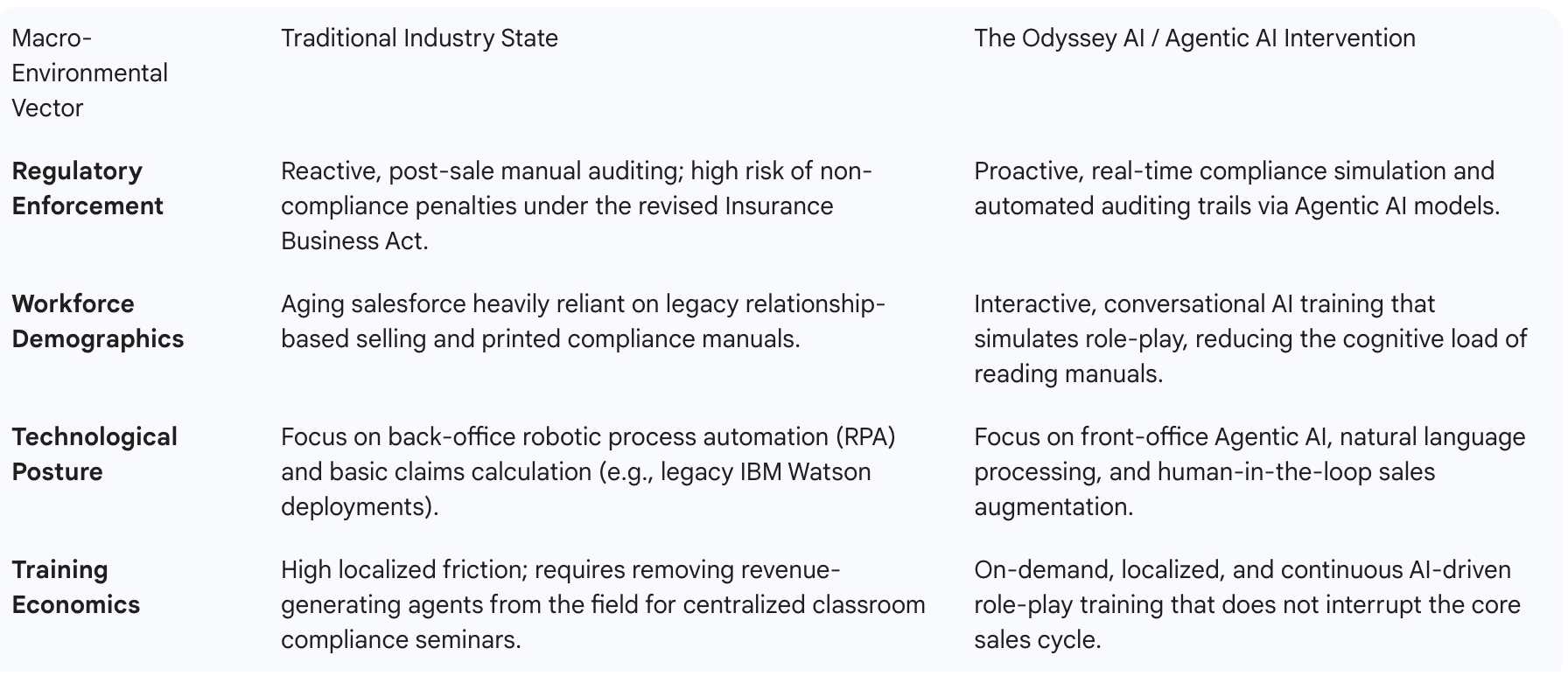
To synthesize the structural drivers propelling OdysseyAI's market entry, the following table outlines the primary macro-environmental factors shaping the Japanese InsurTech sector:
2. Leadership: Profiling of the Founders
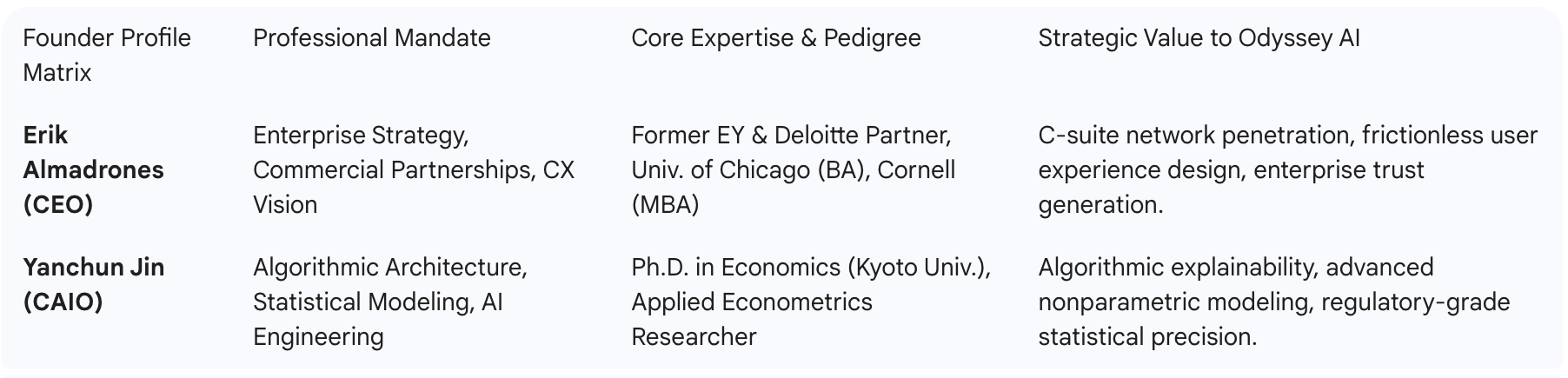
The strategic trajectory, product architecture, and ultimate enterprise credibility of an early-stage B2B enterprise software venture are overwhelmingly determined by the pedigree, network, and intellectual capabilities of its founding team. In the notoriously rigid, hierarchy-driven, and risk-averse environment of Japanese corporate finance and insurance, technological superiority alone is insufficient for market entry; extreme institutional trust is required. In the case of OdysseyAI, the leadership structure represents a highly calculated, exceptionally rare synthesis of elite global enterprise consulting and uncompromising academic data science. This dual-pillar leadership structure is the foundational asset of the firm.
2.1 Erik Almadrones: The Enterprise Strategist and CX Innovator
Operating at the vanguard of the firm's commercial operations, Erik Almadrones serves as Founder and Chief Executive Officer. Almadrones provides the overarching enterprise strategy, commercial acumen, and high-level corporate network required to navigate the complex procurement cycles of the Japanese financial sector. An analysis of Almadrones’s professional trajectory reveals a career deeply entrenched in customer experience (CX), revenue growth management, digital transformation, and the profitable optimization of the corporate "front office" at the absolute highest echelons of global management consulting.
Almadrones brings over two decades of highly specialized experience bridging the notoriously difficult gap between theoretical technological innovation and pragmatic, consumer-centric business strategy. Prior to establishing OdysseyAI as an independent venture, he operated for years as a Big 4 Consulting Partner, most recently serving as the Asia-Pacific Consulting Customer & Growth Leader for EY. In this expansive, highly visible multinational capacity, he established a formidable reputation as an "analytics innovator" and a "data-driven strategist". His professional mandate at EY focused heavily on utilizing complex digital platforms, big data architectures, and advanced analytics to profitably enhance customer experiences across a multitude of heavily regulated sectors, including retail, automotive, and consumer products.
Furthermore, his tenure within the elite consulting ecosystem includes significant leadership roles at Deloitte Tohmatsu Consulting. During his time at Deloitte, he operated as a Partner and served as the Lead Consulting Partner for several multinational corporations operating within Japan, specializing deeply in enterprise technology strategy and cloud transformation initiatives. The ability to lead cloud transformations for legacy Japanese corporations is highly indicative of an executive who intimately understands how to overcome institutional resistance, manage complex stakeholder ecosystems, and deliver highly secure software deployments to entities terrified of data breaches and compliance failures.
The epistemological foundation of Almadrones's distinctive approach to technology integration can be traced to his elite and somewhat unorthodox educational background. Born in New York City and a resident of Tokyo, Japan since 2018, Almadrones earned his Bachelor of Arts in Political Science from the University of Chicago. A foundational education in political science from an institution famous for its rigorous analytical frameworks suggests a deep understanding of structural power dynamics, regulatory theory, and institutional governance—skills highly applicable to navigating the nuances of the Japanese Insurance Business Act.
Following his undergraduate studies, Almadrones completed a Master of Business Administration (MBA) at Cornell University’s School of Hotel Administration. The Cornell MBA is particularly illuminating in the context of his career trajectory; the institution's relentless emphasis on premium hospitality and uncompromising service excellence inherently shapes Almadrones’s self-described "relentlessly consumer-focused" corporate philosophy. Translating the core principles of premium human hospitality into the cold, algorithmic realm of artificial intelligence means prioritizing frictionless user interfaces, deeply intuitive digital interactions, and software systems that proactively anticipate user needs. In the context of building a mandatory compliance platform for stressed insurance agents, this unique background suggests that OdysseyAI's software is engineered to actively mitigate the traditional friction associated with compliance training, deliberately reframing it as an engaging, user-centric experience rather than a punitive, tedious administrative hurdle.
Almadrones’s explicit philosophy regarding team building, corporate culture, and innovation provides further critical insight into the operational DNA of OdysseyAI. He has publicly articulated a leadership ethos grounded in the belief that the best enterprise ideas emerge from cognitively diverse teams capable of debating complex challenges openly, and relying heavily on empirical data to make their case. He has stated that his mission as a leader is to create an environment where ideas flourish and where the process, while potentially messy, results in solutions that are exponentially more resilient. By deliberately framing diversity and inclusion as absolute "business imperatives for getting better outcomes," Almadrones indicates an operational model that values extreme empirical resilience and the rigorous, adversarial stress-testing of ideas. This specific methodology is an absolute necessity when developing generative AI systems that must satisfy the uncompromising legal, ethical, and regulatory standards of the Japanese financial sector.
2.2 Yanchun Jin: The Econometrician and Chief AI Officer
If Erik Almadrones represents the commercial vanguard, strategic networking, and user-experience vision of OdysseyAI, Yanchun Jin represents its foundational algorithmic, mathematical, and statistical architecture. Serving as Co-Founder and Chief AI Officer, Jin brings a formidable academic and technical pedigree to the enterprise, fundamentally differentiating OdysseyAI’s technological approach from the vast majority of AI ventures led solely by traditional software engineers or computer scientists.
Jin holds a Ph.D. in Economics from Kyoto University, widely acknowledged as one of Japan’s most elite academic institutions, particularly renowned for its uncompromising rigor in the quantitative sciences. The transition from an advanced doctorate in economics to the role of Chief AI Officer is deeply revealing regarding the sophisticated nature of the specific AI models being deployed by the firm. Modern generative artificial intelligence, particularly large language models and agentic systems, relies fundamentally on complex probability distributions, statistical inference, and predictive modeling—domains that are native to advanced econometrics.
Jin’s academic footprint includes significant, highly specialized contributions to the Kyoto Institute of Economic Research (KIER) working paper series and broader econometric literature. For instance, Jin has authored highly dense mathematical research on "Nonparametric tests for the effect of treatment on conditional variance" (2016) and co-authored advanced methodologies on "Testing for Overconfidence Statistically: A Moment Inequality Approach" (2018).
The second-order strategic implications of this specific econometric expertise are profound for an InsurTech startup focused on compliance. Nonparametric statistical testing involves advanced methods that do not assume a specific, pre-defined mathematical distribution for the data being analyzed. This makes nonparametric models highly effective, flexible, and accurate for analyzing real-world, unpredictable human behavior—such as the spoken dialogue of an insurance agent. In the specific context of training insurance agents, an Agentic AI must evaluate highly variable, unscripted role-play interactions and determine whether the agent's spontaneous behavior falls within the acceptable parameters of the Insurance Business Act. Jin’s deep expertise in analyzing conditional variance allows OdysseyAI to build advanced algorithms that go far beyond the simple, easily fooled keyword matching used by legacy compliance software. Instead, the system is likely capable of understanding causal relationships, nuanced context, and subtle, statistically significant deviations in agent behavior.
Furthermore, Jin's specific academic research into developing statistical tests for measuring "overconfidence" has massive, direct commercial applications in evaluating financial sales agents. Measuring and flagging statistical overconfidence allows the AI to immediately identify rogue agents who confidently provide inaccurate policy information, guarantee returns that are legally restricted, or aggressively push unsuitable products—which are the exact primary targets of the FSA's revised Insurance Business Act.
Jin’s corporate profile describes over ten years of experience bridging the gap between theoretical academia and applied business, operating simultaneously as a Generative AI Expert and an elite Data Scientist focused on "practical innovation". This highly desirable hybrid background ensures that the AI architectures developed at OdysseyAI are not mere academic theoretical exercises or unstable experimental models, but are heavily optimized for practical, stable, and highly auditable enterprise deployment. In a Japanese regulatory environment where the inherently "black box" nature of artificial intelligence is often viewed with deep suspicion by internal auditors and government regulators, having a published econometrician as the chief algorithmic architect provides a massive competitive advantage. It suggests that OdysseyAI prioritizes algorithmic explainability, mathematical transparency, and statistical robustness over opaque machine-learning wizardry.
3. Technological Product Strategy: Agentic AI and Compliance Mechanics
The synthesis of Almadrones's enterprise customer experience strategy and Jin's econometric rigor manifests directly in the firm’s core technological offering. OdysseyAI is actively developing what it describes as a revolutionary AI-driven Compliance Management Platform, designed to absolutely assure that insurance agents are legally compliant while simultaneously and drastically reducing the massive administrative overhead currently burdening carriers and agencies.
The flagship commercial manifestation of this technological platform appears to be a highly advanced, interactive AI training entity named "Yuki". According to the firm's localized Japanese market positioning, Yuki functions as a sophisticated, always-available interactive training entity that supports sales coaching and compliance instruction through dynamic, unscripted role-play. This represents a monumental evolutionary leap from traditional, passive e-learning modules or multiple-choice compliance quizzes that dominate the current market. By utilizing the bleeding edge of Agentic AI, Yuki can presumably simulate highly complex, unpredictable, and adversarial customer interactions. This forces the human insurance agent to navigate difficult questions, handle unexpected objections, and explain complex, legally binding policy stipulations in real-time, unstructured dialogue.
The advantage of this Agentic AI approach lies in its seamless dual functionality. Primarily, it acts as a non-punitive skills enhancement tool, methodically building the confidence, communication skills, and product competence of the new recruiter or veteran sales agent. Simultaneously, and arguably much more importantly for the enterprise buyer (the insurance carrier), it acts as a flawless, automated, continuous compliance auditing mechanism. As the human agent verbally interacts with Yuki in the role-play simulation, the underlying econometric and natural language processing models architected by Jin can instantly assess the agent's adherence to the strict mandates of the Insurance Business Act. The system can instantly flag unauthorized financial promises, detect the omission of mandatory risk disclosures, or identify structurally unsuitable product recommendations. This generates a verifiable, highly granular, and data-rich digital audit trail for the insurance carrier, effectively neutralizing regulatory risk in a safe simulation before the agent ever interacts with a real, vulnerable consumer.
Furthermore, the firm explicitly emphasizes in its corporate messaging that its technology is firmly grounded in the "practical and responsible application of AI within an ever-changing technological and regulatory ecosystem". This specific rhetoric is a highly deliberate, carefully crafted signal broadcast directly to the nervous chief compliance officers of major Japanese insurance carriers. It proactively acknowledges the fluid, legally dangerous nature of technology law and attempts to position OdysseyAI as a stabilizing, mature, and deeply risk-mitigating institutional partner.
4. Client Ecosystem, Target Demographics, and Partnership Models
The strategy for client acquisition and broad market penetration in the Japanese insurance sector requires a highly sophisticated, multi-tiered approach. The market is effectively an oligopoly, dominated by a few massive, legacy financial conglomerates (encompassing both life and non-life insurers), which in turn dictate the operations of vast, sprawling networks of independent and captive insurance agencies.
OdysseyAI has not publicly disclosed a roster of specifically named corporate clients or early adopters. Despite the lack of named entities, the firm’s public communications meticulously and explicitly define its target client architecture. OdysseyAI states that it is actively "building an ecosystem of insurance agencies, carriers, and go-to market partners". This tri-partite ecosystem strategy reveals the underlying mechanics and sophistication of their market penetration model:
- Insurance Carriers (The Strategic Top-Down Buyers): These are the major underwriters and financial conglomerates who bear the ultimate, crushing regulatory and financial risk of non-compliance. Carriers have vast capital reserves and a desperate, existential need to modernize their oversight over sprawling networks of thousands of individual salespeople. For OdysseyAI, carriers represent the ultimate top-down sales channel. If a major carrier formally adopts the "Yuki" Agentic AI platform, they possess the contractual authority to mandate its immediate use across all their affiliated and captive agencies. Winning a single carrier equates to winning thousands of end-users simultaneously.
- Insurance Agencies (The Operational Bottom-Up Users): These are the regional, local, and independent offices employing the human agents who must directly comply with the daily operational friction of the Insurance Business Act. Agencies face the severe operational and economic friction of taking active, revenue-generating agents out of the field to sit in centralized, traditional compliance training seminars. OdysseyAI's on-demand role-play platform offers these agencies a highly attractive mechanism to train their staff locally, continuously, and on-demand, drastically reducing administrative downtime without sacrificing actual selling time in the field.
- Go-To-Market Partners (The Distribution Multipliers): Given Erik Almadrones's extensive history as a senior Big 4 partner, it is a strategic certainty that OdysseyAI will leverage consulting firms, systems integrators (like NTT Data, which is highly active in Japanese digital transformations), and existing, legacy compliance auditing firms as specialized channel partners. In Japan, direct enterprise sales by a newly formed startup to a legacy financial institution are notoriously, painfully slow. Utilizing established, deeply trusted consulting partners to white-label, recommend, or integrate the software drastically accelerates the sales cycle and bypasses initial trust barriers.
Strategic Implications and Future Outlook
OdysseyAI represents a highly specialized, surgically precise technological intervention in the Japanese Insurtech sector. By correctly identifying a severe, unavoidable operational pain point—the massive friction and existential risk generated by the revised Insurance Business Act—and deploying cutting-edge Agentic AI to address it, the firm possesses an extraordinarily compelling theoretical business model.
The structural advantages and competitive moats of the firm are heavily and securely anchored in its exceptional leadership architecture. The seamless combination of Erik Almadrones’s elite enterprise consulting network, C-suite access, and customer experience expertise running alongside Yanchun Jin’s deep, academic econometric and statistical rigor creates a formidable, almost insurmountable barrier to entry for competing, purely engineering-led startups attempting to enter the compliance space. They possess the exceedingly rare dual capability to not only build complex, mathematically sound predictive models but to package, market, and integrate those models in a manner that satisfies the severe, uncompromising scrutiny of Big 4 auditors, corporate risk committees, and Japanese government regulators.
Looking forward, the distinct absence (to date) of early-stage venture capital is demonstrably a strategic choice rather than a financial deficiency. Operating as a nascent 2024 entity backed by founders with massive corporate leverage, the immediate, overriding imperative for OdysseyAI is to quietly convert its current ecosystem-building efforts into verifiable, highly successful, enterprise-scale deployments.
The realization and eventual public disclosure of these early proof-of-concept deployments will undoubtedly catalyze the next phase of the firm's evolution. This will likely unlock significant tranches of corporate venture capital from the very institutions it serves, solidifying its position as the premier, undisputed compliance artificial intelligence platform in the Japanese insurance market. As global regulatory frameworks regarding financial product sales, consumer protection, and fiduciary duty continue to aggressively converge toward stricter accountability and transparency, the econometric, agent-simulating architecture pioneered in Tokyo by OdysseyAI may well provide the definitive blueprint for financial compliance management far beyond the geographical borders of Japan.
 Norbert Gehrke