JAL to Acquire Stake in Lifenet Insurance as Realignment with KDDI Group Formalizes

Japan Airlines (JAL) is taking a major shareholder position in Lifenet Insurance, a move that accelerates the latter's "Embedded" strategy—the seamless integration of digital insurance into market-leading partner platforms. By diversifying its capital backing from telecommunications into the aviation sector, Lifenet is positioning itself to scale within a "tri-sector pillar" of consumer engagement.
The core parameters of the share transfer are detailed below:
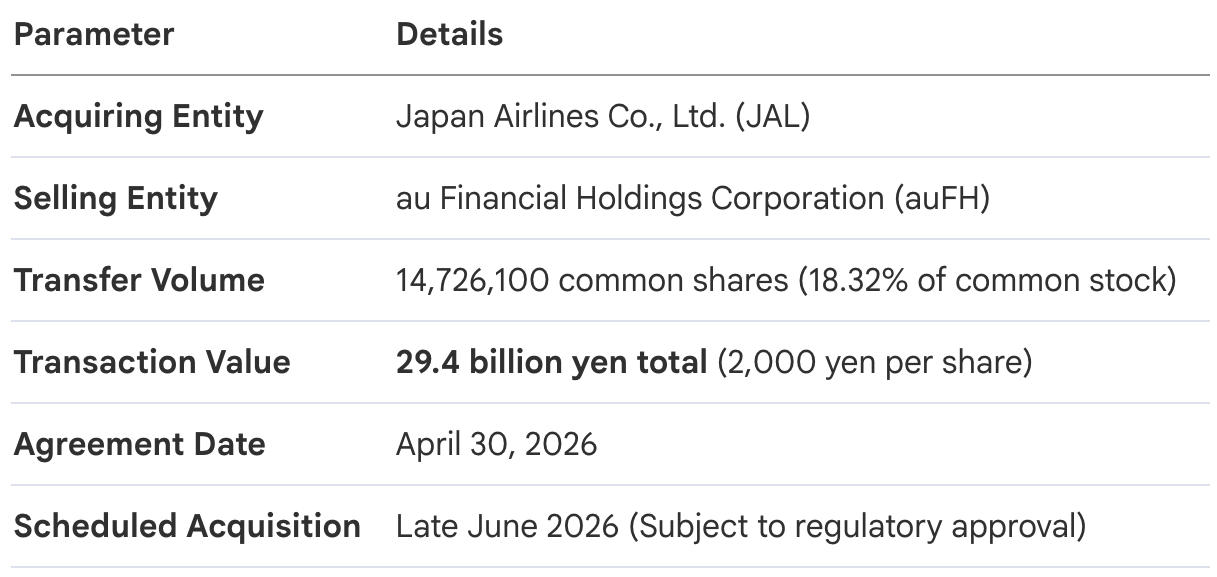
The 2,000 yen per share entry price represents a significant premium over current trading levels and serves as a firm vote of confidence in Lifenet’s stated goal of exceeding a 3,000 yen valuation by March 2029. Crucially, the transaction signals JAL’s acceptance of a valuation model based on future Comprehensive Equity (CE) rather than trailing earnings. The decision to secure an 18.32% stake is a calculated one; Lifenet’s historical success with the KDDI Group proved that this specific ownership level is the "sweet spot" for driving deep operational collaboration and stepwise growth without the complexities of a full buyout.
This transition reweights Lifenet’s capital structure to facilitate a deep-tier integration into the JAL aviation ecosystem while maintaining the operational independence necessary for a multi-partner model.
1. Integration with the JAL Ecosystem and Non-Aviation Expansion
The capital and business alliance with Japan Airlines is a cornerstone of Lifenet’s growth trajectory, dovetailing with JAL’s "Management Vision 2035," which targets aggressive expansion into non-aviation domains. For Lifenet, this is an opportunity to white-label its digital insurance infrastructure for one of Japan’s most aspirational brands.
The alliance centers on three primary strategic initiatives:
- Agency Business: JAL will act as a high-visibility insurance agent, deploying Lifenet products through its extensive digital and physical touchpoints.
- Asset Utilization: The joint development of bespoke insurance products integrated with JAL Miles and other loyalty assets to incentivize policyholder persistence.
- Group Insurance: The provision of tailored coverage for the JAL Group's approximately 38,000 employees.
This move significantly strengthens Lifenet's customer acquisition dynamics. While telecommunications partnerships offer "utility engagement"—often perceived as a "pushed" service bundled with a monthly bill—the JAL alliance taps into "aspirational engagement." Access to 41 million JAL Mileage Bank (JMB) members provides a channel to high-LTV (Life Time Value) targets. In this ecosystem, insurance is a "rewarded" experience where policy acquisition and renewals are tied to travel benefits and brand loyalty.
This aviation-led expansion is designed to function as a new growth engine that complements the established framework Lifenet has refined with the KDDI Group.
2. Realignment of the KDDI Group Relationship
The relationship with the KDDI Group is evolving into an "autonomous and robust" business-only alliance. While capital ties are being dissolved via the share transfer to JAL, the business logic for continued collaboration remains compelling for both parties.
Since 2015, the partnership has scaled significantly through several key milestones:
- The launch of "au Life Insurance," utilizing Ponta point accumulation to drive engagement.
- The deployment of Group Credit Life (GCL) insurance for au Jibun Bank’s mortgage portfolio.
- Broad-market insurance offerings tailored specifically for the "au" mobile user base.
For KDDI, the incentive to maintain this business tie is rooted in data-driven retention; Lifenet’s internal analysis confirms that active insurance contracts have a demonstrably positive impact on the retention of core au mobile subscribers. By shifting to a business-only alliance, KDDI continues to benefit from agency commissions and customer stickiness without the burden of equity management. This realignment allows Lifenet to diversify its risk of partner dependency while retaining a high-margin revenue stream from the telecom sector.
3. The "Embedded" Growth Strategy and Multi-Layered Ecosystems
Central to Lifenet’s Mid-term Business Plan (FY2024–FY2028) is the "Embedded" strategy, which seeks to maximize corporate value by delivering products seamlessly within the digital workflows of partner companies.
Lifenet has now successfully integrated into a tri-sector pillar of cross-industry leaders:
- Telecom/Payment: Continued business alliance with KDDI Group (since 2015).
- Financial/Loyalty: Integration with SMBC Group and the V-Point ecosystem (since 2023).
- Aviation: The new capital and business alliance with JAL Group (2026).
This model’s scalability is driven by its modularity. Lifenet is essentially becoming a "White Label" infrastructure provider for these corporate giants, allowing for a high-margin, low-overhead acquisition model compared to traditional direct-to-consumer (DTC) methods. By "plugging" its insurance engine into these vast, pre-existing loyalty loops—ranging from mobile bills to airline miles—Lifenet is building a multi-layered ecosystem that minimizes the cost of acquisition while maximizing policy persistence across diverse consumer segments.
4. Financial Projections and FY2028 Strategic Goals
Lifenet’s financial targets for the period ending March 2029 reflect the anticipated acceleration provided by these "Embedded" partnerships. The company’s trajectory is focused on aggressive growth in Comprehensive Equity (CE) as the primary measure of corporate value.
Lifenet’s FY2028 financial objectives are summarized as follows:
- Comprehensive Equity (CE): A target of 200 billion to 240 billion yen by March 2029.
- Annual Growth Rate: A targeted ~10% annual growth in CE per share.
- Market Valuation Goal: A long-term stock price target of 3,000+ yen.
According to the company’s "CE growth image", Lifenet is tracking toward these goals, with FY2024 CE at 159 billion yen and an FY2025 projection of 167 billion yen. The JAL alliance is expected to provide the necessary momentum to bridge the gap to the 240 billion yen upper target. By leveraging the "win-win" dynamics of these autonomous partnerships, Lifenet is transitioning into a mature phase of its business model—one where it functions as an independent, online specialist anchored by the loyalty programs of Japan’s largest corporate ecosystems.
 Norbert Gehrke