Japan FinTech Observer #153


Welcome to the one hundred fifty-third edition of the Japan FinTech Observer.

Thank you for your patience (again), we are just a little bit conference'd out, and there are still a few days to go in Japan FinTech Week(s). For us, the highlights during the first week were JPYC's funding round, Progmat's migration to Avalanche, and SBI/Startale's expected launch of JPYSC. More to come from FIN/SUM this week.
Here is what we are going to cover:
- Venture Capital & Private Markets: JPYC secures JPY 1.78bn in Series B first close to cement status as Japan’s default stablecoin infrastructure; Citi aggressively expands AI footprint with new infrastructure banking unit and strategic stake in Japan’s Sakana AI
- Insurance: Sompo Holdings has successfully completed the acquisition of Aspen Insurance Group announced in September 2025
- Banking: Rakuten revives FinTech consolidation plan to combat rising rates and intensifying competition (and nukes Rakuten Bank's stock); Mizuho Bank discloses loss of storage media at subcontractor, data of over 48,000 customers potentially at risk; GMO Aozora Net Bank deploys AI for third-party management, enhances risk governance with "Lens RM"; Zero energy renovation (Zenobe) & portfolio valuation for real estate assets; Fujitsu overhauls Financial DX suite, targets JPY 200bn in revenue by 2030
- Payments: SBI Holdings and Startale unveil JPYSC, a trust bank-backed stablecoin for the enterprise sector; MoneyX: The AI agent economy and why LINE & JPYC are betting on stablecoins for the future of payments
- Capital Markets: Woodstock brings “Robinhood Moment” to Japan with Zero-Fee, 24-Hour US stock trading launch; from failed AI startup to FinTech unicorn, Alpaca becomes the AWS of global investing; BBVA, Spain’s second-largest bank, plans to start a brokerage business in Japan as part of the firm’s global expansion drive
- Asset Management: Stefanie Drews, currently President & CEO of Amova Asset Management, has been appointed to the position of Executive Officer of its parent company, Sumitomo Mitsui Trust Group
- Digital Assets: Progmat pivots to public chain, migrates JPY 440bn in security token assets to Avalanche; MoneyX: Circle and Binance debate the path to a multi-currency crypto market; global divergence, a strategic comparison of US and Japanese blockchain regulatory trajectories
- The Last Word: The Rising Sun in a Crowded Field
Venture Capital & Private Markets
- JPYC secures JPY 1.78bn in Series B first close to cement status as Japan’s default stablecoin infrastructure: JPYC Inc., the issuer of the Japanese Yen-pegged stablecoin "JPYC," has completed the first close of its Series B funding round, raising a total of 1.78 billion yen (approx. $11.8 million USD); the round was led by Asteria Corporation, with participation from a diverse consortium of strategic investors including JR West Innovations, bitFlyer Holdings, and regional banking venture arms; this capital injection serves as confirmation for the Tokyo-based fintech firm's strategy as it transitions from a proof-of-concept phase to full-scale implementation; following its registration as a Funds Transfer Service Provider in August 2025 and the issuance of the new regulatory-compliant JPYC in October 2025, the company is positioning itself as the de facto standard for digital yen circulation
- Citi aggressively expands AI footprint with new infrastructure banking unit and strategic stake in Japan’s Sakana AI: Citigroup has launched a dual-pronged expansion into the artificial intelligence sector, announcing the formation of a dedicated AI infrastructure banking team alongside a landmark strategic investment in Tokyo-based developer Sakana AI; the moves, disclosed in consecutive announcements this past week, underscore the bank’s intent to capture a significant share of the burgeoning AI economy, both by financing the capital-intensive hardware build-out and by integrating next-generation software into its own global financial services
Not FinTech
- Z Venture Capital participated in RLWRLD's $26 million “Seed 2” funding round: the developer of physical AI and robotics foundation models has raised approximately $41 million since its inception; the Seoul-based company is banking on a strategy of training its software intelligence directly within live industrial environments rather than traditional laboratories
- Mega banks participate in Bluefield Energy's 660 million yen seed funding round: the financing will accelerate the development of the company’s cloud-based energy management systems and expand its aggregation business for decentralized solar power plants; the round was led by XTech Ventures, with significant participation from the venture capital arms of Japan’s major financial institutions, including SMBC Venture Capital, Mitsubishi UFJ Capital, and Mizuho Capital; the total figure combines third-party allotment equity financing of 610 million yen and debt financing from MUFG Bank and the Japan Finance Corporation
Insurance
- Sompo Holdings has successfully completed the acquisition of Aspen Insurance Group announced in September 2025; a subsidiary of Sompo Holdings acquired 100% of the issued Class A ordinary shares of Aspen
Banking

- Rakuten revives FinTech consolidation plan to combat rising rates and intensifying competition: Rakuten Group and its banking unit, Rakuten Bank, have agreed to reopen negotiations regarding the reorganization of their financial technology businesses, less than two years after shelving a similar proposal; the companies have executed a Memorandum of Understanding to integrate Rakuten Bank, Rakuten Card, and Rakuten Securities into a unified group structure; the target effective date for the reorganization is set for October 2026
- Mizuho Bank discloses loss of storage media at subcontractor, data of over 48,000 customers potentially at risk: Mizuho Bank announced that a storage medium containing sensitive customer information has been lost at one of its third-party system development subcontractors; according to the bank’s disclosure, the missing media was part of a dedicated terminal used in a development environment for overseas systems; the loss occurred at a "secondary subcontractor" responsible for system development; while the bank is investigating the possibility of unauthorized removal, the storage device has not yet been located
- GMO Aozora Net Bank deploys AI for third-party management, enhances risk governance with "Lens RM": Lens, a provider of governance and risk management solutions, has deployed its third-party management cloud solution, "Lens RM," at GMO Aozora Net Bank; by incorporating artificial intelligence into the increasingly complex risk assessment process associated with expanding startup transactions and its Banking-as-a-Service (BaaS) business, the bank aims to achieve both operational efficiency and strengthened governance
- Zero energy renovation (Zenobe) & portfolio valuation for real estate assets: to achieve carbon neutrality by 2050, Japanese financial institutions are promoting "Zero Energy Renovation (Zenobe) Finance" to upgrade the environmental performance of aging building stocks; this requires a collaborative effort by major banks to address economic hurdles and technical constraints that currently prevent owners from retrofitting older properties; financial institutions aim to move beyond rigid statutory lifespans by developing evidence-based screening and "connoisseurship" to evaluate a building's true green potential; market data suggests a growing "green premium," where tenants are increasingly willing to pay higher rents for sustainable, energy-efficient office spaces; ultimately, the initiative seeks to establish a new investment ecosystem where decarbonization efforts are directly reflected in real estate valuations and asset liquidity; successful implementation requires standardized CO2 disclosure and the widespread adoption of energy certifications to foster trust among global investors
- Fujitsu overhauls Financial DX suite, targets JPY 200bn in revenue by 2030: Fujitsu is doubling down on its digital transformation strategy for the financial sector, announcing a major reorganization of its "Uvance for Finance" portfolio; the Japanese technology giant aims to generate 200 billion yen in sales from this business segment by the fiscal year ending March 2030, betting heavily on generative AI to modernize legacy systems across banking, insurance, and securities; the expanded roadmap, originally established in mid-2025, now encompasses the entire financial spectrum—including credit and leasing—and is structured around seven core offerings; Fujitsu’s strategy pivots away from bespoke legacy maintenance toward "Fit-to-Standard" cloud services driven by automation
Payments
- SBI Holdings and Startale unveil JPYSC, a trust bank-backed stablecoin for the enterprise sector: SBI Holdings and Startale Group officially unveiled "JPYSC" with a view to bridge traditional banking with the burgeoning Web3 economy, branding it as the first Japanese Yen stablecoin backed by a trust bank; the strategic alliance positions JPYSC as a fully regulated digital asset designed for institutional adoption; according to the companies, the stablecoin will be issued by Shinsei Trust & Banking as a "Type III Electronic Payment Instrument"; this specific classification places the asset strictly under Japan’s rigorous regulatory framework, ensuring adherence to financial laws required for high-volume corporate and cross-border settlements
- MoneyX: The AI agent economy and why LINE & JPYC are betting on stablecoins for the future of payments: LINE NEXT announced the integration of the yen-denominated stablecoin JPYC into its upcoming Web3 wallet, "Unify", in order to accelerate the mainstream adoption of cryptocurrency in Japan; the announcement, made during the WebX conference, signals a transition from experimental blockchain projects to tangible implementations, leveraging the ubiquitous LINE messaging app to bridge the gap between retail users and the digital economy
Economics

- Apollo has published an analysis of the volume of crude oil through the Strait of Hormuz, by destination, as shown in the chart above, with Japan having the fourth largest dependency
- The Bank of Japan has published "Supply Constraints and Inflation Dynamics": this paper analyzes the impact of supply constraints on inflation dynamics and its mechanisms from both empirical and theoretical perspectives; it also examines recent changes in the relationship between supply constraints and inflation dynamics, as well as measures to mitigate the effects of supply constraints on inflation
Capital Markets
- Woodstock brings “Robinhood Moment” to Japan with Zero-Fee, 24-Hour US stock trading launch: Woodstock has completed a sweeping overhaul of its service model, introducing 24-hour trading capability and completely eliminating transaction fees for US stocks; the announcement was made during a media briefing held in Tokyo, where Woodstock CEO Brian Yun outlined the company’s aggressive strategy to capture the burgeoning interest in US equities among Japan’s "smartphone-native" Generation Z
- From failed AI startup to FinTech unicorn, Alpaca becomes the AWS of global investing: Alpaca, the API-first stock brokerage platform that powers hundreds of FinTech applications worldwide, has officially secured its Series D funding, pushing the company’s valuation past the coveted $1 billion mark; however, for Co-founder and CTO Hitoshi Harada, the "unicorn" label—once a rarity in the startup world—is less a destination than a mile marker; speaking recently at a Tokyo FinTech Meetup on the company’s trajectory, Harada outlined Alpaca’s evolution from a struggling deep-learning startup into a critical infrastructure provider for the global financial ecosystem
- BBVA, Spain’s second-largest bank, plans to start a brokerage business in Japan as part of the firm’s global expansion drive: the lender, based in the city of Bilbao in Spain, aims to establish a local securities subsidiary in Japan by the end of the year, subject to approval by the FSA; that would make it the first Spanish firm to operate a brokerage house in Japan
- Why Japanese stocks could keep rallying: Goldman Sachs Research’s Bruce Kirk discusses the implications of Japan’s recent snap election and the implications for the equity market and foreign investors
Asset Management
- Stefanie Drews, currently President & CEO of Amova Asset Management (formerly Nikko Asset Management), has been appointed to the position of Executive Officer of its parent company, Sumitomo Mitsui Trust Group, with the added title of Global Asset Management Officer, effective April 1, 2026; her role at Amova will not change, where she will continue as CEO; Drews has also recently appeared on Cathy Wood's ARK Invest podcast, under the title "Leading With Purpose: Personal, Professional And Planet"
Digital Assets
- Progmat pivots to public chain, migrates JPY 440bn in security token assets to Avalanche: Progmat has entered into a strategic partnership with Ava Labs (Avalanche) and blockchain interoperability startup Datachain, aiming to accelerate the "financial on-chain" ecosystem by migrating Progmat’s Security Token (ST) platform from a private ledger to the Avalanche public blockchain ecosystem; Progmat, which holds the top market share in Japan for security tokens, revealed it will transition its "Progmat ST" issuance and management infrastructure from the enterprise-focused "Corda 5" private ledger to "Avalanche L1" (formerly known as Subnets)
- MoneyX: Circle and Binance debate the path to a multi-currency crypto market: while the global stablecoin market has swelled to $300 billion following the U.S. enactment of the "Genius Act" in 2025, the sector remains overwhelmingly tethered to the Greenback; speaking at the MoneyX/WebX conference, executives from Circle Internet Group and Binance debated the path toward a truly multi-currency digital financial system, even as U.S. dollar-denominated assets continue to command 99% of the market; in a panel titled "The Future of Cross-Border Payments," moderated by Nikkei’s Takehiko Koyanagi, the industry leaders outlined divergent yet complementary strategies to bridge the gap between crypto-native trading and real-world utility
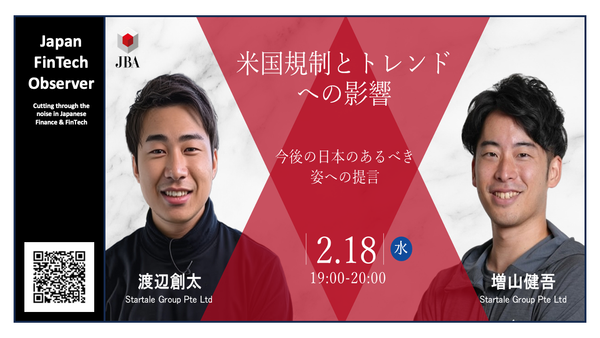
- Global divergence, a strategic comparison of US and Japanese blockchain regulatory trajectories: at a Japan Blockchain Association webinar, Startale Group's Sota Watanabe and Kengo Masuyama discussed the evolving landscape of blockchain regulation in both Japan and the United States; the speakers highlight how US legislative drafts, such as the Lummis-Gillibrand and Clarity Acts, are moving toward a tiered system that distinguishes between securities and network tokens; they emphasize that Japan’s regulatory direction is shifting from a focus on payments to investor protection, potentially reclassifying crypto assets under the Financial Instruments and Exchange Act; to ensure Japan remains competitive, the Japan Blockchain Association has established an On-chain Subcommittee to advocate for practical rules for DeFi and stablecoins; the discussion concludes that clear legal frameworks are essential for encouraging traditional financial institutions to adopt on-chain technology without stifling innovation
The Last Word: The Rising Sun in a Crowded Field: Japan’s Entrepreneurial Standing and the Asian Competitive Edge
In an era defined by intensifying geopolitical fragmentation and the relentless march of technological disruption, a nation’s entrepreneurial health is a critical indicator of national resilience and survival.
For Japan, the stakes are heightened by a deepening demographic depletion that threatens traditional industrial output. To remain relevant, Japan must transition from a reliance on legacy corporate structures to a dynamic ecosystem of agile, new ventures.
This analysis utilizes the Global Entrepreneurship Monitor (GEM) 2025/2026 report as its "ground truth," relying on the Adult Population Survey (APS) to capture the lived experience of the populace and the National Expert Survey (NES) to evaluate the structural integrity of the entrepreneurial framework.
The metrics covered reveal that while Japan remains an upper-income anchor, it faces significant structural fault lines that risk ceding its innovative edge to more aggressive regional peers. Read it here.
Please follow us to read more about Finance & FinTech in Japan, like hundreds of readers do every day. Our short weekly digest, the “Japan FinTech Observer”, is published on LinkedIn, on Medium, Substack & Paragraph, or here on our own FinTech Observer website. Only the latter provides you with the option to subscribe to individual news stories as they are published.
Should you wish to further discuss the Japanese (or Asian) FinTech ecosystem, you may book a consultation via Intro - all proceeds flow towards covering the operating cost of the Tokyo FinTech Association, and research for the Japan FinTech Observer.