Japan FinTech Observer #156

Welcome to the one hundred fifty-sixth edition of the Japan FinTech Observer. This week, we are excited to have new subscribers join us from Mastercard and BVNK (congratulations on tying the knot!), Dealroom.co, the IFC - International Finance Corporation, and TerraPay, among others 🙏
This edition also marks our three year anniversary, 156 weeks of uninterrupted service! Thank you for spending your time with us 🙏 That was fun, let's do it all over again 💪
No snarky comments this week due to the celebratory mood, although a pat-standing BOJ, the Takaichi/Trump summit, and some folks sweeping Epstein involvement in Japan under the carpet (yes, you there, with the chain that has just been rebranded) provide ample opportunity - I will try hard to restrain myself.
Here is what we are going to cover this week:
- Venture Capital & Private Markets: Kyoto University’s venture arm launches JPY 20 Billion Fund III to scale deep-tech "patient capital"; Tokyo FinTech firm "Funds" debuts in South Korea with Baree Mobility Investment launch; Mitsubishi UFJ Capital, Mizuho Capital, and SMBC Venture Capital participate in Orbital Lasers' Series A; JAFCO Asia rebrands as JIF Capital, signaling new era of independence in pan-asian venture capital
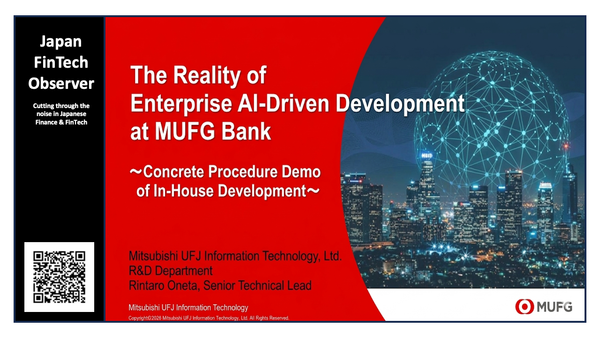
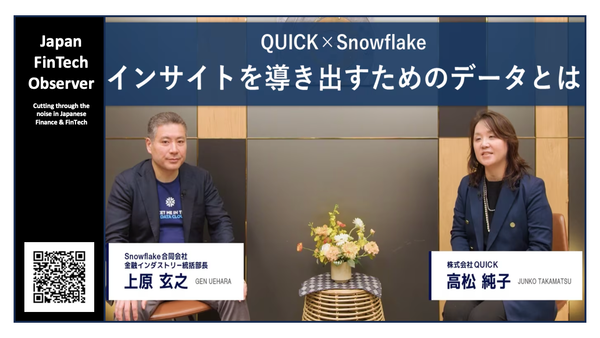
- Banking: Money Forward charges Into 2026 with strategic acquisitions and aggressive AI deployment; inside MUFG’s blueprint for enterprise AI-driven development; transitioning to AI-driven financial intelligence with Snowflake and QUICK; NCR Voyix divests Japanese banking unit to NTT DATA in pivot toward Retail and Restaurant Tech
- Payments: transitioning to Japan’s new real-time payment architecture; SBI VC Trade breaks new ground with Japan’s first licensed USDC lending service; Digital Garage Group to launch hybrid payment solution aimed at solving the "subscription friction" dilemma; Infcurion bolsters B2B payment ecosystem via strategic alliance with Credit Saison; PayPay and SMBC Group launch mutual point exchange
- Capital Markets: Woodstock has been featured in The Japan Times
- Asset Management: can low-cost giants become true ‘flagship’ funds
- Digital Assets: SBI and Megabanks successfully test regulated, KYC-compliant liquidity pools
- The Last Word: Regional Growth
Venture Capital & Private Markets
- Kyoto University’s venture arm launches JPY 20 Billion Fund III to scale deep-tech "patient capital": Kyoto University Innovation Capital (Kyoto iCAP) has established its third flagship investment vehicle, the Innovation Kyoto 2026 Investment Limited Partnership (KYOTO-iCAP Fund III); managed by Kyoto iCAP as the general partner under the leadership of Representative Director Ko Kusumi, the new fund scales the university’s commitment to commercializing high-level academic research; with a target committed capital of JPY 20 billion, the fund follows the successful deployment of Fund I (2016) and Fund II (2021); Bank of Kyoto, The Senshu Ikeda Bank, Sumitomo Mitsui Trust Bank, and Nippon Life Insurance Company are among the LPs
- Tokyo FinTech firm "Funds" debuts in South Korea with Baree Mobility Investment launch: Funds Inc., the operator of the fixed-yield investment platform "Funds," has launched its first South Korean-linked vehicle: the Baree Mobility EC Fund No. 1; this marks a significant milestone for the Tokyo-based FinTech firm as it accelerates its push to become a premier global platform for growth-stage investment and financing; the borrower for this inaugural Korean fund is Baree Inc., a Seoul-based mobility-tech company that operates "REITWAGEN," a specialized e-commerce and financial solutions platform for the motorcycle industry
- Mitsubishi UFJ Capital, Mizuho Capital, and SMBC Venture Capital participate in Orbital Lasers' Series A: Orbital Lasers, a rising Japanese powerhouse in space optics, has successfully raised 3.02 billion yen (approx. 20 million USD) in a Series A funding round; the capital was raised through a combination of third-party allotment of shares and J-KISS stock acquisition rights; this latest infusion brings the company’s total cumulative equity funding to 3.92 billion yen, marking a significant milestone for the startup, which spun out from satellite giant SKY Perfect JSAT just over two years ago, in January 2024
- JAFCO Asia rebrands as JIF Capital, signaling new era of independence in pan-asian venture capital: JAFCO Investment (Asia Pacific), a long-standing fixture in the regional private equity landscape, has officially rebranded as JIF Capital; the move marks the firm's formal transition into an independent venture and growth investment platform following its acquisition by Bee Alternatives Management; while the name is new, the firm’s leadership is signaling a "business as usual" approach for its limited partners and portfolio companies; headquartered in Singapore, JIF Capital confirmed that its internal regional structure, country leadership, and investment philosophy will remain unchanged
Banking
- Money Forward charges Into 2026 with strategic acquisitions and aggressive AI deployment: Money Forward is demonstrating a dual-pronged strategy in the face of challenging software company valuations: an aggressive horizontal expansion into the enterprise market via strategic acquisitions paired with a deep, vertical integration of AI agents to revolutionize both its internal development and its client-facing product suite; by consolidating its hold on back-office operations while simultaneously "dogfooding" cutting-edge AI coding tools, Money Forward is positioning itself as an AI-native ecosystem designed to navigate the increasingly complex regulatory and operational demands of the Japanese business world
- Inside MUFG’s blueprint for enterprise AI-driven development: in the hyper-competitive theater of global finance, the traditional software development lifecycle is undergoing a brutal reassessment; for years, the industry relied on "human-wave tactics"—vast cohorts of software engineers engaged in the linear translation of requirements into syntax; today, Mitsubishi UFJ Information Technology (MUIT), the digital engine room for the MUFG group, views this model as a legacy liability; to remain relevant in a digitized market, MUIT is spearheading a transition toward "AI-Driven Development"; this is a fundamental shift in capital allocation, moving away from manual OpEx toward the orchestration of high-leverage AI coding agents
- Transitioning to AI-driven financial intelligence with Snowflake and QUICK: legacy data fragmentation is a strategic liability that imposes an "intelligence tax" on every executive decision; in the current financial landscape, the volume of data has scaled beyond human cognitive limits, rendering traditional "data hoarding" obsolete; to maintain a competitive edge, organizations must pivot to a model of "active intelligence," where data is not a static archival asset but a dynamic catalyst for immediate, high-stakes action; the objective is the realization of a unified intelligence environment—a frictionless ecosystem where the historical boundaries between structured market data and unstructured global sentiment are eradicated; by collapsing the distance between raw data ingestion and executive insight, firms can transform their decision-making from a reactive posture to a proactive, predictive one; this roadmap serves as the definitive blueprint for navigating this transition, utilizing the Snowflake and QUICK partnership - as discussed in a recent webinar hosted by the companies - to move from months of speculative engineering to minutes of verified insight
- NCR Voyix divests Japanese banking unit to NTT DATA in pivot toward Retail and Restaurant Tech: NCR Voyix has reached a definitive agreement to sell its Japanese bank technology solutions business to Tokyo-based IT giant NTT DATA, further streamlining its global portfolio; the transaction, which includes the operations of NCR Commerce Japan, is expected to close by the end of 2026; while financial terms were not immediately disclosed, the divestiture marks a significant step in NCR Voyix’s ongoing effort to shed non-core assets and sharpen its focus on its primary retail and restaurant software segments; the Japanese unit being offloaded provides mission-critical infrastructure to financial institutions, including specialized solutions for foreign exchange, lending, video tellers, and network management; under the terms of the deal, NTT DATA—a $30 billion leader in global technology services—will integrate these specialized services into its own expansive financial IT portfolio
Payments
- Transitioning to Japan’s new real-time payment architecture: the global financial landscape is currently undergoing a foundational transition toward Fast Payment Systems (FPS) that operate 24/7/365 with near-instantaneous settlement; in this environment, modernizing payment infrastructure is a prerequisite for maintaining national economic competitiveness; as international trade and digital services accelerate, the ability to move liquidity across borders and between institutions with speed and data transparency has become the baseline for the modern economy; for Japan, the transition to a New Settlement System (NSS) is critical to ensuring that its domestic financial ecosystem can interface seamlessly with an increasingly integrated global market; since its second generation, the Zengin System has been updated every eight years; this implied the eighth generation was scheduled for November 2027, and the ninth generation for 2035. However, towards the end of 2024 the eighth generation had been postponed until 2028, and the discussions since have now led to the concept of a "New Settlement System (NSS)" to be implemented by 2030
- SBI VC Trade breaks new ground with Japan’s first licensed USDC lending service: SBI VC Trade has launched Japan’s first licensed stablecoin lending service, marking a significant milestone in the integration of US dollar-pegged digital assets into the Japanese regulated financial ecosystem; to celebrate the launch, the firm is offering an aggressive introductory annual yield of 10% for a 12-week term; following the initial campaign, SBI VC Trade expects to maintain a standard annual yield of approximately 5%, a figure that comfortably outpaces traditional US dollar denominated fixed-term deposits currently offered by domestic banks
- Digital Garage Group to launch hybrid payment solution aimed at solving the "subscription friction" dilemma: DG Financial Technology (DGFT) and its subsidiary SCORE have announced the upcoming launch of "Score Atokara Card" to optimize the burgeoning subscription-based e-commerce market; scheduled for a June 2026 rollout, the service aims to bridge the gap between high-conversion "Buy Now, Pay Later" (BNPL) methods and the high lifetime value (LTV) associated with credit card payments
- Infcurion bolsters B2B payment ecosystem via strategic alliance with Credit Saison: Tokyo-based FinTech leader Infcurion has announced a significant expansion of its “Winvoice” platform by entering into a strategic partnership with Credit Saison, one of Japan’s largest credit card issuers, to integrate American Express brand cards into its service ecosystem; users of Infcurion’s "Winvoice" platform can now utilize American Express cards issued by Credit Saison for invoice settlements; this integration is a direct response to growing market demand for diversified payment options within the business-to-business sector; by broadening its brand portfolio, Infcurion aims to enhance user convenience and sharpen its competitive edge in the high-growth B2B transaction market
- PayPay and SMBC Group launch mutual point exchange: PayPay Corporation, Sumitomo Mitsui Card (SMCC), and CCCMK Holdings announced the launch of a mutual point-exchange program; users will be able to convert "PayPay Points" and "V Points" at a 1:1 ratio, effectively bridging two of the country’s largest consumer ecosystems in a move set to reshape the competitive landscape of Japan’s digital loyalty and payment sectors
- How AI and stablecoins are rewiring global finance: the global financial landscape is undergoing a rigorous restructuring as stablecoins evolve from speculative "safe havens" for crypto-traders into the standardized settlement layer for the real-world economy; as we have progressed through the 2024–2025 cycle, these assets are being integrated into core economic infrastructure, shifting the focus from retail volatility to institutional capital efficiency and cross-border settlement; this post serves as an event report for a webinar hosted by Fracton Ventures and SurfAI
Economics
- Bank of Japan March 2026 Monetary Policy Meeting: the Bank of Japan’s March Monetary Policy Meeting took place against a backdrop of heightened market volatility, and the proceedings underscored the increasing tension between the "look-through" approach to temporary price shocks and the mounting fear of being caught behind the curve as external geopolitical pressures mount; in an 8-1 majority vote, the Policy Board voted to maintain the uncollateralized overnight call rate at approximately 0.75%; also, here is the official "Statement on Monetary Policy"
- Middle East tensions pose new threat to real wages: rapidly escalating tensions in the Middle East are sending shockwaves through global energy markets, raising a critical question for Japan's macroeconomic trajectory; according to a new report from the Itochu Research Institute, if West Texas Intermediate (WTI) crude stubbornly remains near the $100-per-barrel mark, Japanese consumers will face a steep penalty at the pump; the surge could push retail gasoline prices up by nearly 30 yen per liter, applying a direct 0.5% upward pressure on the nation’s Consumer Price Index (CPI); however, Tokyo is stepping in to soften the blow; the government’s move to reinstate gasoline subsidies is projected to suppress this inflationary spike by roughly 0.2 percentage points; provided the geopolitical premium on oil dissipates by the second half of the year, Itochu maintains its forecast that Japan’s real wages will remain in positive territory for 2026; but if oil prices remain higher for longer, the risk of real wages plunging back into the red—and dragging the broader economy down with them—rises significantly
- Brookings' Mireya Solís comments on "Late-breaking shocks and shifting goalposts: Takaichi's highwire Washington visit"
- Oil Risk and Summit Stakes: Moody's Global Economy Unwrapped sits down with David Boling, Principal at The Asia Group, to unpack what Japan is walking into as Prime Minister Takaichi heads to Washington and conflict in the Middle East rattles energy markets; oil supply chains are under strain, the yen wobbles, and U.S. President Donald Trump shows no sign of easing his tariff instincts; Japan clearly has its work cut out; can Tokyo still lean on old alliances and familiar playbooks in a world that feels more fractured and transactional; Boling walks through the risks and what Japan needs to get right
- CaixaBank sees Japan at the dawn of a new cycle
Capital Markets
- Woodstock has been featured in The Japan Times: Tokyo startup betting free trades and small lots will draw young investors; Woodstock recently introduced a zero-fee, around-the-clock U.S. equity trading service; while Japanese online brokers have competed fiercely to cut fees, the discounts are typically limited to domestic equities; a number of Japanese players, including SBI Securities and Rakuten Securities, charge fees of roughly 0.45% to 0.5% of the total trade for U.S. equity transactions
- The Ministry of Finance has issued its "JGB Newsletter" for March 2026
- The NLI Research Institute has published its "Investor Trading Trends" for February 2026
Asset Management
- Can low-cost giants become true ‘flagship’ funds: for decades, the Japanese investment trust market has chased the "trillion-yen" milestone as the ultimate mark of success; but a new report from Morningstar suggests that while Japan is finally seeing the birth of 10-trillion-yen behemoths, the industry is still struggling to cultivate "true" flagship funds that mirror the longevity and philosophical depth of their American counterparts
Digital Assets
- SBI and Megabanks successfully test regulated, KYC-compliant liquidity pools: SBI VC Trade has released the results of a pioneering proof-of-concept aimed at bringing institutional-grade compliance to Decentralized Finance; the experiment, conducted under the auspices of the Financial Services Agency’s "FinTech Proof-of-Concept Hub," marks a significant step toward a "permissioned" DeFi ecosystem where regulated financial institutions can participate in Automated Market Makers (AMMs) without sacrificing Anti-Money Laundering (AML) standards; key participants in the "DeFi Study Group" included a "who’s who" of Japanese finance, including Sony Bank, Daiwa Securities, Nomura Holdings, bitbank, Mizuho Trust & Banking, Sumitomo Mitsui Trust Bank, and Mitsubishi UFJ Trust and Banking
The Last Word: Regional Growth

There are some good reasons to establish your business outside of the Tokyo metropolitan area, but growth certainly is not one of them.
Please follow us to read more about Finance & FinTech in Japan, like hundreds of readers do every day. Our short weekly digest, the “Japan FinTech Observer”, is published on LinkedIn, on Medium, Substack & Paragraph, or here on our own FinTech Observer website. Only the latter provides you with the option to subscribe to individual news stories as they are published.
Should you wish to further discuss the Japanese (or Asian) FinTech ecosystem, you may book a consultation via Intro - all proceeds flow towards covering the operating cost of the Tokyo FinTech Association, and research for the Japan FinTech Observer.