Japan Stablecoin Summit: What Impact have Stablecoins had in the World?


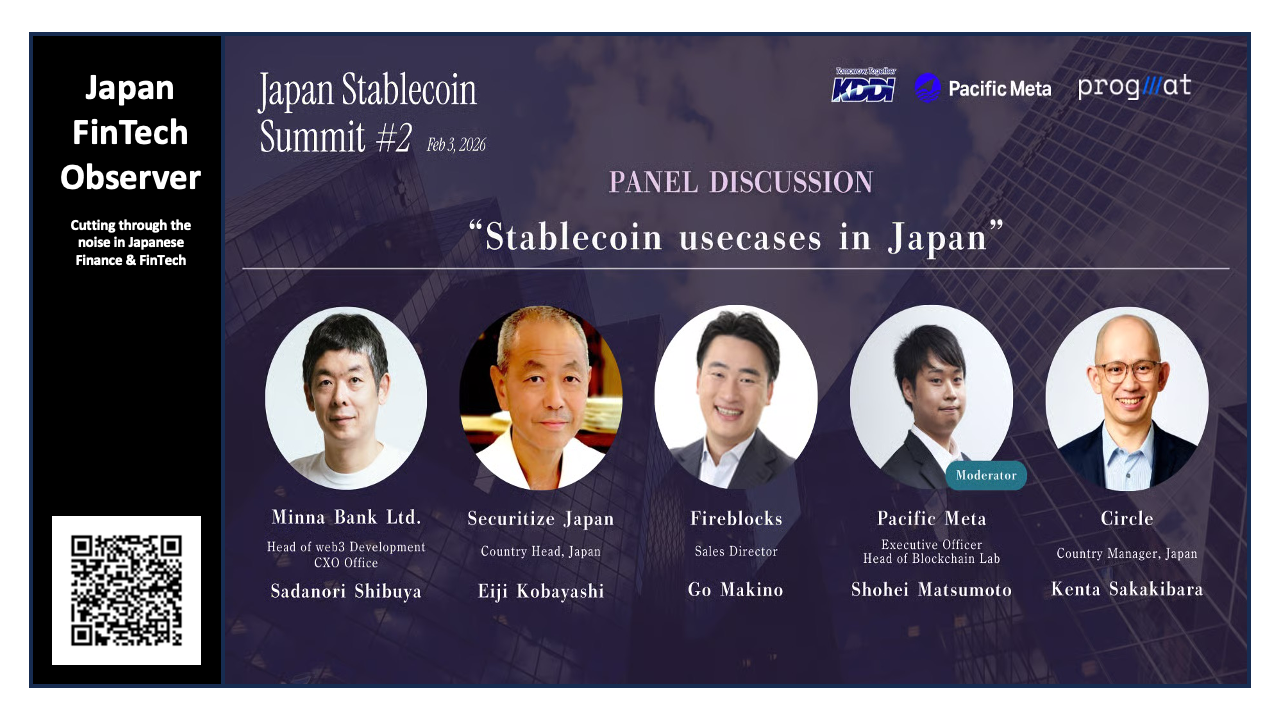
At the second annual Japan Stablecoin Summit hosted by Pacific Meta, KDDI and Progmat, industry leaders from the Ethereum Foundation, Solana Foundation, Anchorage Digital, and Nethermind gathered to discuss the maturation of the digital asset landscape. The panel painted a picture of a sector that has graduated from speculative trading to institutional integration, driven by significant regulatory milestones in the United States and continued innovation in Asia.
Key Takeaways
- Regulatory Clarity Has Unlocked Institutional Capital: The passage of the "Genius Act" in the U.S. has fundamentally de-risked stablecoins by mandating that reserves be bankruptcy-remote, shifting the asset class from a trading tool to a reliable store of value and settlement instrument.
- The Shift from Private to Public Blockchains is Accelerating: The era of isolated enterprise "intranet" blockchains is ending. Institutions are migrating to public ledgers to access global liquidity, relying on advanced privacy technology like zero-knowledge proofs to maintain confidentiality on open networks.
- Stablecoins Are Evolving into Programmable Real-World Assets (RWAs): Panelists argued that stablecoins represent the first successful RWA, capable of compressing custody, settlement, and investment functions into a single programmable token.
- Infrastructure Wars Have Become a Multi-Chain Reality: The debate between Ethereum and Solana has moved from a zero-sum game to specialized utility, with Ethereum favored for its decade-long reliability record and Solana for high-frequency payment use cases.
Regulatory Safety Nets and the "Genius Act"
The panel identified the passage of the "Genius Act" in the U.S. last year as the watershed moment for the industry. Moses Lee, Head of APAC for Anchorage Digital, the only federally chartered crypto bank in the U.S., highlighted that the primary risk for stablecoins had historically been the safety of the underlying reserves held in commercial banks.
Citing the Silicon Valley Bank collapse and previous de-pegging events, Lee noted, "The stablecoin itself was bankruptcy remote of the issuer, but the reserves were not." The new regulatory framework ensures reserves are protected, driving a surge in issuance. With over 99% of stablecoins currently USD-denominated, the panel emphasized that U.S. regulation has effectively set the global standard, though Japan’s early regulatory framework remains a pioneering model.
The Death of the "Intranet" Blockchain
A significant portion of the discussion focused on the migration of institutional activity from private, permissioned blockchains to public networks. Lu Yin of the Solana Foundation compared early private blockchains (such as Hyperledger or Corda) to corporate intranets: secure but isolated and liquidity-poor.
"Institutions realize there is no liquidity [in private chains]," Yin observed. "The new evolution of permissioned environments is happening on public infrastructure."
Both Adrian Li of the Ethereum Foundation and Delane Foo of Nethermind concurred, noting that privacy is no longer an excuse to avoid public chains. Innovations in cryptography, specifically zero-knowledge proofs and selective disclosure mechanisms, now allow enterprises to transact on public ledgers while keeping sensitive data compliant and private. "You can do private transactions on the public train," Li stated.
Stablecoins as the Ultimate RWA
The panel reframed the definition of stablecoins, moving beyond simple payment instruments to viewing them as the foundational Real-World Asset (RWA). According to Lee, a stablecoin token now performs three distinct financial functions simultaneously: it acts as a store of value (reserve), an investable asset, and a settlement mechanism.
"One token can do it all," Lee said, noting that this compressibility of functions offers efficiency that traditional finance cannot match. Delane Foo added that the "composability" of blockchain allow institutions to bake compliance and control directly into the code. This means issuers don't have to "reinvent the wheel" for every financial product but can layer new rules onto existing, interoperable standards.
Ethereum vs. Solana: A Divergence in Utility
The discussion highlighted how the two leading blockchains are carving out distinct niches. Adrian Li pitched Ethereum’s value proposition on its ten-year track record of "zero downtime" and massive network effects, likening it to the reliable bedrock of the crypto economy.
Conversely, Lu Yin positioned Solana as the "broadband" era of blockchain following the "56k modem" era. He cited Western Union’s partnership with Solana as evidence that high-frequency, low-cost transaction models require the specific throughput capabilities that Solana offers.
Ultimately, the consensus was collaborative rather than combative. Infrastructure providers like Nethermind and custodians like Anchorage Digital confirmed they support both ecosystems, suggesting the future financial system will be multi-chain, utilizing different networks for different asset classes and settlement speeds.
 Norbert Gehrke