Japan Stablecoin Summit: Stablecoin Use Cases in Japan

As Japan solidifies its legal framework for stablecoins following the implementation of the revised Payment Services Act, the conversation has shifted from "can we do it?" to "how do we monetize it?"
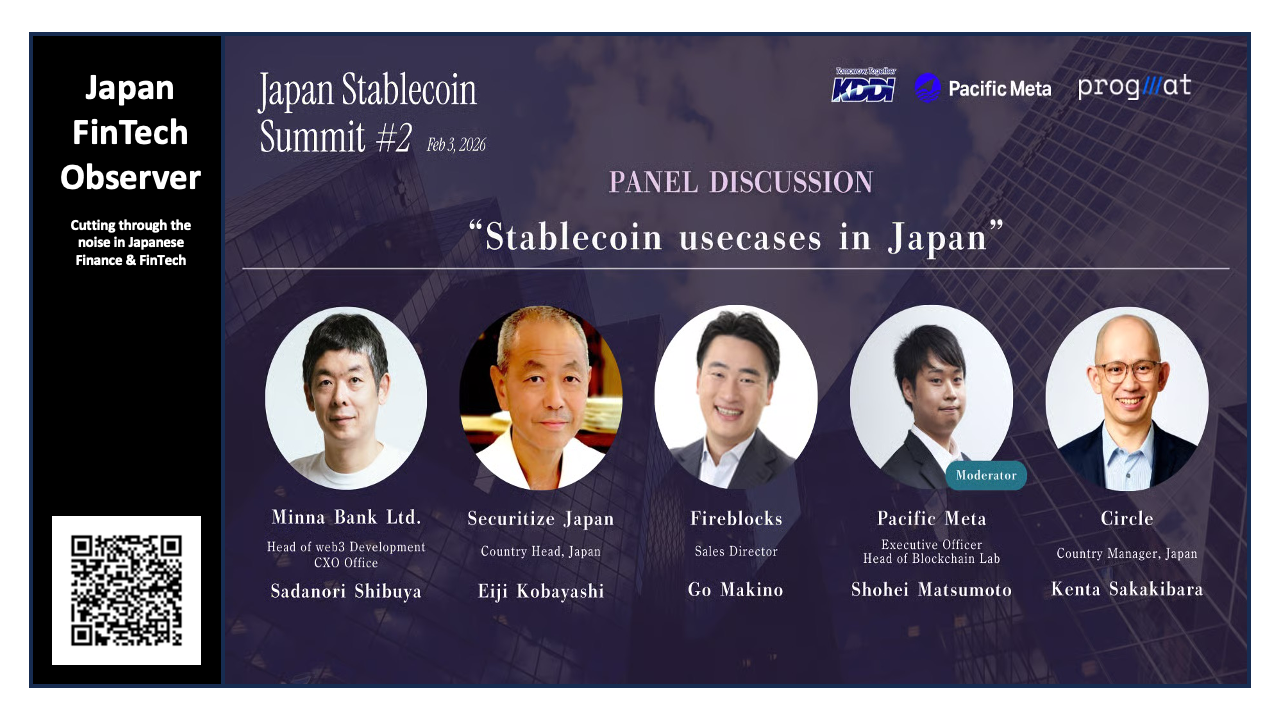
At the second Japan Stablecoin Summit, hosted on February 3, 2026, by Pacific Meta, KDDI and Progmat, a panel consisting of industry leaders from Minna Bank, Securitize, Fireblocks, and Circle convened to map out the country's digital asset future, in particular the use cases for stablecoins in Japan. The consensus was clear: while Japan has regulatory clarity, it lags behind global counterparts in implementation. The path forward relies not on competing with existing domestic money transfer systems, but on leveraging blockchain for speed, programmability, and institutional liquidity.
Key Takeaways
- T+0 Settlement is the "Killer App": In a country with an already efficient banking system, the primary value of stablecoins is not low-cost remittances, but instant (T+0) settlement. This eliminates counterparty risk and frees up liquidity for institutional investors currently bound by T+2 cycles.
- Programmability Trumps Cost Reduction: Minna Bank emphasized that "programmable money"—which can automatically execute rewards or complex B2B payments upon meeting specific conditions—offers a value proposition that traditional banking infrastructure cannot match.
- The Convergence of DeFi and RWAs: Securitize highlighted a growing trend where KYC-compliant institutions utilize decentralized finance (DeFi) protocols to manage Real World Assets (RWAs), enabling strategies like instant collateralization and automated yield generation that are impossible in traditional finance (TradFi).
- Public Blockchains are the Standard: The debate between private versus public blockchains is effectively over. The panel agreed that public chains are the necessary infrastructure for interoperability, with issuers and custodians focusing on security layers (like "Zero Trust" wallets) to protect users.
1. Moving Beyond "Cheap Transfers" to "Instant Finality"
A recurring theme was the difficulty of selling stablecoins solely as a cheaper alternative to bank transfers in Japan, where the Zengin system already works efficiently.
Go Makino, Sales Director at Fireblocks, noted that while migrant workers globally use stablecoins to avoid predatory remittance fees, Japanese adoption requires a different hook. "The survey results are clear: the number one demand is settlement speed," Makino stated.
Eiji Kobayashi, Country Head for Securitize Japan, reinforced this, pointing to the inefficiencies of the T+2 (trade date plus two days) settlement cycle in traditional securities. "With stablecoins, we achieve Delivery vs. Payment (DvP) instantly. For institutional investors, the ability to rebalance a multi-billion dollar portfolio without waiting two days is a massive competitive advantage."
2. The Rise of "Programmable Money" and Deposit Tokens
Sadanori Shibuya of Minna Bank argued that the true innovation lies in programmability. Minna Bank is currently developing a tokenized deposit system (Deposit Tokens) on a public blockchain.
"It’s not just about 24/365 transfers," Shibuya explained. "It’s about embedding logic into the money itself. For example, in a B2B2C context, we can program the money to instantly trigger point rewards or settlements only when specific conditions are met. This level of automation is difficult to achieve with legacy banking APIs."
3. Unlocking Institutional Liquidity via DeFi
The panel highlighted the maturing intersection of regulated assets and DeFi protocols. Kobayashi shared insights from Securitize’s work with giants like BlackRock and KKR. He described a scenario where tokenized assets are used as collateral in DeFi protocols to borrow stablecoins, which are then reinvested—a strategy known as "looping."
"In the traditional world, this takes days and involves heavy paperwork," Kobayashi said. "On-chain, with KYC-compliant permissioned pools, this happens in seconds. This creates capital efficiency that TradFi simply cannot compete with."
4. Infrastructure and The "Japan Lag"
Despite the optimism, Kenta Sakakibara, Country Manager for Circle, and other panelists acknowledged that Japan is several years behind the U.S. in terms of active on-chain volume and infrastructure.
To combat high gas fees and slow transaction speeds on Ethereum mainnet—which make micropayments unviable—Sakakibara mentioned Circle’s testing of new Layer 1 solutions (specifically mentioning "Arc") designed for sub-second finality and negligible costs. "For enterprises to use stablecoins for daily cash management, we need infrastructure that settles instantly and cheaply," Sakakibara noted.
Makino added that security remains the biggest hurdle for mass adoption. "If users lose their private keys or get hacked, the industry dies. We need 'Zero Trust' architecture where the user experience is seamless, and the complex security happens invisibly in the background."
Conclusion: The Cooperative Phase
The session concluded with a call for cooperation. The panelists agreed that building the "rails" of this new financial system is too large a task for any single company.
"The debate over private vs. public chains is essentially settled; public chains are the way forward," Kobayashi summarized. "Now, banks, fintechs, and regulators must stop building silos and start connecting their infrastructure to catch up to the global standard."
 Norbert Gehrke