Japan’s Financial Giants Push On-Chain Toward Wholesale JGB and Collateral Markets


Japan’s major financial institutions and market infrastructure operators are shifting their blockchain strategy from retail security tokens toward wholesale institutional markets, targeting Japanese government bond (JGB) repurchase agreements and real-time collateral management, executives said at an industry seminar.
Speaking at a panel hosted by the Japan Security Token Association (JSTA) on the current state and future of on-chain finance, executives from Nomura Holdings, Mitsubishi UFJ Financial Group (MUFG), Japan Exchange Group (JPX), Progmat, and Boostry noted that the domestic tokenization sector has reached a structural turning point.
Since Japan’s amended Financial Instruments and Exchange Act took effect in 2020, the domestic security token market has surpassed 400 billion yen—driven largely by retail real estate offerings—and is projected to reach roughly 500 billion yen across 100 issuances. However, following commercial tokenization rollouts by the U.S. Depository Trust & Clearing Corporation (DTCC) and ongoing central bank trials in Europe, Japanese institutions are increasingly prioritizing wholesale post-trade and clearing efficiency.
Government Backing and Institutional Trials
Momentum has been reinforced by regulatory initiatives, including the Financial Services Agency’s (FSA) Payment Innovation Project (PIP) launched in February 2026 and an "AI-era On-Chain Finance Forum" established in September alongside the Bank of Japan (BOJ) and the Ministry of Finance.
Under the FSA’s PIP framework, major financial groups are conducting three primary proofs of concept:
- Equities and Stablecoin DvP: Daiwa Securities, Mizuho Financial Group, and Japan’s three megabanks are testing Delivery-versus-Payment (DvP) settlement between stablecoins and listed equities or investment trusts held at the Japan Securities Depository Center (JASDEC).
- Digital Collateral Management: The Japan Securities Clearing Corporation (JSCC), JPX’s clearinghouse, launched a joint trial in April 2026 with Mizuho, Nomura, and U.S. blockchain firm Digital Asset to test distributed ledger technology (DLT) for JGB collateral management.
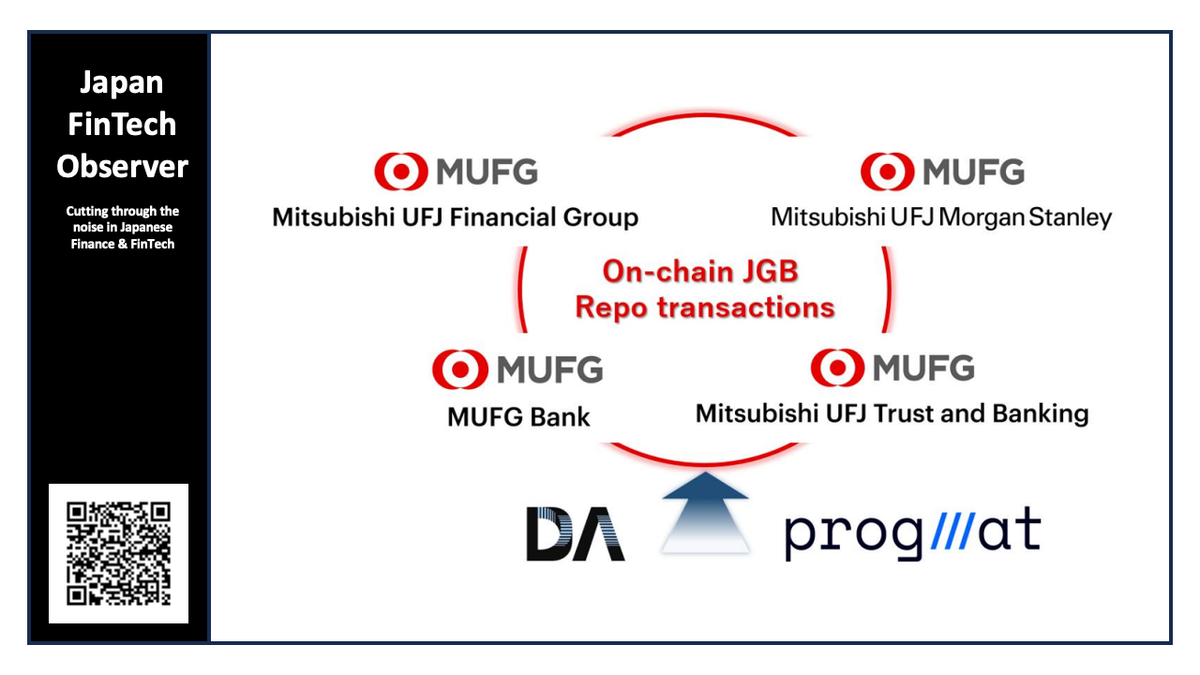
- On-Chain JGB Repos: MUFG is running trials across its banking, trust, and securities units to execute on-chain JGB repo transactions, exploring the use of tokenized bank deposits alongside stablecoins.
Addressing Capital Inefficiency in a Positive-Rate Era
Toshihiro Akema, an executive representing JPX and JSCC, highlighted significant capital inefficiencies in existing collateral operations. JSCC currently holds over 16 trillion yen in deposited collateral against an 8 trillion yen requirement—more than double the necessary amount—due to time-zone gaps for overseas investors, multi-layered intermediaries, and legacy batch-processing constraints.
With interest rates rising in Japan, the funding cost of idle collateral has become a pressing concern for institutional investors. Akema noted that smart contracts and atomic swaps could enable "just-in-time" collateral transfers across asset classes, reducing excess buffers without compromising clearing safety.
Similarly, Funayama of Mitsubishi UFJ Morgan Stanley Securities noted that while Japanese banks currently rely on BOJ intraday overdraft facilities and T+1 settlement windows, transitioning toward instant on-chain DvP settlement will eliminate settlement lags and create new demand for on-chain intraday repo markets.
Regulatory Hurdles and Infrastructure Sovereignty
Panelists warned that Japan faces a narrow one-to-two-year window to align its legal and technical frameworks with global peers.
Naoki Sasaki of Nomura Holdings identified the Act on Book-Entry Transfer of Corporate Bonds and Shares as a key bottleneck, noting that the statute was not designed for decentralized ledgers. He called for regulatory interpretation updates and system upgrades by 2027 to prevent domestic capital markets from losing competitiveness to U.S. and European platforms.
Scaling institutional workflows will also require deeper cash-leg solutions. Funayama pointed out that institutional repo trades routinely involve tens or hundreds of billions of yen, far exceeding the capacity of current retail-focused stablecoins, making tokenized bank deposits or direct central bank money integration critical.
Executives also cautioned against building fragmented, bank-specific blockchains, emphasizing the need for shared domestic market infrastructure. While acknowledging the growing adoption of global networks such as Digital Asset’s Canton Network and Circle’s Arc, speakers stressed the importance of maintaining interoperable, sovereign Japanese infrastructure so domestic financial markets do not become overly dependent on foreign platforms.
 Norbert Gehrke