Key Directives and Priorities of Japan's Financial Services Agency (October 2025)


This article synthesizes the key discussion points, directives, and strategic priorities communicated by Japan's Financial Services Agency (FSA) during its October 2025 meetings with various financial industry associations. The purpose of this briefing is to provide a high-level strategic analysis of the FSA's primary focus areas, significant regulatory shifts, and key initiatives. This analysis is intended to inform executive-level strategic planning and compliance efforts for the upcoming fiscal year. The core themes reveal an agency balancing immediate, non-negotiable compliance demands against a forward-looking national project—the "Asset Management Nation"—all while fundamentally reshaping its own supervisory structure to manage the risks and opportunities of an increasingly digital financial landscape.
1. Immediate Compliance and Operational Imperatives
The FSA has laid down several non-negotiable, cross-sectoral mandates that serve as immediate stress tests of financial institutions' operational agility and commitment to social responsibility. These directives, addressing both geopolitical obligations and domestic crises, establish a baseline of mandatory compliance that underpins all other strategic priorities.
1.1 Reinforcement of Sanctions Against Iran
Following the United Nations Security Council resolution snapback in September 2025, Japan has reintroduced sanctions against Iran. The Foreign Exchange and Foreign Trade Act (外為法) was amended to reflect these changes, becoming effective on September 28, 2025. The new measures include asset freezes and the prevention of fund transfers.
Subsequently, on September 30, 2025, the FSA issued a formal request to all relevant financial institutions. The agency has mandated "flawless compliance" (遺漏なき対応) with the renewed sanctions, emphasizing the need for rigorous fulfillment of Know Your Customer (KYC) obligations and the diligent reporting of any suspicious transactions.
1.2 Support for Typhoon No. 22 Victims
In response to the domestic crisis caused by Typhoon No. 22, the FSA has directed financial institutions to provide flexible and empathetic support to those affected. This directive follows the official application of the Disaster Relief Act (災害救助法) in Tokyo on October 8, 2025. A joint request for specific financial measures was issued by the Kanto Local Finance Bureau and the Bank of Japan on October 9, 2025, calling on institutions to be proactive in understanding and meeting the needs of victims.
While these external shocks demand immediate tactical responses, the FSA is simultaneously escalating its focus on fortifying the financial system against persistent internal threats.
2. Strengthening Defenses Against Financial Crime
The FSA is executing a multi-pronged strategy to combat the persistently high levels of financial crime, with a particular focus on those leveraging digital platforms. These directives are framed as critical to maintaining the integrity of the financial system and preserving public trust, representing a significant area of regulatory scrutiny and required investment for all institutions.
2.1 Overhaul of Non-Face-to-Face Identity Verification
To counter the use of fraudulent identity documents in opening accounts, the enforcement regulations of the Act on Prevention of Transfer of Criminal Proceeds were amended on June 24, 2025. This overhaul will phase out high-risk, non-face-to-face identity verification methods. The new regulations mandate a strategic shift towards the primary use of the My Number Card's public personal authentication system, which offers a more secure and reliable verification process.
While the official enforcement date for this change is April 1, 2027, the FSA has issued a strong request for financial institutions to implement these new protocols "as swiftly as possible" (可及的速やかな対応), signaling the agency's view that the fraud risk associated with current methods is acute and requires immediate mitigation.
2.2 Combating Fraudulent Use of Internet Banking
In a joint effort with the National Police Agency, the FSA is demanding stronger measures to counter the high volume of fraud conducted through internet banking. This is a direct response to the significant financial damages caused by special scams (特殊詐欺) and the growing threat of SNS-based investment and romance scams (SNS型投資詐欺・SNS型ロマンス詐欺).
Statistics for the first half of 2025 highlight the scale of the problem:
- Special Scams: ¥22.02 billion in damages were facilitated via internet banking, out of a total of ¥36.98 billion.
- SNS-based Investment Scams: ¥20.01 billion in damages were funneled through internet banking, out of a total of ¥26.64 billion.
- SNS-based Romance Scams: ¥9.73 billion in damages were processed via internet banking, out of a total of ¥14.21 billion.
The FSA has directed institutions to strengthen their verification procedures, specifically during the internet banking application process and when customers request increases to their transfer limits.
2.3 Utilizing the Special Uncollectible Claims Purchase System
The FSA is urging financial institutions to make better use of the Deposit Insurance Corporation's system for purchasing loans linked to anti-social forces (反社債権). The purpose of this system is to help institutions sever ties with such entities and cleanse their balance sheets. The FSA noted that while approximately ¥8.1 billion across 331 cases from 101 institutions had been purchased as of June 2025, recent usage of the system has been sluggish, prompting the FSA to strongly encourage its use, particularly by credit associations, which may be perceived as needing more robust mechanisms to sever ties with such entities.
While shoring up these critical defenses is a key priority, the FSA is simultaneously advancing a forward-looking agenda focused on national economic growth and industry innovation.
3. Advancing Core Strategic and Economic Initiatives
This section covers the FSA's proactive, forward-looking initiatives designed to stimulate economic growth, enhance Japan's position as a global financial hub, and foster responsible innovation across the industry. These programs represent the agency's primary growth-oriented agenda.
3.1 Driving the 'Asset Management Nation' (資産運用立国) Agenda
The "Asset Management Nation" initiative remains a central pillar of the FSA's 2025 administrative policy. To promote this vision, the agency held Japan Weeks 2025 from October 20-24, a core promotional period featuring over 80 industry events. This builds on the success of the 2024 event, which attracted approximately 30,000 participants and served as a key platform for showcasing the Japanese market. Key progress metrics are encouraging, with the latest NISA utilization data (as of June 2025) showing approximately 26.96 million accounts holding a total investment value of approximately ¥63 trillion. To further support data collection, the survey frequency for NISA usage has been changed to twice a year (June and December) starting in 2025.
To provide the fiscal and regulatory tailwinds for this agenda, the FSA has put forward several strategically aligned FY2026 Tax Reform Proposals, including:
- Enhancements to the NISA system, such as expanding the range of eligible products and simplifying residency verification procedures for account holders.
- A comprehensive review and extension of existing tax incentives for investment corporations.
- A review of the taxation framework for crypto-assets.
- Specific measures to establish Japan as an International Financial Center, including revisions to tax rules for foreign partners and streamlining procedures for cross-border investment.
3.2 Fostering AI Adoption through the FSA AI Public-Private Forum
The FSA is actively promoting the sound utilization of artificial intelligence through its AI Public-Private Forum, a platform designed for open discussion on AI use cases, challenges, and best practices. The second forum, held on September 18, 2025, focused specifically on the critical topic of data management. To ensure broad access to these discussions, the proceedings are available for viewing on YouTube. Future forums are planned to cover regulatory considerations, investment strategies for AI, and human resource development, underscoring the FSA's commitment to guiding responsible AI adoption in finance.
3.3 Enhancing Regional Vitality and Business Lending
The FSA is advancing two primary programs aimed at strengthening the real economy and improving business financing:
- REVICareer (レビキャリ): This program matches skilled professionals from large corporations with regional companies to address talent gaps. As of September 2025, the program has 5,339 registered professionals, 205 registered financial institutions, and has facilitated 259 successful matches. The FSA is now promoting a "Just One Case" (まず1件) campaign, pushing regional banks and credit associations that have yet to make a match to overcome initial hurdles, build expertise, and secure their first placement.
- Enterprise Value Charge (企業価値担保権): In anticipation of the Business Lending Promotion Act (事業性融資推進法) coming into force on May 25, 2026, the FSA is actively working on environmental development for this new form of security. It is facilitating this process by hosting non-public study groups for proactive financial institutions to explore implementation strategies and address practical challenges.
3.4 Promoting Price Pass-Through and Fair Transactions
The FSA is actively relaying a government-wide priority to promote fair trade practices, specifically encouraging companies to pass on rising costs to secure the necessary funds for wage increases. The agency has communicated that this is a critical economic objective that requires firm leadership and commitment from the highest levels of management within financial institutions and their corporate clients.
To support these strategic initiatives and ensure their effective implementation, the FSA is also undertaking significant internal restructuring and refining its supervisory approach.
4. Evolving Supervisory Framework and Sector-Specific Guidance
The FSA's strategic agenda is backed by a fundamental re-engineering of its own supervisory apparatus. The following organizational and policy shifts signal a decisive move toward more specialized, thematic, and proactive oversight, providing a clear roadmap of where regulatory scrutiny will be most intense.
4.1 FSA Organizational Realignment
The FSA is implementing several key structural changes for the 2025 administrative year to enhance the effectiveness and clarity of its supervision:
- Centralized Thematic Monitoring: A new structure has been established where the Deputy Commissioner for Strategy Development and Management (総括審議官) will oversee departments handling specialized, cross-sectoral themes. This is designed to create more integrated and effective supervision across traditional industry silos.
- New Regional Finance Offices: The "Regional Financial Monitoring Councilor" (地域金融モニタリング参事官) and the "Cooperative Financial Monitoring Office" (協同組織金融モニタリング室) have been newly established to centralize and enhance the monitoring of regional and cooperative financial institutions.
- Clarity in Communication: The FSA has stated its intention to more clearly define the nature of its communications, helping institutions differentiate between a formal request, a general warning, or purely informational material.
- Future Reorganization: The agency has announced a plan to reorganize the current Supervisory Bureau into a "Banks and Securities Supervisory Bureau" and an "Asset Management and Insurance Supervisory Bureau" to further strengthen specialized oversight.
4.2 Guidance for the Asset Management Sector
The FSA has issued specific guidance to the asset management industry, spearheaded by the new "Asset Management Division" (資産運用課) established in July 2025. Citing its "Progress Report 2025 toward the Sophistication of Asset Management Services," the agency has delivered three key messages for asset managers:
- Evaluate current business models, identify points of differentiation, and prioritize solving fundamental challenges to growth and performance.
- Ensure robust product governance throughout the entire product lifecycle to provide clients with sufficient value commensurate with the costs and fees charged.
- Achieve a balance between conducting meaningful engagement with investment targets to drive corporate value and ensuring the operational efficiency of stewardship activities.
Furthermore, the FSA continues to promote the Emerging Managers Program (EMP) to foster healthy competition and enhance the overall performance capabilities of the industry.
4.3 Targeted Risk Management for Banking and Derivatives
The FSA has also outlined key risk management priorities for other financial sectors:
- Regional Banks: Following the publication of an analytical report on regional bank mortgage defaults in its FSA Analytical Notes, the agency is urging institutions to strengthen credit risk management. The report noted a correlation between higher default rates and longer loan durations, highlighting a key area for review.
- Credit Associations: In light of recent misconduct cases, the FSA will increase its focus on governance and operational appropriateness. It will also closely monitor the impact of a rising interest rate environment ("金利ある世界") on securities portfolios and the overall financial soundness of these institutions.
- FX Brokers: Given high volatility in foreign exchange markets, the FSA will continue to monitor settlement risk management, particularly the implementation of daily stress tests. It will also increase its scrutiny of cybersecurity postures to defend against unauthorized access and other cyber threats.
The FSA's domestic agenda is increasingly shaped by and aligned with evolving international regulatory standards.
5. Alignment with International Standards and G20 Priorities
Global regulatory coherence is a key priority for the FSA. The outcomes from the G20 Finance Ministers and Central Bank Governors meeting in Washington D.C. in October 2025 directly influence the agency's domestic priorities and regulatory posture, ensuring Japan's financial system remains aligned with international best practices.
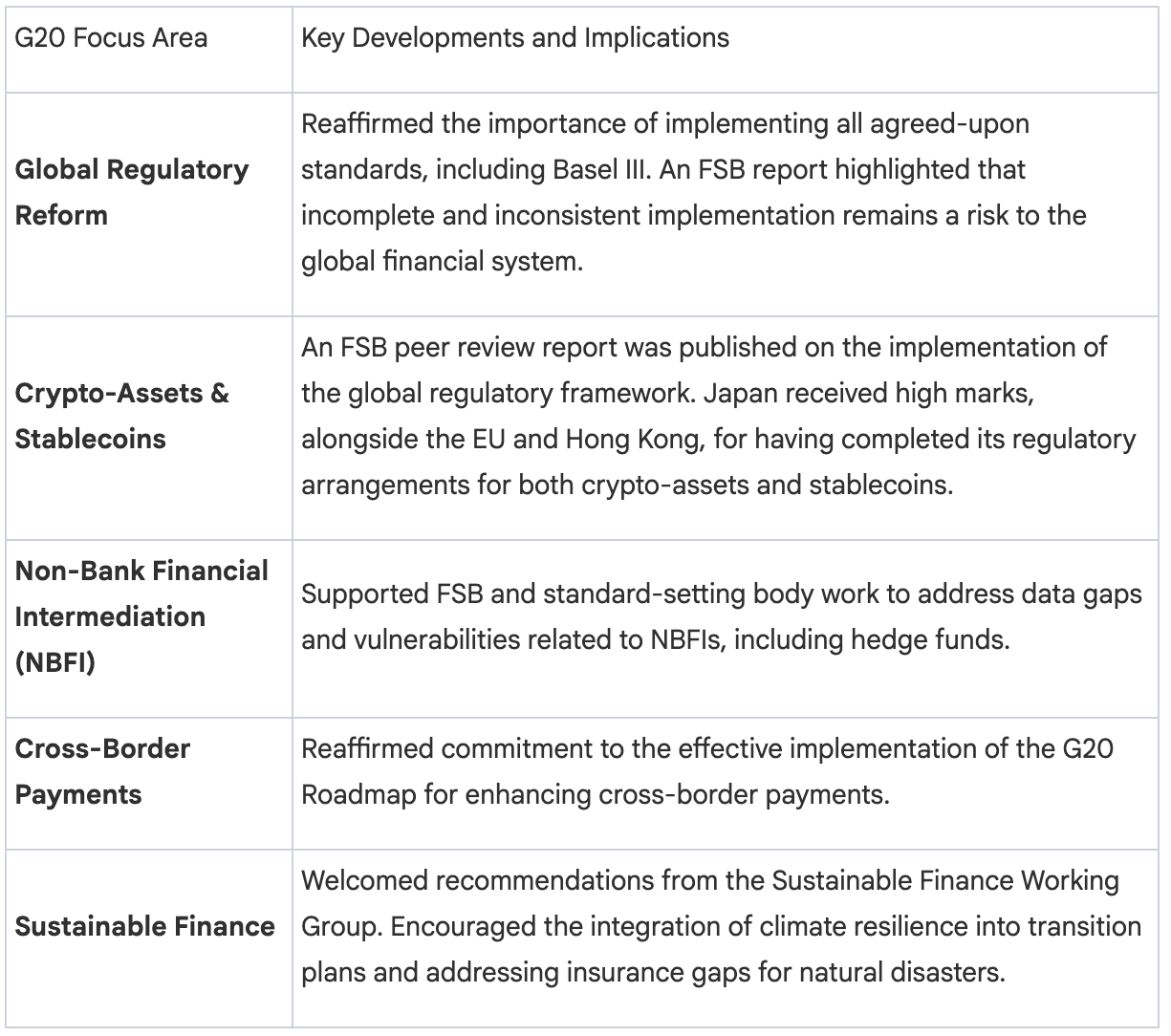
The United States is set to assume the G20 presidency in December 2025. The FSA has affirmed that it will continue to contribute actively to these crucial international discussions.
6. Conclusion: Strategic Takeaways for Financial Executives
This briefing highlights a clear and multifaceted agenda from the Financial Services Agency. For executive leadership, the diverse directives coalesce into several critical strategic takeaways that should guide planning and resource allocation in the coming year.
- The Definition of Operational Resilience Has Expanded. The FSA now defines baseline compliance as an integrated capability encompassing geopolitical awareness, anti-fraud agility, and rapid crisis response. Adherence to international sanctions, the swift implementation of enhanced digital KYC, and effective disaster support are no longer separate issues but a single, holistic expectation of institutional resilience.
- Align Corporate Strategy with the 'Asset Management Nation' Megaproject. This initiative should not be viewed as a standalone opportunity but as the central organizing principle for growth in Japanese finance for the foreseeable future. The agenda's influence over tax policy, product governance, international promotion, and competition makes strategic alignment an imperative for any firm seeking to capitalize on market evolution.
- Prepare for Deeper, Thematic Supervisory Interventions. The FSA's significant restructuring signals a clear move away from siloed supervision toward more specialized, cross-cutting oversight. Executives must prepare for scrutiny that cuts across traditional business lines, focusing on systemic and emerging risks such as AI governance, interest rate exposure across portfolios, and the fundamental viability of sector-specific business models.
- Master the Duality of Digitalization: Innovation vs. Infiltration. The FSA is creating a dual mandate for technology. While actively promoting innovation through forums on AI, it is simultaneously demanding more sophisticated defenses against digital financial crime. This requires a balanced strategic approach that treats technology investment not just as a driver of growth but as an essential component of a robust, modern defense against infiltration.
 Norbert Gehrke