Mission to Tallinn: salv

The third stop of our "ICT & FinTech Mission to Tallinn" last week, courtesy of Enterprise Estonia, led us to salv, where we were hosted by Co-Founder & Chief Executive Officer Taavi Tamkivi, as well as Kadri Pirn, Vice President of the Screening and Monitoring Business Unit.
Here is a comprehensive meeting report based on the presentation by Salv, detailed to cover the company history, product specifics, regulatory discussions, and market-specific interactions with the Japanese delegation.
1. Introduction and Speaker Background
The session began with an introduction by Taavi Tamkivi, identifying himself as a mathematician and data scientist with deep roots in the Estonian tech ecosystem.
- Skype Era: Tamkivi led the anti-fraud data science team at Skype, where he managed analytics for one-third of the world’s international calls, utilizing big data to stop criminal activity.
- Wise (formerly TransferWise): Eight years later, he joined Wise as an early employee, building their compliance, AML (Anti-Money Laundering), and sanctions regimes from scratch. He navigated complex regulatory landscapes in Europe, the US, Australia, and notably, the strict licensing requirements in Japan.
- Salv: Founded seven years ago by Tamkivi and co-founders from Wise and Skype (including the former CTO of Wise, Jeff, and the former COO of Skype), Salv was built to apply these unicorn-level learnings to help other financial institutions.
Kadri Pirn introduced herself as the Business Unit Lead, bringing experience from Skype, Microsoft, Pipedrive, and Twilio, emphasizing a team DNA built on operational excellence and tech scalability.
2. Market Context: The Evolution of Financial Crime
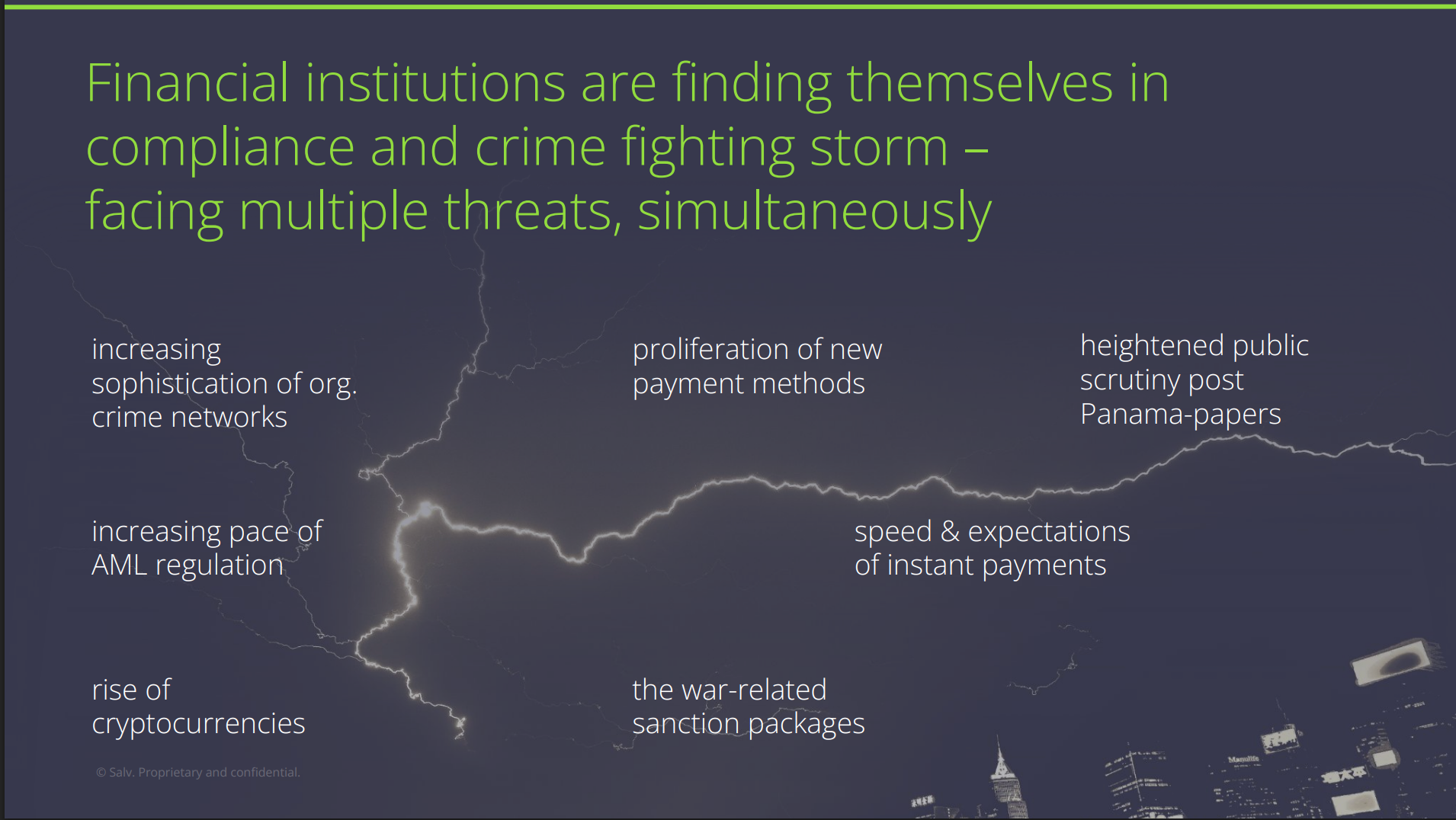
Salv presented a macro view of the financial crime landscape, highlighting why traditional banking methods are failing:
- Volume of Crime: Approximately 2-4% of global GDP is laundered money.
- Shift in Threats: While drug trafficking remains a factor, the landscape has shifted heavily toward investment scams, romance scams, and Authorized Push Payment (APP) fraud. The victims are increasingly everyday citizens rather than just other criminals.
- Speed of Transactions: Modern "Instant Payments" settle in 6–7 seconds. Traditional compliance teams cannot manually review alerts in this timeframe; controls must be automated and real-time.
- The Collaboration Gap: Criminals share information (mule accounts, vulnerabilities) on the dark web efficiently. Financial institutions, however, work in silos, failing to share intelligence due to competition and privacy concerns, effectively giving criminals an advantage.
3. Solution Overview: The Salv Platform
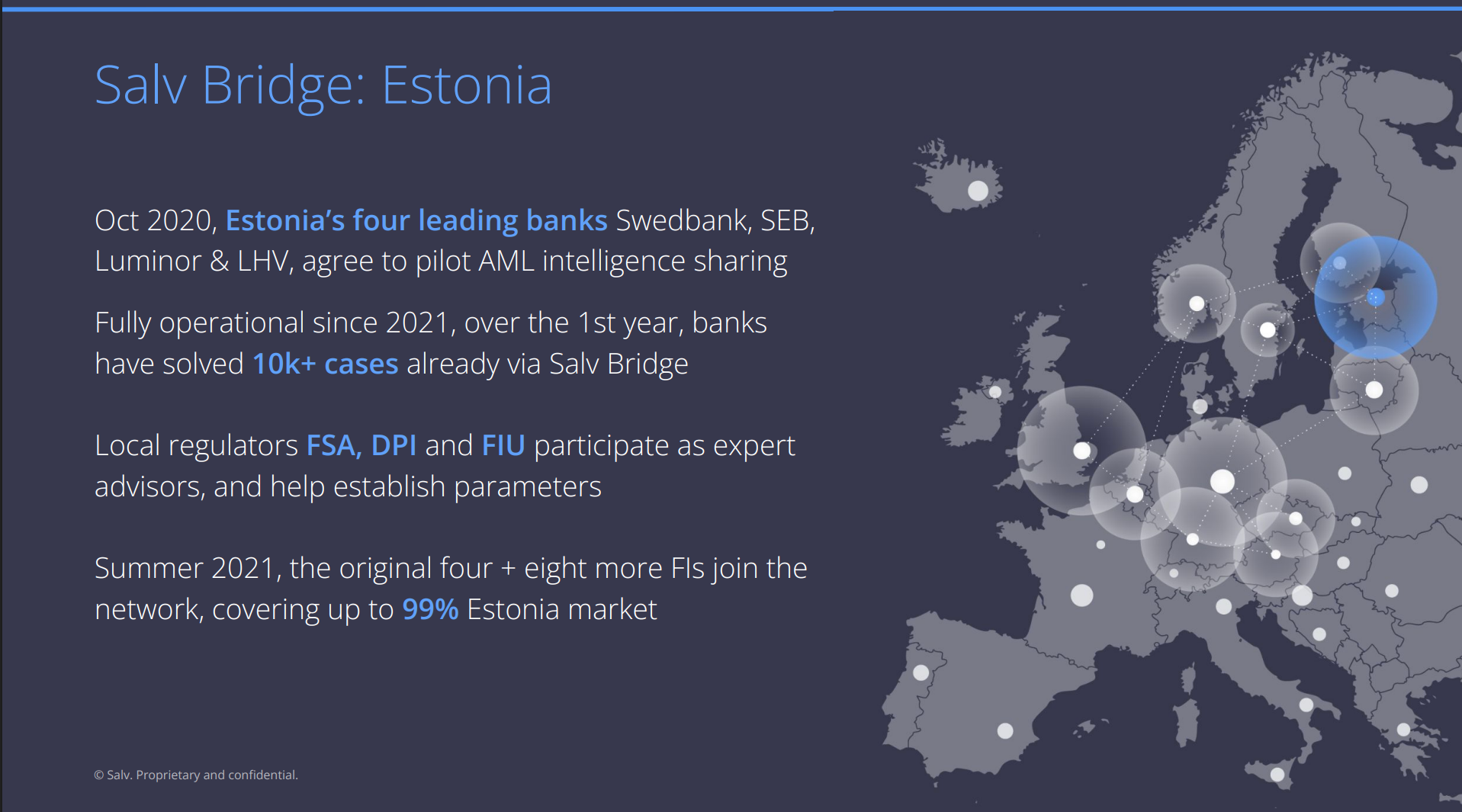
Salv positions itself as a "collaborative crime-fighting platform" rather than just a compliance tool. They currently serve ten European countries, with significant market share in the Baltics (Estonia, Latvia, Lithuania) and a growing presence in the UK, France, and beyond.
The platform consists of three integrated products:
A. AML Bridge (Intelligence Sharing)
- Function: This is Salv’s flagship differentiator. It allows financial institutions to exchange intelligence regarding suspicious accounts and transactions securely.
- Mechanism: Using Privacy Enhancing Technologies (PETs), banks can "ping" the network to see if another bank has flagged a specific customer or IBAN as high-risk (e.g., a money mule) without revealing sensitive data unnecessarily.
- Goal: To break the silos between banks and stop funds from moving from one institution to another illicitly.
B. Transaction Monitoring
- Function: A behavioral analytics engine that monitors customer transactions in real-time.
- Capabilities: It detects patterns indicative of money laundering, terrorist financing, and structured payments designed to evade reporting limits.
C. Screening
- Function: Checks customers against sanctions lists (UN, EU, OFAC) and Politically Exposed Persons (PEP) lists.
- Focus: Designed to reduce false positives while ensuring compliance with increasingly complex global sanctions regimes.
4. Deep Dive: Regulatory Landscape & Data Privacy
A significant portion of the meeting focused on the tension between GDPR (Data Privacy) and AML (Anti-Money Laundering) regulations.
- The European Shift: Historically, data privacy was paramount. However, recent trends in the UK and EU are shifting the priority toward crime prevention. Regulators are increasingly mandating data sharing rather than just permitting it.
- The UK "Reimbursement" Model: Tamkivi highlighted a new UK regulation requiring banks to reimburse 50% of the money lost by victims of scams. This economic penalty changes the incentive structure, forcing banks to invest in better detection and collaboration tools like Salv to protect their own balance sheets.
- Legitimate Interest: Under GDPR, preventing financial crime is considered a "legitimate interest," which legally allows for data sharing provided the technology secures the data appropriately.
- Beneficial Ownership (UBO): The group discussed the difficulty of identifying Ultimate Beneficial Owners. While public registries exist in Europe, they are often inaccurate. Salv argues that banks sharing their own verified KYC data is a more reliable way to identify the true owners of companies.
5. Interactive Discussion: The Japanese Context
The Japanese delegation engaged in a comparative analysis of the European vs. Japanese market.
- Privacy Culture: The delegation noted that Japanese society is highly sensitive to privacy ("My data is private"), and there is significant resistance to sharing personal financial data between institutions.
- Organizational Silos: It was observed that Japanese organizations are culturally "conservative" and tend to hoard data rather than share it. The "trust level" between different Japanese banks is perceived to be lower than the collaborative trust seen in the Nordic/Baltic region.
- The Israel Case Study: An audience member raised a relevant example from Israel, where a similar attempt to build a shared financial crime database failed. Despite having the technology, the banks refused to upload their proprietary data, citing that "information is power."
- Salv's Response: Tamkivi acknowledged this challenge, noting that technology alone cannot solve culture. However, he argued that as scammers globalize and utilize AI, isolated defenses will inevitably fail, forcing even conservative markets to eventually adopt collaboration.
6. Future Outlook and Partnership Opportunities
- Global Expansion: Salv is expanding beyond Europe into Africa (specifically mentions of Nigeria/East Africa) and the Americas (Canada/LatAm), targeting regions where fraud is rampant and digital finance is growing.
- Japan Entry: Salv expressed a strong interest in the Japanese market. They acknowledged that they cannot enter alone and are actively seeking:
- Resellers/System Integrators: Partners who understand the local landscape.
- Forward-thinking Banks/Fintechs: Institutions willing to pilot collaborative technologies.
- AI and Automation: The presenters noted that criminals are using AI to write better scripts and automate attacks. Consequently, banks must deploy AI agents and automated data exchange to keep up with the speed and sophistication of these attacks.
 Norbert Gehrke