Monex Subsidiary Coincheck Wins Japan’s Second EPI License, Clearing Path for Regulated USDC Rollout

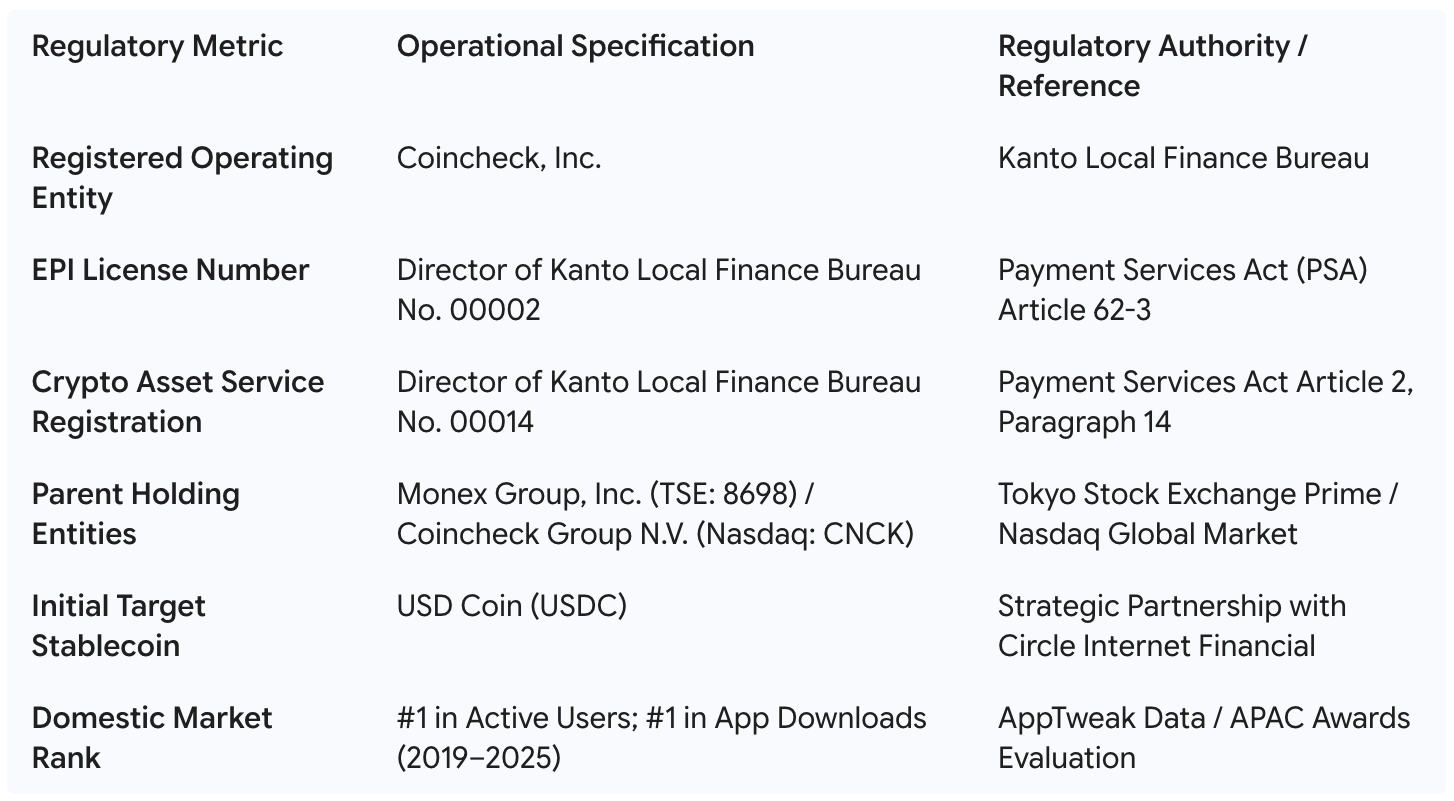
Coincheck, the core digital asset exchange subsidiary of Monex Group and Nasdaq-listed Coincheck Group N.V., has completed registration as an Electronic Payment Instruments (EPI) Service Provider. The regulatory clearance, issued by the Kanto Local Finance Bureau under registration number 00002, formally positions Coincheck as only the second crypto asset exchange in Japan authorized to intermediate and custody fiat-pegged stablecoins under the domestic regulatory perimeter.
The authorization serves as the operational catalyst for Coincheck to initiate full-scale deployment of on-chain finance and stablecoin settlement mechanisms across retail, corporate, and institutional client segments. Crucially, the license operationalizes a cross-border alliance established on February 27, 2024, between Coincheck and Circle Internet Financial. Under that agreement, both entities committed to expanding domestic access to USD Coin (USDC), an initiative that remained contingent upon Coincheck securing formal EPI registration from Japanese financial authorities.
With regulatory approval finalized, Coincheck is positioned to integrate regulated dollar-pegged liquidity into Japan’s digital economy, bridging domestic corporate treasuries and retail traders directly with international public blockchain rails.
Evolution of Japan’s Payment Services Act and the Stablecoin Framework
Japan’s regulatory architecture for stablecoins represents one of the most comprehensive legal frameworks established by a major economy. In June 2022, the National Diet passed landmark amendments to the Payment Services Act (PSA), which took effect on June 1, 2023, formally defining fiat-backed stablecoins as "Electronic Payment Instruments" and segregating them legally from general crypto-assets. Under this regime, the Financial Services Agency (FSA) established an institutional split between token issuance and token distribution.
Issuance is strictly restricted to licensed deposit-taking banks, registered trust companies, and fund transfer service providers. These issuers are mandated to maintain 100% segregated reserves in high-grade liquid assets, guaranteeing redemption at par value on demand. Conversely, intermediaries that broker, sell, exchange, or provide custody for stablecoins without issuing them—such as crypto exchanges—must secure registration as Electronic Payment Instruments Service Providers. These intermediaries are bound by rigorous customer protection mandates, separate management of user assets, comprehensive anti-money laundering controls, and strict compliance with the international Travel Rule for cross-border transactions.
The statutory environment was further modernized through the 2025 PSA Amendment Package, which became fully operational on June 13, 2026. The 2026 implementation expanded the regulatory perimeter to incorporate specialized broker-intermediaries, introduced statutory asset-retention orders allowing the FSA to ring-fence custodial assets during counterparty stress, relaxed reserve rules for trust-type stablecoin structures by permitting up to 50% backing in Japanese Government Bonds maturing within three months, and established standardized compliance gateways for foreign electronic payment instruments such as Circle's USDC.
SBI VC Trade became the first exchange to obtain the EPI intermediary designation on March 4, 2025, opening the pathway for foreign stablecoin distribution in Japan. Coincheck’s registration as the second licensed entity solidifies a competitive, dual-exchange distribution architecture for institutional dollar liquidity in the domestic market.
Corporate Structure and Monex Group’s Institutional Strategy
The licensing achievement represents a structural milestone for Coincheck’s parent conglomerate, Monex Group, listed on the Prime Market of the Tokyo Stock Exchange. Monex acquired Coincheck in April 2018, completely revamping the exchange's internal governance, security infrastructure, and compliance operations. To unlock international capital and elevate the platform's global profile, Monex executed an overseas restructuring that culminated on December 11, 2024, when holding company Coincheck Group N.V. commenced trading on the Nasdaq Global Market under the ticker CNCK following a De-SPAC merger with Thunder Bridge Capital Partners IV. Monex Group retains majority ownership and operational control.
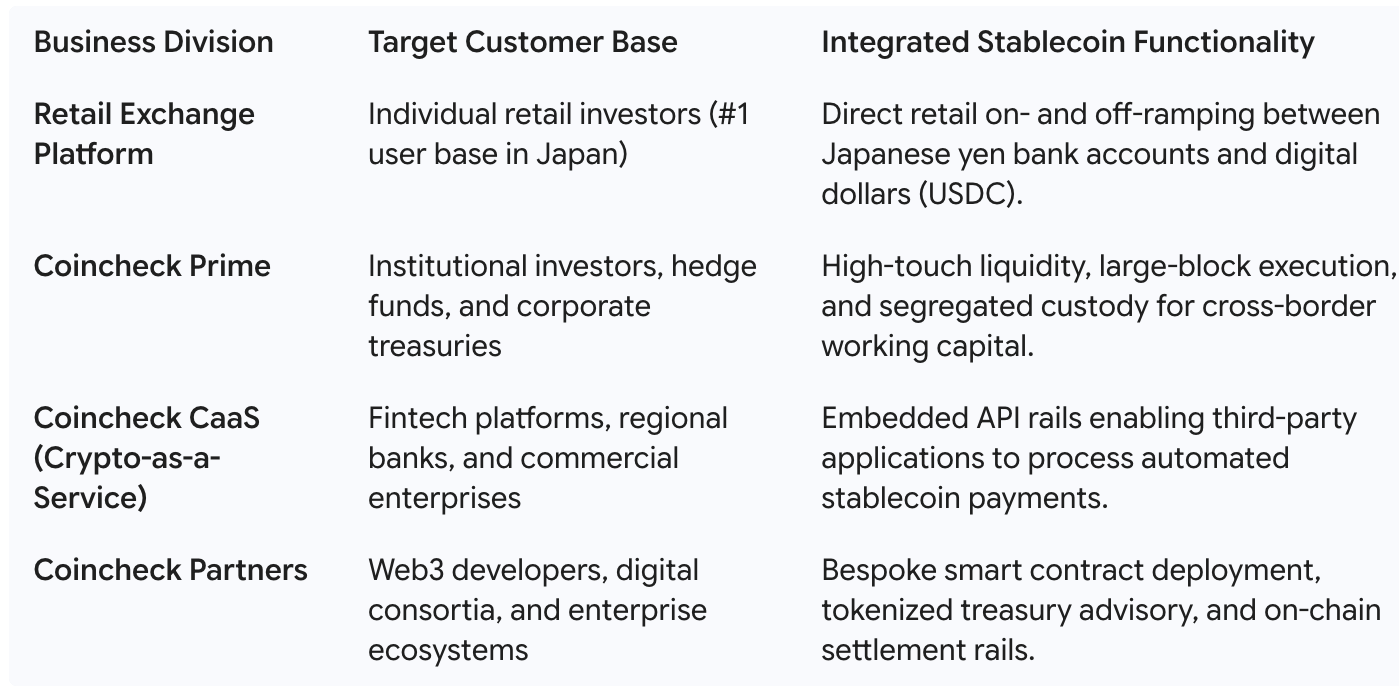
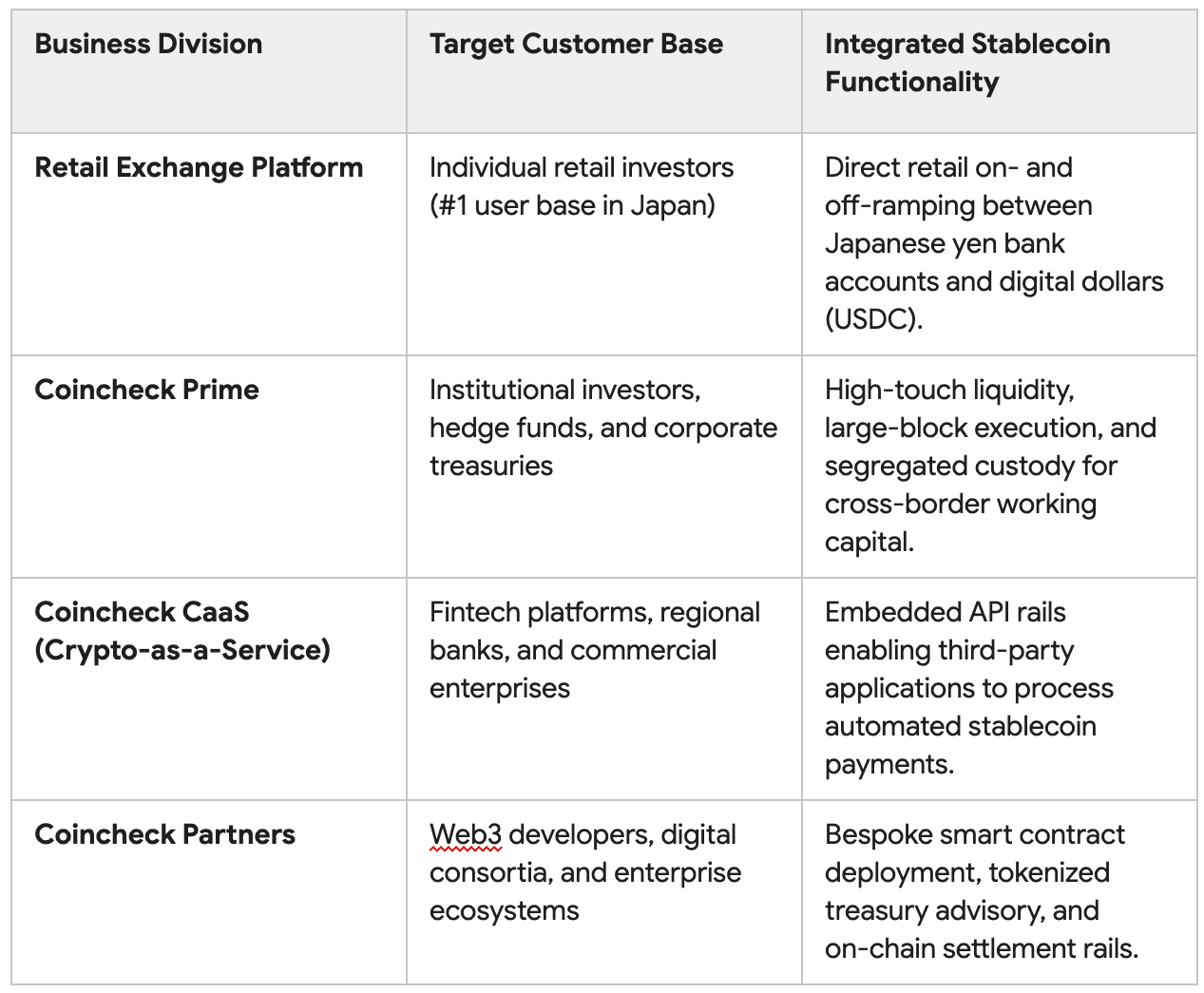
Securing the EPI license allows Monex and Coincheck to diversify revenue away from volatile retail spot-trading commissions toward high-margin, sticky enterprise solutions. Coincheck is embedding stablecoins across its four core operating divisions to capture institutional payment flows, foreign exchange settlement, and Web3 treasury management.
Competitive Landscape and Institutional Settlement Rails
Coincheck’s entry escalates competition within Japan’s digital asset sector while establishing complementary infrastructure alongside emerging traditional banking networks. The domestic market is developing along two distinct rails: crypto exchange-driven distribution of globally standardized, foreign-denominated tokens like USDC, and bank-led consortia engineering wholesale yen-pegged tokens for domestic corporate clearing.
In the private non-bank sector, JPYC Inc. achieved registration as a funds transfer service provider in August 2025, deploying JPYC as a yen-denominated stablecoin for retail payments and commercial fund transfers. In parallel, SBI VC Trade has capitalized on its initial March 2025 EPI license to build institutional trading liquidity in USDC. Coincheck’s formal licensing brings Japan’s largest retail digital asset platform into direct competition with SBI, providing the liquidity depth required to scale corporate adoption.
Simultaneously, traditional financial institutions are establishing wholesale digital currency infrastructure. Japan’s three megabanks—Mitsubishi UFJ Financial Group (MUFG), Sumitomo Mitsui Banking Corporation (SMBC), and Mizuho Bank—have finalized plans to jointly issue a yen-pegged stablecoin by fiscal year 2026, with a dollar-pegged version slated for later deployment. Supported by the FSA's Payment Infrastructure Enhancement Project (PIP) since November 2025 and operating under the commercial initiative known as Project Pax, the megabanks are utilizing the Progmat blockchain platform developed by MUFG and NTT Data.
Progmat provides cross-chain settlement capability across multiple public blockchains, including Ethereum, Polygon, Avalanche, and Cosmos. Project Pax is engineered specifically to modernize intercompany payments and international trade finance across the megabanks’ combined client base of over 300,000 corporate enterprises, targeting ¥1 trillion (approximately $6.5 billion) in annualized B2B stablecoin settlement volume by 2028.
Macroeconomic Analysis and Future Market Implications
The expansion of Japan's licensed EPI framework generates second- and third-order effects across the broader domestic financial architecture and regional cross-border commerce.
First, the integration of compliant USDC distribution channels fundamentally alters cross-border capital management for Japanese multinational corporations. Legacy cross-border trade settlements between Japan and Asian manufacturing counterparties rely on legacy correspondent banking networks, which impose high wire fees, unfavorable foreign exchange conversion spreads, and settlement cycles spanning 24 to 72 hours. By deploying licensed USDC infrastructure through Coincheck Prime and CaaS, corporate treasury desks can execute atomic, programmatic gross settlement 24 hours a day, 365 days a year. This dramatically reduces counterparty credit risk, eliminates trapped intraday liquidity, and reduces FX transaction costs.
Second, the coexistence of exchange-led distribution networks and the megabanks' Progmat consortium fosters institutional convergence rather than structural displacement. While the megabanks dominate large-scale corporate enterprise relationships, crypto-native exchanges possess superior distribution among retail users, fintech developers, and decentralized Web3 protocols. The shared adoption of public blockchain rails allows the banking sector's wholesale deposit tokens to interface with exchange-brokered stablecoins, creating a unified liquidity corridor connecting domestic bank balance sheets directly with global on-chain financial markets.
Finally, Japan’s execution of its stablecoin regime establishes a regulatory and commercial benchmark for global capital markets. By enacting explicit statutory definitions, establishing transparent reserve requirements, mandating strict segregation of intermediary functions, and enforcing Travel Rule compliance, the FSA has successfully integrated digital currencies into the formal financial sector. Coincheck’s licensing as Japan’s second Electronic Payment Instruments Service Provider signals that digital asset platforms can successfully transition into fully regulated payment rails, bridging crypto liquidity with the mainstream macro economy.
 Norbert Gehrke