MoneyX 2026: Orchestrating the On-Chain Revolution in Global Finance

The MoneyX 2026 conference has signaled a definitive shift from blockchain experimentation to a high-velocity era of implementation. As global finance navigates the transition to an on-chain operating system, we identified ten imperatives discussed at MoneyX that define the strategic landscape.
- The Ascension of the AI Agent as Economic Actor: Within a five-year horizon, autonomous agents are projected to handle 99% of on-chain transactions. These entities require high-finality payment rails—stablecoins—capable of executing at machine speed without human intervention.
- The 1,000 Trillion Yen B2B Digitalization Opportunity: Japan’s massive corporate payment market remains a bastion of inefficiency. Transitioning these flows to tokenized deposits (e.g., DCJPY) represents a systemic opportunity to optimize the national Cash Conversion Cycle (CCC).
- The Institutional Migration of Tokenized MMFs: Money Market Funds are evolving through a three-phase roadmap. Having transitioned from stablecoin repositories to DeFi collateral, they are now poised to integrate into traditional repo and lending markets, bridging the liquidity gap between TradFi and digital ecosystems.
- The Persistence of the "Stablecoin Sandwich" Model: Global cross-border trade is currently anchored by a model where fiat is converted to stablecoins, e.g. USDC, for international transit before settling back into local currency. This reinforces USD dominance while providing the immediate liquidity and trust required for institutional-grade FX.
- Architecting Sovereignty via "Known Validators": To resolve the friction between stateless software and state-led monetary oversight, networks like Circle’s Arc Layer-1 are employing "Known Validators." This permissioned architecture offers the institutional comfort necessary for sovereign regulatory compliance.
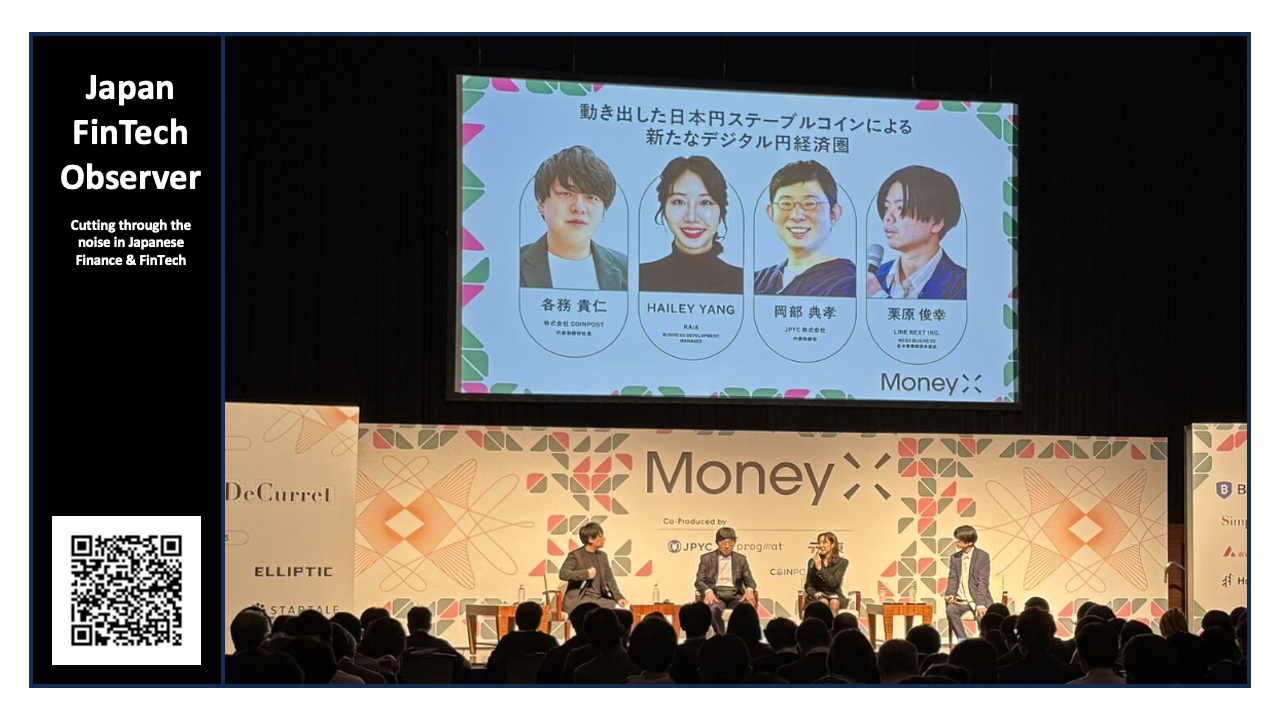
- Implementation through Messaging Hegemons: Mass retail adoption is being realized by embedding Web3 infrastructure into platforms like LINE. By deploying the "Unify" wallet to 90 million users, digital assets are moving from speculative niches to daily utility.
- Programmable Money as an Operational Necessity: Automation via programmable deposits is no longer an elective efficiency but a solution to the "Business Succession" crisis. By automating back-office invoicing and accounting, firms can maintain operational resilience despite a shrinking administrative workforce.
- The Proliferation of Gasless Retail Environments: To mirror the frictionless experience of Web2, providers like HashPort are absorbing network fees. This "gasless" model removes the final technical barrier for retail users, making on-chain transactions indistinguishable from traditional cashless payments.
- Vertical Integration of Asset Management Tech: Leading institutions like Franklin Templeton are internalizing their entire tech stack. By managing record-keeping in-house on public chains, they achieve second-by-second interest distribution and a cost-efficiency profile that third-party platforms cannot match.
- Jurisdictional Clarity as a Competitive Advantage: Japan’s proactive regulatory frameworks for stablecoins and security tokens have established a "first-mover" advantage. This jurisdictional clarity facilitates the tokenization of "S-Class" real estate and institutionalized digital yen issuance ahead of Western counterparts.
The Cross-Border Paradigm: USD Dominance vs. the Multi-Currency Vision
The global stablecoin landscape is currently defined by a profound paradox: while blockchain technology is inherently borderless, its market capitalization remains a digital mirror of the traditional financial world. Of the roughly $300 billion in circulating stablecoins, 99% are pegged to the U.S. dollar. This concentration reflects the entrenched institutional demand for USD liquidity and the market's reliance on the dollar for nearly 90% of international trade settlements. However, as global markets seek to mitigate exchange rate volatility and dependency, a strategic tension has emerged between the current USD-centric reality and an emerging multi-currency vision.
The debate over this future centers on two distinct philosophies. Circle Internet Group is positioning itself as a "full-stack internet financial system," utilizing its newly announced Arc Layer-1 blockchain to support a multi-currency FX platform. Crucially, Arc utilizes "known validators"—identifiable, regulated entities—to solve the trust deficit that has previously hindered institutional adoption of "stateless" public chains. In contrast, Binance maintains a focus on "Consumer Sentiment," arguing that digital markets currently track traditional finance because that is where liquidity depth and reserve quality reside. For a multi-currency ecosystem to be viable for institutional repo markets rather than just retail convenience, it must establish a level of secondary-market trust that currently only the USD-pegged tokens enjoy.
This evolution is gradually moving from the "Stablecoin Sandwich" model—where stablecoins serves as a temporary transit rail between two fiat points—toward direct local-stablecoin payouts. While the USD leads today, the focus is shifting to regional innovation, where established regulatory arbitrage is paving the way for the Digital Yen to challenge the status quo.
The Digital Yen Economy: Implementation via Messaging Giants
Japan has utilized its first-mover advantage to establish jurisdictional clarity under the Revised Payment Services Act, clearing the path for the "Social Implementation" of digital assets. Unlike Western markets where crypto remains largely speculative, Japan is integrating stablecoins into the daily retail fabric through messaging platforms with massive existing user bases.
The partnership between LINE NEXT and JPYC Inc. represents a significant milestone in this trajectory. The launch of the "Unify" wallet within the LINE ecosystem allows JPYC to function as a primary reward and payment token. By integrating with the "Kaia" Layer-1—a bridge connecting Japan’s LINE with South Korea’s KakaoTalk—a unified Asian digital asset corridor is being formed. This infrastructure enables autonomous "AI Agents" to handle complex commerce; for example, a user's bot could negotiate a hotel rate in Seoul (maneuvering a price down from ¥56,000 to ¥50,000) and execute a seamless JPYC-to-Won swap to settle the transaction instantly.
Moving from "Proof of Concept" to implementation for 90 million users fundamentally shifts the retail calculus. By integrating with established point economies like Ponta and au PAY, the entry barrier is lowered to the point of invisibility. However, while retail messaging giants provide the critical "on-ramp" for the masses, the true economic weight of the on-chain revolution lies in the ¥1,000 trillion B2B sector, where programmable deposits are poised to replace aging back-office infrastructure.
B2B On-Chain Models: Programmable Money and the 1,000 Trillion Yen Market
The digitization of Japan’s corporate flows is a strategic imperative driven by a dual crisis: an aging administrative workforce and a critical labor shortage. In this ¥1,000 trillion market, the most acute pain point is not sales or production, but internal operations—the manual processing of invoices, receipts, and journal entries. As elderly staff retire, the "Business Succession" crisis threatens the continuity of SMEs whose back-office operations remain paper-based.
To address this, the DCJPY network, led by DeCurret DCP, has pioneered a tokenized deposit model that distinguishes itself from traditional stablecoins. While JPYC operates under the Payment Services Act, DCJPY functions under the Banking Act, allowing it to maintain full compatibility with existing AML/CFT and SWIFT standards. The network utilizes a dual-zone architecture: a "Business Zone" for tokenizing invoices and contracts, and a "Financial Zone" where banks handle on-chain settlement. This "Real-Time ERP" vision integrates accounting software (such as MJS) with programmable money, automating the supply chain from initial order to final accounting entry and significantly optimizing the Cash Conversion Cycle.
The roles of GMO Aozora Net Bank and Japan Post Bank as "First Penguins" have been instrumental in de-risking this technology for the broader sector. By automating internal operations, these institutions are providing regional SMEs with a survival mechanism that bridges the gap to a digital-first economy. As corporate back-offices become more efficient, the focus naturally shifts to the front-end retail payment infrastructure.
The Retail Frontier: Bridging Web3 Holdings to Visa & QR Networks
Despite the technological advancements, retail stablecoin adoption in Japan currently hovers around 15%, highlighting a significant incentive gap between merchants and users. To bridge this, the winning strategy has shifted toward interoperability with existing "Web2 rails"—utilizing the Visa and QR networks that merchants already understand to facilitate the spending of Web3 assets.
Contemporary solutions like the Slash Card (a partnership with Visa and Orico) exemplify this "Credit Portability" concept. Users charge the card with USDC, but merchants receive Yen through the standard Visa network, effectively allowing global spending of digital assets without merchant-side friction. Similarly, NETSTARS’ implementation at Haneda Airport allows MetaMask users to generate QR codes compatible with standard Japanese readers, enabling international tourists to pay in USDC at physical airport tenants. Furthermore, HashPort’s "Expo 2025 Digital Wallet" has evolved to support a "gasless" model, where the provider bears the network fees, creating a zero-fee environment that mirrors the ease of Alipay or WeChat Pay.
The "So What?" for the retail sector remains a debate over monetary sovereignty. While USD-denominated payments offer utility for foreign tourists, domestic players argue that a country’s economy risks attrition if it defaults to USD-denominated stablecoins for AI-driven payments. Ensuring the Digital Yen circulates effectively on these new rails is a matter of national economic interest as these retail assets are increasingly institutionalized.
Global On-Chain Finance: The Institutional "Wake-Up Call"
The convergence of DeFi and TradFi has reached an inflection point, particularly as Real-World Assets (RWA) and Money Market Funds (MMFs) move on-chain. This institutional awakening is characterized by two dominant approaches to liquidity and technology.
BlackRock’s "BUIDL" (Biddle) roadmap represents a phased integration: moving from MMFs as stablecoin repositories to their use as DeFi collateral, and finally to full integration within traditional repo markets. Conversely, Franklin Templeton’s "Benji" model offers a blueprint for "internalized" tech stacks. By maintaining their own engineers and record-keeping on public chains, they achieve second-by-second interest distribution and a level of transparency that provides a major competitive advantage in cost-efficiency. Meanwhile, Japan leads in the Security Token (ST) market, tokenizing "S-Class" real estate—such as the ¥50 billion Dojimahama development—to deliver high-value private assets to retail investors.
The "US-Japan Gap" is rapidly closing: Japan provides the regulatory blueprint, while the U.S. provides the requisite MMF liquidity. In a five-year horizon, where AI agents manage nearly 99% of these high-value transactions, the "Connected Money Paradigm" will be the standard. Trust is being re-engineered from a legal construct into the very infrastructure of global finance, making the on-chain shift not only inevitable but commercially superior.
 Norbert Gehrke