MoneyX: Circle and Binance Debate the Path to a Multi-Currency Crypto Market

While the global stablecoin market has swelled to $300 billion following the U.S. enactment of the "Genius Act" in 2025, the sector remains overwhelmingly tethered to the Greenback. Speaking at the MoneyX/WebX conference, executives from Circle Internet Group and Binance debated the path toward a truly multi-currency digital financial system, even as U.S. dollar-denominated assets continue to command 99% of the market.
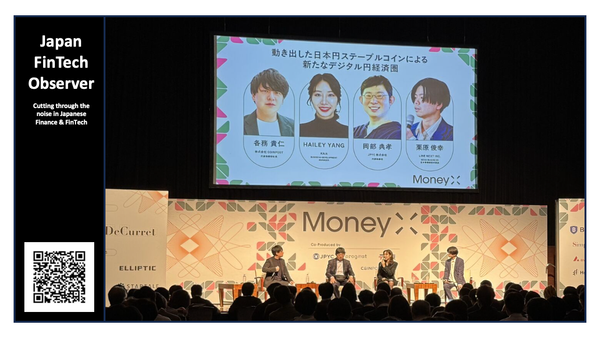
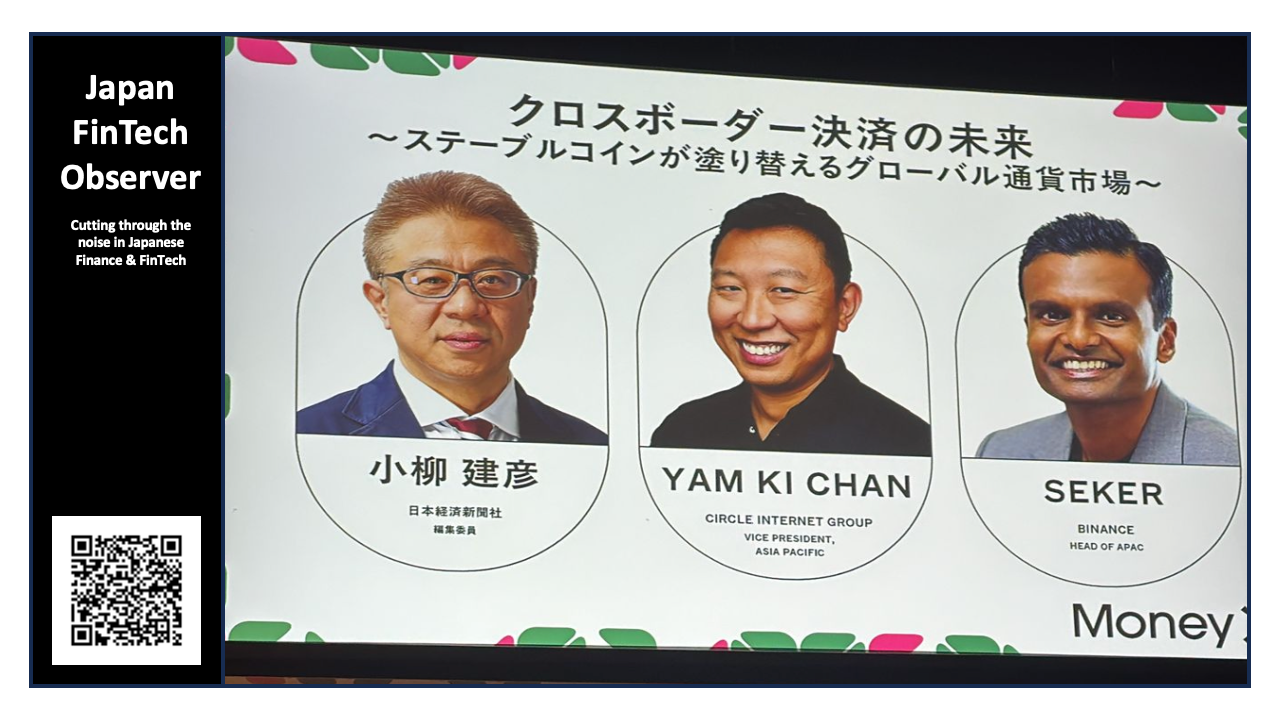
In a panel titled "The Future of Cross-Border Payments," moderated by Nikkei’s Takehiko Koyanagi, the industry leaders outlined divergent yet complementary strategies to bridge the gap between crypto-native trading and real-world utility.
The Dollar Dilemma and the Multi-Currency Ambition
Despite a 50% year-over-year surge in market capitalization, the sector faces a utility crisis. According to data presented during the session, "real" transactions—actual payments rather than speculation—account for a mere 0.02% of gross stablecoin volume. The remainder serves as liquidity for crypto trading, a landscape dominated by the U.S. dollar.
Yam Ki Chan, Vice President for Asia Pacific at Circle, acknowledged the disparity. "Today's market is over 90% dollar-denominated," Chan noted, citing traditional trade invoicing in Asia as a parallel driver. However, Circle is aggressively pivoting toward infrastructure that supports diversification. Beyond its flagship USDC, the company is bolstering its Euro-coin (EURC) and has launched "Arc," a Layer-1 blockchain designed to facilitate compliant, multi-currency transactions.
"We believe in a multi-currency stablecoin world," Chan said, highlighting regulatory strides in Japan, Hong Kong, and South Korea as catalysts for local-currency issuance.
Liquidity and Consumer Sentiment
Representing the exchange side, Seker, Head of Asia Pacific at Binance, offered a pragmatic view rooted in liquidity. Binance, which holds approximately 40% of global stablecoin reserves, structures its treasury based on consumer sentiment, which currently mirrors traditional finance's preference for the dollar.
"There is no divergence between what happens in the traditional finance world and the digital finance world," Seker argued. While Binance supports multi-currency markets, Seker warned against fracturing liquidity. He emphasized that for smaller economies, a local stablecoin might not be viable without a massive domestic ecosystem. Instead, he advocated for tighter spreads and better on-ramps to existing liquid assets.
The Compliance Pivot: "Known Validators"
A central tension of the session was the conflict between blockchain’s permissionless ethos and the tightening grip of global anti-money laundering (AML) regulations.
Circle signaled a move toward "permissioned" architectures to appease financial regulators. Chan described the company’s new Arc blockchain as utilizing a "known set of validators," a departure from anonymous decentralized networks. "Institutions find greater comfort in knowing who the validators are," Chan explained.
Binance defended the centralized exchange model as the ultimate firewall for compliance. Seker pushed back against the notion that blockchain is incompatible with Know Your Customer (KYC) norms, stating that centralized platforms offer a safety net that self-hosted wallets cannot. "One in three transactions globally passes through a Binance wallet," Seker noted, positioning the exchange as a critical partner for law enforcement rather than an adversary.
Outlook
Both speakers concluded that a multi-currency system is inevitable, driven by institutional adoption and clearer regulatory guardrails like Japan’s Revised Payment Services Act. However, the transition from a USD-monopoly to a basket of G7 digital currencies will likely be a gradual evolution, contingent on deep liquidity and regulatory reciprocity.
 Norbert Gehrke