MUFG Enters Talks with BlackRock and Morgan Stanley to Establish Open Private Credit Platform in Japan

Mitsubishi UFJ Financial Group (MUFG), Japan’s largest banking institution by assets, has initiated separate discussions with BlackRock and Morgan Stanley Investment Management (MSIM) to construct an open-platform private credit framework tailored to the Japanese market. The simultaneous announcements outline an initiative to establish syndicated institutional conduits linking corporate loan demand across Japan with domestic and cross-border private capital.
Rather than restricting private loan originations to bilateral balance-sheet exposures, the proposed architecture is designed as an open distribution system. Through this mechanism, external institutions—including domestic regional banks, life insurance companies, and pension funds—can participate alongside global asset managers in evaluation, origination, and co-investment activities. The move aligns MUFG's corporate relationships with global alternative debt managers at a time when corporate restructuring and private equity dealmaking in Japan are accelerating.
Parameters of the Dual Partnerships
The discussions pursue parallel, non-exclusive frameworks intended to evaluate, source, and underwrite corporate debt facilities across Japan. By formalizing ties with both the world’s largest asset manager and its primary Wall Street partner, MUFG is engineering a multi-channel structure to address diverse corporate financing requirements.
The BlackRock and HPS Deployment Framework
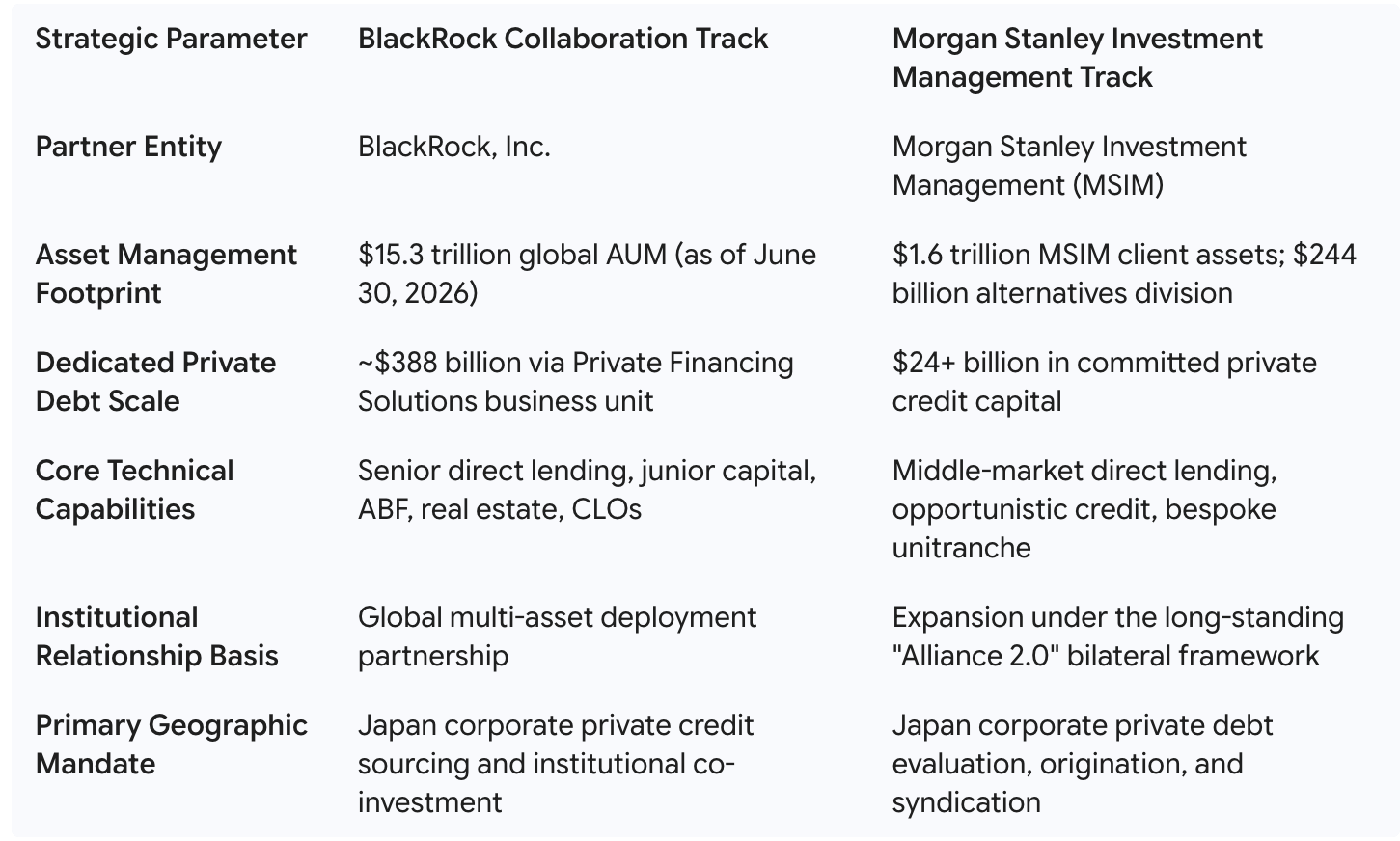
MUFG’s discussions with BlackRock draw upon the expanded private credit infrastructure established through BlackRock’s 2025 acquisition of HPS Investment Partners in an all-stock transaction valued at approximately $12 billion. Following the completion of that acquisition, BlackRock combined its alternative lending activities with HPS into a consolidated private financing solutions business unit holding approximately $388 billion in client assets.
Operating as a consolidated subsidiary within BlackRock's $15.3 trillion platform, the unit maintains specialized capabilities spanning senior and junior capital solutions, asset-based finance, corporate real estate debt, collateralized loan obligations (CLOs), and general partner-limited partner solutions. Through an open-platform model, BlackRock secures direct origination pipelines into Japanese enterprises facilitated by MUFG’s corporate client base, while MUFG gains access to alternative structuring techniques and global institutional syndication channels.
Deepening MSIM Ties Under Alliance 2.0
The parallel discussions with Morgan Stanley Investment Management deepen an equity and strategic relationship that originated during the 2008 financial crisis. MUFG holds an equity stake of approximately 23.6% in Morgan Stanley, and the institutions operate domestic securities ventures in Japan, including Mitsubishi UFJ Morgan Stanley Securities. In July 2023, the groups broadened their cooperative scope by launching "Alliance 2.0," an expanded framework targeting global investment banking, currency execution, and asset management.
MSIM’s private credit platform brings an operational track record of more than 15 years in alternative debt solutions, commanding over $24 billion in committed capital across direct lending and opportunistic credit strategies. By integrating MSIM’s debt-structuring experience with MUFG’s corporate lending teams, the collaboration aims to provide Japanese borrowers with flexible unitranche, subordinated, and transitional facilities that lie outside the standard underwriting tolerances of Japanese commercial banks.
Structural Drivers in Japan's Private Debt Market
The push toward an open-platform investment model reflects a transformation in Japanese corporate finance. Globally, the private debt market has expanded to between $1.5 trillion and $2.0 trillion—with projections reaching $5 trillion by 2029—displacing traditional syndicated bank lending in roughly 80% of leveraged buyout financings. In contrast, Japan's domestic corporate borrowing market has remained anchored to commercial bank balance sheets offering compressed lending spreads.
This historical dynamic is shifting under the influence of capital market reforms initiated by the Tokyo Stock Exchange. Regulatory pressure on publicly listed companies to eliminate persistent price-to-book discounts and improve return on equity has generated an increase in corporate carve-outs, management buyouts, and take-private transactions. In 2025, private equity carve-out transactions in Japan rose to $4.1 billion, driven by conglomerates divesting non-core subsidiaries. These sponsor-backed corporate restructurings frequently demand leverage multiples, flexible payment-in-kind features, and accelerated closing timelines that traditional bank syndicates cannot provide due to conservative credit screening protocols. Private credit fulfills this operational gap by offering certainty of capital execution without demanding liquid public credit ratings.
Simultaneously, domestic institutional allocators are reevaluating their balance-sheet allocations. Japanese life insurers, pension trustees, and regional financial institutions have faced prolonged margin compression from domestic sovereign yields. Although the Bank of Japan has initiated policy rate normalization, spreads on plain-vanilla corporate loans remain narrow. Consequently, institutional allocators are actively seeking floating-rate private credit assets to secure illiquidity premiums and maintain duration protection.
Stricter capital standards under Basel III and Basel IV have elevated risk-weighted asset (RWA) charges for commercial banks that retain unrated or leveraged loans on balance sheet. By structuring an open platform, MUFG can originate transactions, collect debt arrangement and syndication fees, and place underlying loan exposures with dedicated investment vehicles managed alongside BlackRock and MSIM, reducing balance-sheet capital absorption.
Mechanics of the Open-Platform Architecture
The open-platform model departs from bilateral proprietary lending and closed-loop fund administration. Under traditional Japanese corporate finance, an enterprise negotiates directly with a lead relationship bank, which either absorbs the loan or syndicates pro-rata slices among regional institutions.
In the emerging open-platform model, corporate borrowers requiring capital for buyouts, corporate succession, or cross-border acquisitions are originated through MUFG's domestic branch and corporate banking network. These financing requirements are screened collaboratively with BlackRock and MSIM investment committees to determine the optimal capital structure, including senior first-lien debt, unitranche facilities, or subordinated junior capital.
Once structured, debt facilities are placed across diversified institutional channels rather than held statically on a single balance sheet. Domestic institutional allocators—including Japanese lifers and regional lenders—gain fractional access to structured domestic credit opportunities managed with global underwriting standards. Concurrently, global institutional capital aggregated by BlackRock and Morgan Stanley is funneled directly into Japanese corporate credit, providing multi-currency syndication depth and cross-border placement capability.
Market Positioning and Strategic Implications
MUFG’s dual agreements reflect a proactive institutional strategy in response to international asset managers expanding their on-the-ground presence in Tokyo. International alternative asset firms have been establishing dedicated Japanese credit teams to target mid-market corporate borrowers directly. KKR recruited specialized credit leadership from Goldman Sachs in 2025, while asset managers such as Fiera Capital and Fortress Investment Group have built out Tokyo operations to deploy alternative credit strategies into local transactions.
Rather than attempting to compete directly with global alternative asset managers across specialized underwriting niches, MUFG is leveraging its domestic relationship network to position itself as the core origination and structuring gateway for Japan. By providing BlackRock and MSIM with access to Japanese corporate borrowers, MUFG captures upfront structuring and syndication fees while insulating its balance sheet from excessive credit concentration.
The strategy addresses the key operational hurdle confronting offshore credit funds in Japan: access to transaction flow. While international managers possess sophisticated underwriting platforms and deep institutional pools, direct mid-market origination in Japan remains relationship-driven. MUFG's corporate lending footprint provides deal sourcing that would otherwise require decades for foreign entrants to replicate.
Outlook for Japan's Institutional Lending Landscape
The preliminary discussions between MUFG, BlackRock, and Morgan Stanley Investment Management highlight a modernization of Japanese corporate debt intermediation. As discussions advance toward operational joint ventures or co-investment fund structures, the open platform has the potential to alter corporate debt distribution throughout the domestic financial sector.
The entry of an open-architecture model provides Japanese corporate borrowers with alternatives to traditional covenant-heavy commercial bank borrowing. If fully realized, this framework will allow private equity sponsors and mid-market enterprises to finance corporate acquisitions, spin-offs, and expansions through custom-tailored credit facilities distributed seamlessly across domestic and international institutions. By organizing this capital aggregation, MUFG is actively positioning itself at the intersection of Japanese banking relationships and global alternative credit distribution.
 Norbert Gehrke