OKI and Hitachi to Integrate ATM Businesses

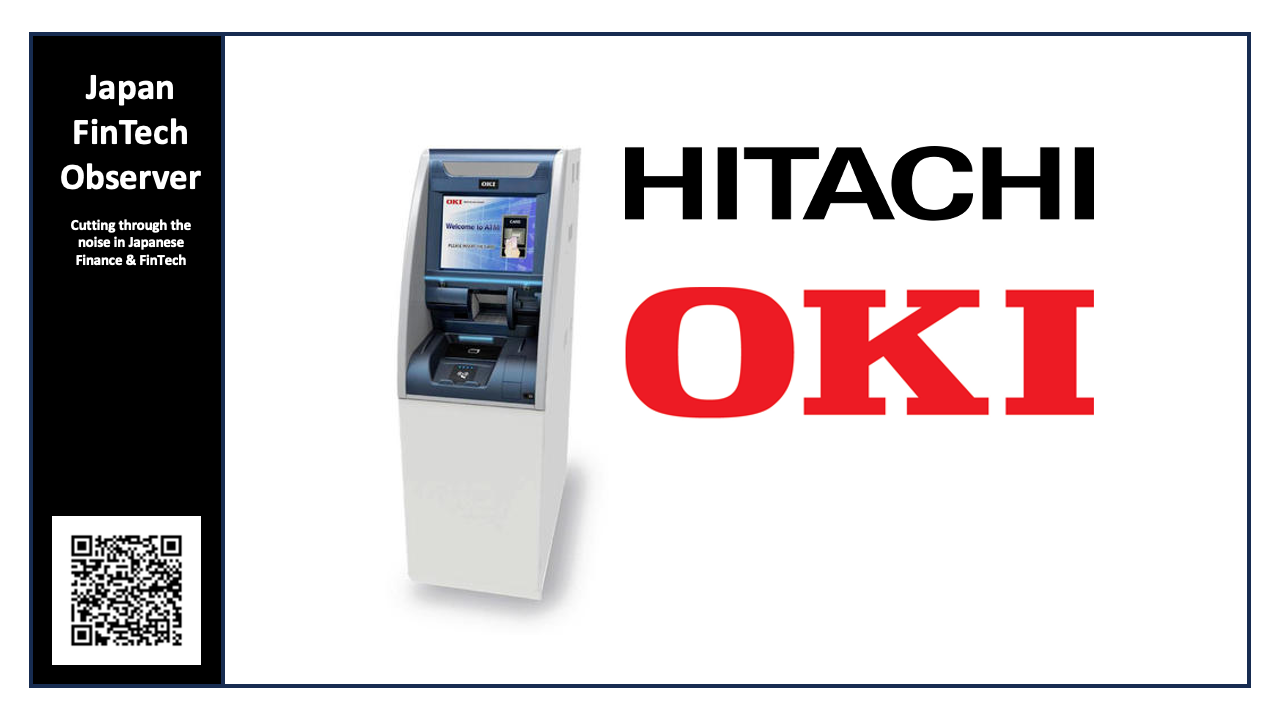
In a move to consolidate their footprint in the financial hardware market, Oki Electric Industry (OKI) and Hitachi have entered a definitive agreement to integrate their automated teller machine (ATM) and automated equipment businesses.
The deal, structured as a joint venture, aims to combat the headwinds of a global shift toward cashless payments while leveraging new opportunities in digital banking infrastructure.
Deal Structure and Ownership
Under the terms of the "Integration Agreement," OKI will transfer its development and production arms for automated equipment to Hitachi Channel Solutions (HCS), a wholly owned subsidiary of Hitachi. Following an absorption-type split, OKI will acquire a controlling interest in the entity. The resulting joint venture will be owned 60% by OKI and 40% by Hitachi.
While the backend manufacturing and development will be unified, the companies confirmed that their respective sales subsidiaries will continue to operate independently for the time being, maintaining existing client relationships.
Strategic Rationale: Beyond Cash
The partnership comes at a critical juncture for the embattled ATM industry. As traditional cash usage declines in favor of QR code payments and contactless transactions, the role of the ATM is being redefined. The new venture plans to pivot toward "advanced ATM functionality," including the integration of public utility billing and cardless transaction support.
The collaboration seeks to marry OKI’s integrated value chain—which recently saw a doubling of production capacity at its Vietnam facility—with Hitachi’s "Lumada" data suite. By applying AI-driven analysis to the data generated at the machine level, the companies hope to offer financial institutions deeper insights into customer behavior and operational efficiency.
Global Expansion and Timeline
The joint venture will not limit its focus to the Japanese domestic market. Executives highlighted aggressive growth plans for the ASEAN region, India, North America, and the MEA (Middle East and Africa) markets. By pooling resources, the companies aim to create a "world-class product" capable of competing in high-growth regions where banking automation is still expanding.
The integration is subject to standard regulatory hurdles, including approval from the Japan Fair Trade Commission. If cleared, the joint venture is scheduled to begin operations on October 1, 2026.
Market Impact
Analysts view this as a necessary consolidation in a maturing industry. For Hitachi, the move streamlines its hardware portfolio while keeping its digital services (DX) integrated into the banking sector. For OKI, taking the majority stake signals a commitment to remaining a dominant player in the hardware space while gaining access to Hitachi’s advanced software ecosystem.
As of the last fiscal year, Hitachi’s relevant sectors generated over 9 trillion yen in revenue, and this merger represents a significant step in the companies' broader "Social Innovation" strategies.
 Norbert Gehrke