SBI Institutional Blockchain and Digital Asset Developments in Japan and Southeast Asia


SBI Group entities and other major financial and corporate institutions have entered into various strategic partnerships and announced several technological advancements during November so far.
Key initiatives include the Norinchukin Bank Group entering the digital securities business through a collaboration utilizing the Progmat platform to issue real estate security tokens, and SBI Global Asset Management expanding the global distribution of its tokenized Japanese equity fund to Hong Kong's HashKey Exchange.
Additionally, SBI Traceability implemented its SHIMENAWA inventory management system using RFID and blockchain technology for the luxury Chinese restaurant Zazenka to track high-end wine inventories.
Other notable developments feature SBI Holdings signing agreements with the National Bank of Cambodia to conduct proof-of-concept tests for tokenized national bonds and cross-border stablecoin settlements, alongside Bitbank partnering with the Nyx Foundation to enhance the safety of AI agent-driven cryptocurrency trading.
1. Norinchukin Group’s Entry into Real Estate Security Tokens via Progmat
The entry of Norinchukin Bank—traditionally one of Japan’s most conservative financial institutions with deep roots in agricultural co-operative lending—into the Security Token (ST) market marks a significant development for the domestic digital securities sector. Japanese financial giants are systematically transitioning real-world asset (RWA) management to standardized on-chain balance-sheet infrastructure. Norinchukin’s entry through its trust banking arm demonstrates that asset tokenization in Japan is becoming the infrastructure of choice for primary institutional capital deployment.
Nochu Trust Bank (a 100% subsidiary of Norinchukin Bank) formally entered into a strategic alliance with Kenedix (KDX), KDX ST Partners (KST), SBI Securities, and Progmat. This multi-party consortium was assembled to structure, issue, and manage Norinchukin Group’s inaugural real estate Security Token transaction.
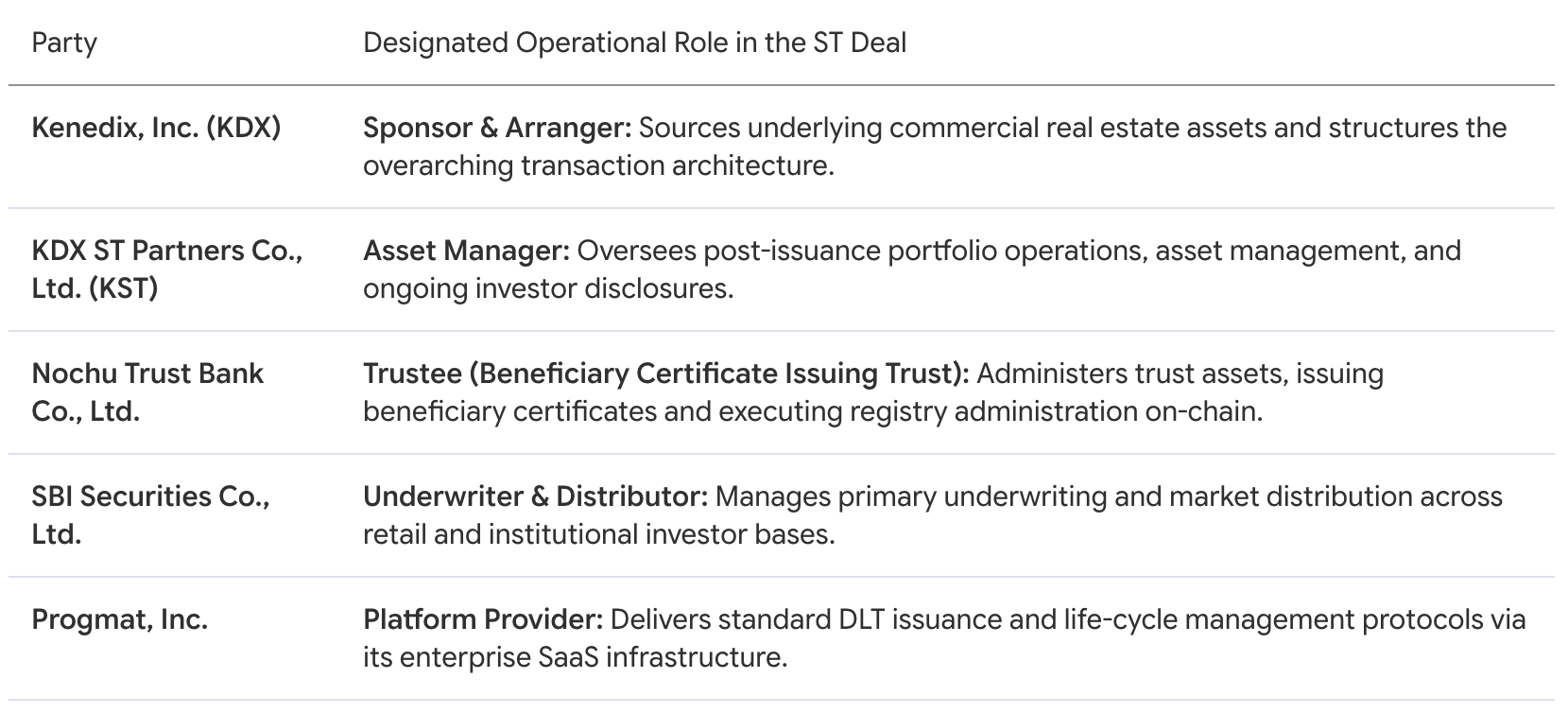
The transaction's operational execution is anchored by "Progmat SaaS," an enterprise infrastructure architecture that separates functions between an Asset Node (utilized by Nochu Trust Bank for trust asset administration and beneficiary register management) and a Custodian Node (utilized by SBI Securities and secondary distributors for customer account management and underwriting).
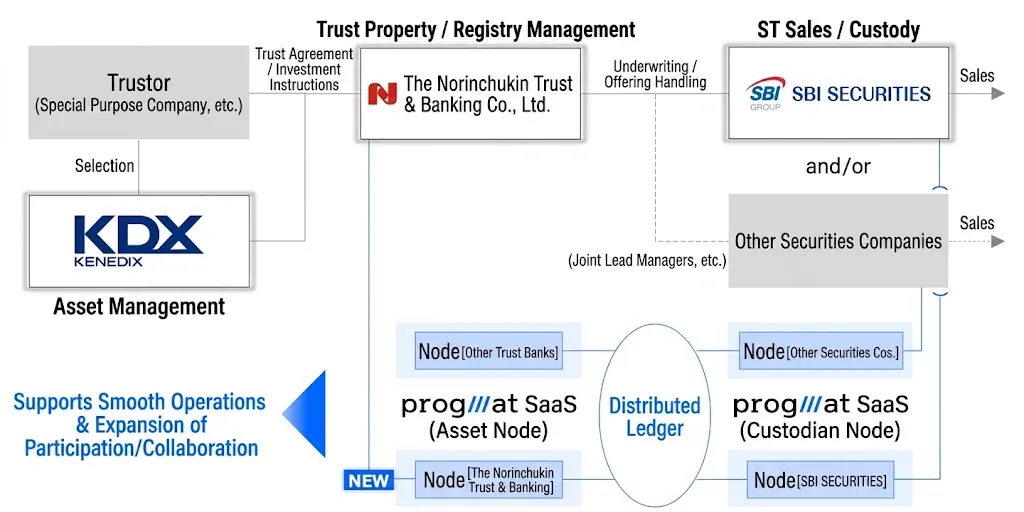
By operating Progmat SaaS over distributed ledger infrastructure (utilizing Avalanche and interconnected node environments), Nochu Trust Bank executes legal beneficiary registry management directly on a DLT without exposing itself to raw cryptographic key custody risks or requiring the costly internal buildout of proprietary blockchain node clusters. Furthermore, this modular SaaS framework provides immediate interoperability, allowing Nochu Trust Bank to seamlessly federate registry and settlement operations with external securities brokerages beyond SBI Securities under standardized, compliant workflows.
This alliance enters an expanding Japanese digital securities ecosystem. According to market data through the end of October 2026, Japan’s total ST outstanding balance reached approximately ¥910.4 billion, with cumulative issuance volume standing at roughly ¥467.3 billion across 102 public and private offerings. Within this landscape, Progmat maintains a dominant platform infrastructure share, accounting for 10 of the 16 participating brokerages active in the Japanese digital securities market.
From a strategic standpoint, Kenedix views this transaction as a foundational step toward an explicit macro objective: expanding the broader real estate ST market to ¥2.5 trillion by 2030. Positioned alongside traditional J-REITs and private unlisted funds, real estate security tokenization has been designated by Kenedix as its "third business pillar."
While domestic institutions reinforce asset-backed tokenization within Japanese borders, parallel developments demonstrate how these tokenized capital market instruments are being engineered for direct cross-border distribution across Asia-Pacific financial hubs.
2. Global Distribution Expansion of Tokenized Equity Fund "JX" via Hong Kong's HashKey Exchange
The structural evolution of cross-border digital asset distribution is transitioning from single-venue primary offerings to multi-jurisdictional secondary liquidity networks. Modern institutional asset managers are organizing capital flows so that financial assets tokenized on public or permissioned rails in one jurisdiction can be distributed to accredited institutional liquidity pools across multiple international financial centers.
SBI Global Asset Management has announced that the "SBI Japan High Dividend Equity Strategy Token"—managed by its subsidiary SBI Asset Management— commenced trading on Hong Kong’s licensed digital asset exchange, HashKey Exchange, through its dedicated "HashKey Earn" platform.
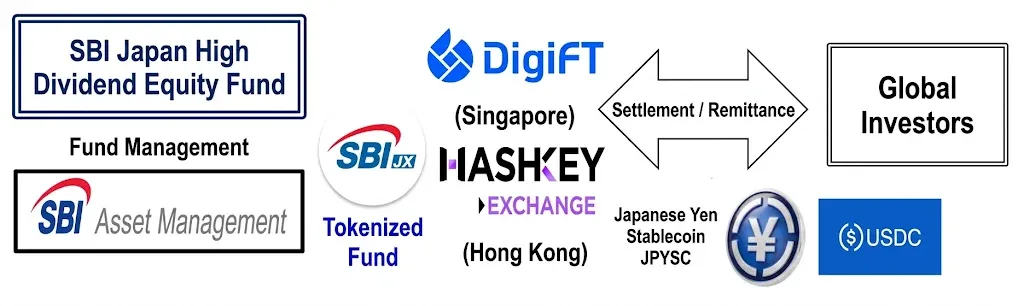
The underlying asset structure of the JX token relies on a private unlisted fund that feeds directly into SBI Asset Management’s core mother fund strategy. This strategy actively selects high-dividend Japanese equities based on dividend yield, operational cash flow, balance sheet capitalization, and valuation multiples. Tokenized on-chain by Singapore-based DigiFT Tech, JX targets professional and institutional investors, utilizing the U.S. Dollar-pegged stablecoin USDC as the primary subscription and redemption currency.
This dual-hub framework represents a significant transformation in cross-border capital allocation. By integrating USDC settlement on HashKey Earn, offshore professional investors in Hong Kong and Singapore gain direct economic exposure to high-yield Japanese corporate equities without setting up legacy Japanese brokerage accounts, navigating spot foreign exchange conversions, or managing traditional cross-border clearing rails.
This listing builds upon JX's initial Singapore launch via DigiFT during July 2026. Expanding secondary availability to Hong Kong advances SBI Group’s strategic goal of establishing an "On-Chain Capital Market Originating from Japan."
HashKey Exchange operates under parent company HashKey Holdings (3887.HK) as Hong Kong’s institutional digital asset venue. Operating via Hash Blockchain Limited, it holds Securities and Futures Commission (SFC) Type 1 (Dealing in Securities), Type 7 (Providing Automated Trading Services), and Virtual Asset Service Provider (VASP) licenses, supported by ISO/IEC 27001 and 27701 security certifications. In accordance with cross-border regulatory boundaries, the platform excludes retail and institutional residents of the United States and Mainland China.
This cross-border expansion of tokenized equity funds set the stage for mid-month operational deployments that extended DLT applications from abstract financial markets directly into physical commercial supply chains.
3. Enterprise Inventory Transformation: SBI Traceability Deploys "SHIMENAWA" at Sazenka
Enterprise DLT deployments are expanding beyond traditional financial instruments to solve high-value real-world asset (RWA) operational friction. Luxury asset management and high-end gastronomy face structural supply chain vulnerabilities, including manual inventory audit costs, lack of standardized item identification, and exposure to high-value product substitution or theft.
SBI Traceability announced the operational deployment of its "SHIMENAWA" DLT traceability and inventory management platform at Sazenka, a three-star Chinese restaurant located in Minami-Azabu, Tokyo, operated by sazen sazen Inc.
Sazenka manages a high-value wine inventory exceeding 12,000 individual master entries, the majority of which lack standard JAN barcoding. Historically, restaurant staff tracked these non-standardized SKUs manually via spreadsheets, creating significant administrative overhead, data-entry discrepancies, and heightened operational risk in inventory control.
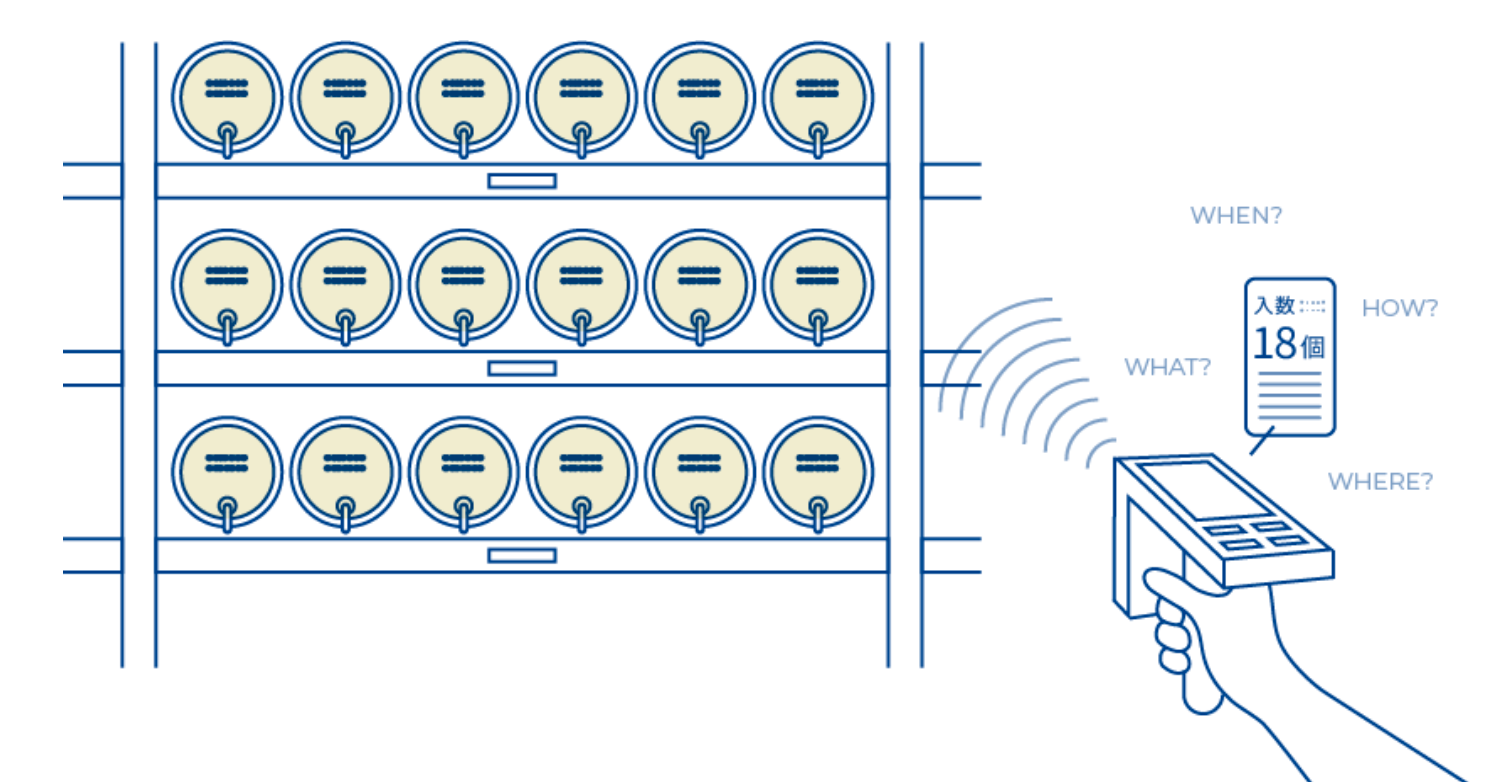
The SHIMENAWA implementation addresses this by pairing hardware authentication with cryptographic ledger logging:
- Hardware Authentication: Individual wine bottles are tagged using custom, logo-embedded NFC tags co-developed with Uni Tag. These tags enable item-level cryptographic authenticity verification alongside RFID bulk-scanning capability.
- Contactless Cellar Auditing: Sommelier and operations teams utilize handheld RFID readers to perform contactless, instant bulk inventory audits across physical cellar locations.
- Ledger Synchronization: Scan records automatically synchronize with a DLT back-end log, linking physical bottle identifiers to immutable movement records, real-time location metrics, and valuation tracking.
- Enterprise Efficiency: Mitigates operational risk and administrative overhead across 12,000+ unbarcoded luxury SKUs, replacing manual spreadsheet tracking with automated DLT inventory synchronization.
- Consumer Quality Assurance: Assures verifiable bottle provenance, handling chain compliance, and authenticity from storage to table.
- Industry Benchmark: Provides a replicable operational model for luxury enterprise management by integrating DLT asset tracking into non-standardized real-world assets.
This operational deployment of enterprise DLT for physical asset tracking coincided with major sovereign financial infrastructure projects finalized on the exact same date.
4. Sovereign Bond Tokenization: SBI Holdings Partnership with the National Bank of Cambodia
Sovereign bond distribution in emerging economies often encounters friction from legacy clearing systems, high minimum investment thresholds, and fragmented domestic distribution channels. Tokenizing government debt on distributed ledgers allows central monetary authorities to streamline registry administration, enable micro-fractional issuance, and expand retail domestic financial inclusion.
SBI Holdings has executed a Memorandum of Understanding (MOU) with the National Bank of Cambodia (NBC)—Cambodia's central bank—to initiate a Proof-of-Concept (PoC) for tokenizing Cambodian government debt.
The PoC establishes a structural separation between legal oversight and DLT infrastructure:
- National Bank of Cambodia (NBC): Retains regulatory oversight and ultimate legal authority over government bondholder registration and transfer validation.
- SBI Group Subsidiaries: SBI Bank (Cambodia), a licensed commercial bank, and SBI Digital Practice build and manage the institutional DLT network environment.
The PoC architecture utilizes Canton Network, an institutional-grade, privacy-enabled DLT framework. Canton Network was selected specifically because its sub-ledger privacy architecture protects sensitive institutional transaction data and sovereign registry details, while retaining cross-ledger interoperability across external financial networks.
From a market structure perspective, tokenizing Cambodian sovereign debt enables fractional ownership models, automated smart-contract coupon distribution, real-time clearing, and transparent audit visibility. This framework paves the way for retail citizens to purchase government debt in micro-denominations using established commercial banking applications linked directly to Cambodia's central payment infrastructure.
This sovereign debt tokenization initiative was complemented by a simultaneous cross-border payment MOU executed alongside NBC.
5. Next-Generation Cross-Border Remittances: JPYSC Stablecoin Integration with NBC's Bakong System
Traditional correspondent banking channels for international remittances remain subject to multi-bank routing delays, legacy intermediary fees, and foreign exchange slippage. Interfacing fiat-backed stablecoins with native central bank digital payment ecosystems creates an efficient, programmable settlement corridor.
Concurrently with the bond tokenization agreement, SBI Holdings signed a second MOU with the NBC to conduct a joint PoC establishing a next-generation cross-border remittance corridor linking Japan and Cambodia via the Japanese Yen-backed stablecoin JPYSC.
The PoC operates as a closed-loop, end-to-end sandbox designed to bypass correspondent banking frictions—such as intermediary fees, routing delays, and FX spreads—without altering the end-user application interface. Japanese senders and Cambodian receivers interact with standard digital banking screens while settlement settles instantly over DLT. Furthermore, by linking JPYSC directly into NBC's native Bakong system, the corridor actively supports NBC's policy objective of increasing native Cambodian Riel (KHR) liquidity and usage.
While sovereign payment corridors address institutional settlement flows, late November brought announcements addressing security frameworks for autonomous AI agents executing financial transactions.
6. AI Agent Transaction Security: Bitbank and Nyx Foundation Joint Research Agreement
The convergence of Artificial Intelligence and Web3 protocols creates a critical security requirement: verifiable authorization frameworks for autonomous agents. As Large Language Models (LLMs) evolve from advisory tools into operational agents capable of executing multi-step programmatic workflows, delegating financial wallet access to non-human entities requires cryptographic boundaries.
Bitbank, an SBI Group-affiliated entity operating the licensed Japanese digital asset exchange "bitbank", announced a joint research agreement with the Nyx Foundation, a general incorporated association specializing in cryptographic logic and security verification.
The objective of this research is to construct an Agentic Trust Infrastructure capable of enforcing mathematical execution boundaries when AI agents manage capital or trade digital assets on behalf of human users. The partnership combines Bitbank’s exchange matching engine expertise with Nyx Foundation’s cryptographic verification methods.
This joint research builds directly upon Bitbank’s open-source tooling released during July 2026, which included bitbank-lab-mcp and bitbank-lab-cli. Significantly, bitbank-lab-mcp utilizes Anthropic's Model Context Protocol (MCP), an open standard designed to enable secure, standardized interoperability between LLMs and external software environments. By integrating MCP into exchange interfaces, Bitbank is adapting emerging AI communication standards directly to digital asset execution. Corporate venture arm Bitbank Ventures Co., Ltd. has prioritized research funding and capital deployment around this infrastructure layer.
To achieve commercial production, the joint research focuses on three primary requirements:
- Granular Permission Scopes: Restricting autonomous execution agents to explicitly authorized parameter ranges and asset pairs.
- Programmatic Spending Caps: Applying hard cryptographic limiters to single-transaction values and cumulative volume per execution cycle.
- Formal Mathematical Verification: Utilizing cryptographic verification to prove agent code logic integrity prior to order routing.
This research into autonomous transaction safety concludes a month of strategic deployments across digital securities, physical RWA tracking, cross-border settlement, and AI integration.
7. Strategic Takeaways Heading into 2027
- Convergence of Traditional Mega-Banking and Standardized DLT Infrastructure: The entry of conservative institutions like Norinchukin Bank via standardized SaaS frameworks (such as Progmat SaaS) confirms that DLT has evolved into a standard, compliant deployment layer for Japanese institutional balance sheets.
- Construction of Interoperable Cross-Border Financial Rails: By linking Japanese Yen-backed stablecoins (JPYSC) and tokenized Japanese equity funds (JX) directly into international liquidity venues (Hong Kong, Singapore) and sovereign central bank frameworks (Cambodia's Bakong), Japanese institutions are constructing alternative international clearing corridors.
- Expansion into Non-Financial Assets and Autonomous Execution: The deployment of DLT for physical luxury inventory control (SHIMENAWA) alongside research into AI agent safety boundaries (Bitbank/Nyx utilizing Anthropic's MCP) demonstrates that institutional blockchain deployment is extending beyond basic asset tokenization into enterprise supply chain control and autonomous, machine-to-machine financial execution.
 Norbert Gehrke