Systemic Failure at Aflac Japan: Bank Data of 230,000 Leaked Amid Massive System Intrusion

Aflac Life Insurance Japan is currently grappling with a cascading cybersecurity crisis following a massive unauthorized system intrusion that has compromised the data of millions of policyholders and thousands of business partners.
In a sector where consumer trust and the absolute security of sensitive health and financial data are the primary assets, a breach of this magnitude—affecting approximately 4.38 million individuals—is a watershed event for the Japanese insurance industry.
The incident exposes not only the fragility of centralized digital platforms but also significant gaps in real-time threat detection within the Japanese financial services landscape. For Aflac, the subsequent total suspension of its digital ecosystem represents a profound operational paralysis that threatens to erode long-term corporate reputation and market stability.
As the company transitions from immediate containment to a protracted investigative phase, the following chronology details a security failure defined by a dangerously prolonged period of unauthorized presence.
1. Chronology of the Breach and Detection Mechanism
In investigative cybersecurity, the "dwell time"—the window between an adversary’s initial entry and the victim's detection—is the definitive metric of a security posture’s efficacy. For Aflac Japan, this window spanned a critical ten-day period (June 15–June 25) during which unauthorized actors maintained persistent, undetected access to internal systems. The eventual discovery was not the result of a sophisticated behavioral firewall or an intrusion prevention system (IPS), but rather an incidental observation of hardware strain.
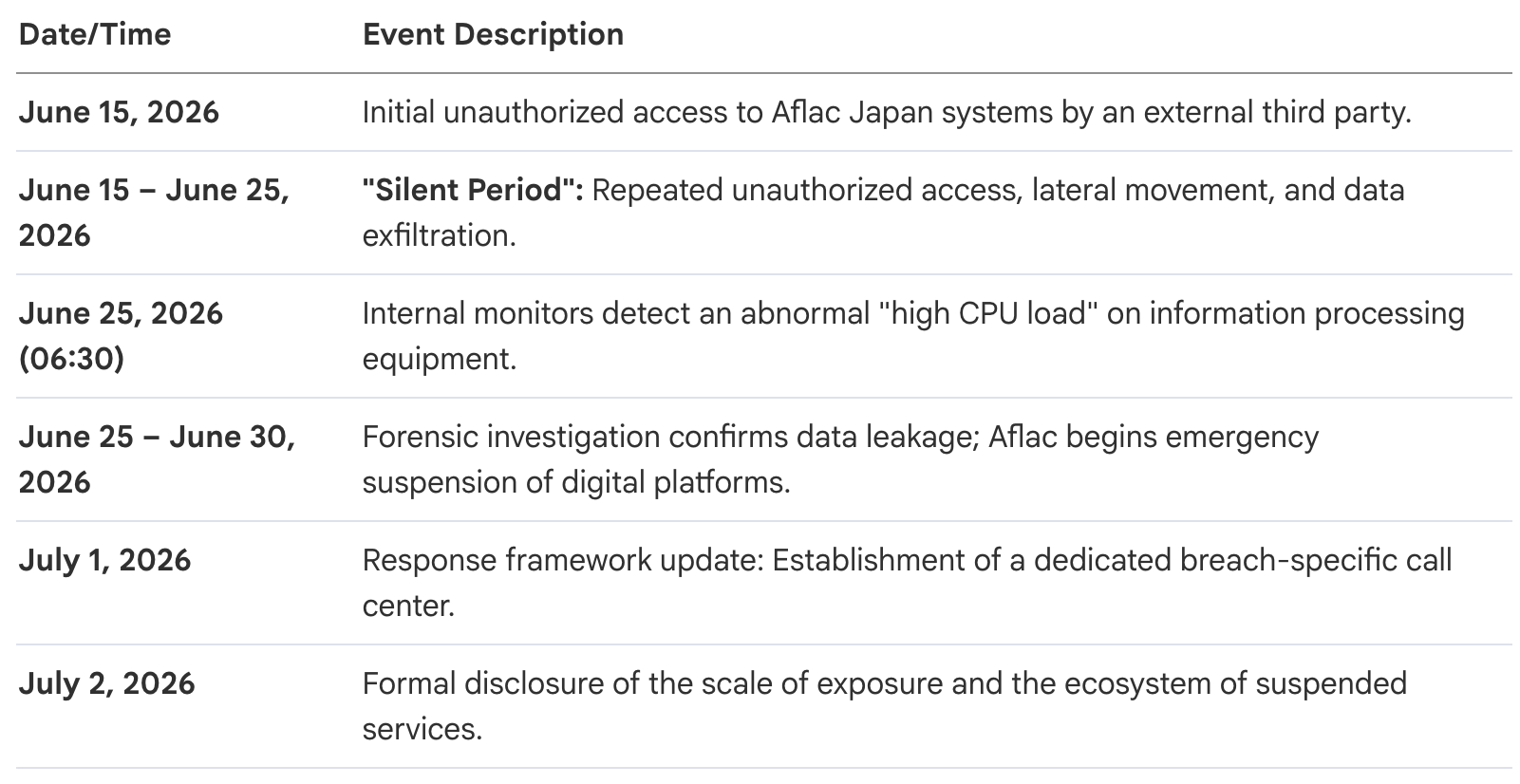
The detection of a "high CPU load" on the morning of June 25 serves as a diagnostic indicator of the breach's intensity. While intruders successfully bypassed access alerts for ten days, the sheer volume of data exfiltrated during the final stages of the heist reached a technical breaking point, manifesting as a physical strain on the processing hardware. This indicates a massive "smash-and-grab" exfiltration strategy that only became visible once the volume of traffic compromised system performance.
This detection triggered an immediate shift toward assessing the significant human and institutional toll of the intrusion.
2. Quantifying Exposure: The Human and Financial Data Toll
In the insurance sector, the leak of Personal Identifiable Information (PII) is a severe privacy breach, but the exposure of "premium transfer account information" elevates the crisis to a tier of immediate financial fraud risk. Aflac’s current assessment reveals a breach that is both wide in scope and deep in risk, affecting current clients, former policyholders, and the company's extensive agency network.
Magnitude of Data Compromise
- Total Consumers Impacted: Approximately 4.38 million individuals, including current policyholders and former customers.
- High-Risk Financial Exposure: Roughly 230,000 customers had their "premium transfer account information" exfiltrated.
- B2B Impact: Personal data relating to approximately 40,000 insurance agencies (代理店) was also compromised, threatening the security of the broader brokerage ecosystem.
- Exfiltrated Data Points: Leaked records include Name, Date of Birth, Gender, Address, Phone Number, Policy Number, Coverage Details, and Agency Information.
- The Financial Leak: For the high-risk subset, the data stolen includes bank names, branch names, account types, account numbers, and account names.
Security Safe Zones
Aflac confirms that "My Number" (national ID) and credit card information were not compromised in this incident. Furthermore, "Yorisou Net" login credentials (IDs and passwords) remain secure as of the current investigation.
The distinction between generic PII and financial data is critical for risk modeling. While the general PII leak facilitates sophisticated credential stuffing and social engineering attacks, the theft of bank account details enables targeted unauthorized debiting and provides the necessary architecture for fraudulent financial transactions.
This catastrophic loss of data integrity led directly to a complete paralysis of Aflac's digital infrastructure.
3. Operational Fallout and Systemic Suspensions
Following the breach, Aflac Japan was forced into a preemptive total shutdown of its customer-facing digital services. This "scorched earth" security tactic—while necessary to halt ongoing exfiltration—has effectively severed the digital link between the insurer and its 4.38 million affected stakeholders, resulting in a total suspension of the "Aflac Yorisou Net" ecosystem.
Suspended Digital Services (as of July 2, 2026)
- Core Administrative Platforms:
- Aflac Yorisou Net: The primary digital interface for policyholder contract management.
- Value-Added Ecosystem Services:
- Financial & AI Tools: "Money Forward for Aflac" (online household account book) and the Aflac AI Support Concierge.
- Health & Lifestyle Services: Human dock/health checkup reservations, Ninkatsu (fertility) concierge, online medical consultations, and online fitness benefits.
- Nutritional & Wellness Support: "Oishii Kenko" (meal management) and sports club discount portals.
The impact on the customer user experience (UX) is severe. By severing digital access, Aflac has forced a massive migration of customer traffic back to "legacy" channels. While telephone-based claim services and the "Aflac Hot Service 24" (automatic voice response for paper-based inquiries) remain operational, the company now faces an administrative bottleneck as it attempts to handle millions of anxious inquiries through labor-intensive manual systems.
4. Corporate Response and Remediation Framework
Aflac Japan’s response strategy currently balances public transparency with a logistical nightmare. While the company has deployed a multi-channel communication strategy, including web FAQs and dedicated hotlines, the promise of "sequential mailing" to 4.38 million affected parties represents a massive logistical undertaking that will likely take weeks to complete, leaving millions of customers in a state of high uncertainty.
Strategic Next Steps and Priorities
- Forensic Deep-Dive: Ensuring no persistent "backdoors" exist before attempting system restoration.
- Sequential Logistical Rollout: Physical mailing of breach notifications to the millions of affected current and former policyholders.
- Safety Auditing: Rigorous security confirmation of "Yorisou Net" architecture prior to re-enabling digital services.
- Administrative Hardening: Developing new technical and managerial protocols based on the investigation’s root-cause analysis.
Current Status
As of July 2, 2026, the investigation into the specific point of entry and the identity of the third party remains ongoing. No evidence of secondary misuse of the leaked data has been confirmed to date; however, the company remains in a state of operational crisis as it moves to restore digital services without compromising system integrity.
 Norbert Gehrke