The 2025 Tokyo Financial Award Innovation Category Winners

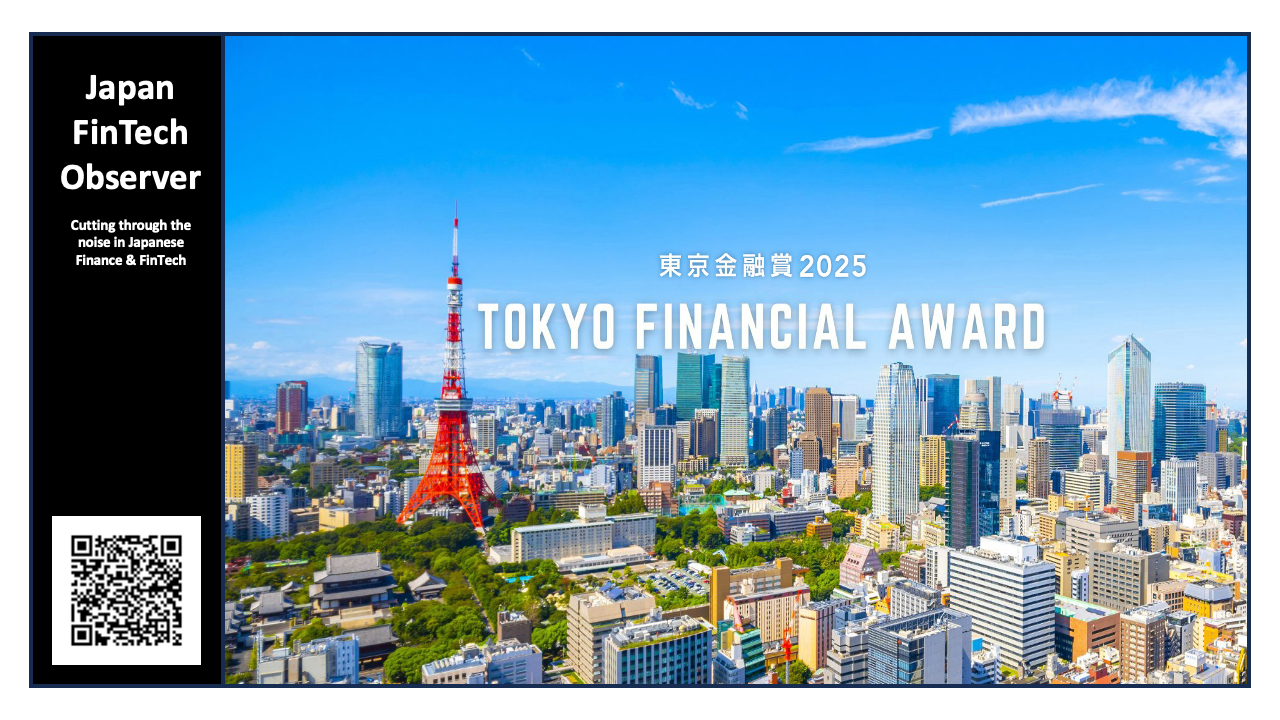
The 2025 Tokyo Financial Award winners—Impact Circle, Clarity AI, Japan Asset Management Platform Group, Myna Wallet, EduCare, and Henry could provide functional components of a broader structural reorganization of the Japanese financial landscape. As the Tokyo Metropolitan Government intensifies its "Global Financial City: Tokyo" initiative, these six innovators provide a comprehensive roadmap for addressing Japan’s most pressing structural challenges: an aging demographic, chronic labor shortages in critical sectors, the activation of a $14 trillion household asset pool, and the digitalization of national identity.
The 2025 cohort reflects a sophisticated integration of artificial intelligence, blockchain-based sovereign identity, and novel credit modeling designed to bridge the gap between financial capital and social utility. By examining their founding histories, venture capital trajectories, and market positioning, it becomes clear that the Tokyo Financial Award has the potential to signal which technologies will define the next decade of Japanese finance.
Impact Circle: Quantifying the Social Return on Capital
Impact Circle secured the first-place ranking in the 2025 Tokyo Financial Award, an achievement that highlights the rising institutional priority of "Impact Finance" within the Japanese and broader Southeast Asian markets. Founded in 2021, the firm was established during a period of intense global focus on the "Social" component of ESG (Environmental, Social, and Governance) criteria. Under the leadership of President and CEO Satoshi Takahashi, Impact Circle was designed to solve a fundamental inefficiency in the capital markets: the "invisibility problem" of social returns. Takahashi, a founding member and former Executive Director of Business Development at Global Mobility Service, brought a proven pedigree of scaling fintech solutions that integrate financial inclusion with tangible social outcomes.
The Founding Narrative and Global Mobility Heritage
The inception of Impact Circle is deeply rooted in the success of Global Mobility Service (GMS), where Takahashi was instrumental in raising over 2 billion yen across Series A through Series C rounds and expanding operations into the Philippines, Cambodia, and Indonesia. This experience provided the blueprint for Impact Circle’s "international-first" philosophy. Within its first 18 months of operation, the company established two critical group entities: Impact Circle Finance Philippines (founded May 19, 2022) and Impact Circle Leasing (founded December 28, 2022).
The firm’s mission is centered on the visualization of impact—generalizing the expertise required to report on social outcomes so that capital can be allocated more effectively toward poverty reduction and job satisfaction. By systematizing impact reporting, Impact Circle aims to move social investment from a niche, philanthropic activity into a standardized asset class suitable for institutional participation.
Venture Capital and Capital Evolution
The funding trajectory of Impact Circle reflects a strategic accumulation of capital from investors who prioritize long-term sustainability and environmental transition.
| Date | Deal Type | Amount | Key Investors and Strategic Partners |
| March 16, 2022 | Seed Round | $691,000 | Undisclosed |
| October 19, 2022 | Early Stage VC | $1.17 Million | Energy & Environment Investment (EEI), G-STARTUP |
| January 27, 2023 | Accelerator | - | Mirai Cross |
| November 7, 2024 | Series A | $2.22 Million | EEI, Creative Heart Co., Ltd., False Co., Ltd. |
The involvement of Energy & Environment Investment (EEI) is particularly significant, as EEI is one of Japan's most prominent venture capital firms focused on the intersection of technology and sustainability. This backing indicates that Impact Circle is being positioned as a key infrastructure provider for the "Green" and "Social" finance markets, rather than a standalone microfinance lender. The company’s investor base also includes Noritoshi Nakajima, the CEO of GMS, further solidifying the connection to established FinTech leadership in the region.
Market Positioning: The IMM Advantage
In the competitive landscape of ESG and social finance, Impact Circle has carved out a unique position by focusing on Impact Measurement and Management (IMM). While many competitors provide third-party ratings based on public disclosures, Impact Circle operates a "closed-loop" model. By managing its own microfinance operations in the Philippines and leasing operations in Japan, the company generates proprietary data that it uses to refine its impact visualization algorithms.
The firm’s market moat is reinforced by a robust patent strategy. Impact Circle holds active and pending patents for "Social impact visualization systems" and "Information processing methods," suggesting a pivot toward a Software-as-a-Service (SaaS) model where it can license its reporting technology to larger financial institutions under increasing regulatory pressure to quantify the social outcomes of their portfolios. This positioning allows the company to capture high-margin value from data and reporting without the massive capital requirements of traditional banking.
Clarity AI: The Technological Antidote to Greenwashing
The second-place award winner, Clarity AI, represents the global scale and technological sophistication required to manage the modern sustainability mandate. Founded in 2017 by Rebeca Minguela—a former executive at Santander and McKinsey—Clarity AI was born from the recognition that traditional ESG data was fragmented, subjective, and prone to "greenwashing". Headquartered in New York, the firm has rapidly established itself as a dominant force in the sustainability tech sector, leveraging artificial intelligence to provide factual, transparent sustainability insights.
Algorithmic Core and Methodological Rigor
Clarity AI distinguishes itself from traditional rating agencies through its "technology-first" approach. The platform uses advanced machine learning to analyze more than 2 million data points bi-weekly, performing reliability checks and running estimation models at a scale far beyond human capacity. This capability is critical for addressing the "data gap" in sustainability reporting; for example, if a company only reports emissions for a single subsidiary, Clarity AI’s models can estimate the carbon footprint for the entire organization with high statistical confidence.
The platform is designed to be modular, allowing institutional clients—including some of the world’s largest asset managers like BlackRock and pension funds like APG—to select specific capabilities such as UN SDG alignment, net-zero commitment evaluation, or regulatory compliance tools. This flexibility is a primary differentiator in a market where financial institutions often have varying internal frameworks for assessing sustainability.
Global Capital and Strategic Expansion into Japan
Clarity AI’s funding history is a masterclass in securing high-conviction capital from the world's most influential financial and technology investors. The company has raised a total of $335 million, providing the firepower needed to penetrate complex international markets like Japan.
| Funding Stage | Date | Amount | Lead and Notable Investors |
| Seed/Grant | 2017-2018 | ~$5 Million | EU Horizon 2020, Kibo Ventures |
| Series A | Oct 2020 | $15 Million | Deutsche Börse AG, Mundi Ventures |
| Series B | Jan 2021 | $24 Million | BlackRock, Kibo Ventures |
| Series C | Dec 2021 | $50 Million | SoftBank Investment Advisers, Fifth Wall |
| Series D | Sept 2024 | $213 Million | Undisclosed (Lead), SoftBank Vision Fund, Atempo |
The $213 million Series D round in September 2024 was a pivotal moment for the company's expansion into Asia, particularly Japan. By securing lead investment from SoftBank, Clarity AI gained a local partner with deep ties to the Japanese corporate elite. This partnership is essential for navigating the specific disclosure requirements and cultural nuances of the Japanese market. Furthermore, Clarity AI’s acquisition of ecolytiq in 2025 and its strategic partnership with Visa have expanded its reach into the consumer banking and e-commerce space, allowing it to provide sustainability insights directly to retail bank customers.
Market Positioning: Defining the Standard for Traceability
For the Japanese market, Clarity AI’s positioning focuses on "traceability." As Japanese institutional investors, led by the Government Pension Investment Fund (GPIF), move toward more rigorous ESG integration, the demand for data that can withstand audit-level scrutiny has become paramount. Clarity AI’s ability to provide detailed explanations for every AI-generated estimate addresses the "black box" criticism often leveled at ESG rating providers. By positioning itself as an independent, evidence-based platform, Clarity AI serves as a critical infrastructure layer for the entire Japanese investment ecosystem.
Japan Asset Management Platform Group (JAMP): Breaking the "In-House" Legacy
Japan Asset Management Platform Group (JAMP), the third-place winner, addresses a structural bottleneck that has historically limited the productivity of the Japanese financial sector: the "in-house approach" to operations. Founded in 2019 by CEO Keiichi Ohara, JAMP operates as a platform solutions provider designed to liberate financial institutions from their legacy back-office systems.
The White-Label ETF Revolution
Ohara has famously described Japan as the "last frontier" for global asset managers, citing the 2 quadrillion yen ($13.9 trillion) in household assets that remain largely uninvested. Traditionally, the cost and regulatory burden of establishing an Exchange-Traded Fund (ETF) in Japan were prohibitive for all but the largest domestic institutions. JAMP’s "White-Label ETF" service—the first of its kind in Japan—was designed to eliminate these barriers.
By providing the necessary investment trust management license and handling the complex operational, administrative, and regulatory formalities, JAMP Fund Management allows foreign and boutique managers to launch ETFs in Japan at a fraction of the traditional cost and time. This innovation directly aligns with the Tokyo Stock Exchange’s (TSE) mandate to increase the variety and vibrancy of the Japanese ETF market to attract more retail investors.
Capital Structure and Institutional Integration
JAMP’s venture capital journey highlights its integration into the core of the Japanese financial infrastructure. The company has raised approximately $12.4 million across four rounds.
| Round | Date | Amount | Key Investors |
| Series A | Oct 2020 | $2.65 Million | Aozora Corporate Investment, PKSHA Algorithm Fund |
| Series B | March 2022 | $2.27 Million | Mitsubishi UFJ Capital, Japan Investment Adviser |
| Series D | Jan 10, 2025 | $4.03 Million | Hiroshima Capital Partners, Aozora Corp Investment |
The participation of Aozora Corporate Investment and Mitsubishi UFJ Capital (the venture arm of one of Japan’s "megabanks") underscores JAMP’s role as a systemic optimizer. The recent Series D round in early 2025, led by Hiroshima Capital Partners, suggests that regional banks are increasingly looking to JAMP to modernize their own wealth management offerings. In an era of shrinking margins for traditional banking, JAMP provides regional institutions with a low-capital-expenditure route to sophisticated fee-based income.
Market Positioning: The Gateway to the Japanese Wealth Formation Era
JAMP positions itself as a strategic partner that runs "beside" its clients rather than behind them as a mere service provider. By enabling "trial and error at a reasonable cost," JAMP is fostering a more innovative and competitive fund management environment. The May 2024 amendment to the Financial Instruments and Exchange Act, which facilitated broader outsourcing in the asset management industry, acted as a major tailwind for JAMP’s business model, effectively legitimizing the "Platform-as-a-Service" approach for Japanese finance.
Myna Wallet: Bridging Sovereign Identity and Web3
Myna Wallet, recipient of a Special Jury Prize, represents the most significant attempt to date to integrate blockchain technology with Japan’s existing public digital infrastructure. Founded in June 2023 by CEO Hiroyuki Tachibana, the company is on a mission to ensure that "no one is left behind in the use of digital assets".
Leveraging 100 Million Identity Nodes
The fundamental innovation of Myna Wallet is its utilization of the "My Number Card," the Japanese government-issued identity card currently held by approximately 100 million residents. By leveraging the NFC-type B chip and the RSA keypair stored on the card, Myna Wallet allows users to manage digital assets—including stablecoins, NFTs, and cryptocurrencies—simply by tapping their card against a smartphone.
This approach addresses the "user experience barrier" that has plagued the web3 sector. Users do not need to manage complex seed phrases or install specialized browser extensions; the sovereign identity card acts as the hardware wallet. The platform uses EIP-4337 (Account Abstraction) to generate contract wallets that are secure yet flexible, allowing for features like social recovery, which are essential for adoption among the elderly.
Seed Funding and Ministerial Certification
Myna Wallet’s rapid ascent is backed by strategic investments from the primary actors in the Japanese crypto-asset space.
| Date | Funding Round | Amount | Lead Investors |
| June 16, 2025 | Seed Round | 200 Million Yen (~$1.3M) | Coincheck Group N.V., gmjp holdings |
The seed round in June 2025, led by Coincheck—Japan’s dominant crypto exchange—is a critical strategic alliance. It bridges the gap between public identity infrastructure and the private sector’s trading and custody expertise. Furthermore, in October 2025, Myna Wallet received approval from the competent minister for the use of the Japanese Public Key Infrastructure (JPKI), a certification held by only 24 companies nationwide. This certification provides the company with a unique legal mandate to perform high-level digital authentication for financial services.
Market Positioning: The Interface for the Digital Yen
Myna Wallet is positioning itself as the essential interface for the coming era of digital value exchange in Japan. Its collaboration with Sumitomo Mitsui Card for stablecoin payment experiments and its research partnerships with regional institutions like the Shizuoka Financial Group suggest that the company is building the "last mile" infrastructure for any future Central Bank Digital Currency (CBDC) or regional stablecoin projects. By aligning itself with government policy and sovereign identity, Myna Wallet has effectively de-risked web3 for both regulators and conservative retail users.
EduCare: Reengineering the Economics of Healthcare Education
EduCare, another Special Jury Prize winner, focuses on the intersection of FinTech and human capital development. Under Representative Director and President Kenta Murakami, the firm is pioneering the use of Income Share Agreements (ISA) to address the labor shortage in the Japanese healthcare sector.
The ISA Mechanism: Financing the Future of Nursing
Japan’s healthcare crisis is exacerbated by the high cost of specialized education and the financial risk associated with student loans. EduCare’s platform provides income-based education financing tools designed to support healthcare-related academic advancement. Instead of traditional debt, students receive funding for their studies in exchange for a commitment to pay a fixed percentage of their future salary for a set period once they enter the workforce.
This model facilitates scholarship programs tied to future earnings, effectively shifting the risk of education from the individual to the capital market. The platform also offers refinancing options for existing student loans and integrates career support services for nursing professionals. By aligning the financial incentives of the student, the school, and the funding source, EduCare creates a sustainable ecosystem for healthcare training.
Venture Ecosystem and Institutional Support
EduCare has successfully integrated itself into the prestigious University of Tokyo venture ecosystem, providing it with high-level academic and institutional credibility.
| Date | Funding Stage | Amount | Notable Investors |
| June 30, 2023 | Seed Round | $850,000 | Undisclosed |
| Aug 10, 2023 | Accelerator | - | University of Tokyo Founder's Association |
| Oct 1, 2025 | Early Stage VC | $270,000 | Undisclosed |
The company’s total funding of approximately $1.91 million as of late 2025 has been strategically utilized to build the risk-assessment models needed for ISA programs. The backing of the University of Tokyo’s Founder's Association is particularly vital for navigating the complex regulatory environment surrounding education finance and labor laws in Japan.
Market Positioning: The Human Capital Reskilling Platform
EduCare positions itself as much more than a lender; it is a "Life-cycle Partner" for healthcare workers. As the Japanese government emphasizes "reskilling" under its "New Capitalism" agenda, EduCare’s ability to provide low-risk financing for career transitions makes it a critical player in the national labor strategy. By focusing on the healthcare sector—a segment with high job security and predictable salary trajectories—EduCare has identified the optimal market for the first large-scale implementation of ISA in Japan.
Henry: The Cloud-Native Spine of Modern Healthcare
Henry, the final member of the 2025 Special Jury Prize winners, is dedicated to solving the chronic "analog debt" of the Japanese medical system. Founded in May 2018 by CEO Akito Sakasegawa, the company develops cloud-based core systems—including Electronic Medical Records (EMR) and medical receipt (billing) systems—specifically for small to medium-sized hospitals and clinics.
Solving the Medical Receipt Complexity
In Japan, the complexity of the medical billing (receipt) system is a significant operational burden. Tariff changes and regulatory updates require constant system maintenance. Henry’s "Henry" platform addresses this by providing a unified, cloud-based solution that is automatically updated, allowing medical staff to focus on patient care rather than administrative overhead.
The platform is designed for interoperability, allowing for the seamless sharing of data across different medical facilities. This is a critical departure from the traditional on-premise EMR systems that have long contributed to the fragmentation of patient data in Japan.
The Institutional Megabank Backing
Henry’s venture capital profile reflects its status as a high-conviction infrastructure play. The company has raised a total of $12.2 million over three major rounds.
| Round | Date | Amount | Key Investors |
| Jan 2021 | Seed Round | $1.86 Million | Undisclosed |
| June 2022 | Series B (Initial) | $5.72 Million | Globis Capital, SMBC Venture Capital |
| July 30, 2025 | Series B (Ext.) | $6.81 Million | Globis, SMBC, MUFG, Aozora, Mitsubishi UFJ Cap. |
The July 2025 round—a 1 billion yen extension—is particularly notable for the participation of the venture arms of Japan’s major financial groups (SMBC, MUFG, and Aozora). This level of support suggests that Henry’s cloud-based EMR is being viewed as the potential national standard for healthcare DX (Digital Transformation).
Market Positioning: From Clinic to Acute Care Hospital
Henry’s strategic positioning has evolved from a focus on small clinics to a broader mandate for acute care hospitals. By targeting hospitals with 100-500 beds—the "sweet spot" of the Japanese medical landscape—Henry is capturing the segment most in need of DX but most underserved by large, expensive legacy providers. The platform’s ability to integrate with AI-driven clinical decision support tools positions Henry as the "Operating System" for the next generation of Japanese hospitals.
Comparative Analysis of the 2025 Cohort: Synergies and Structural Themes
The selection of these six winners reveals a cohesive strategy by the Tokyo Metropolitan Government to modernize the foundational pillars of the Japanese economy. The synergies between these firms represent a blueprint for a fully digitized financial ecosystem.
The Role of Regulatory Convergence
The 2025 winners are the beneficiaries of significant regulatory tailwinds. JAMP’s white-label business was catalyzed by the 2024 FIEA amendments; Myna Wallet’s identity play is built on the government’s 100-million-card My Number rollout; and Henry’s cloud-native EMR aligns with national healthcare interoperability mandates. This "regulatory-first" approach to innovation ensures that awarded firms have a clear path to commercial scale.
The Institutionalization of Venture Capital
The cap tables of these firms indicate a maturing venture ecosystem where traditional financial institutions (MUFG, SMBC, Aozora) are active equity participants in the disruptors that will replace their legacy systems. This "Internalized Disruption" model reduces the risk of systemic failure during the transition to a more modern financial infrastructure.
| Transformation Pillar | Core Winner(s) | Impacted Macro Variable |
| Asset Modernization | JAMP / Clarity AI | 2 Quadrillion Yen Savings Gap |
| Social Infrastructure | Impact Circle / EduCare | Demographic Aging & Labor Shortage |
| Digital Identity | Myna Wallet | Public Sector DX & Web3 Adoption |
| Operational Efficiency | Henry Inc. | Healthcare Productivity & Billing Cost |
Synthesis and Strategic Outlook
The 2025 Tokyo Financial Award winners signal the end of the "pilot" phase of Japanese FinTech and the beginning of the "infrastructure" phase. The firms selected are building the cloud spines, the identity gates, and the credit engines that will support the next phase of Japanese economic activity.
For the global observer, the 2025 cohort proves that Tokyo’s path to becoming a global financial capital is uniquely Japanese—rooted in sovereign identity, focused on the social utility of capital, and driven by a necessity to solve the demographic challenges of the world’s oldest population. As these six firms move from the award stage to the core of the Japanese economy, they will collectively define a new model for "Enlightened Capitalism" where technology serves to heal the structural inefficiencies of society while generating sustainable financial returns. The Tokyo Financial Award has thus successfully identified the architects of the city’s digital renaissance.
 Norbert Gehrke