Transitioning to AI-Driven Financial Intelligence with Snowflake and QUICK


Legacy data fragmentation is a strategic liability that imposes an "intelligence tax" on every executive decision. In the current financial landscape, the volume of data has scaled beyond human cognitive limits, rendering traditional "data hoarding" obsolete. To maintain a competitive edge, organizations must pivot to a model of "active intelligence," where data is not a static archival asset but a dynamic catalyst for immediate, high-stakes action.
The objective is the realization of a unified intelligence environment—a frictionless ecosystem where the historical boundaries between structured market data and unstructured global sentiment are eradicated. By collapsing the distance between raw data ingestion and executive insight, firms can transform their decision-making from a reactive posture to a proactive, predictive one. This roadmap serves as the definitive blueprint for navigating this transition, utilizing the Snowflake and QUICK partnership - as discussed in a recent webinar hosted by the companies - to move from months of speculative engineering to minutes of verified insight.
1. Collapsing the Silos: Unifying Structured and Unstructured Data
The historical separation of structured data (price movements, portfolio allocations) and unstructured data (global news, regulatory disclosures) represents the primary friction point in modern finance. This fragmentation forces a "manual cross-referencing" tax on analysts, especially when bridging the gap between English-language global news and Japanese-language market data. This linguistic and structural divide prevents a holistic understanding of market drivers and delays critical responses to volatility.
The Snowflake Intelligence paradigm introduces an "Agentic" layer—a reasoning engine that treats all data types as a single, searchable, and interpretable analytical surface. Rather than merely retrieving data, this layer understands the "why" behind market movements, providing cross-lingual synthesis that allows Japanese institutions to query global data in natural language without separate translation or engineering workflows.
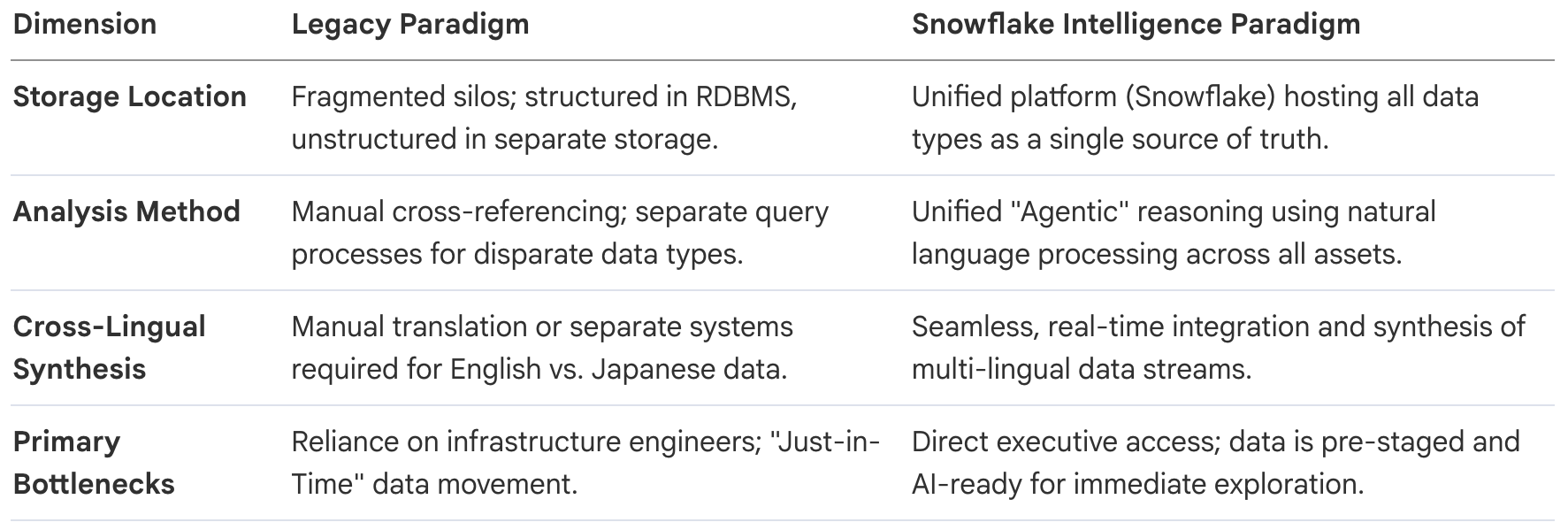
This unification transforms the data environment into a reasoning-capable asset, removing the engineering friction that previously paralyzed executive discovery.
2. Accelerating the "Time-to-Insight" Lifecycle
In high-frequency and high-stakes financial environments, the speed of the Plan-Do-Check-Act (PDCA) cycle is the ultimate differentiator. Traditionally, testing a new business hypothesis required a "Data Request Workflow" involving FTP transfers, infrastructure setup, and file formatting—a process that often stretched Proof of Concept (POC) projects into year-long endeavors.
The transition to a modern intelligence platform enables the "45-Minute Executive Insight," fundamentally compressing the timeline of strategic validation.
Case Study: The 45-Minute Executive Realization
A prominent Executive Director, utilizing QUICK’s Investment Trust (Toshin) data within the Snowflake environment, bypassed the traditional engineering bottleneck entirely. After the data was delivered via a modern transfer application, the executive generated a complete competitive analysis in 45 minutes—a task that previously would have taken weeks of coordination with technical teams.
- Reasoning vs. Retrieval: The executive used natural language to query not just fund rankings, but the "why" behind commission logic and performance variations.
- Compression of PDCA: By reducing the discovery phase from a one-year POC cycle to 45 minutes of natural language exploration, the firm can iterate on business hypotheses in real-time.
- Disintermediation: Technical intermediaries (infrastructure and analysis engineers) are transitioned from "gatekeepers" to "enablers," as leadership directly interacts with the data logic.
3. Constructing the AI-Ready Data Foundation
For data to be consumable by AI agents, it must undergo a fundamental shift from being "human-readable" to "machine-interpretable." This requires a shift in how data architects prioritize their efforts.
3.1 The Three Strategic Pillars of AI-Ready Data
- Wide-Area Pre-Staging: High-value intelligence is often found at the intersection of seemingly unrelated data points. Architects must host a "Wide-Area" of data (ESG, News, Market Prices, Toshin) before a specific use case is identified. The value of AI is discovered through exploration, not pre-planned engineering.
- AI-Ready Semantic Formatting: Raw data must be abstracted into "Semantic Views." These layers provide the context and definitions (metadata) that allow AI agents to understand financial logic, fee structures, and sector relationships without human intervention.
- Synthesis of Proprietary and External Data: The objective is to move beyond external feeds to "Integrated Insights," where proprietary internal portfolio data is merged with QUICK’s market intelligence to create a unique, unreplicable competitive advantage.
3.2 Strategic Mandates for Data Architects
- Eliminate Just-in-Time Ingestion: Automate the ingestion of QUICK’s diverse data streams (ESG, Toshin, News) into Snowflake immediately to allow for spontaneous AI discovery.
- Deploy Semantic Layers: Prioritize the creation of automated semantic views over traditional report-building, ensuring the "Reasoning Engine" understands the underlying financial logic.
- Optimize for Machine Analysis: Shift focus from human-centric formatting to machine-ready data structures that maximize the accuracy of LLM-based reasoning.
4. High-Impact Use Cases for Integrated Financial Intelligence
The synergy between QUICK’s external market data and internal proprietary records creates a "moat" of intelligence that enables faster, more accurate strategic pivots.
4.1 Market Volatility and Sentiment Synthesis
- Input: Real-time price movements integrated with global multi-lingual news feeds.
- AI-Facilitated Query: "Correlate recent volatility in our energy holdings with linguistic sentiment changes in English-language global news over the last 48 hours."
- Transformation: The AI synthesizes price action and news sentiment, enabling an immediate tactical shift in sector exposure.
4.2 Risk Mitigation via ESG and Disclosure Analysis
- Input: Internal portfolio data combined with external ESG ratings and corporate disclosure documents.
- AI-Facilitated Query: "Which portfolios are exposed to manufacturing sector risks based on the latest environmental disclosure revisions in Japan?"
- Transformation: A move from manual disclosure review to proactive risk rebalancing, identifying non-financial risks before they manifest in price action.
4.3 Competitive Fee Analysis (Toshin)
- Input: Investment Trust (Toshin) performance history and commission structures.
- AI-Facilitated Query: "Identify funds where our performance is in the top decile but our commission structure is uncompetitive against the top five market leaders."
- Transformation: The organization shifts from "asking if data exists" to "optimizing the logic of the business," resulting in data-driven fee adjustments that protect market share.
5. The Future of Machine-Analyzed Financial Ecosystems
The transition from human-mediated data analysis to AI-driven intelligence is an evolutionary certainty. As the volume of financial data scales exponentially, the "human-read-only" model becomes an insurmountable bottleneck. In the very near future, AI-mediated analysis will be the primary—and perhaps only—mode of effective data consumption for large-scale financial institutions.
The partnership between Snowflake’s agile data platform and QUICK’s authoritative market intelligence provides the essential infrastructure for this transition. By unifying structured and unstructured data, compressing the time-to-insight to under an hour, and mandating an AI-ready foundation, your organization will evolve from a reactive consumer of data into a proactive, AI-led market leader. The era of the "intelligence tax" is ending; the era of machine-analyzed, executive-led intelligence has begun.
 Norbert Gehrke