WEA Japan Secures Dual Patents to Shield Blockchain Payments from Oracle Failure and Refund Fraud

In an era where decentralized finance (DeFi) and digital payment systems are frequently undermined by structural vulnerabilities, WEA Japan has secured two critical intellectual property assets designed to fortify the integrity of blockchain transactions.
The granting of Patents JP 7811423 and JP 7857640 marks a calculated effort to institutionalize high-security, automated transaction processing. By addressing the dual challenges of outbound liquidity management and inbound data reliability, these patents represent a strategic "architectural moat" intended to reduce systemic risk while maintaining the high-speed responsiveness demanded by institutional fintech users.
These advancements signal a shift toward systems that prioritize automated error suppression and hardware-level security, beginning with a sophisticated response to the "Refund Fraud" epidemic that has plagued early decentralized protocols.
Automated Refund Architecture: Balancing Speed and Risk (Patent JP 7811423)
For digital merchants, the tension between "refund responsiveness" and "loss mitigation" is a constant operational challenge. Fully automated systems often lack the nuance to catch fraudulent high-value requests, while manual systems suffer from delays that degrade the user experience. WEA Japan’s solution utilizes a logic-gate approach to ensure that speed does not come at the cost of security, specifically targeting the risk of rapid capital drain through automated exploits.
Threshold-Based Processing Logic
The system categorizes transaction requests based on their financial weight, ensuring that the automation engine is only deployed when the risk is mathematically manageable.
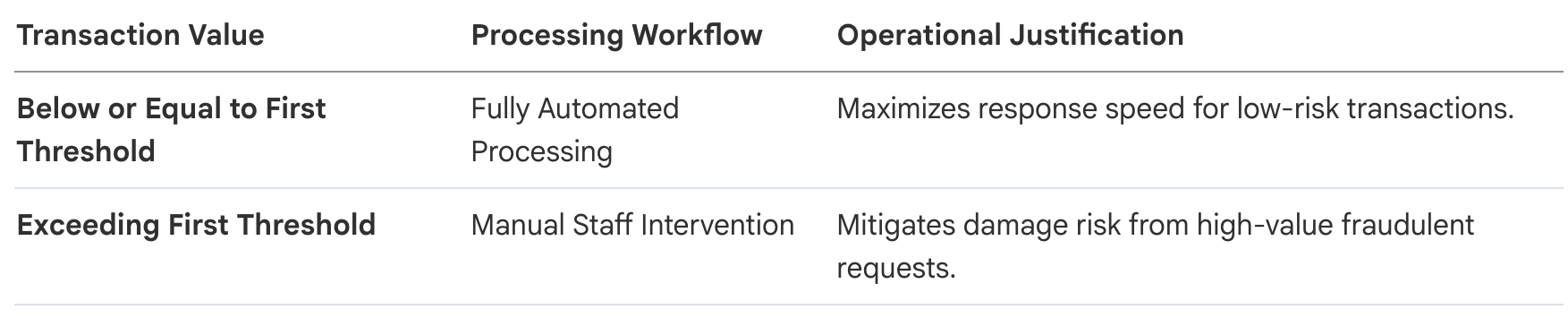
Note: To ensure continuous operation, the system requires that the contract’s liquidity reserve (Second Threshold) remains greater than or equal to the First Threshold.
The Security Layer: Multi-Party Computation (MPC)
To prevent unauthorized transactions, the system implements a robust signing process involving multiple entities. This ensures that no single terminal has the unilateral power to move Stablecoin (安定貨幣) assets.
- Generation of Signature Data: The Management Server generates "Signature-to-be-signed" information containing the user address, refund ID, and specific amount.
- Merchant Approval: The Merchant Terminal uses its private key to sign this information, proving the merchant’s explicit consent.
- Server Authentication: The Management Server then applies its own separate private key to generate a server signature.
- Verification: The Refund Smart Contract executes the payout only after verifying that both the merchant and server signatures are valid and that the Refund ID has not been previously utilized.
Smart Liquidity Management and the 1-Hour Circuit Breaker
To protect the core capital held in the merchant's "Wallet," the system utilizes a Refund Smart Contract as a buffer. The contract monitors its own balance against a "Second Threshold" (minBalance). If the balance falls below this level, it triggers an automated recharge command to the Wallet.
Crucially, the system includes a sophisticated anti-attack counting mechanism. If the number of low-balance warnings reaches 3 alerts within a 1-hour timeframe, the Management Server identifies the anomaly as a potential attack and halts all further recharges from the main Wallet. This circuit breaker prevents attackers from draining a merchant's primary treasury through a high-frequency sequence of automated Stablecoin refunds. However, while this system ensures the amount of the refund is handled safely, that safety is predicated on the price being accurate—a vulnerability addressed by WEA Japan’s second patent.
Oracle Integrity: The Reliable Exchange Rate Protocol (Patent JP 7857640)
Reliable currency settlement on a blockchain requires "oracles"—external data feeds that provide real-world exchange rates. Single-oracle architectures present a systemic risk; if the oracle is compromised or fails, the entire payment gateway may miscalculate settlement values. WEA Japan’s second patent addresses this through a multi-layered defense-in-depth strategy and hardware-level isolation.
Multi-Layered Defense-in-Depth Sequence
Every request for exchange rate data must pass through several security tiers designed to filter malicious traffic and prevent manipulation:
- Cloudflare WAF: Performs initial traffic filtering to block malicious web-based requests.
- Rate Regulatory Device: Acts as an anti-DDoS layer by counting requests; it is strictly limited to 10 requests per 1 second, blocking any excess volume to maintain system stability.
- Nonce Server: Verifies the uniqueness of the request to prevent "replay attacks" where an old, potentially outdated rate request is maliciously re-sent.
- Oracle Machines: Once validated, the request is signed and passed to the oracle cluster for execution.
Reliable Exchange Rate Calculation Methodology
To eliminate outliers and data manipulation, the system queries multiple Oracle Machines, each operating within a secure SGX Enclave. The Smart Contract identifies the "Median Value" from these various reports to serve as the "Trustworthy Exchange Rate." This median-based approach effectively filters out "noise" or anomalies from a single malfunctioning node. In the event of a total oracle cluster failure, the system falls back to the last specified reliable exchange rate (previously validated) cached within the contract to ensure business continuity without settlement errors.
Hardware-Level Security Requirements
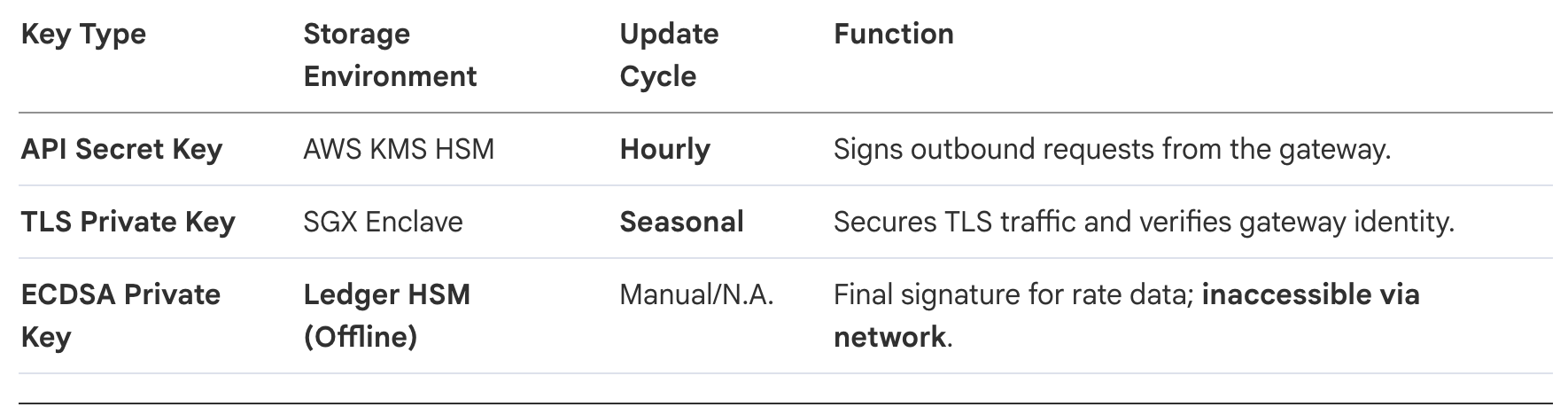
The system segregates cryptographic keys across diverse hardware environments, utilizing both cloud-based and air-gapped storage to ensure that a breach in the network layer cannot reach the core signing keys.
Operational Impact and Market Implications
By synchronizing these two technologies, WEA Japan has constructed a unified "High-Security, Low-Risk" ecosystem. One patent secures the outbound flow of liquidity (Stablecoin refunds), while the other ensures the integrity of the data informing inbound value (exchange rates). Together, they solve the critical "trust gap" that has historically limited the adoption of automated blockchain finance at the institutional level.
Critical Takeaways for Institutional Stakeholders
- Redundant Security: The integration of MPC and offline Ledger HSM storage ensures that even a partial system compromise cannot lead to a total loss of treasury funds.
- Automated Responsiveness: By automating low-value refunds and exchange rate updates within strict parameters, the system maintains a high-tier user experience without manual bottlenecks.
- Error and Attack Suppression: The combination of median-value oracle calculations and time-bound circuit breakers (3 alerts per hour) provides a robust defense against both technical glitches and coordinated external exploits.
WEA Japan’s recent filings position the company at the forefront of financial integrity, providing a blueprint for how blockchain systems can move from experimental protocols to reliable, institutional-grade infrastructure.
 Norbert Gehrke