WebX Fintech Expo Osaka - Panel on Crypto ETFs

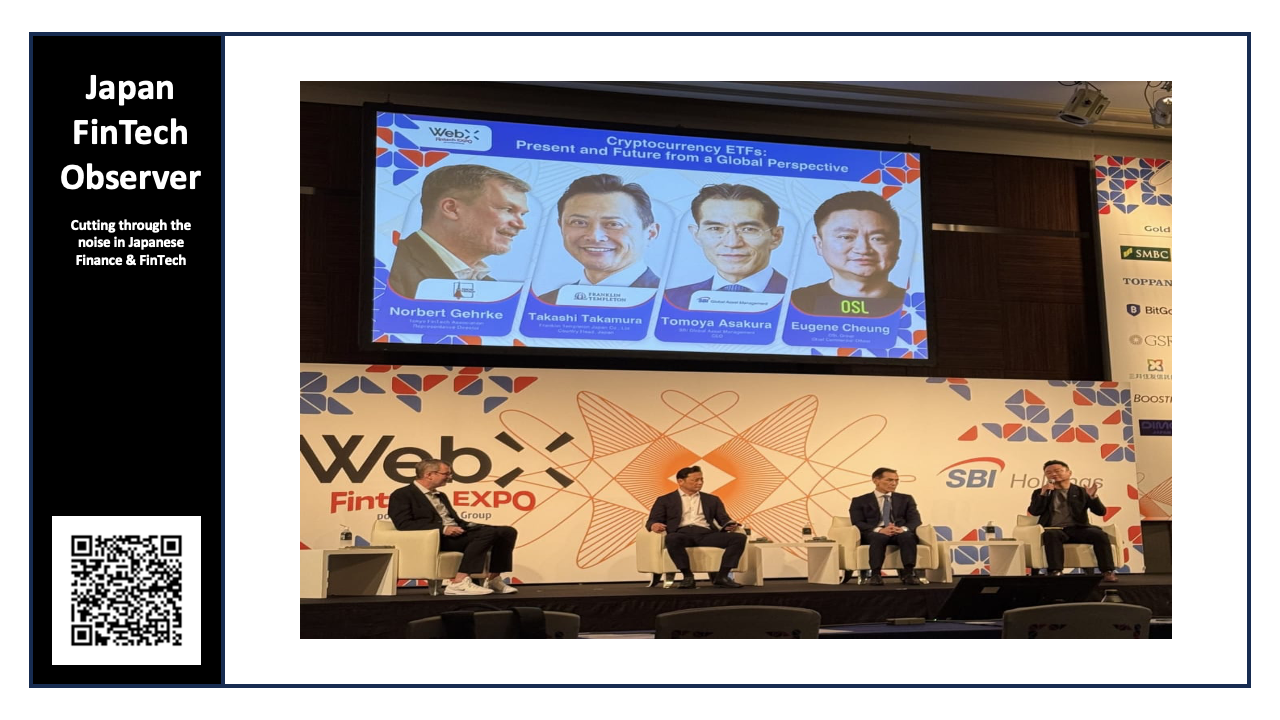
Splendid experience to moderate the panel on Crypto ETFs at the WebX FinTech Expo in Osaka on Friday, sharing the stage with Takashi Takamura, Country Head at Franklin Templeton Japan, Tomoya Asakura, Chief Executive Officer at SBI Global Asset Management, and Eugene Cheung, Chief Commercial Officer at OSL, covering the state of Crypto ETFs around the globe as well as the outlook for Japan.
Five Key Takeaways
- Japan is a Sleeping Giant for Crypto ETFs, But Regulatory Hurdles Remain: Japan holds immense potential with over ¥2,200 trillion in household assets, much of it in cash. Crypto ETFs are seen as a key catalyst to unlock this capital, but the country is significantly behind the U.S. and Hong Kong due to a slow regulatory process.
- Taxation is the Key Hurdle in Japan: The single biggest obstacle is the need to change the tax classification of crypto gains from "miscellaneous income" (up to 55%) to the standard financial product rate (~20%). Without this change, a crypto ETF is not viable. The timeline for this reform is uncertain, ranging from 2025 to as late as 2027.
- ETFs Offer Security and Convenience, Not Just Access: While Japanese investors can already buy crypto directly, ETFs are crucial for attracting mainstream and traditional investors. They solve major concerns around security (by using regulated custodians) and convenience (by allowing investment through existing brokerage accounts).
- The Future Extends Beyond Spot ETFs to Staking and Tokenization: The evolution of digital asset products is already underway globally. The next wave will likely include ETFs that incorporate staking rewards, adding an income component. The ultimate vision is the full convergence of traditional and digital finance through the tokenization of all assets.
- Hong Kong Provides an Innovative Blueprint: Hong Kong's rapid and successful launch of spot crypto ETFs, featuring the world's first "in-kind" creation and redemption model, demonstrates the power of a proactive, regulator-led approach. This serves as a potential model for other jurisdictions looking to integrate digital assets into their financial systems.
The State of Crypto ETFs in Japan
Asakura provided a detailed and candid assessment of the situation in Japan.
- Current Status: He clarified that recent news of SBI filing for a crypto ETF was "fake news" and that crypto ETFs are not currently permitted in Japan.
- Regulatory Discussions: However, positive steps are being taken. The Financial Services Agency (FSA) has begun discussions within its Financial System Council.
- The Main Hurdle - Taxation: The most significant barrier is Japan's tax law. Currently, crypto gains are treated as "miscellaneous income," taxed at a marginal rate of up to 55%. For a crypto ETF to be viable, it would need to be treated as a financial product, with gains taxed at the standard ~20% rate. This requires a fundamental change in tax policy.
- Timeline: The timeline for approval is uncertain. Best case scenario, according to Asakura, would be an approval in the second half of 2025. However, if it gets tied to a major tax reform cycle, the worst-case scenario could be as late as January 2027. He stressed that such a delay would put Japan far behind its global peers.
- SBI's Stance: While they haven't officially filed, SBI is actively "lobbying hard" to accelerate the regulatory and tax reform process.
International Perspectives: Hong Kong & Institutional Views
The panel drew on experiences from other markets to highlight different approaches and future trends.
- Hong Kong's Innovative Model: Eugene from OSL, a key infrastructure provider for Hong Kong's crypto ETFs, explained that Hong Kong was the world's first jurisdiction to launch spot crypto ETFs with an "in-kind" creation and redemption mechanism. This allows authorized participants to exchange the actual underlying crypto (BTC/ETH) for ETF shares. This was achieved through a proactive, "regulation-first" approach and close collaboration between regulators, issuers, and infrastructure players.
- Franklin Templeton's Institutional View: Takamura from Franklin Templeton described crypto ETFs as a monumental first step in connecting traditional finance (TradFi) with digital assets. He outlined three core benefits: meeting investor demand, increasing market liquidity, and institutionalizing the asset class by enabling more complex financial products.
Benefits and Market Impact for Japan
The panel argued that even with over 25 existing crypto exchanges in Japan, ETFs would serve a critical function.
- Security, Convenience, and Portfolio Integration: ETFs solve three key issues for mainstream investors: security concerns (assets are held by regulated custodians), convenience (trading within an existing brokerage account), and ease of portfolio construction (combining crypto with stocks and bonds).
- Unlocking Japan's Savings: Asakura believes ETFs could be the "catalyst" to move a portion of Japan's ¥2,200 trillion in household financial assets—half of which sits in low-yield cash and deposits—into the investment market.
- Broadening Access: By wrapping crypto ETFs into mutual funds (investment trusts), players like SBI can enable Japanese banks to sell these products, dramatically expanding distribution.
The Future: Convergence, New Products, and NISA
The discussion concluded with a look at the long-term vision for digital assets.
- Beyond Spot ETFs: Takamura noted that Europe and Canada are already innovating beyond simple spot ETFs, with products that include staking rewards. This transforms crypto from a pure capital appreciation asset into an income-generating one.
- Full Convergence with Tokenization: Mr. Asakura articulated a vision where, eventually, all financial assets (stocks, real estate, bonds) will be tokenized and traded on digital exchanges like ODX (Osaka Digital Exchange). In this future, crypto-native assets and tokenized traditional assets will coexist and be managed on the same infrastructure.
- Inclusion in NISA: The panel agreed that including crypto ETFs in Japan's tax-advantaged savings scheme (NISA) is a logical long-term goal but is a "long way off," as it would require both ETF approval and a shift in the scheme's conservative mandate.
 Norbert Gehrke