Will $100 Crude Derail Japan’s Wage Recovery? Middle East Tensions Pose New Threat to Real Wages

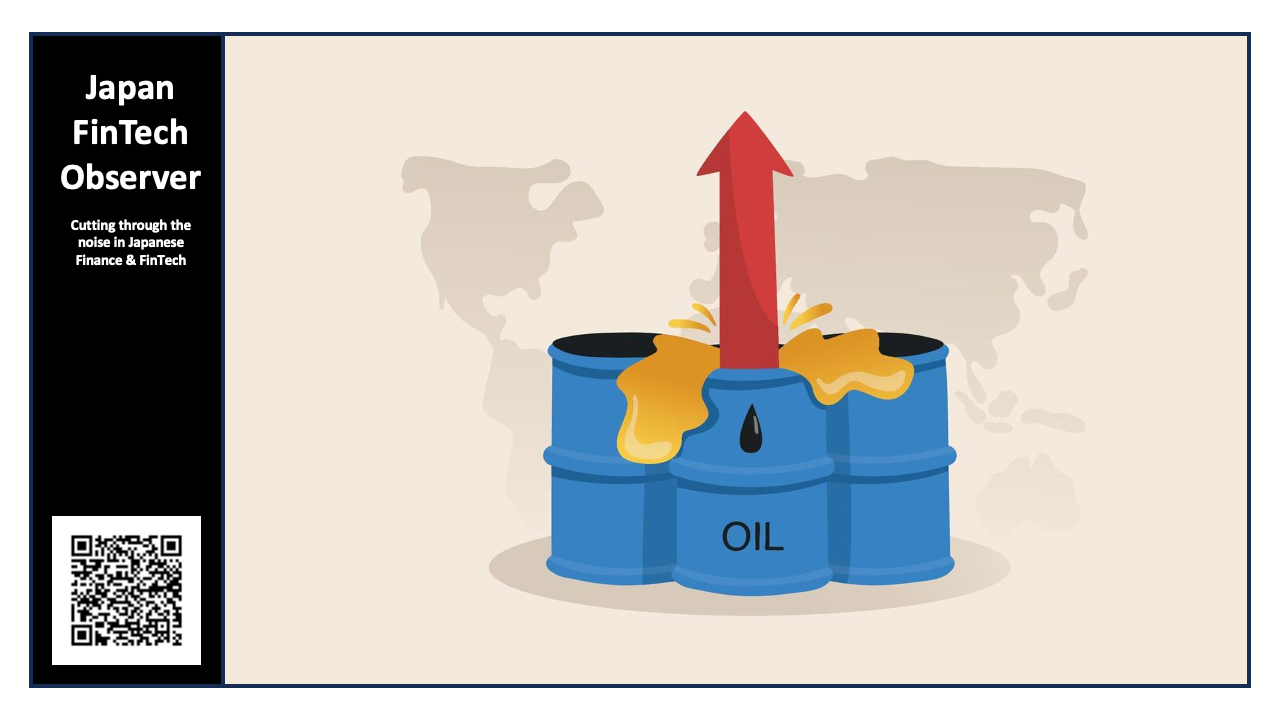
Rapidly escalating tensions in the Middle East are sending shockwaves through global energy markets, raising a critical question for Japan's macroeconomic trajectory: Will soaring crude prices choke off the country’s hard-won transition to positive real wage growth?
According to a new report from the Itochu Research Institute, if West Texas Intermediate (WTI) crude stubbornly remains near the $100-per-barrel mark, Japanese consumers will face a steep penalty at the pump. The surge could push retail gasoline prices up by nearly 30 yen per liter, applying a direct 0.5% upward pressure on the nation’s Consumer Price Index (CPI).
However, Tokyo is stepping in to soften the blow. The government’s move to reinstate gasoline subsidies is projected to suppress this inflationary spike by roughly 0.2 percentage points. Provided the geopolitical premium on oil dissipates by the second half of the year, Itochu maintains its forecast that Japan’s real wages will remain in positive territory for 2026. But if oil prices remain higher for longer, the risk of real wages plunging back into the red—and dragging the broader economy down with them—rises significantly.
The Math Behind the Pump Shock
The catalyst for the recent energy rally was a military strike involving the U.S., Israel, and Iran, which sent WTI crude skyrocketing from around $65 a barrel in late February to a fleeting peak of $119 by early March. As of mid-March, prices continue to hover perilously close to the $100 mark.
The domestic fallout is already visible. After dipping to 154.7 yen per liter in mid-January, Japan's national average for regular gasoline rebounded to 161.8 yen by early March, with wholesale prices signaling further pain ahead.
Historical data suggests that a 10% year-over-year increase in yen-denominated WTI crude translates to a 2.5% bump in domestic retail gasoline prices within weeks. Assuming the yen remains historically weak at around 159 to the dollar, a sustained $100 WTI price equates to a massive 62% year-over-year leap in yen-denominated crude. Without government intervention, this would squeeze Japanese drivers with gasoline prices approaching 190 yen per liter.
The Pass-Through Threat to Real Wages
While energy accounts for less than 10% of Japan's CPI basket, a prolonged $100-per-barrel scenario would inflate energy-specific indices by nearly 6.9%. Beyond the immediate 0.5% bump to headline CPI, the prolonged elevation of crude would inevitably trigger a cascade of indirect inflationary pressures as corporations pass on soaring raw material and shipping costs to consumers.
Despite these headwinds, Itochu’s primary baseline assumes real wages will weather the storm. Going into the 2026 Shunto (spring wage offensives), robust corporate earnings and a tight labor market are expected to secure nominal wage hikes of around 5%—closely mirroring the aggressive 5.94% average demands recently announced by Rengo, Japan’s largest labor union.
A Tale of Two Scenarios
Itochu’s outlook hinges entirely on geopolitical timelines, outlining two distinct macroeconomic paths:
- The Base Case (Main Scenario): Assuming military strikes halt by late March and shipping traffic through the Strait of Hormuz normalizes by July, oil is projected to cool back to pre-conflict levels in the $60 range by the latter half of the year. Coupled with resumed government gasoline subsidies capping retail prices at roughly 170 yen, real wage growth is expected to remain positive, hovering between +0.5% and +0.9% throughout 2026.
- The Bear Case (Pessimistic Scenario): If the conflict drags on and WTI remains anchored at $100, the picture darkens. While direct modeling suggests real wages might eke out a meager +0.1% to +0.2% growth in late 2026, this excludes indirect cost-push inflation and potential further yen depreciation. Once those factors are priced in, real wages will likely slip back into negative territory, flashing yellow warning lights for the Japanese economy and necessitating extended government subsidies.
Looking Ahead to 2027
Interestingly, the temporary inflation spike may paradoxically bolster wages next year. Because spring wage negotiations are heavily influenced by the previous year's inflation, Itochu estimates that nearly 70% of 2026's price surges could be offset by higher wage demands in 2027.
Under the base case, this means 2027 real wages could actually see an upward revision. However, under the pessimistic $100-oil scenario, Japan risks a vicious macroeconomic cycle: suppressed real wages will choke off private consumption, denting corporate profits and ultimately dampening labor demand and wage growth from 2027 onward.
For the Bank of Japan and Prime Minister's office, the message is clear: the longer the Middle East boils, the harder it will be to orchestrate Japan's long-awaited economic virtuous cycle.
 Norbert Gehrke