AI Integration and Governance at Mizuho Financial Group

Mizuho Financial Group is investing heavily in its approach to artificial intelligence, moving from centralized expert-led development to a decentralized, frontline-led model. In May 2026, the group initiated the full-scale deployment of "Dify Enterprise," a development platform designed to enable non-engineers to build and refine AI agents within a framework that meets strict financial governance standards.
Key results from pilot programs indicate substantial efficiency gains, particularly in corporate sales, where business processing times were reduced by up to 52.2%. Looking toward the future, Mizuho has partnered with NEC to develop "KYA" (Know Your Agent), an authentication infrastructure aimed at the "Agentic Finance" era—where AI agents autonomously execute financial services. This transition aims to balance the rapid expansion of AI utility with the rigorous regulatory requirements of the financial sector.
Frontline-Led AI Development: The Dify Enterprise Implementation
A central challenge for financial institutions is reconciling the need for "AI expansion" with "strict control." Mizuho addresses this through the deployment of "Dify Enterprise," which empowers staff who best understand the business to build their own AI solutions.
Governance and Security Framework
To prevent risks such as hallucinations and information leakage, the Dify Enterprise environment incorporates several administrative controls:
- Access Control: Department-specific permission settings to manage data exposure.
- Auditability: Comprehensive utilization logs and trackable evidence management for organizational oversight.
- Integration: Utilization of Single Sign-On (SSO) for secure, streamlined access.
- Compliance: Alignment with the Financial Services Agency's "AI Discussion Paper (Version 1.1)" regarding model risk management and customer protection.
Strategic Objectives
- Democratization of Development: Moving beyond a structure where AI development is confined to specialized departments like the Digital Strategy Department.
- Agility: Enabling frontline departments to implement AI agents at high speed to meet specific site needs.
- Experience Bridging: Using AI to supplement the knowledge gap between veteran and junior employees.
Performance Evidence: Practical Application Results
Pilot implementations in corporate sales demonstrate that AI agents can significantly reduce the burden of information gathering and proposal preparation.
Time Reduction Metrics (Corporate Sales Domain)
The following table outlines the efficiency gains observed during the trial of an AI agent designed to support the selection and proposal of institutional loans:
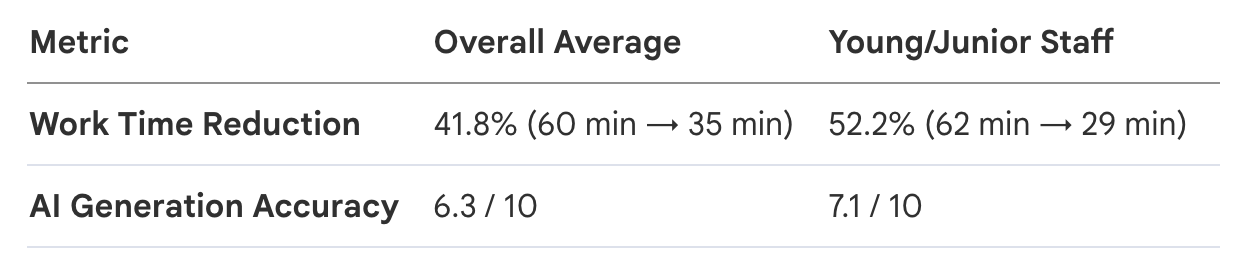
Analysis of Findings:
- Impact on Junior Staff: The higher accuracy rating and time savings among junior employees suggest that AI agents serve as an effective "experience supplement," aiding in early-stage competency and information collection.
- Quality Improvement: Beyond efficiency, the goal is to enhance the quality of proposals by accumulating and sharing site-specific knowledge through the agents.
Sector-Specific Use Cases
Mizuho is designing specialized use cases across various departments to integrate AI into existing workflows:
- Industrial Research Department:
- Analyst Support: Integrating AI into workflows to handle initial stages of information collection and document preparation.
- Advanced Analysis: Verifying the potential for AI to assist in hypothesis construction and logical organization to improve strategic consulting for clients.
- Human Resources & Organizational Development:
- AI Career Navigation: Building a dialogue-based AI that uses internal data on departments, regulations, and learning content to assist employees with career self-assessments, planning, and learning schedules.
- Corporate Sales:
- Subsidy Selection Agent: Specialized tools to identify and propose appropriate institutional financing.
Future Innovation: "Agentic Finance" and the KYA Infrastructure
Mizuho and NEC have identified a shift toward "Agentic Finance," a state where AI agents autonomously access, query, and execute financial procedures on behalf of users based on their intentions and permissions.
The KYA (Know Your Agent) Framework
Starting in June 2026, Mizuho and NEC will conduct joint trials for a new authentication platform called KYA. This is intended to supplement traditional "KYC" (Know Your Customer) protocols.
Four Essential Pillars of KYA Validation:
- Authentication: Verifying the authenticity of the AI agent using Decentralized Identifiers (DID) and Verifiable Credentials (VC).
- Consent: Ensuring the user has explicitly agreed to delegate authority to the AI agent.
- Delegation: Guaranteeing the agent only executes actions within its assigned scope of authority.
- Audit: Maintaining a verifiable and traceable record of all AI agent actions.
Technical Implementation: "Wiz Base"
The joint trial involves scenarios where a customer's AI agent interacts with Mizuho's common AI platform, "Wiz Base." This setup uses NEC’s "FaceVC" technology (combining facial recognition with VC) to prove that the AI agent is a "legitimate representative of a specific user" through cryptographic evidence.
Long-term Outlook and Industry Impact
Mizuho aims to establish a new model for AI utilization in the Japanese financial sector with the following goals:
- Global Standardization: Aligning KYA with global standards and engaging with regulators to establish new institutional frameworks.
- Common Infrastructure: Developing KYA into a shared industry-wide infrastructure for AI agent authentication.
- Operational Transition: Moving from the "creation" phase of AI agents to a sophisticated "operational" phase, where AI is deeply embedded in flexible business workflows.
By maintaining high governance standards while enabling site-led agility, Mizuho intends for its employees to concentrate on high-value analysis and strategic proposal work, ultimately driving broader social and economic transformation.
 Norbert Gehrke