Evaluating the Efficacy of Tokyo Stock Exchange Extended Trading Hours and Closing Auction Reforms

On November 5, 2024, the Tokyo Stock Exchange (TSE) extended the trading day to 15:30 and implementing a formalized closing auction. This transition was designed to enhance global competitiveness and accommodate the liquidity requirements of passive investment strategies. By extending the trading window, the TSE has effectively minimized the gap between domestic price discovery and international news cycles, facilitating more robust institutional participation.
The reform’s operational directive focused on optimizing the closing call auction—the "Afternoon Close Itayose"—to provide a reliable venue for end-of-day valuation. According to TSE directives, the primary expected effects include:
- Increased Transparency: Dissemination of Indicative Closing Prices (ICP) and Indicative Equilibrium Volumes (IEV) to signal market intent.
- Improved Price Discovery: Transitioning from continuous "Zaraba" trading to a call auction mechanism that prioritizes price over time, facilitating efficient matching.
- Enhanced Global Competitiveness: Aligning with international standards to attract capital that requires execution certainty at the market close.
For institutional stakeholders, these reforms address the structural alpha associated with end-of-day liquidity. The extension provides a safety net for execution, particularly for index-tracking funds that must manage tracking error through precise closing-price execution. The data evaluated for this report confirms a significant shift in liquidity provision profiles.
1. Empirical Analysis of Aggregate Liquidity and Trading Value
Aggregate liquidity indicators—specifically Average Daily Trading Value (ADTV) and spread-to-depth metrics—serve as the definitive barometers for assessing the 15:30 extension's success. Initial market concerns focused on the potential for "Zaraba liquidity" fragmentation; however, the empirical data suggests the extension has been additive rather than cannibalistic.
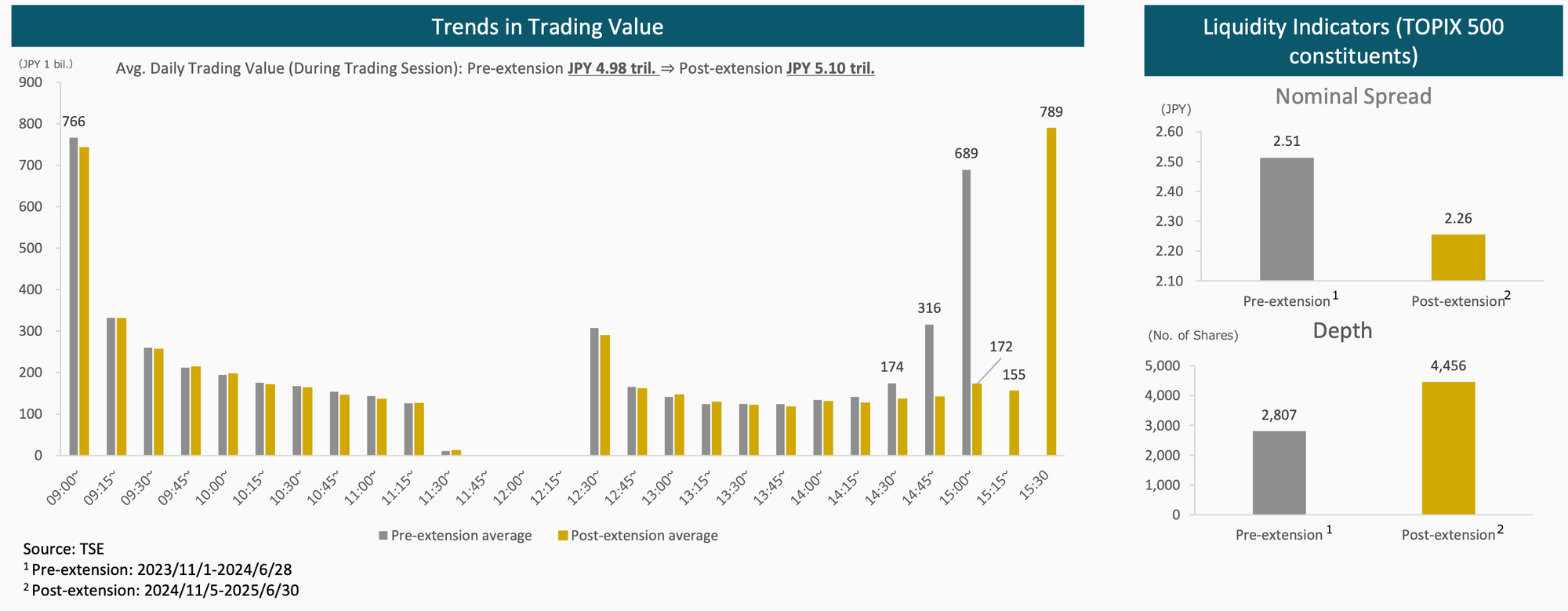
Analyzing the TOPIX 500 constituents, a substantial improvement in the liquidity profile can be observed. Market depth increased by approximately 58%, while nominal spreads tightened from JPY 2.51 to JPY 2.26.
These metrics effectively refute the fragmentation hypothesis. The extension did not dilute liquidity but rather supported an additional JPY 1 trillion in trading activity specifically in the post-3:00 p.m. window. This additional volume represents a successful expansion of the market's capacity to absorb large-block flow without increasing slippage or compromising the quality of continuous trading. This stable-to-improving liquidity environment provides a robust foundation for the specific call auction mechanisms driving the afternoon close.
2. Dynamics of the Afternoon Close Itayose and Closing Auction
The Afternoon Close Itayose functions as a call auction mechanism where the exchange aggregates buy and sell interest to determine a single clearing price. This is distinct from the price-time priority of Zaraba (continuous) trading, as it focuses on maximizing matched volume at a single price point.
- Trading Value Ratios: The importance of this session is evidenced by the rising ratio of value traded at the close. Historically, this stood at 13.5% (March 2020); post-reform, it reached a peak of 16.8% in August 2024.
- Order Placement Behavior: Within the "Pre-closing Session" (15:25:00–15:30:00), order concentration is heavily front-loaded. Data indicates that 70% of executed orders are placed during this five-minute window, with 70% of those arriving within the first minute (15:25:00–15:26:00).
- Coefficient of Variation (CV): The CV, a measure of price Discovery stability, rises sharply at the start of the pre-closing session but begins a steady decline after 15:29:00, signaling price stability as the auction nears its conclusion.
The concentration of orders at 15:25:00 is critical for reducing information asymmetry. By signaling intent early, participants provide the market with the transparency needed for efficient price discovery. For institutional traders, the acceleration of new orders after 15:29:00—coupled with a decrease in modifications and cancellations—serves as mathematical proof of price convergence. On index rebalancing days, this concentration occurs even earlier, allowing for more controlled execution of index-sensitive blocks.
3. Price Formation Stability and Volatility Mitigation Mechanisms
To maintain the integrity of the closing price against potential "gaming" or manipulation, the TSE utilizes "Special Execution" and Indicative Closing Price (ICP) monitoring.
- Convergence Metrics: Deviation from the final closing price typically fluctuates between 0.6% and 0.7% before 15:29:00, followed by a sharp narrowing in the final minute.
- Special Execution Logic: This mechanism processes trades at the boundary of the executable price range when matching occurs outside that range. For example, if the buy/sell match is at JPY 195 but the upper limit is JPY 190, the trade is forced at JPY 190, with allocation following chronological order (time priority).
- Efficacy and Stress Tests: Special executions average two cases per day, primarily in ETFs and small-caps. However, this frequency spiked significantly during the market volatility following the April 2025 U.S. tariff announcements, proving the system's resilience during high-stress exogenous shocks.
- Small-Cap Volatility: Sudden price fluctuations (exceeding the renewal price interval) in the final minute remain a risk, with 80% of such cases occurring in the "Small" segment of the Prime market.
The Special Execution system provides a vital "closing price establishment" opportunity, particularly in illiquid names. While large-caps enjoy smooth convergence, the disproportionate volatility in small-caps suggests that institutional investors must employ more sophisticated slippage mitigation strategies when navigating the final 60 seconds of the auction for smaller issues.
4. Global Benchmarking and Structural Optimization (Tick Sizes)
The TSE’s reforms are part of a global movement toward randomization and liquidity-based tick sizes, as seen in the LSE and Euronext Paris.
- International Comparisons: Research on "Random Closing" confirms its value as an anti-gaming measure. On the LSE, the final five seconds of the auction saw price deviation from the close drop from 0.21% to a mere 0.06%, proving that randomization promotes earlier order accumulation and tighter spreads.
- Tick Size and STR Analysis: The TSE defines the Spread-to-Tick Ratio (STR) as the nominal spread divided by tick size. Current data shows that 52% of TOPIX 100 constituents have an STR < 1.5, indicating that current tick sizes are too large for ultra-high liquidity issues, thereby artificially inflating trading costs. Conversely, 45.2% of Growth market issues have an STR > 5.0, suggesting ticks are too small.
- The "Smoking Gun": Critically, 30% of issues that changed tick-size tables due to current index membership rules ended up with an "inappropriate STR." This confirms that index-based tick sizing is structurally flawed.
TSE research has determined that the "Number of Executions" has a structurally stronger connection to STR than "Trading Volume" does. In fact, volume provides almost no additional information regarding appropriate tick size. To align with U.S. standards (including the 2026 Rule 612 shift toward Time Weighted Average Quoted Spread (TWAQS)-based tick sizes) and European MiFID II standards, the TSE must transition toward a tick-size model driven by execution frequency rather than index membership.
5. Conclusion: Assessment of Post-Extension Market Health
The empirical evidence since November 5, 2024, confirms that the TSE's reforms have successfully enhanced market utility. The extension has avoided the pitfalls of liquidity fragmentation while improving execution certainty for institutional participants.
Key Findings Summary:
- Zaraba Resilience: The extension supported an additional JPY 1 trillion in post-3:00 p.m. volume, with improved depth and tighter spreads across the TOPIX 500.
- Auction Efficiency: The Afternoon Close Itayose has become a vital liquidity hub, with the 15:29:00 window providing peak price convergence and transparency.
- Reform Imperative: The STR data reveals a clear need for a move away from index-based tick sizes toward an execution-frequency model to eliminate the 30% "inappropriate STR" rate currently found in the system.
Institutional investors are advised to leverage the 15:25:00 window to signal intent and reduce information asymmetry, while targeting the 15:29:00 window for final price convergence. Given the volatility profile, small-cap executions require more granular monitoring, particularly in the final 60 seconds. Overall, the TSE has successfully laid the groundwork for a globally competitive, resilient market microstructure.
 Norbert Gehrke