From Cultivation to Global Leap: A Strategic Roadmap for Japan’s Next-Generation Startup Ecosystem

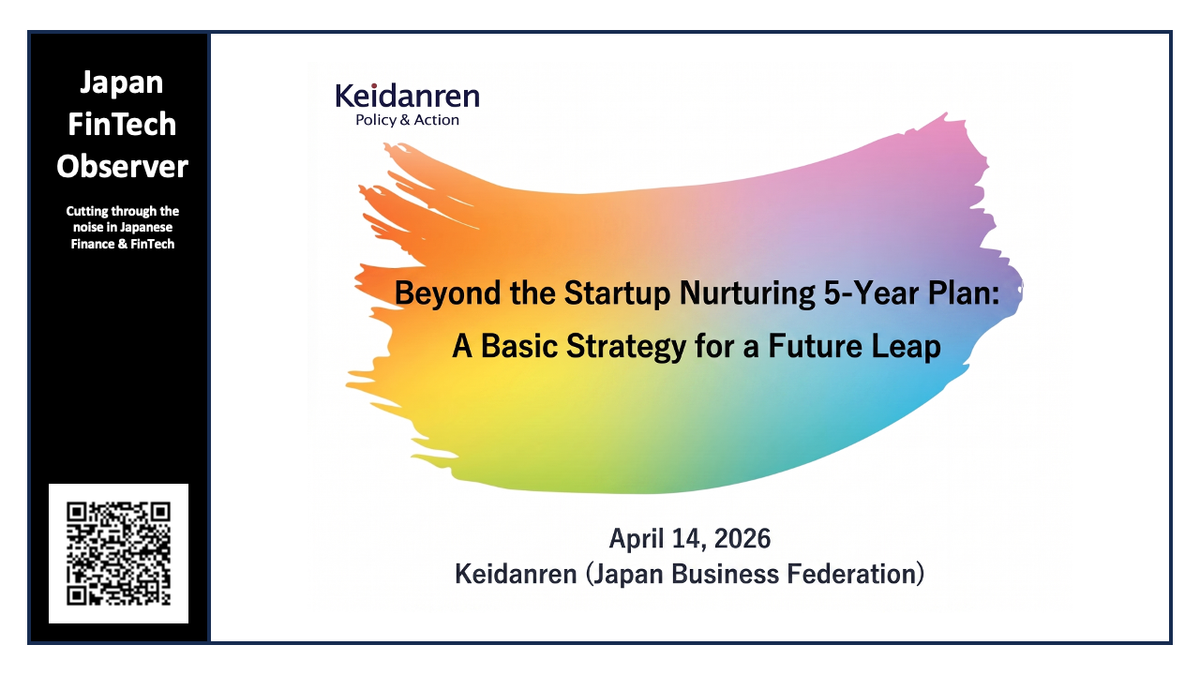
In 2022, the "10X10X" vision was established as the structural North Star for Japan’s economic revitalization, aiming to increase both the "base" (startup volume) and the "height" (valuation and success level) tenfold by 2027. While the initial years of the "Startup Development Five-Year Plan" successfully expanded the ecosystem's footprint, the strategic landscape has evolved. Under the current Takaichi Administration and the guidance of the Japan Growth Strategy Council, a harsh reality must be acknowledged: volume without value is not a strategy for global leadership. As the Summer 2026 growth strategy deadline approaches, Japan must pivot from merely cultivating ventures to orchestrating a "Global Leap."
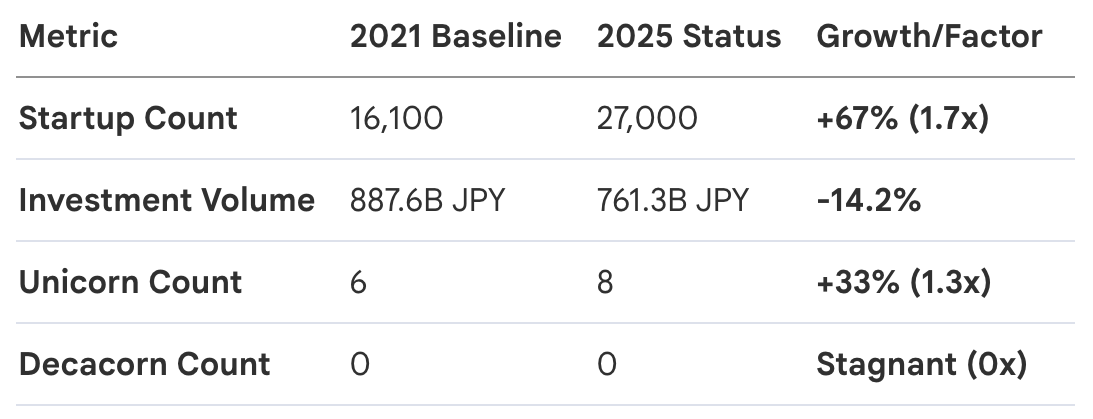
While the ecosystem achieved a respectable 1.7x growth in the number of startups, the "height" remains critically stagnant. The contraction in investment volume and the failure to produce a single decacorn have led to a decline in Japan's global standing. According to the Global Startup Ecosystem Report by Startup Genome, Tokyo fell from 10th place in 2024 to 11th in 2025, having been overtaken by Shanghai. This regional displacement confirms that matching global standards is insufficient; Japan is losing ground to rivals who are scaling faster. To arrest this decline, a "Second Five-Year Plan" must be institutionalized that prioritizes global market dominance over domestic headcount.
1. The Strategic Pillars of the Second Five-Year Plan
Sustainability in a high-tech economy is predicated on predictable, long-term government commitment and an internationalized policy framework. The transition to the next phase should be architected upon three non-negotiable strategic pillars:
- Continuous Government Commitment: Ecosystem maturity is a decadal endeavor, not a budgetary cycle. Following the proven blueprints of Israel (YOZMA), the UK (Tech City), and Singapore (Startup SG), Japan must ensure policy continuity. A mandate for the formulation of the "Second Five-Year Plan" to Review progress and bridge the 2027 transition is required, signaling to global markets that Japan's pro-startup stance is a permanent structural fixture, immune to political volatility.
- Global "Leap" Ecosystems: The Global Startup Campus (GSC) must be more than a real estate project; it is the multicultural gateway for research-to-business translation. This hub must be "agile-by-design" to account for the rapid advancement of AI. A multinational management team capable of operating at global velocity must be recruited, ensuring the GSC serves as a magnet for top-tier international researchers and VCs.
- Public Demand as a Scale-up Driver: Market forces alone often fail to support the "Scaling" phase in high-public-interest sectors. The government must act as an "Anchor Tenant" in Defense, Space, and Disaster Prevention. By providing concentrated, long-term procurement, the "Initial Demand" necessary for startups to bypass early-stage market failures will be provided and the industrial capacity required for global competition will be built.
2. Strengthening the Foundation: Deep Tech and the "Ignition Team" Model
The primary bottleneck for "Height" is the historical inability to translate university-led research into commercial powerhouses. The "Science to Startup" (S2S) model is the essential fuel for Japan's future, but it requires a specialized catalyst to bridge the gap between the laboratory and the stock exchange.
To enhance visibility for global investors, international benchmarks such as the European Patent Office’s (EPO) "Deep Tech Finder" should be adopted. To actively "excavate" these seeds, the formation of "Ignition Teams"—expert units possessing four non-negotiable capabilities—is recommended:
- Business Design/Concept: Orchestrating commercial narratives from technical breakthroughs.
- IP Strategy: Leveraging patent portfolios for global competitive advantage.
- Staffing/Human Capital: Phased recruitment of executive talent.
- Funding/Finance: Engineering sophisticated, multi-stage capital plans.
To catalyze this, the government will provide "pump-priming" matching funds to VCs for talent acquisition. These funds will be more generous when used to attract international experts, acknowledging the necessity of world-standard compensation. Furthermore, "Customer Discovery" at the pre-incorporation stage must be mandated. By testing market needs during R&D, it will ensure that Japan no longer produces "technology looking for a problem," but rather solutions for high-value global challenges.
3. Commercialization Catalysts: Procurement and Regulatory Transformation
Institutional barriers and rigid market entry hurdles are the primary killers of scale-ups. Public procurement must be treated as a strategic lever for industrial transformation.
An immediate transition from the current 1.5% procurement achievement to the 3% short-term benchmark must be mandated, with an ultimate strategic target of 10%. To reach this, the following "Startup-Friendly" institutional shifts have to be implemented:
- Multi-year & Agile Contracts: Overhauling the single-year budget cycle to accommodate iterative tech development.
- Exemption from Contract Deposits: Removing capital-draining requirements for smaller ventures.
- "Fast-Pass Procurement": Streamlining dual-use (Defense) technology adoption to ensure rapid deployment of cutting-edge innovation.
Critical to this transformation is the link between SBIR Phase 2 and Phase 3. Currently, too many projects stall at the technical proof stage (Phase 2) and fall into the "Valley of Death." Phase 3 technical support must be linked to private risk money (VC/CVC). By making private investment a prerequisite for advanced government support, public R&D is tethered to commercial reality and mass-production capacity.

4. Global Capital Infusion and the Diversification of Exit Strategies
The "Success Height" of the ecosystem is directly proportional to its integration with top-tier global Venture Capital and the availability of diversified exit liquidity.
Aggressive Attraction of Foreign VCs: Japan must implement bold economic incentives, including attractive matching fund structures. Crucially, "living infrastructure" has to be developed—encompassing education, housing, and family support—to make Japan a viable long-term base for global investors. Simultaneously, domestic venture capitalists need to be dispatched abroad to embed themselves in global networks and master international best practices.
Exit Diversity Roadmap: Japan must move beyond the "small-scale IPO" trap by activating three specific pathways:
- Secondary Market Activation: Leveraging the revised Financial Instruments and Exchange Act to facilitate the trading of unlisted shares, providing liquidity for early investors and employees.
- Corporate M&A: Japan must aggressively promote the Open Innovation Tax System, which now explicitly includes the acquisition of 50% or less (minority stakes) of a startup. This is a critical tool for large enterprises to integrate startup innovation into their core strategies.
- Startup-to-Startup M&A: Japan should facilitate the integration of smaller ventures to build larger, globally competitive entities with the scale to disrupt international markets.
5. Conclusion: The Roadmap to 2027 and Beyond
The era of "cultivation" is over; the era of the "Global Leap" is a structural imperative. The behavioral change of Japan's large corporations will be monitored via the "Startup Friendly Scoring" system, focusing on:
- Resource Provision: Human capital, funding, and strategic procurement.
- Incorporation/M&A: Proactive acquisition and "acqui-hiring."
- Spinoffs/Carve-outs: Facilitating the flow of talent and technology back into the ecosystem.
By Spring 2027, Keidanren will deliver the definitive proposal for the Second Five-Year Plan. The mandate is clear: matching global standards is no longer the goal. Japan must surpass global standards to reclaim its competitive edge. Startups are the central engine of our national economic transformation; their success is the only viable path to Japan's future growth.
 Norbert Gehrke