From Failed AI Startup to FinTech Unicorn: Alpaca Becomes the AWS of Global Investing

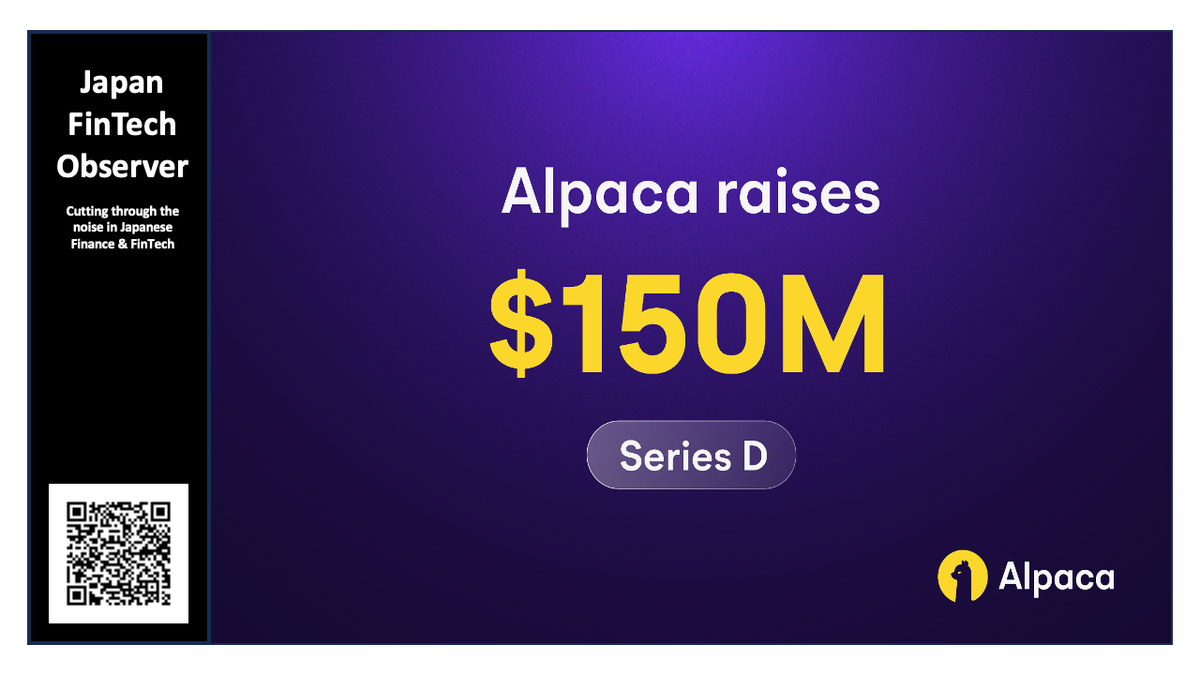
Alpaca, the API-first stock brokerage platform that powers hundreds of FinTech applications worldwide, has officially secured its Series D funding, pushing the company’s valuation past the coveted $1 billion mark.
However, for Co-founder and CTO Hitoshi Harada, the "unicorn" label—once a rarity in the startup world—is less a destination than a mile marker. Speaking recently at a Tokyo FinTech Meetup on the company’s trajectory, Harada outlined Alpaca’s evolution from a struggling deep-learning startup into a critical infrastructure provider for the global financial ecosystem.
The Pivot: From Database Visualization to Financial Infrastructure
Alpaca’s road to a billion-dollar valuation was paved with rejection and reinvention. Founded in 2015 by Harada and CEO Yoshi Yokokawa, the company initially launched as a deep-learning AI product. Harada candidly describes that initial venture as a solution in search of a problem.
"We started the company because we wanted to start a company, which was a huge mistake," Harada admitted.
The turning point came when the founders observed the meteoric rise of Robinhood and the subsequent demand for mobile-first trading. They realized that while consumer demand was shifting, the backend infrastructure for trading remained archaic. Developers were resorting to reverse-engineering private APIs just to execute algorithmic trades.
Alpaca pivoted to become the "AWS of stock trading"—a developer-first API allowing anyone to build trading applications. The transition wasn't an overnight success; the company applied to Y Combinator four times before finally being accepted into the Winter 2019 batch.
Finding Product-Market Fit in B2B
While initially embraced by individual algorithmic traders, Alpaca found its true engine for growth in the B2B sector. Following their Y Combinator stint, the company began receiving inquiries from other FinTech startups that wanted to offer trading services but lacked the regulatory licenses and technical infrastructure to do so.
Today, Alpaca operates as a "Brokerage-as-a-Service," providing the regulatory and technical plumbing for over 300 partners globally. Their client roster includes major international players such as Midas in Turkey, IndMoney in India, and Baraka in the UAE.
The company now boasts a notional trading volume exceeding $2.5 billion.
A Remote-First Global Strategy
The pandemic forced Alpaca to close its Silicon Valley office, a move Harada says turned into a strategic advantage. Now a fully remote company, Alpaca hires talent regardless of geography, allowing them to better serve a client base that is overwhelmingly international.
"Even though our roots are in the US, our business is global," Harada noted.
The company is aggressively pursuing a global licensing strategy. Already licensed in the US (FINRA/SEC/CFTC) and holding local licenses in Japan, Alpaca is currently applying for regulatory approval in Singapore, Canada, and Saudi Arabia to support the burgeoning FinTech ecosystem in the Middle East.
The Future: Tokenization and 24/7 Markets
With the fresh Series D capital, Alpaca is expanding its asset classes beyond US equities and crypto. The company recently launched options trading and fixed income support.
However, Harada’s long-term vision centers on the digitization of finance. He points to the rapid regulatory shifts in markets like Japan and the Middle East regarding real-world asset (RWA) tokenization. Alpaca aims to position itself at the forefront of this shift, moving toward 24/7 trading and a completely tokenized investment environment.
"Our vision is much bigger than where we are today," Harada said. "We want to provide financial services and investment opportunities to all 8 billion people on the planet. We are still only at 10 million accounts, so it is a long journey ahead."
 Norbert Gehrke