How to Establish a USD 5bn Digital Bank in Less than Six Months

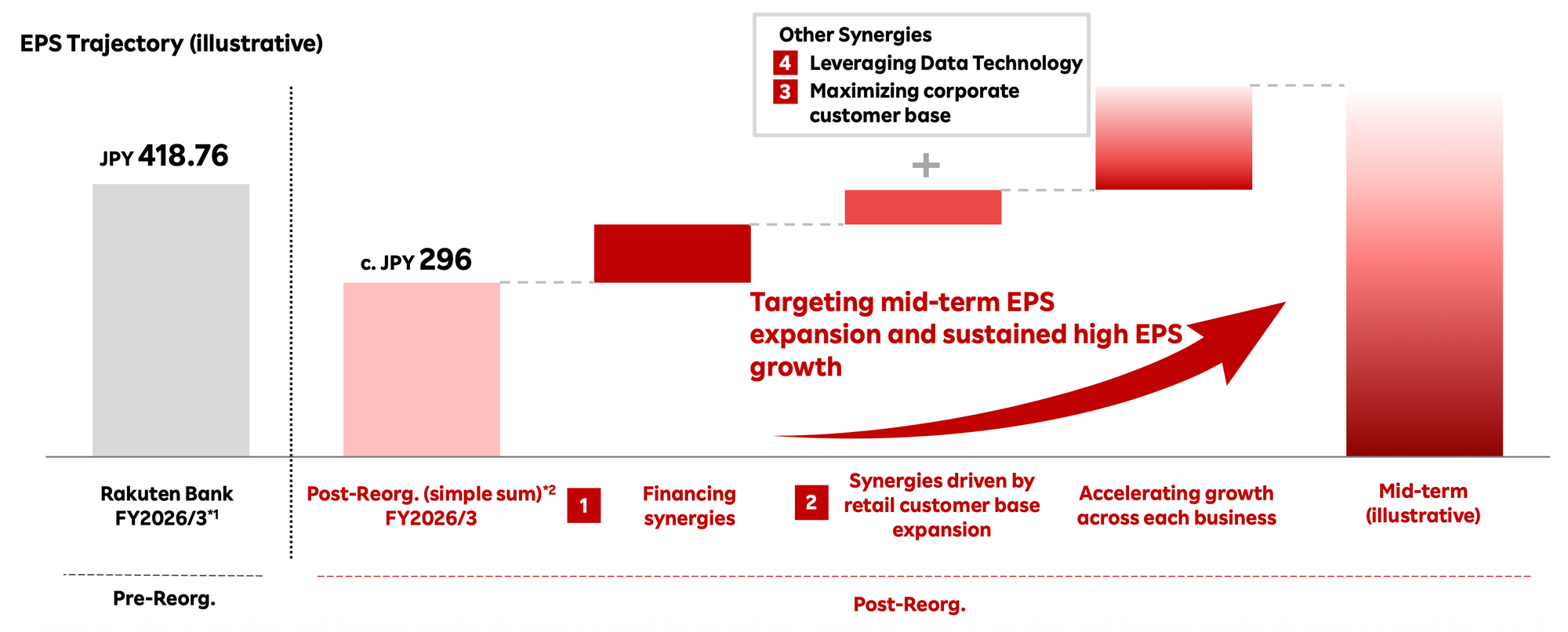
In last week's Japan FinTech Observer, we detailed the planned reorganization of Rakuten's FinTech business, highlighting that the punchline, a post-reorganization EPS of JPY 296, compared to a pre-reorganization forecast of JPY 418.76, was conveniently tucked away on page 31 of the supplementary materials.
Rakuten Bank's stock, which held around JPY 5,000 post-announcement, suffered further and has slipped below JPY 4,400 at the time of writing, even accelerating its decline once more after Rakuten Bank published "FAQs" on Friday to respond to the market.
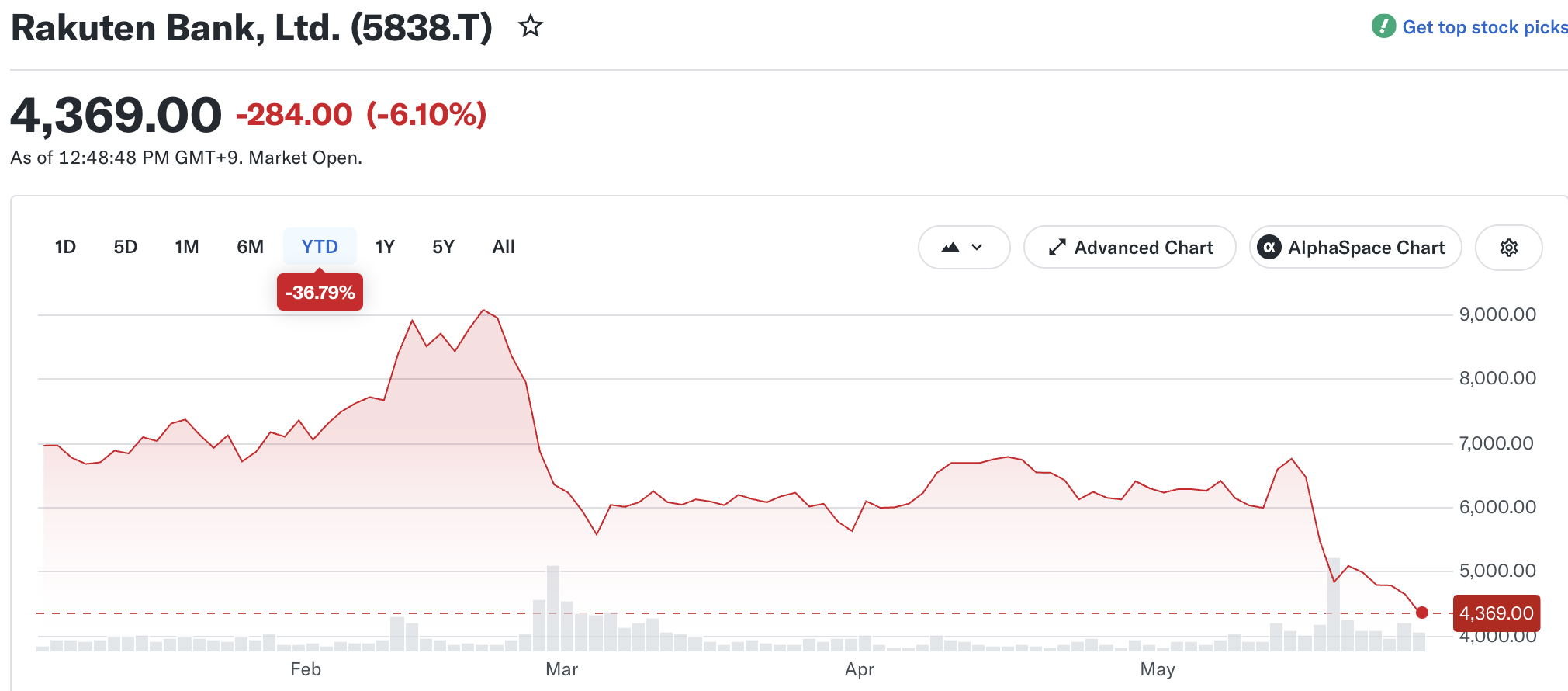
So, Rakuten Bank, which was worth about USD 10bn at the end of February, before the nebulous "FinTech Reorganization" announcement hit the wires, has lost about half its value since. Key information from the FAQ document has been summarized below.
Recap of Reorganization Strategy
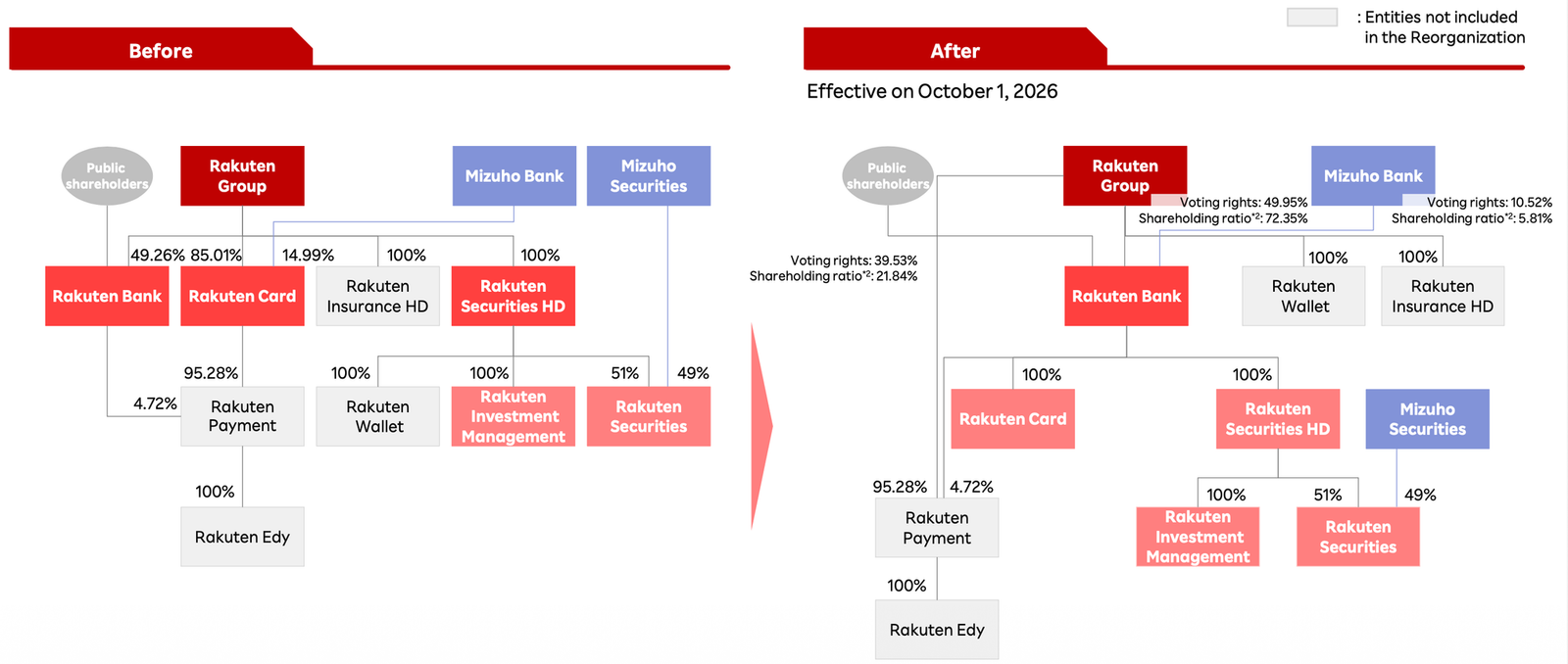
Rakuten's FinTech Reorganization strategy will bring Rakuten Card and Rakuten Securities Holdings under Rakuten Bank's umbrella as subsidiaries via a share delivery mechanism.
Controlled Dilution and Capital Strategy via Class A Shares
To fund the transition without triggering an immediate dilution of voting power or breaching Tokyo Stock Exchange Prime Market listing requirements, Rakuten Bank is utilizing a specialized Class A Non-voting Share structure.
- Structure & Conversion: These shares carry transfer restrictions and zero voting rights, but maintain economic parity with common stock regarding dividends. Upon the effective date, Rakuten Group will convert 25,859,500 of its newly issued 207,330,443 Class A shares, while strategic partner Mizuho Bank is scheduled to convert all 23,559,673 of its allocated Class A shares into common stock.
- Dilution Safeguards: Under an integrated agreement, Rakuten Group cannot convert remaining shares without Rakuten Bank’s prior consent. Any exceptional conversion is strictly capped to ensure Rakuten Group’s ultimate voting rights ratio does not exceed 50%.
- Free-Float & Stakes: The non-voting design prevents a drop in the bank's free-float ratio below the mandatory 35% threshold. Furthermore, management noted that neither Rakuten Group nor Mizuho Bank has any current intention to sell their common shares post-conversion. Rakuten Group views the FinTech unit as a core segment, clarifying that the reorganization is not intended for fundraising.
Long-Term Financial Guidance and Interest Rate Positioning
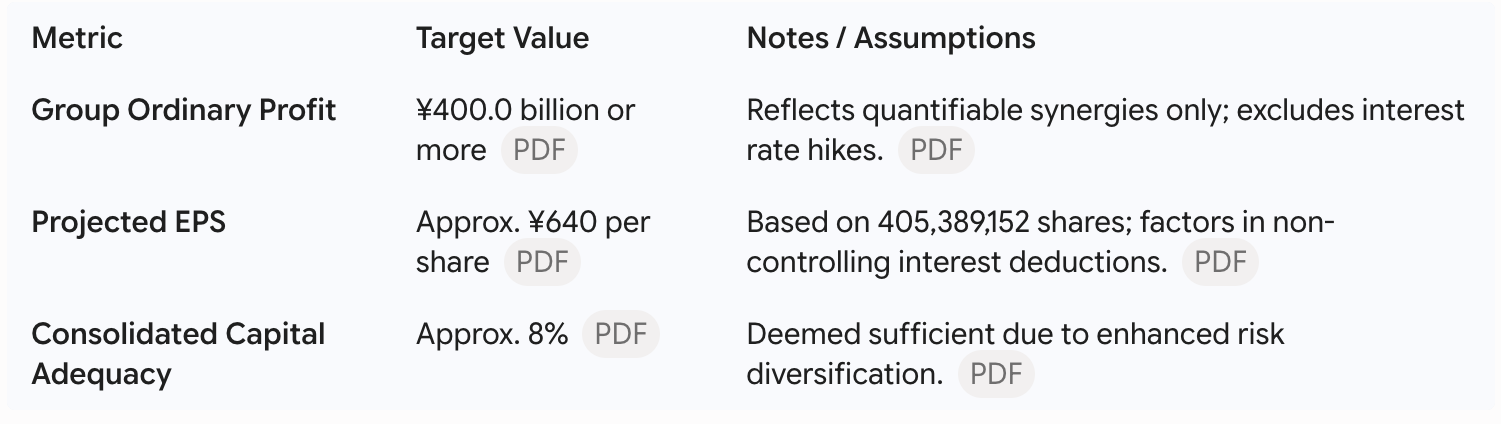
The bank projected an ambitious growth trajectory through the fiscal year ending March 2030, driven by the consolidated profit contributions of the newly acquired subsidiaries.
Target Financial Metrics (FY Ending March 2030)
Reshaping Earnings Sensitivity
The consolidation will fundamentally shift Rakuten Bank's revenue mix away from balance-sheet dependency. The standalone earnings composition of approximately 75% interest income to 25% non-interest income (based on FY2026/3 expectations) will transition to a more balanced 55% to 45% split on a simple sum basis.
Management confirmed that the group's overall earnings will remain positively levered to rising interest rates on the asset side. Concurrently, the negative impact of rising rates on the funding side will be largely neutralized on a consolidated basis by progressively replacing the external interest-bearing debt of Rakuten Card and Rakuten Securities with intra-group borrowings.
Corporate Governance and Conflict Management
Because the reorganization constitutes a transaction with a controlling shareholder, Rakuten Bank implemented stringent measures to insulate its decision-making from potential conflicts of interest.
An independent Special Committee—comprising two independent outside directors, two independent outside audit & supervisory board members, and one outside legal expert—held 18 meetings between February 11 and May 20, 2026. The committee retained Deloitte Tohmatsu LLC as its independent valuation institution to secure a Share Delivery Ratio Valuation Report and a Fairness Opinion.
To preserve the integrity of the negotiations, Rakuten Group Chairman and CEO Hiroshi Mikitani recused himself entirely from the bank's board deliberations and decision-making processes. Rakuten Bank President Tomotaka Torin similarly abstained from the reorganization votes, participating exclusively in reviews regarding the capital and business alliance with the Mizuho Group.
 Norbert Gehrke