ITFOR is Leveraging AI and "Co-Creation" to Scale the JPY 70 Billion Frontier

The history of ITFOR (4743.T) is essentially a chronicle of the Japanese technology sector’s transition from hardware-led social infrastructure to high-margin software. Founded in 1972 as CJK—a trading entity specializing in the importation of sophisticated American and Israeli communications hardware—the company’s identity was initially forged in the era of physical connectivity. However, the true genesis of its current market-leading position occurred in 1975, when the company developed Japan’s first online Point-of-Sale (POS) system. This was the birth of a proprietary software philosophy that would define the company for the next five decades. By shifting from a distributor of foreign technology to a developer of domestic business logic, ITFOR began its ascent as a "niche-leader," focusing on the complex, industry-specific workflows that major global players often ignored.
Today, the Prime Market-listed entity stands at a critical inflection point that investors must parse with care. Under its "HIGH FIVE 2033" long-term vision, ITFOR is aggressively moving to scale its net sales to JPY 70,000 million—a target that requires a pivot from linear, incremental growth to a "non-linear" trajectory. To achieve this, the company is systematically dismantling its traditional "In-House Approach"—the siloed internal development model that served it well for decades—in favor of a "Co-creation" model. This shift is designed to address the "Digital Cliff," a period where legacy systems across Japan are expected to become operational liabilities. By leveraging Artificial Intelligence (AI) and external startup technologies via Corporate Venture Capital (CVC), ITFOR aims to redefine its value proposition from a vendor of packaged software to a strategic partner in "regional economic circulation." ITFOR is positioning itself as the indispensable digital architect for regional Japan. This evolution is underpinned by a dominant, high-barrier grip on specific niches where competition has effectively vanished, creating a stable, cash-rich foundation for its next decade of expansion.
1. The Competitive Moat: Analyzing Market Dominance in Regional Finance
The cornerstone of ITFOR’s investment thesis is its formidable "domain knowledge," which serves as a structural barrier to entry that is virtually impossible for new entrants to replicate. In the highly regulated and operationally idiosyncratic world of regional banking, ITFOR has cultivated a "niche-leader" status that makes its systems the functional backbone of financial stability. This is most visible in the Financial Systems Division, where the company commands a staggering 70% market share in credit management systems for regional banks.
1.1 Flagship Products: The Lending Lifecycle
ITFOR’s dominance in this sector is driven by a suite of three flagship products that manage the entire lifecycle of credit and lending:
- CMS (Credit Management System): This is the flagship platform for personal loan collection. It allows for the centralized management of delinquent debt, integrating complex Japanese regulatory requirements with efficient collector workflows. It is the "gold standard" for debt collection operations among regional lenders.
- SCOPE (Personal Loan Operation Support System): A sophisticated credit screening system that originated in 1983 as a personal credit information inquiry tool. It has since evolved to integrate with AI-based screening services, such as those provided by Mitsubishi Research Institute, to automate application processing.
- WELCOME (Web-based Personal Loan Application Contract System): This remote, end-to-end electronic contract platform has seen a surge in adoption as regional banks scramble to modernize their customer-facing portals in the post-pandemic digital era.
The analytical significance of this 70% market share lies in what management describes as "Survivor’s Benefits." In a classic case of a natural monopoly born of attrition, major domestic computer manufacturers and large-scale system integrators withdrew from these specialized, relatively low-volume niche markets because they lacked the margins required for massive conglomerates. ITFOR, as an independent integrator with deep specialization, remained. This has left the company with an effective monopoly in certain sub-segments.
Furthermore, the switching costs are prohibitively high. ITFOR’s top 30 customers exhibit a 10-year retention rate of 65%. For a regional bank, replacing a CMS or SCOPE system is a "heart transplant" involving the bank's core lending logic. This stability creates a defensive perimeter that protects the company’s high-margin "stock" revenue—comprising maintenance, cloud fees, and BPO—which now accounts for a significant portion of its recurring earnings. This reliable cash flow provides the "firepower" for ITFOR’s more aggressive R&D and AI ambitions.
1.2 Financial Architecture: Revenue Mix and Profitability Reforms
ITFOR’s financial health reflects a strategic transition from "flow" (one-time implementation fees) to "stock" (recurring) revenue. Under its "Third Medium-Term Management Plan," the company moved away from chasing raw sales volume to prioritizing "core earnings power" and capital efficiency.
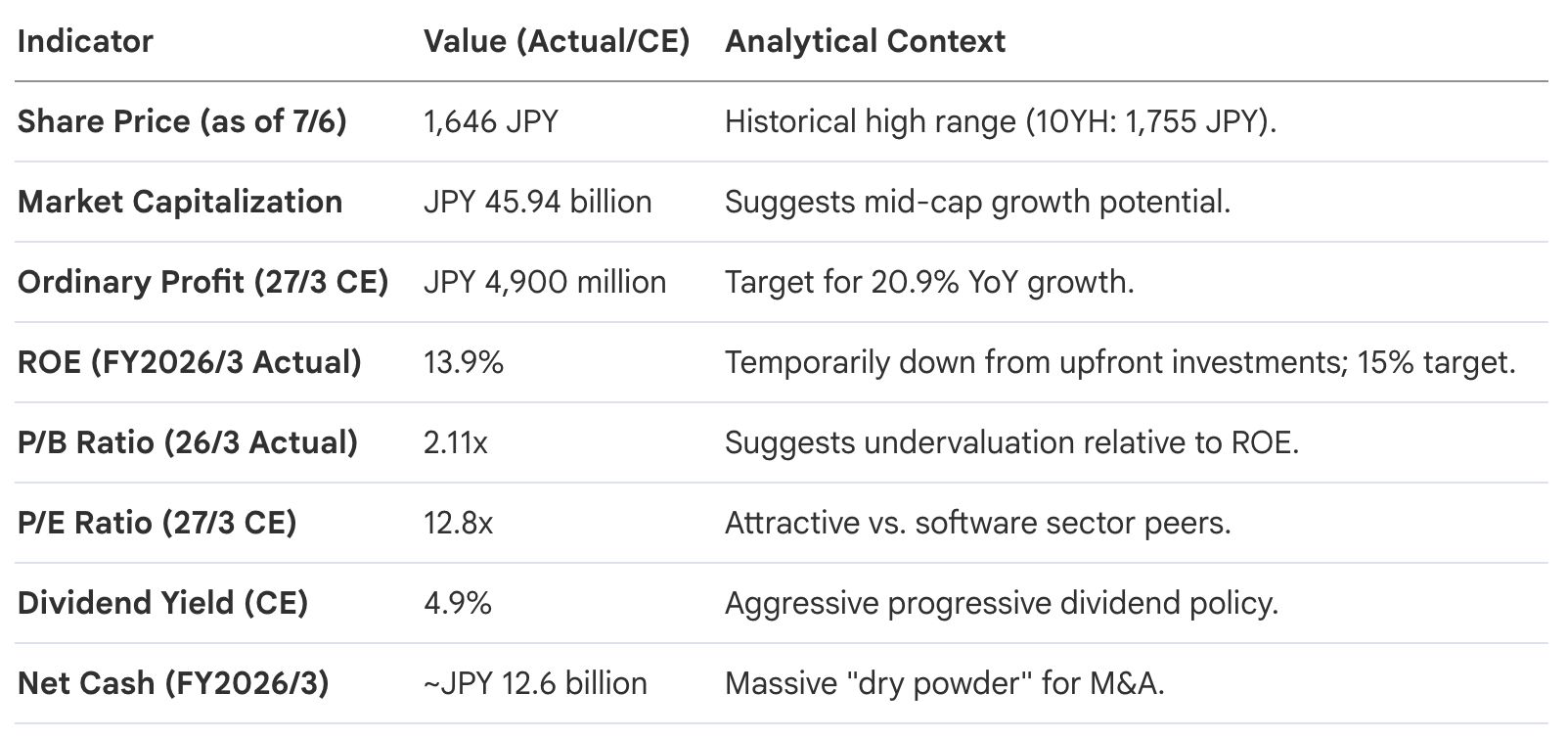
While FY2026/3 saw record sales of JPY 23,101 million, the performance fell slightly short of internal plans. This was not a failure of demand but rather a matter of timing and investment. Specifically, the shortfall was driven by the "carryover of public-sector subsystem projects" due to schedule delays at major core system vendors, alongside project delays in the Retail EC and Payment segments. On the profit side, margins were suppressed by JPY 239 million in new product development and JPY 112 million in human capital investment (base pay increases). Additionally, JPY 138 million was allocated for the "relocation and renovation" of the Kyushu and West Japan offices.
From an investor’s perspective, these are "healthy" suppressants. The 15% ROE target remains the North Star. With an 18% operating margin target in the "HIGH FIVE 2033" vision, the company is signaling that its "core earnings power" is at an exceptionally high level. The progressive dividend policy and high yield (4.9%) suggest that management is committed to returning value while it waits for its "Growth Capital Initiative" to deliver non-linear results.
1.3 The Digital Frontier: AI Implementation and "Co-Creation" Strategy
The Japanese technology market is currently facing the "Digital Cliff"—the point where legacy systems become too costly and risky to maintain. Simultaneously, ITFOR is identifying a paradigm shift it calls the "death of SaaS." This concept argues that standardized, one-size-fits-all cloud services are becoming a commodity that fails to provide a competitive edge. To stay relevant, ITFOR is positioning AI not as a back-end tool, but as a "co-creation" partner that integrates industry-wide best practices with client-specific needs.
This shift is operationalized through the Growth Capital Initiative, which has institutionalized M&A and CVC through a dedicated team handling everything from deal generation to post-merger integration (PMI). The velocity of this pivot is evident in the specific investments made between 2025 and 2026:
- February 2025: Investment in Real-Time Crowding Visualization technology to monitor human density, vital for modern urban and retail planning.
- April 2025: Investment in a Shopping Support App for International Visitors, aimed at the booming inbound tourism market.
- April 2026: Investment in an Online Duty-Free Shopping Platform, further solidifying its "Store DX" offerings.
- May 2026: A strategic investment in Financial ID and Credit Infrastructure for Foreign Workers.
By integrating startup technologies with its existing regional bank networks, ITFOR is facilitating "regional economic circulation." For example, the Financial ID infrastructure allows regional banks to offer credit and services to an underserved demographic (foreign workers), while the duty-free platforms support local retail customers. This is the essence of co-creation: using ITFOR’s massive "domain knowledge" and 47-prefecture customer base as a launchpad for high-growth external technologies.
2. Segment Deep-Dive: Diversification as a Risk Mitigant
ITFOR’s strategic architecture acts as a hedge against market volatility and a mechanism for deepening "area-dominance." The company is currently transitioning to an account-based sales model, where single representatives cross-sell the entire portfolio. The goal is to raise the regional cross-sell rate (involving two or more divisions) to 95% by FY2026.
2.1 Public Systems Division: The CARS Strategy
This division leverages the "CARS Series" to manage delinquent taxes and insurance premiums for 155 organizations across 32 prefectures. Unlike competitors who focus on core registry systems, ITFOR pursues a "niche strategy" in delinquency management. As regional government systems standardize, competitors who cannot meet these rigorous requirements are withdrawing, leaving ITFOR to capture "Survivor’s benefits." Their "all-in-one" model—combining software with BPO staff recruited from local communities—creates a B2B2C feedback loop that ensures high service quality and regional loyalty.
2.2 Retail EC Systems Division: The Shopify Pivot
Historically reliant on an in-house model (RITS), this division has strategically shifted to a co-creation model with Shopify. This allows regional department stores to leverage globally standardized e-commerce functionality while retaining ITFOR’s specialized "gift demand" logic. Furthermore, the division is pushing "Store DX" through smartphone-based mini-POS systems for event venues, directly addressing the labor shortages and location constraints of regional retailers.
2.3 CTI Systems Division: Robotic Calling and CXone
Originally a hardware importer for Israel’s NICE, this division now integrates the "CXone" cloud platform with ITFOR’s proprietary debt management systems. The standout product is "robotic calling," which automates delinquency reminders. This is a critical solution for the "2040 problem" of severe labor shortages; by automating mundane collection calls, financial institutions can reallocate human talent to high-value tasks.
2.4 Payment Systems Division: The Fixed-Fee Disruptor
Unlike the per-transaction fee model common in the industry, ITFOR’s iRITSpay uses a "fixed monthly fee model." This is a significant selling point for regional banks; it prevents the outflow of regional funds to global payment processors and ensures that as transaction volume grows, the profit stays within the regional community. The division is also expanding into "terminal-free" solutions like SoftPOS to capture the mobile payment market.
2.5 Communications Systems Division: Niche Infrastructure
The company’s oldest division continues to provide "Survivor advantages" in social infrastructure. As domestic manufacturers exit the Time-Division Multiplexing (TDM) equipment market, ITFOR uses overseas equipment (e.g., from Israel’s RAD) to help utilities and telecommunications carriers migrate to IP networks while retaining legacy interfaces (e.g., Megaplex). It also offers cybersecurity through "CyCraft AIR" and "RansomGuard" for SMEs, cross-selling these to its existing financial and public-sector base.
3. Operational Foundation: The "Yorisou Chikara" Philosophy and Human Capital
ITFOR’s competitive advantage is ultimately rooted in a human capital strategy it calls "Yorisou Chikara" (The Strength to Support). This is a functional driver of the company’s 10-year, 65% retention rate.
The company invests in its workforce with a rigor that is rare in the IT sector. New employees undergo 7.5 months—over 1,000 hours—of intensive technical and business training before their first assignment. The goal is to create "salesperson-engineers" who possess the business acumen to translate a customer’s "vague anxieties" into precise system requirements. This internal expertise is supplemented by "User Groups"—forums where customers discuss shared operational challenges. This creates a virtuous cycle where direct feedback from the front lines is fed back into the next software package update.
The analytical significance here is risk management. In a market where the "competition for talent" is intensifying, ITFOR’s debt-free balance sheet and managerial independence are vital recruitment tools. As an independent integrator, ITFOR can attract engineers who wish to work across multiple industries (Finance, Public, Retail) without being tied to a specific hardware manufacturer’s ecosystem. This human foundation enables the "B2B2C" perspective, ensuring that ITFOR’s software provides "peace of mind" for the end consumer—the citizen paying taxes or the bank customer applying for a loan.
4. Strategic Outlook and the "FLY ON 2026" Mandate
The central question for investors is whether ITFOR can successfully transform from a steady "packaged software vendor" into a "non-linear growth" engine. The "FLY ON 2026" plan is the critical bridge to that future, targeting net sales of JPY 28,000 million by FY2027/3.
SWOT Analysis & Strategic Verdict
- Strengths: 70% share in niche finance; 65% customer retention; JPY 12.6 billion in net cash; debt-free status.
- Weaknesses: Risk of dependence on specific domestic markets; low recognition in capital markets.
- Opportunities: Public-sector DX demand (regional government standardization); AI-driven labor savings; new businesses through CVC.
- Threats: Japan’s shrinking population; "2025 Digital Cliff"; intensifying competition for high-level engineers.
The verdict on ITFOR is one of "calculated transformation." The company possesses the necessary "firepower"—the JPY 12,600 million in net cash—to fund the M&A and CVC investments required to hit its JPY 70 billion target for 2033. While the shift from an "In-House" silo to an open "Co-creation" ecosystem carries execution risks, ITFOR’s "Survivor’s Benefits" in financial and public sectors provide a high margin for error.
The successful integration of AISEL into the consolidated accounts and the rapid-fire CVC investments in 2025 and 2026 suggest that management is moving with a velocity that belies the company's 50-year age. If ITFOR can successfully bridge its dominant regional bank network with its new "Platform for Foreign Nationals," it will transcend its role as a software vendor to become a central pillar of Japan’s regional economic infrastructure. For the patient, yield-seeking investor, ITFOR represents a cash-rich legacy player that is aggressively—and methodically—buying its way into the future.
 Norbert Gehrke