Japan FinTech Observer #190

Welcome to the one hundred ninetieth edition of the Japan FinTech Observer.
We would like to award our annual "20/20 Foresight" Prize to the smart (and lucky) people at Aon, who fortuitously decided to schedule one of their two annual company holidays for the past Friday the 13th, thus limiting the business impact of the Microsoft outage globally, as well as getting all their people home before the air traffic stop in the US. I am certain the real reason is that it was the CEO's wedding anniversary or so, but it surely makes you look damn good!
Here is what we are going to cover this week:
- Venture Capital & Private Markets: Olyv raises USD 6.15m in Series C extension led by Nippon Life; Mitsubishi UFJ Capital participates in robotics prosthetics maker BionicM's JPY 710m Series B first close; Avatar Capital Partners secures USD 156m first close for Japan Living Fund II; tech firm aisaac backs seed-stage VC TOKI’s JPY 2bn inaugural fund
- Insurance: Sony Financial Group first-half net profit jumps 66%, cuts full-year IFRS profit outlook on market swings; Hokan Group launches insurance-focused accelerator, selects two inaugural startups
- Banking: Rakuten Bank posts record first-half profit on rate hikes, lifts full-year outlook following FinTech reorganization; Saison International partners with ADB in up to USD 500m push for Asian MSME and climate financing
- Payments: Rakuten Card posts double-digit first-half profit growth as fee hikes offset rising funding costs
- Capital Markets: Japan Post Bank to acquire near-20% stake in Matsui Securities in broad strategic alliance; Rakuten Securities Q3 operating profit surges 50% as accounts top 15m and assets hit record JPY 60.8trn; AI governance, JPY 370trn growth push, and retail shift anchor LSEG Tokyo Forum
- Digital Assets: Japan’s financial giants push on-chain toward wholesale JGB and collateral markets; SBI Digital Markets and Ember Protocol sign MoU to explore institutional RWA tokenization on Arbitrum; Minna no Ginko and Backpack operator Trek Labs Japan sign MOU on web3 financial services; TOPPAN and BitGo complete trial of three-party digital asset key management system
- The Last Word: The FSA's Third Working Group on the Provision of Funds to Growing Companies
Venture Capital & Private Markets
- Olyv raises USD 6.15m in Series C extension led by Nippon India Digital: Digital personal lending platform Olyv has raised ₹57.62 crore (approximately $6.15 million) in an extension of its Series C funding round; the capital infusion was led by new investor Nippon India Digital (ultimately owned by Nippon Life Insurance Company) with a ₹50 crore investment, while existing backer Fundamentum Partnership Fund contributed the remaining ₹7.62 crore; according to regulatory filings, the Bengaluru-based company allotted 25,057 compulsorily convertible preference shares (CCPS) and 10 equity shares at an issue price of ₹22,985.82 per share to complete the transaction; the follow-on tranche was executed at a flat valuation of roughly ₹1,104 crore; it builds on Olyv’s initial ₹207 crore (around $23 million) Series C round in February, which was led by Fundamentum with participation from the SMBC Asia Rising Fund, bringing the total capital raised across the combined round to approximately ₹265 crore
- Mitsubishi UFJ Capital participates in robotics prosthetics maker BionicM's JPY 710m Series B first close: BionicM Inc., a Tokyo-based developer of powered prosthetic legs utilizing humanoid robotics technology, has raised JPY 710 million (approximately $4.5 million) in the first closing of its Series B financing round; the tranche, which incorporates prior investments made via J-KISS convertible equity, brings the startup’s cumulative funding—encompassing both equity financing and government grants—to JPY 2.58 billion ($16.4 million); the round drew participation from domestic venture firms B Dash Ventures and Mitsubishi UFJ Capital, alongside overseas investors and individual angel investors; BionicM will allocate the fresh capital toward reinforcing its production infrastructure and expanding U.S. sales and marketing operations ahead of the planned 2027 U.S. commercial launch of its next-generation prosthetic knee, ASISTA
- Avatar Capital Partners secures USD 156m first close for Japan Living Fund II: Asia-based alternative asset manager Avatar Capital Partners (ACP) has raised US$156 million in the first close of its second fund, Fund II, which targets US$300 million for investments in Japan’s residential sector; the capital raise is anchored by a joint commitment of up to US$100 million from GCM Grosvenor and the Teacher Retirement System of Texas (TRS); under the agreement, TRS and GCM Grosvenor’s real estate practice—a middle-market platform builder and GP stakes investor—will serve as both anchor investors in Fund II and strategic partners supporting ACP’s institutional expansion; Chicago-headquartered GCM Grosvenor (Nasdaq: GCMG) oversees approximately $97 billion in assets across alternative investment strategies; Fund II is structured to target off-market opportunities across Japan’s living sector; according to ACP, the strategy is underpinned by favorable demographic trends, sustained rental demand, accelerating rental growth, and an attractive financing environment in Japan
- Tech Firm aisaac backs seed-stage VC TOKI’s JPY 2bn inaugural fund: Tokyo-based web service developer aisaac has invested as a limited partner (LP) in the inaugural fund of venture capital firm TOKI; founded in 2025 by former Genesia Ventures capitalist Masami Ichinohe and former Globis Capital Partners investor Sho Masubuchi, Minato-ku-based TOKI began operating its first vehicle—TOKI No. 1 Investment Limited Partnership—in 2026; the firm plans to complete raising a total of ¥2 billion for the fund by the end of 2026; TOKI’s fund targets seed-stage domestic startups, focusing on sectors within the Sanae Takaichi administration's 17 strategic fields, including advanced medicine and content; the fund aims to invest in roughly 10 companies with a maximum allocation of ¥800 million per startup, and has already backed preventive medical service AI Dock
Insurance
- Sony Financial Group first-half net profit jumps 66%, cuts full-year IFRS profit outlook on market swings: Sony Financial Group (TSE: 8729) reported a 65.8% year-on-year increase in first-half net profit, supported by earnings growth across its life insurance, non-life insurance, and banking units, even as it lowered its full-year statutory profit forecasts due to financial market fluctuations; for the six months ended September 30, 2026, profit attributable to owners of the parent rose to ¥28.63 billion from ¥17.27 billion a year earlier under International Financial Reporting Standards (IFRS); operating profit increased 22.8% to ¥32.53 billion, while operating revenue climbed 10.2% to ¥545.26 billion; group consolidated adjusted net income—a management metric that strips out market volatility and non-recurring items—rose 32.6% year-on-year to ¥62.48 billion
- Hokan Group launches insurance-focused accelerator, selects two inaugural startups: Japanese InsurTech holding company Hokan Group has launched "Hokan Accelerator," a six-month, hands-on startup support program tailored to the insurance sector, naming end-of-life platform neo Shukatsu and disaster-simulation developer aerota as its first cohort; the program commenced in October 2026 with the aim of accelerating commercial deployment and business growth across both life and non-life insurance markets; privately held Hokan Group, led by CEO Naoyuki Kosaka, will leverage its domestic industry network to support the startups; that infrastructure includes its core cloud-based customer and policy management software, hokan—adopted by more than 600 insurance agencies across Japan as of October 30, 2026—alongside consulting subsidiary CIEN, peer-to-peer coverage platform Frich, and its internal research institute, hal; both startups have already initiated field hearings with industry participants to evaluate practical implementation
Banking
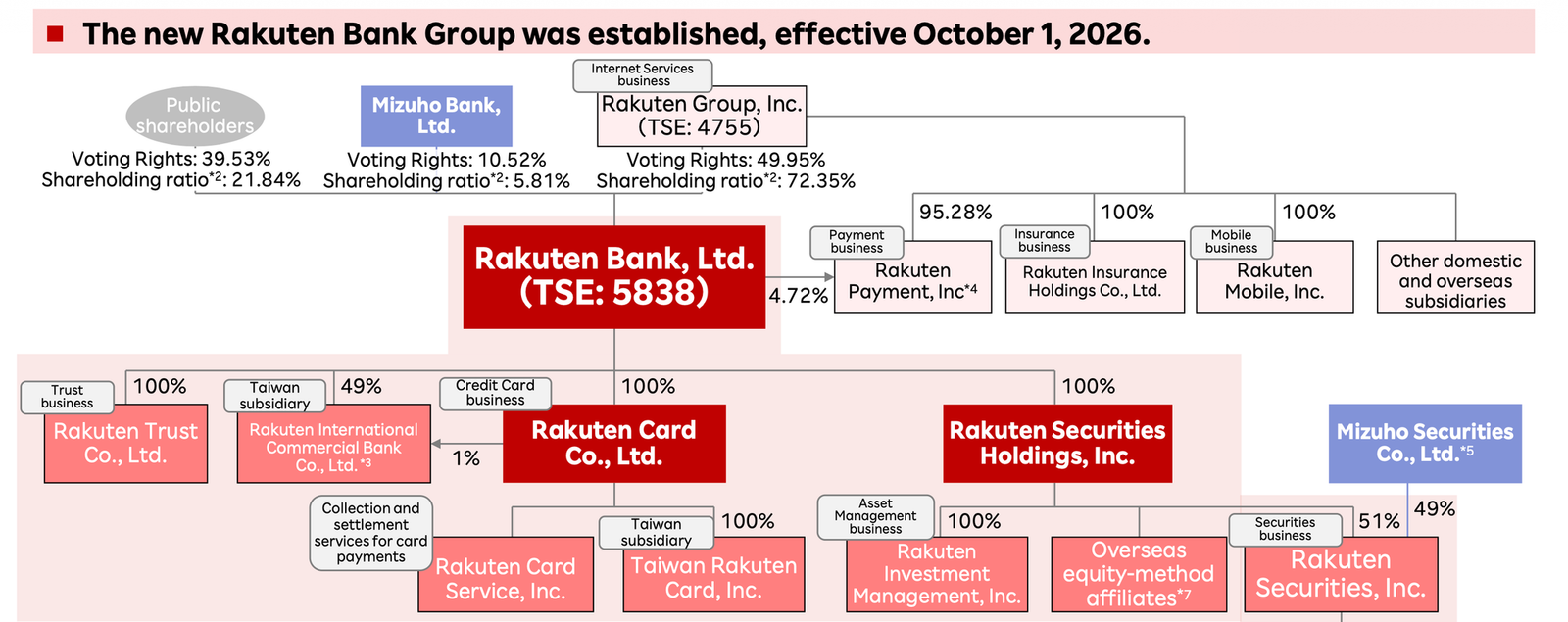
- Rakuten Bank posts record first-half profit on rate hikes, lifts full-year outlook following FinTech reorganization: Rakuten Bank reported record consolidated earnings for the first half of fiscal 2026 ended September 30, propelled by higher interest income following Bank of Japan rate hikes and double-digit deposit growth, while raising its full-year profit guidance and integrating Rakuten Group’s credit card and brokerage units; consolidated ordinary profit rose 30.6% year-on-year to JPY 63.0 billion for the six-month period, while net income attributable to owners of the parent increased 26.9% to JPY 43.1 billion; ordinary income climbed 38.4% to JPY 163.8 billion, marking first-half highs across all three metrics; excluding JPY 2.20 billion in expenses related to the Rakuten FinTech Group reorganization project, ordinary profit rose 35.1% to JPY 65.2 billion; top-line expansion was led by a 47.6% surge in consolidated interest income to JPY 133.1 billion, supported by the accumulation of floating-rate investment assets and a JPY 9.0 billion profit contribution from Bank of Japan policy rate increases; consolidated non-interest income grew 9.2% to JPY 30.3 billion, underpinned by an 11.0% rise in fees and commissions from settlement, direct debit, and debit card transactions
- Saison International partners with ADB in up to USD 500m push for Asian MSME and climate financing: Saison International, the Singapore-headquartered international arm of Tokyo Stock Exchange-listed Credit Saison, has executed a strategic Memorandum of Understanding (MOU) with the Asian Development Bank (ADB) to expand credit access and sustainable finance across developing Asia; the alliance establishes a formal operational framework to explore arranging a prospective financing package of up to US$500 million in medium- and long-term financial assistance over a three-year period; rather than functioning as a direct balance-sheet expansion for the Singapore holding entity, the prospective capital package will be targeted directly at the downstream operating portfolio companies of the Credit Saison Group—such as Credit Saison India—operating across ADB’s developing member countries; the prospective capital allocation aims to resolve persistent liquidity bottlenecks for underserved micro, small, and medium-sized enterprises (MSMEs), mobilize capital for female entrepreneurs, and promote climate-resilient operational practices across emerging regional markets
Payments
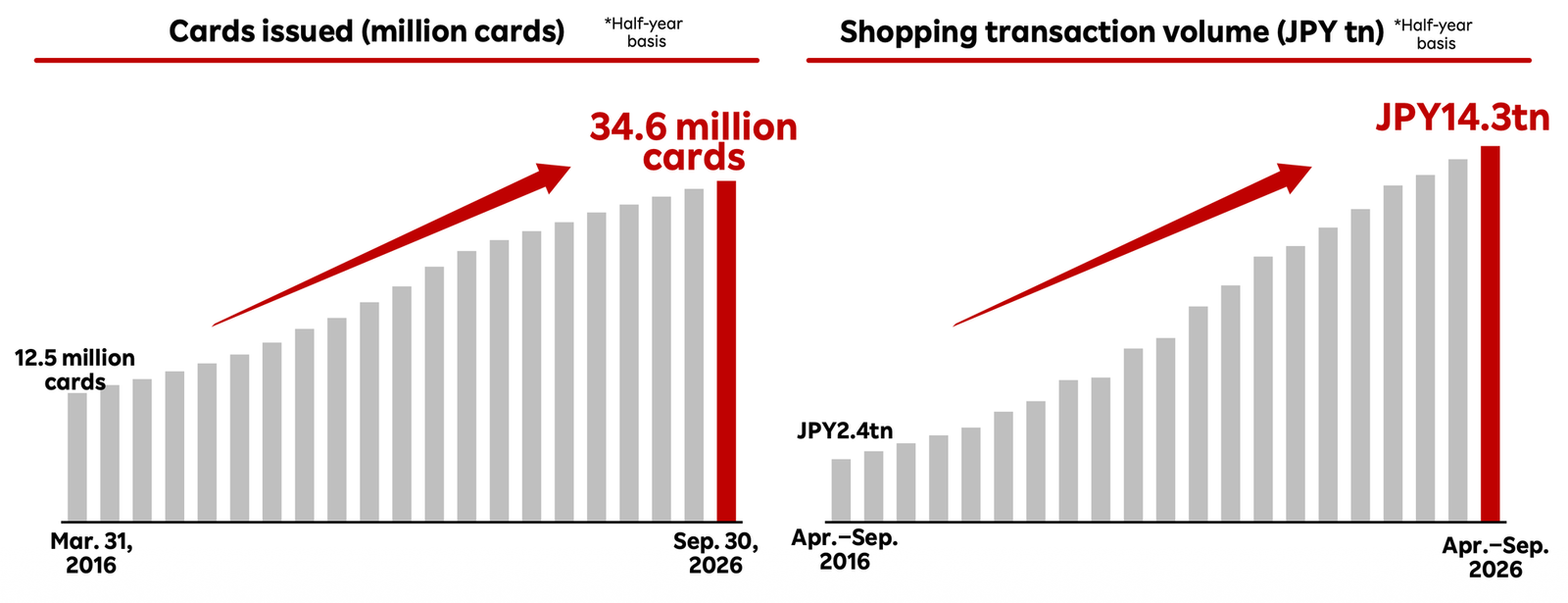
- Rakuten Card posts double-digit first-half profit growth as fee hikes offset rising funding costs: Rakuten Card reported double-digit growth in both revenue and operating profit for the first half of fiscal 2026, as higher customer fee rates outweighed rising borrowing expenses; for the six months ended Sept. 30, 2026, non-consolidated operating revenue climbed 17.4% year-over-year, or JPY 31.8 billion, to JPY 215.3 billion; operating profit rose 13.8%, or JPY 3.4 billion, to JPY 28.6 billion; total operating expenses increased 18.0% over the same period to JPY 186.6 billion, with operational efficiencies holding overall expense growth roughly in line with top-line expansion; top-line performance was underpinned by steady growth in card issuance and consumer spending; total cards issued reached 34.6 million as of Sept. 30, 2026, up 5.0% from a year earlier, while first-half shopping transaction volume rose 8.1% year-over-year to JPY 14.3 trillion
Capital Markets
- Japan Post Bank to acquire near-20% stake in Matsui Securities in broad strategic alliance: Japan Post Bank has agreed to acquire a 19.99% voting stake in Matsui Securities, positioning the postal banking giant as the online brokerage’s largest shareholder as part of a wide-ranging capital and business partnership; under the terms of an off-market private transaction, Japan Post Bank will purchase 51,489,700 common shares—representing 19.86% of issued stock—from Maruroku, the asset management vehicle of Matsui’s founding family; the founding family had approached Matsui in early 2026 regarding the potential divestment of an approximate 20% holding, prompting the brokerage to search for a strategic partner capable of driving sustainable, long-term expansion while preserving its managerial autonomy; the alliance establishes a major bridge between Japan Post Bank’s retail reach—comprising roughly 120 million customer accounts and a nationwide branch and digital network—and Matsui’s digital brokerage platform; through customer referrals and joint marketing initiatives, Matsui aims to capture active investors and high-net-worth clients seeking a shift from traditional face-to-face banking to online trading
- Rakuten Securities Q3 operating profit surges 50% as accounts top 15m and assets hit record JPY 60.8trn: Rakuten Securities posted a 49.6% year-on-year jump in third-quarter consolidated operating income to 19.5 billion yen, propelled by surging domestic equity trading, higher interest-rate-driven financial revenue, and a retail customer base that crossed 15 million accounts earlier this month; for the three months ended September 30, 2026, consolidated operating revenue rose 37.8% from a year earlier to 57.4 billion yen, lifting the brokerage’s operating profit margin by 2.7 percentage points to 34.1%; across the first nine months of its fiscal year ending December 2026, operating income exceeded 55 billion yen with an operating margin of 33.2%; for the April–September six-month period, operating revenue climbed 49.5% year-on-year to 115.6 billion yen while operating income jumped 84.5% to 40.4 billion yen
- Building the AWS of Global Finance: In this episode of the Wharton FinTech Podcast, Bobby Ma sits down with Yoshi Yokokawa, Co-Founder & CEO of Alpaca, the modern brokerage and clearing infrastructure that connects every asset class to the applications people use with DTCC, FICC, OCC, and Nasdaq memberships that powers over 15 million brokerage accounts through 300+ partners in more than 50 countries; the company clears or custodies roughly 94% of tokenized US securities; Yoshi shares his journey starting his career at Lehman Brothers to founding Alpaca with his university friend Hitoshi Harada and building it through Y Combinator into Japan's first unicorn; the discussion covers: his journey growing up between US/Japan to Lehman to founding Alpaca; why Alpaca internalized the entire regulatory stack; tokenized securities and anchor in traditional finance; shift from a developer-first to agent-first infrastructure; and Alpaca’s role in connecting every asset class into one programmable platform
- AI governance, JPY 370trn growth push, and retail shift anchor LSEG Tokyo Forum: Financial executives, regulators, and policymakers convening at the LSEG Insight Series Tokyo 2026 forum pointed to a structural shift in capital markets, as institutions move from raw data collection toward integrating artificial intelligence directly into core decision-making workflows; discussions across five sessions held at The Okura also underscored Japan’s multi-trillion-yen push to attract private capital, evolving retail investment habits under the revamped NISA program, and mounting cross-border financial crime risks
- Mitsubishi UFJ Morgan Stanley Securities (MUMSS) has published an "Investor Q&A" as part of its regular "Fixed Income Commentary"
Digital Assets
- Japan’s financial giants push on-chain toward wholesale JGB and collateral markets: Japan’s major financial institutions and market infrastructure operators are shifting their blockchain strategy from retail security tokens toward wholesale institutional markets, targeting Japanese government bond (JGB) repurchase agreements and real-time collateral management, executives said at an industry seminar; speaking at a panel hosted by the Japan Security Token Association (JSTA) on the current state and future of on-chain finance, executives from Nomura Holdings, Mitsubishi UFJ Financial Group (MUFG), Japan Exchange Group (JPX), Progmat, and Boostry noted that the domestic tokenization sector has reached a structural turning point; since Japan’s amended Financial Instruments and Exchange Act took effect in 2020, the domestic security token market has surpassed 400 billion yen—driven largely by retail real estate offerings—and is projected to reach roughly 500 billion yen across 100 issuances; however, following commercial tokenization rollouts by the U.S. Depository Trust & Clearing Corporation (DTCC) and ongoing central bank trials in Europe, Japanese institutions are increasingly prioritizing wholesale post-trade and clearing efficiency
- SBI Digital Markets and Ember Protocol sign MoU to explore institutional RWA tokenization on Arbitrum: SBI Digital Markets, a subsidiary of Japanese financial conglomerate SBI Group, has signed a memorandum of understanding with investment platform Ember Protocol to explore structuring, tokenizing, and distributing institutional real-world assets (RWAs) onchain; the parties plan to target Arbitrum, an Ethereum-based blockchain platform built by Offchain, for the initial deployment of these products; the collaboration pairs SBI Digital Markets' regulated financial services, asset origination, structuring, custody, and institutional distribution with Ember Protocol's infrastructure for tokenization, vault deployment, liquidity, and ongoing operations; the scope of the partnership covers the entire product lifecycle, including asset structuring and issuance, investor subscriptions and redemptions, settlement, secondary market access, and cross-network distribution
- Minna no Ginko and Backpack operator Trek Labs Japan sign MOU on web3 financial services: Digital bank Minna no Ginko, led by President Kenichi Nagayoshi, has signed a memorandum of understanding (MOU) with Trek Labs Japan to explore integrating banking functions into Trek Labs Japan’s upcoming Web3 infrastructure and cryptocurrency trading platform; established in April 2023 and headquartered in Tokyo's Shinjuku Ward, Trek Labs Japan is the local subsidiary of the global group operating the "Backpack" brand, which provides self-custody, non-custodial wallets and a high-speed cryptocurrency trading platform; the Japanese unit is currently preparing to register as a licensed crypto asset exchange service provider in compliance with domestic regulations
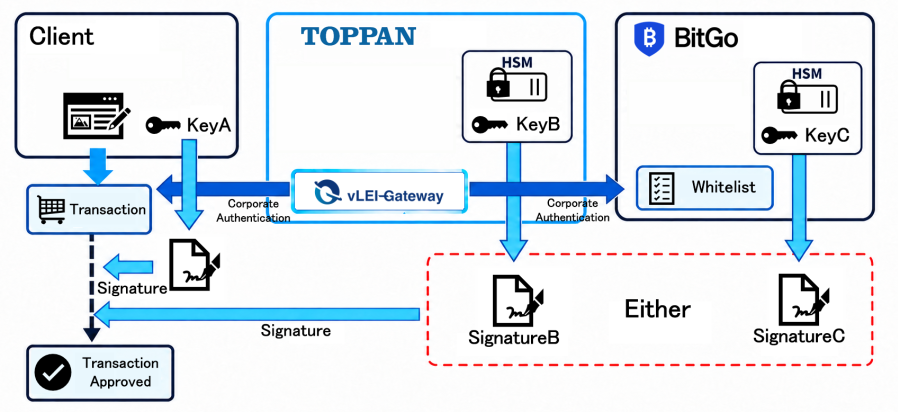
- TOPPAN and BitGo complete trial of three-party digital asset key management system: TOPPAN, a wholly owned subsidiary of TOPPAN Holdings (TYO: 7911), and digital asset infrastructure provider BitGo Holdings (NYSE: BTGO) have completed a joint proof-of-concept for a decentralized private key management system designed to secure institutional digital asset transactions; conducted from August to October 2026, the trial verified a framework that the two companies aim to launch as a commercial service as early as 2028, subject to definitive agreements, regulatory requirements, and technical and commercial readiness; the system distributes private key authority across three parties—the client, BitGo, and TOPPAN—to eliminate single points of failure and block unauthorized asset transfers; under the tested configuration, a client initiates a transaction using its primary signature key, while BitGo provides a mandatory countersignature via a hardware security module (HSM); TOPPAN holds a third backup key in a separate HSM, enabling transactions to proceed using two of the three keys if either the client’s or BitGo’s key becomes unavailable due to a system failure or natural disaster
- Financial interoperability and digital ledgers: Although financial institutions are increasingly adopting tokenized assets, the modern digital asset landscape remains severely fragmented across isolated networks with costly intermediaries; to solve this major industry roadblock, the financial sector desperately requires an open and neutral connectivity standard comparable to the internet's TCP/IP framework; addressing this challenge, Cosmos has contributed its Inter-Blockchain Communication (IBC) protocol to The Linux Foundation's LF Decentralized Trust (LFDT); this strategic transition provides a battle-tested, token-agnostic solution governed transparently by a global community of developers and organizations; ultimately, this open-source movement seeks to unite disparate ledgers into the largest financial network in the world, driving seamless global growth and interoperability; developers from Datachain, Inc., alongside OpenZeppelin and the Cosmos team, serve as voting maintainers of the IBC protocol following its contribution to the LFDT; under this neutral, contributor-led governance structure, Datachain’s developers are recognized as open-source owners of IBC
The Last Word: The FSA's Third Working Group on the Provision of Funds to Growing Companies
On November 9, 2026, the Financial Services Agency (FSA) convened its Financial System Council Working Group on the Provision of Growth Capital to Enterprises for its third session, with the aim to launch a comprehensive modernization of Japan’s non-bank and commercial lending regulations.
At the centerpiece of the agenda is a decisive move away from the uniform, retail-focused borrower protections introduced under the landmark 2006 overhaul of the Moneylending Business Act. In its place, regulatory authorities, economic planners, and industry representatives are fashioning a differentiated, risk-based "flexible structure". This framework recalibrates statutory oversight according to borrower sophistication, debt structure, and institutional negotiation leverage. The primary objective is to dismantle structural rigidities that currently constrain the flow of growth capital into private equity (PE) buyouts, venture investments, corporate M&A, and intra-group treasury operations, while maintaining rigorous consumer safeguards for retail borrowers.
This policy shift addresses a long-standing structural mismatch: statutory mechanisms designed twenty years ago to eradicate predatory consumer lending and over-indebtedness have become unintended drag factors across corporate finance. The 2006 regulatory architecture imposed strict conduct rules, total exposure caps, and mandatory paper disclosures regardless of borrower sophistication. Applied universally, these requirements create administrative drag for large-scale enterprise financing, private equity buyouts, and corporate Cash Management Systems (CMS). Meanwhile, capital allocation through alternative investment channels has expanded dramatically. According to FSA data presented to the Working Group, asset volumes managed by collective investment schemes expanded to roughly ¥81 trillion by FY2024 (with real estate funds at 38%, and buyout funds with 17% leading the allocation), demonstrating robust growth across private equity, buyout, venture, and real estate funds. Adapting Japan’s legal credit framework to accommodate this modern, institutional asset base has become a macroeconomic priority for financial authorities in Tokyo.
These macroeconomic pressures and the rapid institutionalization of asset management have brought fund-level subscription financing directly to the top of the FSA’s regulatory overhaul agenda.
Read the full report here.
Please follow us to read more about Finance & FinTech in Japan, like hundreds of readers do every day. Our short weekly digest, the “Japan FinTech Observer”, is published on LinkedIn, Medium, Substack, or on our own FinTech Observer website. Only the latter provides you with the option to subscribe to individual news stories as they are published.
Should you wish to further discuss the Japanese (or Asian) FinTech ecosystem, you may book a consultation via Intro - all proceeds flow towards covering the operating cost of the Tokyo FinTech Association, and research for the Japan FinTech Observer.