Money Forward Swings to 1Q Operating Profit with Record EBITDA Performance


Money Forward (TSE: 3994), a leading Japanese provider of back-office SaaS and financial management solutions, has delivered a surprisingly positive first-quarter performance for the fiscal year ending November 2026. The company achieved a positive operating profit of JPY 170 million, defying initial expectations of a loss. The results, underpinned by a 42% year-on-year (YoY) surge in consolidated net sales (excluding divestiture impacts), demonstrate that the firm's aggressive AI adoption and its burgeoning Fintech business are beginning to translate into sustainable margin expansion.
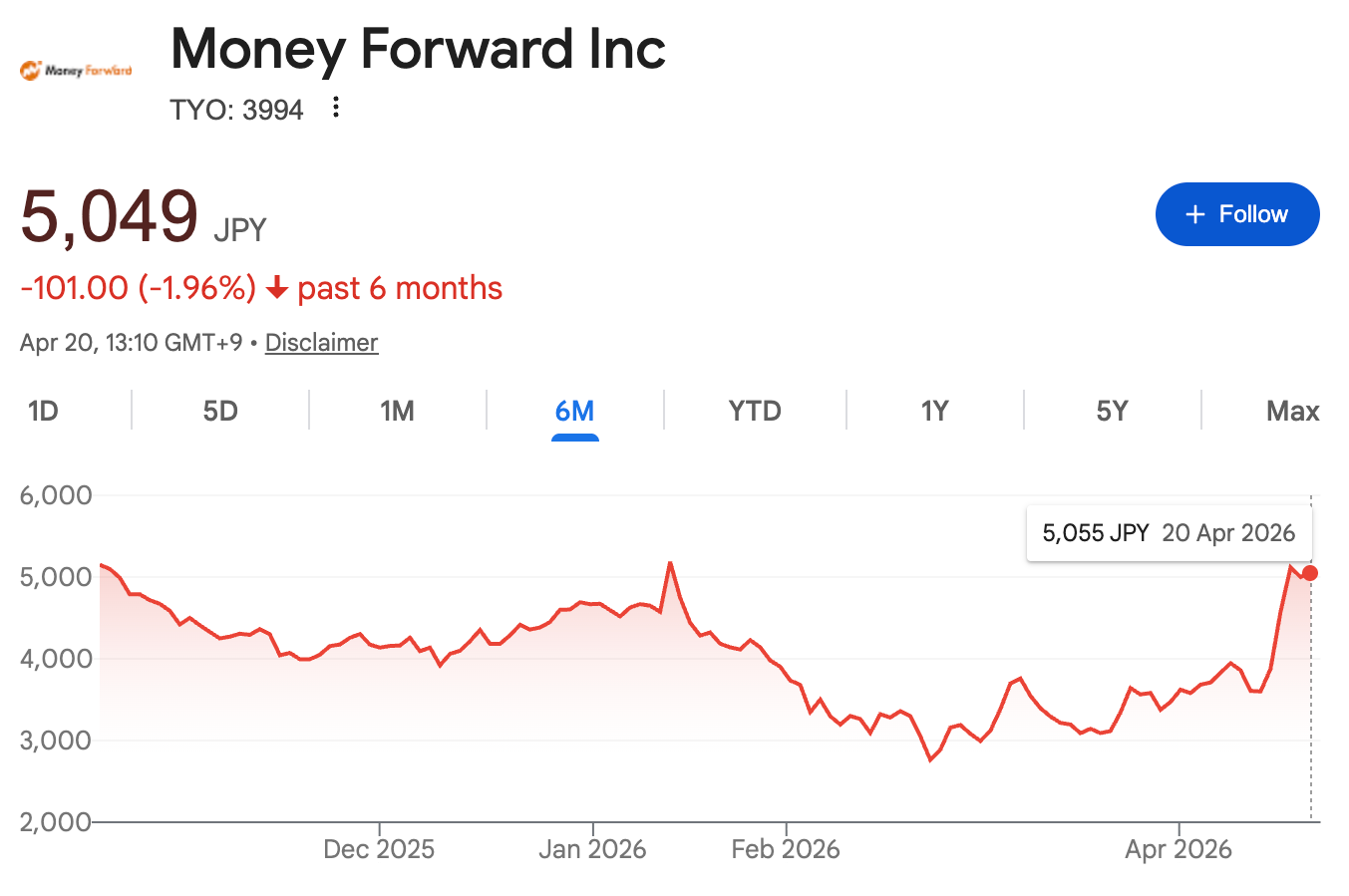
The results announcement also capped a tumultuous first calendar quarter for the stock, which reached a temporary low below JPY 3,000 in February.
Financial Overview: Profitability Meets High-Octane Growth
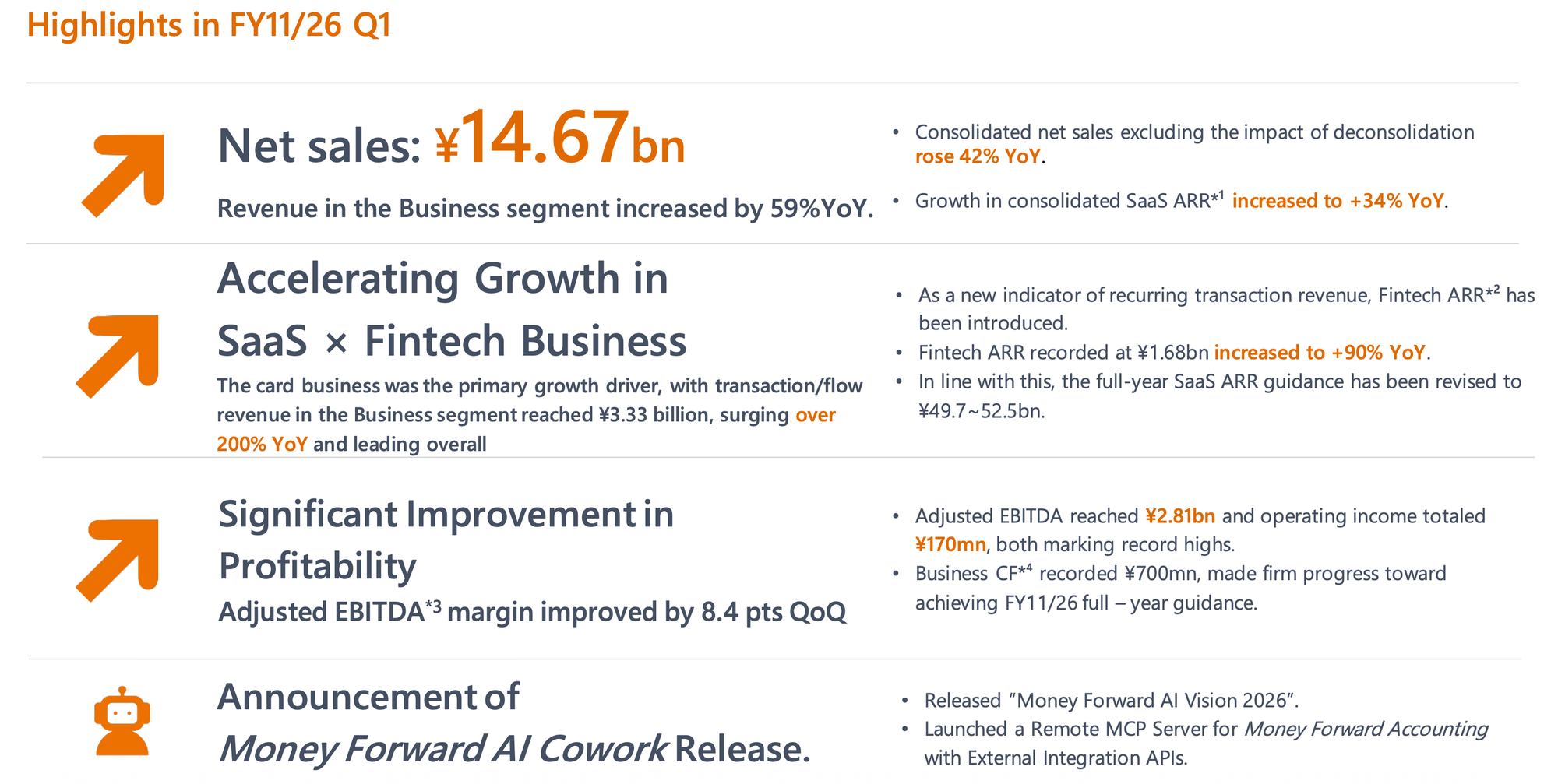
For the three months ended February 28, 2026, Money Forward reported consolidated net sales of JPY 14.67 billion. While the headline YoY growth rate stood at 25%, the company highlighted that, excluding the impact of the deconsolidation of SMARTCAMP and Next Solution, organic growth reached a robust 42%.
The most striking takeaway for analysts was the "Significant Improvement in Profitability." The company’s Adjusted EBITDA—a key metric for SaaS firms—reached a record JPY 2.81 billion, with the margin improving by 8.4 percentage points quarter-on-quarter (QoQ) to 19.2%. This margin expansion was driven by a combination of high-margin recurring revenue growth and disciplined cost control, specifically the strategic use of AI to suppress headcount growth.
Operating income, which stood at a loss of JPY 581 million in the same period last year, turned positive to JPY 170 million. This milestone is particularly notable as the first quarter is traditionally a period of heavy investment and seasonal fluctuation for the firm.
Segment Performance: The Business Engine Accelerates
1. Business Segment (Back-office SaaS & Fintech)
The Business segment remains the undisputed engine of the group, contributing JPY 12.37 billion in net sales—a 59% increase YoY. This acceleration was attributed to two primary factors: the continued success of the card business (transaction revenue) and successful price revisions for Small and Medium Business (SMB) corporate customers.
Corporate Annual Recurring Revenue (ARR) reached JPY 33.73 billion, up 37% YoY. Management noted that the growth in corporate ARR accelerated on a QoQ basis, a sign that market saturation remains far off. The net increase in corporate paying customers reached 9,918, a sharp jump from the 8,914 added in the same period last fiscal year, fueled by successful promotional campaigns and a strong accounting firm channel.
A new strategic highlight this quarter is the introduction of "Fintech ARR." This metric, which focuses on recurring transaction revenue from products like Money Forward Business Card and Fast Receivables, recorded JPY 1.68 billion, up a staggering 90% YoY. By breaking this out, Money Forward is signaling to investors that its FinTech revenue is becoming as predictable and valuable as its traditional SaaS subscriptions.
2. Home Segment (Personal Financial Management)
The Home segment, which centers on the Money Forward ME app, reported net sales of JPY 1.25 billion. While the headline growth was a modest 4% due to the divestiture of Nexsol, the underlying growth excluding that impact was 17%. Revenue from premium paying users expanded by 19%, driven by price revisions implemented in August 2025.
The total user base for Money Forward ME has topped 18.1 million, with 640,000 premium paying subscribers. A major catalyst for this segment looking ahead is the integration into the SMBC Group’s "Olive" platform. Starting March 2026, features of Money Forward ME will be incorporated directly into the SMBC and Vpass apps, which is expected to drastically lower customer acquisition costs (CAC) and accelerate user growth.
3. X Segment (Financial Institution Digital Transformation)
The X segment, which focuses on co-development with financial institutions, grew 36% YoY to JPY 934 million. Recurring revenue in this segment grew by 14%, while non-recurring (project-based) revenue surged 68%. Key projects include the Cashmap development with JCB and Orient Corporation, alongside the expansion of "BANK APP" services for regional banks like Shizuoka Chuo Bank and Kagawa Bank.
The AI Frontier: "AI Cowork" and Structural Productivity
Money Forward has positioned itself as an "AI-native" enterprise. The company used this earnings release to double down on its "Money Forward AI Vision 2026."
The flagship product, Money Forward AI Cowork, is scheduled for a full release in July 2026. Unlike traditional seat-based licensing, management revealed they are moving toward a value-based pricing model, including pay-per-task and volume-tiered structures. This is designed to capture the "Digital Worker" market—essentially charging for the labor the AI replaces rather than just the software access.
The internal impact of AI is already visible on the balance sheet. Management announced they are "suppressing hiring" by at least 100 employees compared to original forecasts for the fiscal year. This is made possible by productivity gains from AI coding agents like Cursor, which the company claims has reduced engineer workloads by 15–20 hours per week on average. By "raising the bar" for new hires and automating routine functions (including automatic coding and AI-powered help desks), Money Forward is aiming for an ambitious JPY 30 million in annual sales per employee by FY2028.
Cost Structure and Efficiency Metrics
The company’s gross profit margin for the overall business rose sharply to 73%. In the Back-Office SaaS business specifically, the margin reached a staggering 88% on a management accounting basis.
The breakdown of Cost of Sales and SG&A as a percentage of net sales shows a clear downward trend. Personnel expenses, which previously hovered above 50-60% of sales in earlier years, have been optimized to 43% this quarter. Advertising expenses were also kept in check at 10% of sales.
Management’s commitment to the "Rule of 40" (the sum of growth rate and profit margin exceeding 40%) was a recurring theme. With the Business segment currently delivering a 59% revenue growth rate and an 18.4% EBITDA margin, the company is well within the healthy range for high-performing SaaS organizations.
Balance Sheet and Cash Flow Dynamics
As of February 28, 2026, Money Forward maintains a high level of liquidity with JPY 69.3 billion in cash and deposits. There was a significant temporary increase in cash due to the settlement cycle of the invoicing BPO business, which added JPY 24.39 billion in collections that were held prior to being paid out to customers.
Business Cash Flow (excluding the impact of the Pay/Card business) was positive at JPY 698 million, making steady progress toward the full-year target of JPPY 2 billion. The company noted that it successfully sold one unlisted equity investment during the quarter, leading to an upward revision in the forecast for "Profit attributable to owners of the parent."
Strategic Acquisitions: AKASHI and michibiku
The quarter saw the active integration of two key acquisitions:
- michibiku: A corporate governance DX service that joined the group in Q1, contributing approximately JPY 100 million in ARR and JPY 50 million in net sales.
- AKASHI: In a major move in the HR space, Money Forward took over the attendance management system AKASHI from Sony Biz Networks Corporation. This acquisition, effective March 31, 2026, will be consolidated from Q2 onwards. With JPY 600 million in ARR and a high EBITDA margin of 60%, AKASHI is expected to be immediately accretive to the group’s bottom line.
Revised Guidance: Aiming for the Upper Bound
Following the strong Q1 results and the formal introduction of Fintech ARR into the guidance metrics, Money Forward has revised its full-year SaaS ARR forecast upward.
- Previous Guidance: JPY 47.5–49.8 billion
- Revised Guidance: JPY 49.74–52.50 billion (Representing 21.7% to 27.8% YoY growth)
The company also adjusted its forecast for net income attributable to owners of the parent from a range of JPY (5.2)–(2.2) billion up to JPY (3.7)–(0.7) billion, an upward revision of JPY 1.5 billion due to extraordinary income.
For the full year, management stated their policy is to aim for a level "above the median" of the current guidance for adjusted EBITDA (JPY 8.0–10.0 billion) and operating profit.
Q&A Insights: Sustaining the Momentum
In a follow-up session with analysts, CEO Yosuke Tsuji and the executive team addressed concerns regarding the sustainability of the Q1 surge.
Regarding the Business segment's 200% surge in transaction revenue, management clarified that while a portion was due to a "temporary surge in seasonal transactions," the underlying Fintech ARR growth of 90% remains stable. They expressed confidence in reaching the upper end of the growth range through cross-selling initiatives.
When questioned about the potential for net headcount reduction, management clarified they do not expect a net reduction but will continue to "raise the bar" for hiring, as AI utilization allows them to achieve revenue targets with fewer new additions. This structural shift is perhaps the most significant long-term takeaway for investors: Money Forward is decoupling revenue growth from headcount growth.
The Mid-Term Horizon: ¥90 Billion by FY2028
The company reaffirmed its medium-to-long-term financial targets, aiming for over JPY 90 billion in net sales by FY2028, with the Business segment contributing JPY 65–70 billion of that total. Perhaps most ambitiously, the company is targeting an AI-related ARR of over JPY 15 billion by FY2030, a goal that would place them at the forefront of the global AI software market.
Analysis: A Maturing SaaS Giant
For years, Money Forward was viewed by the market as a "high-growth, high-burn" player. These Q1 FY2026 results suggest that narrative is outdated. By turning an operating profit in the first quarter—traditionally a challenging period—the company has proven that its unit economics are sound and that its scale is finally yielding operating leverage.
The breakout of "Fintech ARR" is a clever tactical move. It reclassifies transaction-based revenue (which some investors view as lower quality) into the ARR framework, highlighting its recurring nature and stability. When combined with the aggressive 37% growth in the "Corporate" ARR, Money Forward presents a dual-engine growth story that few SaaS peers can match.
Furthermore, the suppression of hiring and the 15-20 hour weekly time savings for engineers are hard data points that demonstrate how AI is fundamentally altering the company’s cost curve. If Money Forward can maintain its 40%+ organic growth while keeping headcount growth in the low single digits, the target EBITDA margin of 40% in the long term appears not just possible, but likely.
Conclusion
Money Forward has kicked off FY2026 with a "very good start," in the words of its management. With record EBITDA, a swing to operating profit, and a clear, data-backed AI strategy, the company has provided a compelling case for its valuation. Investors will likely look to the July launch of AI Cowork and the integration of AKASHI in Q2 as the next major catalysts. As the company continues to tap into a total addressable market (TAM) estimated at JPY 5.7 trillion—and potentially JPY 14.1 trillion in the "digital worker" space—Money Forward appears well-positioned to dominate the Japanese back-office ecosystem for the remainder of the decade.
 Norbert Gehrke