Strategic Transformation via Generative AI and Data Consolidation: The Sumitomo Mitsui Trust Asset Management (SMTAM) Model

Sumitomo Mitsui Trust Asset Management is revolutionizing its business operations by integrating Snowflake and generative AI to automate complex tasks.
Executive Officer Matsumoto explained during the Snowflake World Tour Tokyo how the firm uses "skills" defined in natural language to replace traditional programming, allowing employees to build internal tools without advanced technical expertise. This initiative has already impacted over 35% of their business costs by mapping and automating hundreds of distinct workflows within just a few months.
The company emphasizes a "Loop Engineering" philosophy, where systems autonomously identify and solve problems to continuously improve efficiency. By centralizing data and business logic, they have moved beyond traditional silos to create a transparent, self-improving organizational structure. Ultimately, the transition focuses on aligning AI capabilities with high-level business goals rather than just implementing new technology.
Five Key Takeaways
- The "Muscular" Organizational Mandate: SMTAM has committed to a three-year executive mandate to become a lean, "muscular" organization, redesigned to maintain core operations with 50% of the current headcount through deep AI integration.
- Transition to Agentic In-Sourcing: Transformation has evolved from simple LLM-assisted programming to "agentic in-sourcing," where natural language logic—formalized as "Skills"—replaces proprietary software and disconnected programmatic tools.
- High-Value Prioritization: Rapid scaling is driven by strategic prioritization; by addressing only 20% of identified tasks, SMTAM has already impacted 35% of its total business cost-base.
- Observability as Governance: The failure of traditional End-User Computing (EUC) was not its ease of use, but its lack of observability. By centralizing logic in Snowflake, "shadow IT" is replaced by a transparent system where AI diagnoses its own performance.
- Leading with Context, Not Control: In a decentralized AI environment, the role of leadership shifts from imposing rigid restrictions to providing AI agents and employees with the rich business context necessary for autonomous, high-quality decision-making.
1. The Strategic Mandate: Building a "Muscular" Organization
In the asset management industry, technological transformation fails when it is treated as an IT cost-center rather than an executive mandate. For structural change to take root, it must be anchored in the firm’s Mid-Term Business Plan. At SMTAM, the drive for digital transformation is a survival strategy designed to build a "muscular" organization.
The strategic objective is uncompromising: within three years, the firm will be capable of operating its core functions with half the members. This "muscular" goal serves as the catalyst for every subsequent architectural decision. It moves beyond incremental efficiency toward a total redesign of business throughput. This mandate is operationalized through a rigorous three-layered approach:
- Organizational Level: Integration into the mid-term plan ensures top-down commitment and explicit resource allocation.
- Departmental Level: A systematic audit of every department identified 650 specific business tasks as targets for transformation.
- Individual Level: "Promotion members" are assigned from each department to lead execution, with performance evaluations explicitly tied to AI-driven output and results.
This alignment ensures that data consolidation within the Snowflake ecosystem is a practical necessity for organizational survival.
2. Theoretical Framework: The Shift from Programmatic to Agentic In-Sourcing
The definition of "in-sourcing" has reached a turning point. Prior to 2025, in-sourcing was programmatic, utilizing LLMs to assist humans in writing code faster. We have now entered the era of agentic in-sourcing, where natural language serves as the primary interface for specialized business knowledge.
This shift was signaled by the "Anthropic Shock." When Anthropic released specialized capabilities for its Claude model, the market reaction was immediate and telling: shares of specialized providers like Thomson Reuters (Legal) and IBM (Cobol analysis) saw double-digit pressure. The market now recognizes that specialized logic, once trapped in proprietary SaaS silos, can be expressed and executed via natural language logic.
Within SMTAM’s internal AI environment, "CoCo," this is achieved through "Skill" development—a three-step process to transform human intuition into an autonomous asset:
- Data Preparation: Consolidating 4,000+ internal tables, manuals, and reports into Snowflake to provide a foundational knowledge base.
- Logic Verbalization: Transforming implicit business intuition—the "Judgment Axes" of an expert—into explicit, verbalized criteria.
- Skill Formalization: Consolidating these criteria into natural language "Skills" that an agent can execute.
Example: CoCo "Stock Commentary Skill"
- Input: Stock performance data and market trends.
- Timing: Executed upon market close or specific volatility triggers.
- Method: Evaluate stocks based on defined "Judgment Axes" (e.g., sector performance vs. historical volatility) and generate a natural language summary.
This transition redefines the human role. Creating a mere "search function" is a dead end; it creates disconnected processes that ignore business motivation. The architect's goal is now agentic orchestration, where humans supervise the total throughput of the workflow.
3. Empirical Results: Measuring Three Months of Rapid Scaling
To validate AI investments, SMTAM utilizes a data-driven PDCA cycle. After three months of utilizing the CoCo environment, metrics indicate a fundamental increase of "utilization depth".
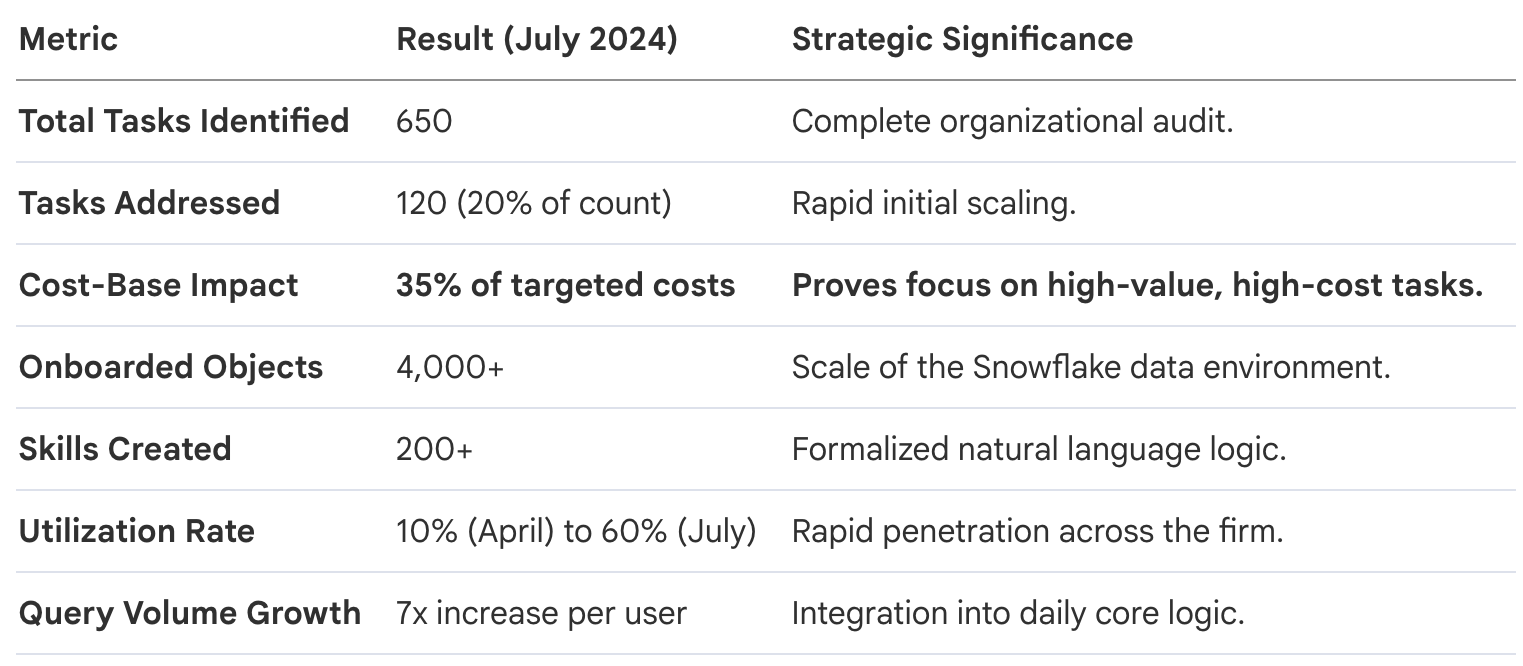
The fact that 20% of tasks account for 35% of the cost-base proves the strategic focus of the CDO: we are not merely automating easy tasks; we are systematically dismantling the firm’s highest cost centers.
4. Redefining Governance: From "Wild EUC" to Observable Systems
Executive leadership often fears that empowering end-users leads to "Wild End-User Computing (EUC)"—the unmanageable shadow IT of the Excel era. However, the failure of traditional EUC was not that it was too easy to use, but that it was impossible to observe.
Snowflake and Cortex flip this script. By moving logic from isolated Excel files into observable "Skills" and centralized tables, SMTAM has achieved a transparent ecosystem. In CoCo, natural language skills serve as both execution logic and live, self-updating manuals.
SMTAM employs an automated "Diagnosis" demo to evaluate usage. This AI-driven system analyzes system logs and user queries to identify:
- Individual and team utilization trends.
- Bottlenecks (distinguishing between data gaps, functional missing links, or user adoption issues).
- Automatic hypothesis generation for the next iteration of system improvements.
5. The Future Frontier: Loop Engineering and Autonomous Improvement
"Loop Engineering" is the ultimate evolution: a system that recursively and autonomously improves itself. Success requires mastering two capabilities: Problem Discovery and Problem Solving. When natural language queries are treated as a direct feed for requirements, the cost of problem discovery drops to near zero. SMTAM implements this through a dual-loop architecture:
- The Small Loop: Individualized, automated feedback. For example, CoCo sends automated emails to users to optimize their token efficiency and query behavior based on their specific usage patterns.
- The Large Loop: System-wide autonomous improvements. The AI identifies context gaps—missing metadata or objects that users are frequently searching for—and proposes system-level updates to the architecture.
This recursive cycle is supported by three technical pillars:
- Microservices Architecture: Ensuring automated "Skill" changes do not disrupt the wider system.
- Harness Engineering: Providing the safety and reliability frameworks for autonomous action.
- Context Engineering: The heart of the system, enhancing the accuracy of problem recognition through business metadata.
6. Technical Execution: Context Engineering in the Snowflake Ecosystem
The guiding philosophy at SMTAM is to "Lead with context, not control." Traditional IT restricts users to prevent errors; an intelligent organization provides users and LLMs with enough metadata to make the right decisions autonomously.
SMTAM implements Context Engineering across four layers in Snowflake:
- Semantic Meaning: Utilizing Snowflake’s comment functions to define the precise business meaning of every data point, ensuring LLMs do not misinterpret "raw" values.
- Delegation and Responsibility: Defining the scope and "duties" of data sets so agents understand their interpretative boundaries.
- Business Logic: Using formalized "Skills" to bridge non-structured data (emails, manuals) with agent interpretation.
- Structural Context: Leveraging Knowledge Graphs and Cortex Search for advanced reasoning, allowing AI to understand the complex relationships between business entities.
7. Conclusion: The Intelligent Organization
The transformation of Sumitomo Mitsui Trust Asset Management—from a 3-year "muscular" mandate to a self-improving, agentic system—provides the definitive blueprint for the financial services industry.
The era of programmatic control is over. Success in the AI age is not determined by the specific model a firm selects, but by the richness of the business context it provides to that model. By democratizing context and centralizing logic within the Snowflake ecosystem, SMTAM is evolving into an "intelligent organization" that learns and grows autonomously. As Matsumoto-san’s vision demonstrates, the organizations that thrive will be those that stop trying to control their tools and start leading them with context.
 Norbert Gehrke