Japan FinTech Observer #188

Welcome to the one hundred eighty-eighth edition of the Japan FinTech Observer.

A busy week for hackers and cybersecurity experts. While the world mostly followed Binance and European supermarket refrigerators, GMO Internet went as far as pleading with the government for an offensive cyberattack on its hackers. A little later it turns out that the vulnerability in question had been identified in 2024, with no action taken, which reminded me of Naoto Kan's assessment of NISA during 3/11:
I was irritated that the first actions taken in response to the nuclear accident were not accomplished more smoothly. The Nuclear and Industrial Safety Agency [NISA], the government organization that should be at the center of any response to a nuclear accident, offered neither a status update nor a forecast of what lay ahead. I had previously served as minister of health, labor and welfare and as minister of finance, and the bureaucrats at the helm of each of these ministries were experts in their related fields. It was common practice, even before the minister gave any orders, for the bureaucracy to consider a course of action and make a proposal. But the director-general of NISA was not a nuclear energy expert, and his explanation of the situation in Fukushima was inadequate. Moreover, no suggestions were forthcoming with regard to actions that might be taken to address the ongoing crisis.
Quoted from: Kan, Naoto. My Nuclear Nightmare: Leading Japan through the Fukushima Disaster to a Nuclear-Free Future
Many Japanese technical architectures are glued together from various system integrator components, there is little expertise in-house with financial institutions (although there are clear efforts under way to change that), and the Head of Technology position might well be one that is considered a cushy retirement job for those who do not make it to the board. "Nothing will happen anyway" is not a strategy, as Japan should have learned 15 years ago. Years of under-investment cannot be overcome with an offensive cyberattack. We are slated for an "interesting" two to three years at least.
Elsewhere, broker/dealers reported their earnings, which came along with Korea's Mirae Asset and Viva Republica (operator of Toss) making their move into the Japanese market. Japan Post Bank leaked a minority investment in Matsui Securities, and refuted it, with the final word likely coming at the next board meeting.
Here is what we are going to cover this week:
- Venture Capital & Private Markets: ITOCHU and Mercuria back duty-free software provider ahead of Japan’s tax refund overhaul
- Insurance: Meiji Yasuda to invest JPY 200bn with Man Group and acquire 5% stake in expanded alliance; Simplex partners with SBI Life to deploy Generative AI in core digital modernization drive
- Banking: MUFG has completed its European legal entity reorganization, and launched Virtual Account Management in the Americas; Shiga Bank and Senshu Ikeda Holdings to integrate operations in JPY 14trn Kansai tie-up
- Payments: SBI Holdings partners with Cross River parent to launch Japan joint venture, plans strategic stake; SB Payment Service unveils 'AI Commerce Simulator' to bridge agentic e-commerce infrastructure; DCP consortium eyes FY2028 commercial launch for blockchain-based trade settlement platform in Japan; Infcurion and TOPPAN expand cashless reach across Japanese municipalities via Bank Pay integration; UPBOND and Japan Tax Free roll out JPYC stablecoin tax refunds on Avalanche; Samsung integrates Rakuten Rewards into digital wallet to boost cash-back ecosystem
- Capital Markets: Nomura delivers double-digit ROE in first half amid rising Japanese rates and deal momentum; Mirae Asset enters Japan’s brokerage market with acquisition of Sanko Securities; Viva Republica acquires Cheer Securities as South Korean FinTechs race into Japanese retail wealth; Japan Post Bank is considering investing in Matsui Securities
- Asset Management: Japan ETF assets hit record JPY 137.8trn in Q3 as equity inflows rebound and bond offerings surge; Sumitomo Mitsui Trust Bank acquires stake in India’s One Planet Partners to anchor USD 315m industrial fund
- Digital Assets: Okasan, JICA, and TISI complete security token study to mobilize private capital for development; from Wall Street to music rights, Startale bolsters onchain finance via BlackRock alliance and Soneium RWA expansion; JCBA releases first vendor-focused cybersecurity guidelines to shore up crypto supply chain
- The Last Word: US' Closest Partners Cut Back on Treasury Purchases
Venture Capital & Private Markets
- ITOCHU and Mercuria back duty-free software provider ahead of Japan’s tax refund overhaul: Trading house ITOCHU has partnered with Mercuria Holdings and En Growth Fund to jointly invest in Capital Ship, the holding company of domestic duty-free system developer Smart Technologies & Resources; the transaction comes ahead of a nationwide regulatory overhaul scheduled for November 2026, which will restructure Japan's duty-free shopping mechanism; under the incoming rules, overseas travelers will no longer receive upfront tax exemptions at retail counters; instead, they will pay tax-inclusive prices at checkout and claim consumption tax refunds upon departure after clearing airport customs; this shift has created an immediate industry requirement for specialized infrastructure capable of managing back-end refund processing
- Ryoko Fukaya takes on "Pre-IPO financial constraints and the tilt toward intangible investment: Evidence from Japanese IPOs"
- Ashurst Perkins Coie explain Japan’s Beneficial Ownership Bill: A bill before the Diet would require almost all Japanese entities, LPS/LLPs and certain foreign entities to identify their beneficial owners and file that information with the Minister of Justice
- Alvarez & Marsal see a "Bold Investment Promotion Tax Incentive"
- RIETI asks "Picking Winners or Making Them?"
Insurance
- Meiji Yasuda to invest JPY 200bn with Man Group and acquire 5% stake in expanded alliance: Meiji Yasuda Life Insurance Company has expanded its strategic partnership with UK-based asset manager Man Group, agreeing to allocate ¥200 billion ($1.27 billion) in investments and mandates over the next three years and outlining plans to acquire an equity stake of approximately 5% in the firm; the agreement, finalized on October 26, 2026, broadens a collaboration first launched in February 2025; while the initial pact focused primarily on private assets, the expanded framework extends into quantitative investment strategies, artificial intelligence, and broader asset management products; the initiative also includes cross-organizational knowledge sharing and personnel exchanges, including secondments of Meiji Yasuda employees to Man Group
- Simplex partners with SBI Life to deploy Generative AI in core digital modernization drive: Simplex, the core operating unit of Tokyo-listed financial technology firm Simplex Holdings (TSE Prime: 4373), has entered into a strategic collaboration with SBI Life Insurance to deploy generative artificial intelligence across its system modernization initiatives; under the agreement, the two companies will implement an AI-Driven Development (AiDD) model to overhaul SBI Life’s corporate website; the initiative embeds generative AI throughout the entire software lifecycle—spanning requirements definition, architecture design, coding, and testing—in an effort to streamline development turnaround times while strengthening software quality
Banking
- MUFG has completed its European legal entity reorganization: MUFG Securities (Europe) N.V. has merged into MUFG Bank (Europe) N.V., creating an integrated securities and banking business as of November 1, 2026; MUFG Bank Europe, headquartered in Amsterdam with a newly established branch in Paris, provides a comprehensive range of corporate and investment banking and global markets services; the bank also has operations in Austria, Belgium, Germany, and Spain; the merged business builds on the strategic momentum delivered in EMEA in recent years and reflects MUFG’s commitment to growth that meets the evolving needs of its clients
- MUFG Launches Virtual Account Management Solution in the Americas to Enhance Treasury Operations: Mitsubishi UFJ Financial Group has launched Virtual Account Management (VAM), a new digital liquidity solution designed to help clients simplify cash management, improve cash visibility, and streamline treasury operations; VAM enables organizations to link multiple virtual accounts to a single physical account; by reducing the need for multiple bank accounts, clients can simplify structures while maintaining visibility and control over cash flows; benefits could include improved reconciliation, centralized liquidity management, enhanced transparency, and greater operational efficiency; the release follows a successful pilot program by MUFG, where VAM was used to establish virtual accounts, process U.S. dollar transactions, and leverage enhanced reporting capabilities; in addition to the launch of VAM in the Americas, MUFG Bank is also exploring opportunities to expand this solution globally
- Shiga Bank and Senshu Ikeda Holdings to integrate operations in JPY 14trn Kansai tie-up: Japan’s The Shiga Bank and Senshu Ikeda Holdings have entered into a basic agreement to integrate their operations by April 2028, setting the stage to form the Kansai region's largest regional banking group by gross assets; the proposed business combination will unite Shiga Bank—anchored in Shiga and Kyoto prefectures—with Senshu Ikeda Holdings, whose banking arm focuses primarily on Osaka and Hyogo prefectures; on a simple aggregate basis, the combined group would control approximately ¥14.26 trillion ($93 billion) in consolidated gross assets, ¥11.82 trillion in deposits, and ¥9.51 trillion in outstanding loans, based on March 2026 figures, alongside a combined market capitalization topping ¥1 trillion as of late September 2026
Payments
- SBI Holdings partners with Cross River parent to launch Japan joint venture, plans strategic stake: Financial services conglomerate SBI Holdings has entered into a preliminary agreement with CRB Group, the parent entity of U.S.-based Cross River Bank, to establish a strategic alliance, take an equity stake, and form a Japan-based joint venture; under the basic agreement the two financial groups intend to launch a joint venture targeting Japan and the wider Asia-Pacific market, subject to definitive contracts and regulatory approvals; the proposed venture will focus on three key operational pillars: (I)developing, structuring, and distributing tokenized real-world asset (RWA) products, specifically including loan receivables; (II) offering cross-border payment rails leveraging the shared banking and settlement infrastructure of both groups; (III) building payment solutions designed for "agentic commerce," enabling financial transactions executed autonomously by artificial intelligence agents
- SB Payment Service unveils 'AI Commerce Simulator' to bridge agentic e-commerce infrastructure: The rapid evolution of automated retail environments demands that payment service providers (PSPs) proactively adapt their underlying technical infrastructure; as consumer interaction models shift from traditional storefront navigation toward automated, conversational channels, financial technology architects must establish risk-free environments to test and validate end-to-end transactional workflows; proactive testing infrastructure is critical for bridging the gap between emerging consumer interfaces and existing merchant backends, ensuring that data specs, system boundaries, and security protocols are fully verified prior to commercial rollout; addressing this structural transition, Tokyo-based SB Payment Service (SBPS)—a subsidiary of SoftBank—announced the development of its "AI Commerce Simulator"; leveraging the Universal Commerce Protocol (UCP), the simulator provides a dedicated verification environment that enables merchants and e-commerce/cart platform operators to test and evaluate the entire agentic commerce journey—from initial product discovery to final payment gateway integration; this institutional foundation positions SBPS to address the operational friction and technical uncertainty currently confronting online merchants attempting to enter autonomous commercial channels
- Consortium eyes FY2028 commercial launch for blockchain-based trade settlement platform in Japan: Digital payment infrastructure firm DCP and trade-technology provider STANDAGE have launched a joint initiative with The Shoko Chukin Bank to develop an integrated trade and settlement platform, targeting commercial deployment in fiscal 2028; the project aims to achieve delivery-versus-payment (DvP) settlement by synchronizing electronic bills of lading (eBL) with "DCJPY," a tokenized deposit issued by The Shoko Chukin Bank; by connecting STANDAGE’s trade infrastructure—utilizing the CargoX eBL platform—with DCP’s tokenized deposit network, the partners plan to automate transactions via smart contracts, executing payments simultaneously with the transfer of cargo ownership
- Infcurion and TOPPAN expand cashless reach across Japanese municipalities via Bank Pay integration: Financial technology firm Infcurion and printing & digital solutions conglomerate TOPPAN have announced a platform integration, adding direct bank account charging capabilities to TOPPAN’s municipal cashless payment service, "Chiiki Pay®"; the new functionality links TOPPAN’s regional platform with Infcurion’s embedded top-up infrastructure, "CharG"; the system saw its first commercial rollout on November 1, 2026, in Kihoku Town, Ehime Prefecture, for its local digital currency, "KIHOCA"; through an integration with the Japan Electronic Payment Promotion Organization’s "Bank Pay" network, registered KIHOCA app users will be able to transfer funds directly from accounts across 369 financial institutions nationwide at launch, with additional participating banks expected over time
- UPBOND and Japan Tax Free roll out JPYC stablecoin tax refunds on Avalanche: Web3 infrastructure provider UPBOND and Japan Tax Free have launched a service enabling international visitors to receive consumption tax refunds in JPYC, a yen-denominated stablecoin; the initiative, which went live on November 1, 2026, operates on the Avalanche blockchain; the rollout commercializes a framework first announced by Japan Tax Free and JPYC in March 2026, integrating Japan Tax Free’s "JAPAN Refund" platform with UPBOND’s digital wallet architecture; under this setup, arriving foreign tourists—including those without prior cryptocurrency experience or pre-existing digital wallets—can create an authenticated wallet on the spot to receive and track their reimbursements
- Samsung integrates Rakuten Rewards into digital wallet to boost cash-back ecosystem: Samsung Electronics and Rakuten Rewards have rolled out an integrated rewards and payment feature aimed at expanding the functionality of Samsung Wallet for U.S. consumers; under the newly announced "Samsung Wallet Perks, powered by Rakuten," eligible U.S. Galaxy users can earn cash-back rewards across digital and physical storefronts and deposit those earnings directly onto a Samsung Cash Card; the feature connects users to Rakuten’s network of more than 3,500 retail brands and over 25,000 in-store and dining partners, featuring merchants such as Sephora, Expedia, PetSmart, Gap, Lands' End, and LEGO
Economics
- BOJ holds policy rate at 1.25%, doubles down on balance sheet unwinding with accelerated ETF sales: At its Monetary Policy Meeting concluded on October 30, 2026, the Policy Board of the Bank of Japan (BOJ) voted 8-1 to maintain its primary monetary policy setting, encouraging the uncollateralized overnight call rate to remain at approximately 1.25%; concurrently, in an unanimous decision, the central bank authorized a structural acceleration of its balance sheet reduction by nearly tripling the annual disposal pace of its Exchange-Traded Fund (ETF) holdings from roughly 330 billion yen to 860 billion yen on a book-value basis; this operational adjustment accompanies a major macroeconomic milestone: the BOJ officially declared that underlying Consumer Price Index (CPI) inflation has reached a level generally consistent with its 2% price stability target and is projected to remain anchored around that level over the medium term; this decision represents a deliberate, dual-track normalization strategy; by maintaining borrowing costs at 1.25%, the central bank preserves necessary monetary accommodation to support real wage growth and corporate liquidity against global growth headwinds and energy price shocks; simultaneously, by aggressively stepping up the unwinding of non-conventional asset purchases, the central bank is actively dismantling its decade-long crisis-era intervention framework; this operational decoupling separates short-term interest rate management from legacy balance sheet contraction, allowing the BOJ to mitigate market distortion risks without delivering an overt shock to commercial borrowing costs
- In addition to our analysis above, Junko Ishikawa at NRI Group has reviewed the Bank of Japan Monetary Policy Meeting, as has Naomi Fink at Amova Asset Management in "BOJ’s hawkish hold: target reached, more rate hikes to come"
- Japan's Q3 GDP projected to expand annualized 1.4% on AI-driven capex: Japan’s economy likely grew for a fourth consecutive quarter in the July–September period, buoyed by robust business investment in artificial intelligence and automation that countered soft consumer spending and weakening net exports, according to an estimate by ITOCHU Economic Research Institute; real gross domestic product (GDP) is projected to have expanded 0.3% quarter-on-quarter in the three months through September, translating to an annualized rate of 1.4%; the official preliminary reading is scheduled for release by the Cabinet Office on November 16; on a nominal basis, output is estimated to have risen 1.5% quarter-on-quarter, or 6.3% annualized, with the GDP deflator advancing 3.3% year-on-year
- The Japan Research Institute, Ltd. looks into "Balancing Industrial Policy and Fiscal Sustainability"
Capital Markets
- Nomura delivers double-digit ROE in first half amid rising Japanese rates and deal momentum: Nomura Holdings posted a 13% increase in second-quarter net profit from a year earlier, leveraging double-digit gains in wealth management and rising domestic interest rates to offset a sequential normalization in trading activity; Japan’s premier brokerage and investment bank reported net income attributable to shareholders of ¥103.7 billion ($659 million) for the three months ended September 30, 2026, compared with ¥92.1 billion during the same period in 2025; group net revenue rose 18% year-on-year to ¥607.5 billion ($3.9 billion), while income before income taxes gained 8% to ¥148.0 billion ($941 million); although quarterly earnings retreated from record-setting trading volumes logged in the first quarter—with net income and pretax profit dropping 29% and 30% quarter-on-quarter, respectively—the results cemented an annualized return on equity (ROE) of 10.9% for the quarter; this marks the second consecutive quarter meeting the brokerage's updated quantitative target of 10% to 12% or higher under its 2030 Management Vision; earnings per share (EPS) for the quarter came in at ¥34.61; the performance lifted first-half net profit by 27% year-on-year to ¥249.3 billion ($1.6 billion) on revenue of ¥1,294.2 billion, up 25%; pretax profit across the firm’s four operating business divisions rose 50% year-on-year to ¥356.4 billion, bringing total consolidated first-half pretax profit to ¥359.5 billion; first-half ROE reached 13.3%, prompting the board to declare an interim dividend of ¥35 per share, representing a 41% payout ratio
- Mirae Asset enters Japan’s brokerage market with acquisition of Sanko Securities: Mirae Asset Securities has signed an agreement to acquire a 100% stake in Tokyo-based Sanko Securities from Okasan Securities Group, securing direct operational access to Japan’s equities and capital markets; the transaction marks the first time a South Korean brokerage has obtained direct trading qualifications to conduct full-scale financial operations in Japan; the share transfer agreement was formalized on October 29, 2026, following board approvals by both Mirae Asset Securities and Okasan Securities Group; the transaction will be executed through Mirae Asset’s intermediate holding entity, New York–based Mirae Asset Securities Holdings (USA), with the closing scheduled for 15 business days after the satisfaction or waiver of all contractual closing conditions, targeting completion within fiscal year 2026; the deal follows public remarks by Mirae Asset Group Chairman Park Hyeon-joo on October 27 outlining plans for Japanese market acquisitions
- Viva Republica acquires Cheer Securities as South Korean FinTechs race into Japanese retail wealth: South Korean financial technology group Viva Republica, the operator of the mobile financial super-app Toss, has agreed to acquire a 100% equity stake in Japanese smartphone-based brokerage Cheer Securities from Tokai Tokyo Financial Holdings; the board of directors of Tokai Tokyo Financial Holdings formally ratified the share transfer agreement on October 30, 2026, approving the disposition of all 955,000 common shares of Cheer Securities to Toss Global, Viva Republica’s Singapore-incorporated international operations subsidiary; while the contracting parties declined to formally disclose the financial consideration in their exchange filings, transaction participants and market disclosures estimate the equity purchase price at approximately ¥4.0 billion (KRW 34.0 billion / $25.4 million); the transaction is scheduled to close within the second half of fiscal year 2026, targeting full completion before March 31, 2027, contingent upon regulatory approvals from the Japanese Financial Services Agency (FSA) and the fulfillment of customary pre-closing conditions; the divestment brings an end to Tokai Tokyo’s five-year proprietary effort to build a standalone digital retail brokerage; for Tokai Tokyo, the transaction represents the third major portfolio divestment executed during calendar year 2026, advancing an aggressive capital-reallocation program designed to eliminate non-core operating losses and concentrate group resources on wealth management and wholesale financial services; for Viva Republica, the transaction capstones an 18 months target search and acquisition process, while securing an operational beachhead in Japan’s rapidly expanding retail equity market by inheriting Cheer Securities’ Type I Financial Instruments Business Operator license
- Japan Post Bank is considering investing in Matsui Securities, an online brokerage firm, apparently aiming to provide a wider range of investment products to customers nationwide, according to reporting by the Nikkei; "We are in discussions on a partnership with Japan Post Bank, including a possible capital injection," Matsui said in a statement; in its medium-term business plan released in May, Japan Post Bank said it would explore tie-ups with securities firms and other financial institutions to expand its lineup of investment trust products and potentially sell stocks and bonds; Japan Post Bank, meanwhile, responded as has been customary when dealing with board leaks
- Georgeson reviews the 2026 Japan AGM season: Governance reform in Japan is entering a new phase; (I) activism volume remains high: Japan was the second most highly targeted market in the world after the US with its listed companies facing a number of high‑profile activist campaigns during the 2026 AGM season; (II) proxy advisor influence: Proxy advisors continue to have a significant influence on voting totals, most clearly seen in the correlation between negative advisor recommendations and lower votes in support of key resolutions; (III) contested resolutions: The category of board resolutions with the highest proportion of contested votes was director elections (246 resolutions), accounting for 89.1% of all contested board resolutions; (IV)cCorporate governance: Japan's corporate governance framework continues to evolve, with greater emphasis on capital efficiency, board effectiveness, transparency and long-term value creation
- The Ministry of Finance - Japan has released its "JGB Newsletter" for October 2026
- The European Corporate Governance Institute (ECGI) has published "Value-Up Initiatives as a Strategy for Corporate Governance and Capital Market Development", analyzing corporate governance and capital market intervention initiatives that have spread across Asia in recent years
Asset Management
- Japan ETF assets hit record JPY 137.8trn in Q3 as equity inflows rebound and bond offerings surge: Japan’s exchange-traded fund market expanded to an all-time high of ¥137.8 trillion in assets under management at the end of the third quarter of 2026, up from ¥137.3 trillion at the end of the second quarter, according to a report by Morningstar Manager Research; the modest quarterly expansion in total assets was underpinned by a decisive pivot back into equity ETFs, which saw heavy net inflows following sharp drawdowns earlier in the year
- Sumitomo Mitsui Trust Bank acquires stake in India’s One Planet Partners to anchor USD 315m industrial fund: Sumitomo Mitsui Trust Bank has acquired a minority stake in Mumbai-based asset manager One Planet Partners Private Limited and signed an agreement to establish a dedicated Separately Managed Account as an anchor investor; under the arrangement, One Planet Partners plans to deploy approximately 30 billion rupees ($315 million) over the next five years into real assets across India's manufacturing, mobility, and energy transition sectors; ticket sizes are expected to range from $25 million to $75 million per transaction, structured to benefit from governmental industrial policies such as "Make in India"; the fund completed its initial deal in August with an investment in the mobility enterprise Yulu Bikes
Digital Assets
- Okasan, JICA, and TISI complete security token study to mobilize private capital for development: The Japan International Cooperation Agency (JICA), in partnership with Okasan Securities and IT services firm TISI, has published findings from a joint research initiative examining the issuance of blockchain-based security token (ST) bonds; initiated in February 2026, the study represents the first proof-of-concept (PoC) in Japan to simulate a digital bond issuance by a domestic Fiscal Investment and Loan Program (FILP) agency; the initiative addresses widening funding shortfalls in international development; with an estimated $4 trillion annual investment gap required to achieve the United Nations Sustainable Development Goals (SDGs) by 2030, combined with stagnant or shrinking official development assistance (ODA) budgets, public development institutions face increasing pressure to catalyze private capital
- From Wall Street to music rights, Startale bolsters onchain finance via BlackRock alliance and Soneium RWA expansion: Web3 infrastructure developer Startale Group has rolled out a series of institutional finance and real-world asset (RWA) initiatives across Japan and international digital asset markets; within a seventy-two-hour window, the company entered into a strategic pact with BlackRock and SBI Holdings, opened retail and accredited access to a $549 million tokenized royalties fund on its Soneium blockchain, and secured a spot on CB Insights’ ninth annual Fintech 100 list
- JCBA releases first vendor-focused cybersecurity guidelines to shore up crypto supply chain: The Japan Cryptoasset Business Association (JCBA) has published a draft set of operational security practices tailored specifically for third-party system vendors in the cryptocurrency sector, establishing the domestic industry's first vendor-centric cybersecurity framework; the publication arrives amid a wave of cyberattacks targeting external wallet and transaction-signing providers; the initiative directly anticipates tightening regulatory obligations under Japan's revised Financial Instruments and Exchange Act (FIEA); enacted and promulgated in July 2026, the updated legislation introduces a formal regulatory framework for "crypto-asset management-related service providers," bringing key third-party infrastructure contractors under direct regulatory oversight within a year of promulgation
The Last Word: US' Closest Partners Cut Back on Treasury Purchases
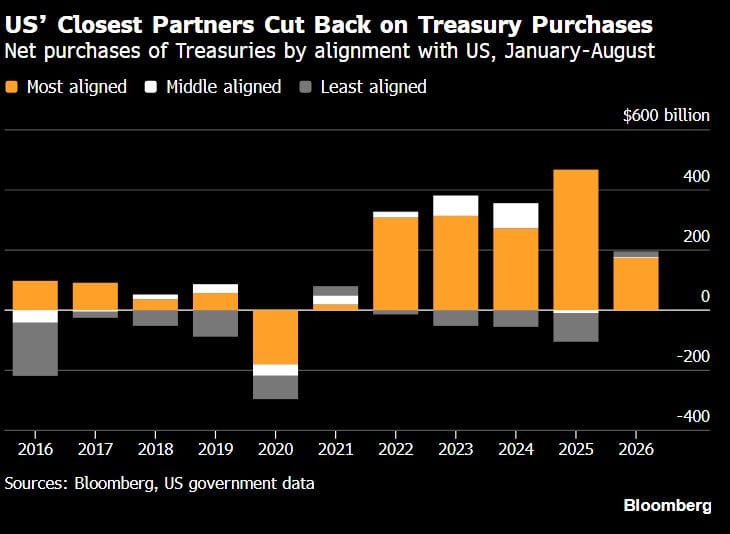
In a LinkedIn post, Ruth Carson stated that "US-Friendly Nations Slash Treasury Purchases by 60%, Led by Asia".
"Countries and regions most aligned with the US bought a net $174.3 billion of Treasuries, excluding bills, in the first eight months of 2026, according to an analysis of Treasury and State Department data. That was the lowest for the period since 2021 and down more than 60% from a year earlier.
The shift is noteworthy in Asia, where economies running large surpluses are putting less of that money into US debt. Japan, the biggest foreign holder of Treasuries, bought just $389 million in the first eight months — down 99% from a year earlier. South Korea sold $23.8 billion, the most for the period in records going back to 1977. Taiwan was also a net seller.
There’s no single explanation for the shift. Governments have said little about any plans to move away from Treasuries, and the data don’t separate government buying from private investment at the country level. Several factors may be contributing, including weak currencies, rising yields at home, growing demand for stocks and unease over US policy."
Please follow us to read more about Finance & FinTech in Japan, like hundreds of readers do every day. Our short weekly digest, the “Japan FinTech Observer”, is published on LinkedIn, Medium, Substack, or on our own FinTech Observer website. Only the latter provides you with the option to subscribe to individual news stories as they are published.
Should you wish to further discuss the Japanese (or Asian) FinTech ecosystem, you may book a consultation via Intro - all proceeds flow towards covering the operating cost of the Tokyo FinTech Association, and research for the Japan FinTech Observer.