The 2026 Gender Equality White Paper and the Economics of Lifelong Reskilling

The 2026 White Paper on Gender Equality highlights the growing importance of recurrent education to address technological shifts and longer lifespans. While women face digital adaptation challenges and lower vocational training rates, men are more susceptible to social isolation and lack local community engagement. Data reveals a significant gap between the desire to learn and actual behavior, with financial constraints and domestic duties primarily hindering women, while men are restricted by heavy workloads. To bridge these divides, the report advocates for supportive environments such as flexible online programs, childcare services, and financial aid. Ultimately, these initiatives aim to bolster women's economic independence and enrich men’s personal lives, fostering a society where all individuals can achieve diverse forms of happiness.
1. The Political Milestone: A Catalyst for Institutional Change
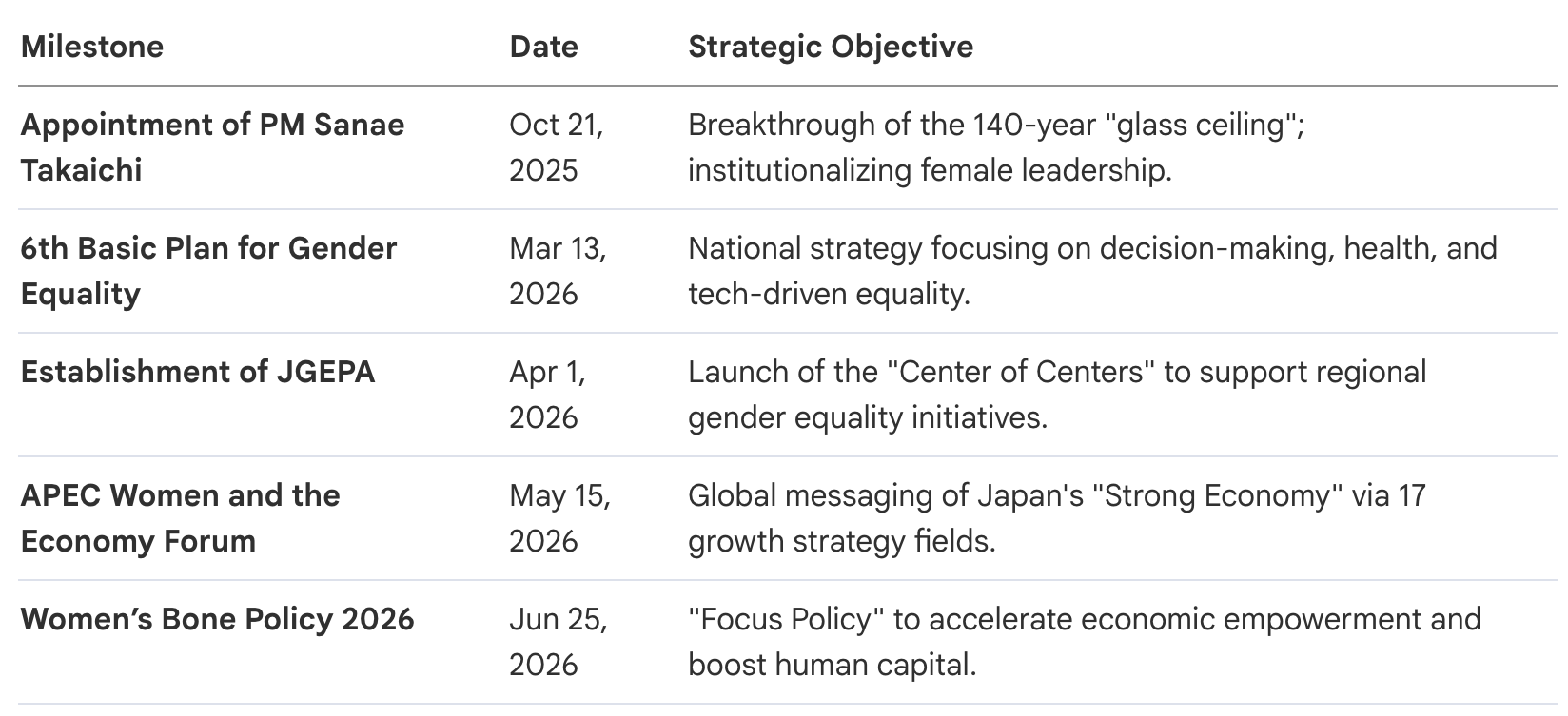
The appointment of Sanae Takaichi as Japan’s 104th Prime Minister on October 21, 2025, represents a symbolic and practical inflection point for the nation’s economic and social policy. As the first female Prime Minister in the 140 years since the inauguration of the cabinet system in 1885, Takaichi’s leadership serves to shatter a "glass ceiling" that has long defined the Japanese establishment. This political transition signals a fundamental shift in how the state views the integration of women into the upper echelons of power. By placing a woman at the apex of decision-making, the administration aims to dismantle the systemic assumption that "politics is a male domain," thereby catalyzing a broader acceleration of female participation across every industrial and social sector.
From late 2025 through mid-2026, the Takaichi cabinet moved aggressively to institutionalize this momentum. The approval of the 6th Basic Plan for Gender Equality in March 2026 marked a transition toward "Gender Mainstreaming," prioritizing female expansion in decision-making roles, addressing gender-specific health challenges, and leveraging technological advancement to close the participation gap. These moves represent a calculated, if desperate, attempt to salvage national productivity from a demographic core that is rapidly hollowing out.
This political realignment is the necessary precursor to addressing Japan's macro-demographic crisis. Without a fundamental shift in gendered labor roles, the nation's "multi-stage" life model—a requirement for a society with centenarian expectations—will remain an unattainable theory.
2. Macro-Demographic Realities: The "100-Year Life" Framework
Japan is currently navigating an unprecedented transition from a "linear" life model—the traditional sequence of education, a single-track career, and retirement—to a "multi-stage" model. The 2026 White Paper underscores that the "100-year life" has graduated from a sociological concept to a hard macroeconomic reality. By 2070, Japan’s total population is projected to fall to 86.99 million, just two-thirds of its historical peak. The implications for the labor market are stark: the 15–64 age bracket, the engine of national production, is expected to halve, dropping from a 1995 peak of 87.26 million to a mere 45.35 million by 2070.
While the population base is shrinking, longevity is extending the duration for which the state and individuals must remain economically and socially active. By 2070, average life expectancy will reach 91.94 years for women and 85.89 years for men. However, a critical disparity persists between average and "healthy" life expectancy (the period during which individuals live without daily activity limitations), necessitating a policy focus on the "active years" remaining after traditional retirement ages.
The Longevity Gap (2022 Data)
- Women: Healthy life expectancy is 75.45 years, while average life expectancy is 87.13 years. This creates a 11.68-year window of potential health-related dependency.
- Men: Healthy life expectancy is 72.57 years against an average of 81.09 years, leaving an 8.52-year window.
- Productivity Persistence: Workforce participation for those in their 60s is already rising—56.2% for women and 74.2% for men as of 2025—indicating that the "retirement" phase is increasingly being replaced by continued economic engagement.
This demographic squeeze demands a reassessment of labor participation. Longer lifespans are only sustainable if the population remains skilled and healthy enough to contribute beyond the 20th-century model of retirement at 60. The challenge, therefore, is not just one of longevity, but of ensuring that these additional decades are economically viable and socially connected.
3. Labor Market Analysis: Participation, Gaps, and the "L-Curve"
The Japanese labor market has largely eradicated the "M-Curve"—the historical phenomenon where women exited the workforce in their 30s for childcare. In 2025, the female employment rate for the 15–64 age group hit 75.3%, a record high. However, the eradication of the M-Curve has given rise to the "L-Curve": a structural pattern where women remain in the workforce but are systematically shunted into non-regular, lower-paying roles with minimal career progression as they age.
The L-Curve is a symptom of the "experience gap." Historically, women were hired for clerical tracks with a narrow "breadth of experience" (業務経験の幅) compared to their male counterparts. This limited exposure to diverse business operations effectively bars them from management roles later in life. Consequently, while 20-something women and men start on relatively equal footing, the gender wage gap widens significantly with tenure, culminating in a persistent 76.6 wage index (where men = 100).
The Economic Shadow of Career Interruption
The long-term financial consequences of the L-Curve are devastating to female economic independence in old age:
- The Non-Regular Trap: In 2025, non-regular employees included 14.5 million women versus 6.78 million men. Wages for non-regular female workers show statistically zero growth regardless of years of service.
- The Pension Chasm: The cumulative effect of lower wages and shorter regular-employment tenures creates a severe retirement disparity. As of late 2024, the average monthly benefit for the Employee Pension (Old Age Pension) was approximately 170,000 yen for men compared to 110,000 yen for women.
- The 60,000 Yen Monthly Shortfall: This gap forces many elderly women into poverty, proving that gender equality in the workforce is a direct prerequisite for the fiscal solvency of the social security system.
Bridging this gap requires moving women from low-value clerical tracks into the high-value regular employment sectors through targeted, professional-grade reskilling.
4. Technological Disruption and the 2040 Workforce Mismatch
Generative AI and automation are set to fundamentally reorganize Japan’s industrial structure by 2040. While technology is the primary tool to mitigate labor shortages, it carries a gender-asymmetric risk. Clerical and administrative roles—industries with high concentrations of female workers—are the most susceptible to AI displacement.
International Labour Organization (ILO) data highlights this exposure: 28% of female employment in Japan is at risk of AI displacement, compared to 21% for men. This is because 60.8% of clerical workers are women, and these roles consist largely of routine, automatable tasks. By 2040, Japan faces a severe "Supply-Demand Mismatch" unless its human capital is aggressively pivoted toward growth sectors.
The 2040 Structural Mismatch
- Projected Surplus: 3.39 Million Clerical Workers. As AI takes over administrative processing, three million human roles will become redundant.
- Projected Shortage: 1.81 Million Specialized Professionals. High-tier roles requiring human intuition and specialized knowledge will face a critical deficit.
- Projected Shortage: 2.6 Million Field Personnel. Essential "on-the-ground" labor in manufacturing and services will see a massive vacuum.
- The ICT/AI Pivot: Within these shortages, a subset of 3.4 million workers will be required specifically to handle AI and Robotics utilization.
The Digital Divide Barrier
The transition to these new roles is hampered by a significant "Digital Divide." According to the 2026 White Paper, 37.3% of women feel they are "unable to keep up" with the digitalization of society, compared to 24.3% of men. This is particularly acute among older women; only 15.2% of technical professionals in Japan are female. Without a massive reskilling effort to move women from the "surplus" clerical sector to the "shortage" ICT sector, Japan will suffer from simultaneous unemployment and a crippling lack of technical talent.
5. Feature Study: The Economics and Barriers of "Re-learning"
The 2026 White Paper defines "re-learning" (reskilling) as a mechanism for both career survival (for women) and social survival (for men). However, the motivations for engaging in this process are sharply divided along gender lines, reflecting the different pressures faced by each group.
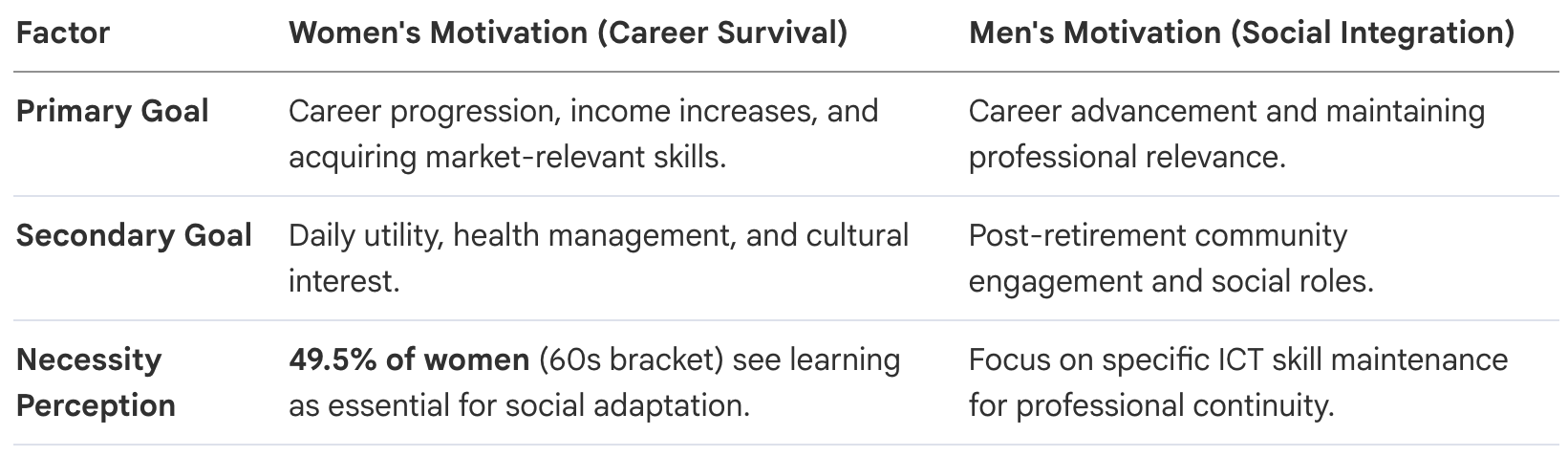
The barriers to reskilling are equally gendered and serve as a "structural disincentive" for the multi-stage life model.
- Women’s Barriers: Financial constraints (32.7%) and domestic labor time (housework and childcare) are the primary hurdles. Even with the desire to learn, women lack the "economic cushion" and the time-flexibility to pursue intensive reskilling.
- Men’s Barriers: Work-related time constraints (20.5%) and a perceived lack of corporate evaluation for outside learning. If Japanese firms do not reward proactive learning with promotions or higher pay, men remain trapped in a work-centric loop with no outside development.
The Spousal Support Correlation
A critical finding of the 2026 report is that domestic environments are the ultimate gatekeepers of learning success. There is a profound correlation between a spouse's stance and a person's learning activity:
- When spouses are "Actively Supportive": 55.9% of women and 68.9% of men engaged in learning in the past year.
- When spouses are "Negative": Participation plummeted to 24.1% for women and 21.9% for men. This suggests that the "Reiwa Model" of co-parenting is not just a social ideal, but a prerequisite for the nation’s reskilling strategy.
6. Social Capital and the "Isolation Gap" in Post-Career Men
While the economic risk for women is financial, for men, the strategic risk is social isolation. Fixated on a work-centric identity for four decades, many Japanese men possess zero "social capital" outside of their employer. This "isolation gap" has direct, measurable impacts on long-term health and national well-being.
The isolation rate among men is a quiet epidemic. Men are more than twice as likely as women to have no one to rely on for consultation (11.8% vs. 4.4%). Among men in their 50s, the situation is even more dire: one in five (20%) report having no one to rely on for support. This lack of community makes them vulnerable to physical and mental decline once they leave the workforce.
There is a significant correlation between active learning and the feeling of having a "place or role" (居場所) in society.
- Active Learners: 63.1% of men who engaged in learning in the past year felt they had a secure social role.
- Non-Learners: Only 34.0% felt the same.
For men, re-learning is a tool for social survival. It facilitates the transition from "company man" to "community member," providing the networks necessary to navigate the final 20–30 years of the 100-year life.
7. Strategic Policy Interventions and Future Outlook
The 2026 White Paper concludes that the success of Japan's structural pivot depends on a robust "Regional Model" for gender equality. This infrastructure is anchored by local Gender Equality Centers, which are being upgraded from consultation points to reskilling hubs.
Case Studies in the Regional Model
- "Scrum 21" (Kawasaki City): A model for city-level intervention, providing women with vocational training and professional networking that circumvents traditional corporate silos.
- Tokyo Women’s Plaza: Focusing on "Hataraku Josei Square," this facility offers integrated support for career advancement, digital literacy, and DV consultation, creating a "safe harbor" for female economic independence.
- JGEPA (Japan Gender Equality Promotion Agency): Established April 1, 2026, as the "Center of Centers," this agency provides the national resources and guidelines that empower regional hubs to offer time-flexible, cost-effective learning programs.
The government’s ultimate goal is the "Reiwa Model"—a social structure defined by co-working and co-parenting. This requires a three-pronged approach:
- Financial & Time Flexibility: Subsidies for reskilling and labor reforms that mandate "learning time" within the work week.
- Addressing the Experience Gap: Policy incentives for firms to provide women with a "breadth of experience" early in their careers to prevent the L-Curve.
- Digital Literacy for All: National programs to close the 37.3% digital anxiety gap among women, ensuring they can transition into the 3.4 million AI-utilization roles required by 2040.
Outlook
Whether Japan can achieve this pivot remains the defining question of the Takaichi era. The establishment of JGEPA and the symbolic breakthrough of a female Prime Minister provide the necessary institutional scaffolding, but the cultural inertia of the "clerical trap" and the "work-centric male" remains formidable. These moves represent a calculated attempt to salvage productivity from a hollowed-out labor core.
The data is clear: gender equality is a macroeconomic imperative for survival in a 100-year-life society. If Japan succeeds in reskilling its female workforce for the AI era while socially reintegrating its aging male population, it will provide a global blueprint for the economics of longevity. If it fails, the demographic burden of 2070—where 38.7% of the population is over 65—may prove untenable. The "Structural Pivot" is not just a policy change; it is Japan’s final defense against demographic obsolescence.
 Norbert Gehrke