The First FY2026 Study Group on How to Respond to Digital and Decentralized Finance


The first "Study Group on How to Respond to Digital and Decentralized Finance" of the 2026 fiscal year took place on Tuesday, October 20, 2026. The session commenced, as is customary, with explanations from the Secretariat, followed by presentations by Nomura Holdings and Securitize Japan.
Global financial capital markets are seeing distributed ledger technology (DLT) transition from speculative crypto asset trading toward institutional real-world asset (RWA) tokenization. This technological migration has established a distinct competitive divide in global financial centers: key institutional venues in the United States have moved aggressively into live commercial execution across programmable payment and asset rails, whereas major Asian hubs—most notably Japan—remain predominantly in the demonstration and proof-of-concept (PoC) phase. As cash instruments, sovereign debt, equities, and institutional investment funds migrate to distributed ledgers, capital market velocity and liquidity standards are being redefined on a global scale.
1. Analytical Deep-Dive into the U.S. Market Lead
The United States has established a commanding lead in on-chain capital market deployment, driven by concurrent advancements in institutional tokenized cash infrastructure, sovereign debt tokenization, and rapid adoption among top-tier asset managers.
1.1 Tokenized Cash and Settlement Infrastructure
U.S. dollar stablecoin (SC) market capitalization has crossed $300 billion, with over 80% of transaction volume directly tied to crypto-asset trading, liquidity provisioning, and cross-border settlement. Concurrently, commercial banking deposit tokenization has reached production scale: JPMorgan’s corporate tokenized deposit (TD) network processes over $7 billion in daily transaction volume across major global currencies. Citi offers 24/7 global dollar settlement services to institutional clients, including Japanese corporate entities, while a consortium of major U.S. commercial banks is consolidating shared DLT networks to operationalize multi-bank tokenized deposit settlement.
1.2 Institutional Asset Management & Native Tokenization Milestones
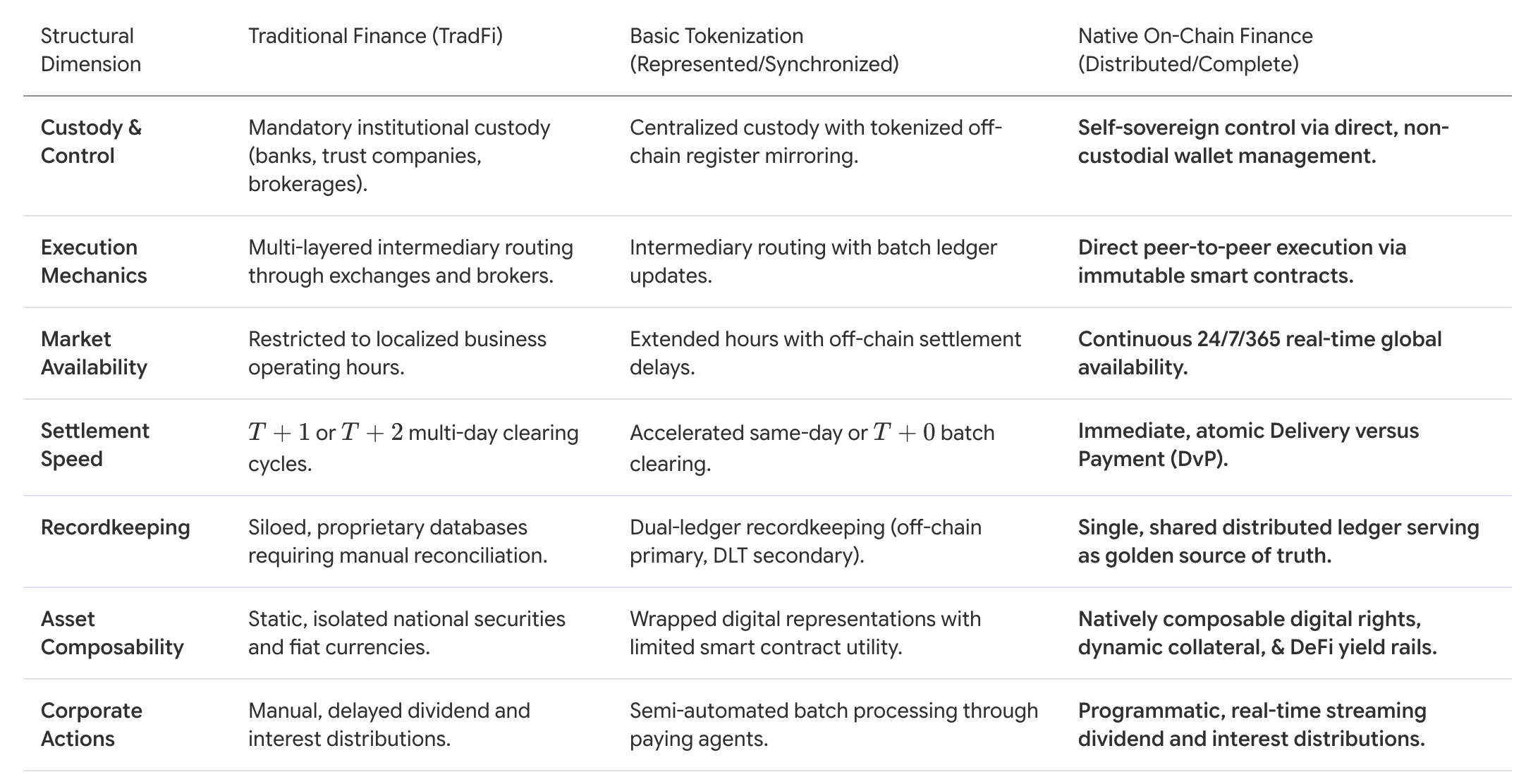
Major global asset managers have fundamentally altered market structure by transitioning from legacy "Represented/Synchronized" tokenization (where an off-chain ledger is mirrored onto a blockchain) to "Native/Distributed" fund architectures. In a native on-chain structure, fund unit issuance, subscription, redemption, yield accrual, and cross-chain transfers are executed directly via smart contracts.
BlackRock has led the market transformation with its USD Institutional Digital Liquidity Fund (“BUIDL”). Launched in early 2024, BUIDL demonstrated explosive asset expansion—scaling from $2.2 billion to over $2.8 billion in AUM within months. Offering Moody's Aaa-rated exposure to U.S. Treasuries and repo transactions across Ethereum, Aptos, Arbitrum, Avalanche, Optimism, Polygon, Solana, and BNB Chain, BUIDL served as the primary catalyst for native institutional money market funds (MMFs). Building on this momentum, BlackRock announced plans to tokenize a portion of its $311 billion European MMF pool and launched the GENIUS Act-compliant BlackRock Daily Reinvestment Stablecoin Reserve Vehicle (“BRSRV”) in August 2026.
Tier-One Institutional Fund Deployments
- Blockchain Capital: $949 million tokenized venture capital fund (the largest tokenized VC vehicle globally).
- Securitize: $358 million in tokenized equity issuances.
- BNY: $283 million tokenized credit vehicle and the October 2025 launch of the Securitize Tokenized AAA CLO Fund (“STAC”) on Ethereum and Solana.
- Hamilton Lane: SCOPE Fund (May 2023, senior credit) and Secondary Fund VI (August 2024, private equity) featuring native cross-chain execution on Polygon, Ethereum, and Optimism.
- Apollo: Tokenized Apollo Diversified Credit Fund (“ACRED”, January 2025) operating natively across seven blockchain environments.
- VanEck: Treasury Fund (“VBILL”, May 2025).
- Neuberger Berman: High Income Tokenized Fund (“HINC”, September 2026).
- ARK Invest: ARK Venture Fund (September 2026).
1.3. Marketplace & Sovereign/Corporate Debt Infrastructure
The Depository Trust & Clearing Corporation (DTCC) is launching live tokenization services for U.S. Treasuries and listed equities in October 2026 through a designated subsidiary operating on the Canton Network. In tandem, Nasdaq and the New York Stock Exchange (NYSE) have secured SEC regulatory approvals to integrate tokenized asset clearing. Retail and institutional brokerage platforms such as Robinhood have expanded tokenized U.S. equity access to accredited users in over 120 countries. European markets are advancing in parallel, with tokenized corporate bond issuances reaching approximately €4 billion, complemented by the United Kingdom’s official target to launch a sovereign tokenized gilt pilot by early 2027.
2. Assessment of Japan’s Current Position
Despite possessing robust regulatory protections, Japan’s domestic on-chain financial market remains "one step behind," characterized by isolated proofs-of-concept and structural dependence on legacy off-chain clearing systems.
2.1 Security Token (ST) Market Concentration
Total issuance in Japan’s domestic Security Token market has surpassed ¥400 billion. However, approximately 90% of this aggregate volume remains narrowly concentrated in real estate securitization products (GK-TK structures and real estate trust beneficiary rights), with minimal penetration into liquid corporate debt, equities, or institutional money market instruments.
2.2 Institutional Pilots and Interbank Cash Rails
- Tokenized Deposits: The Digital Currency Innovation Organization (DCIO) has initiated cross-industry studies on deposit tokenization; SBI Shinsei Bank is validating digital security settlement via tokenized bank deposits; and a consortium led by DCP involving roughly 40 domestic banks is evaluating DLT integration for general bank transfer (Sogo Sosai) systems.
- Stablecoins: Japan's three megabanks (MUFG, SMBC, Mizuho FG) established a joint council on shared infrastructure and governance, targeting joint issuance and commercial transactions within FY2026. SBI plans to issue a trust-type yen-denominated stablecoin ("JPYSC") in June 2026 alongside commercial money-transfer-type stablecoins.
- Central Bank Initiatives: The Bank of Japan (BOJ) has initiated a sandbox environment to test DLT integration for BOJ account balances across interbank cash and securities settlement. The BOJ is actively participating in Project Agora to co-develop a multi-currency platform for tokenized central bank money. In June 2026, the BOJ published its CBDC pilot progress report, confirming that no critical technical impediments had been identified in core ledger mechanics.
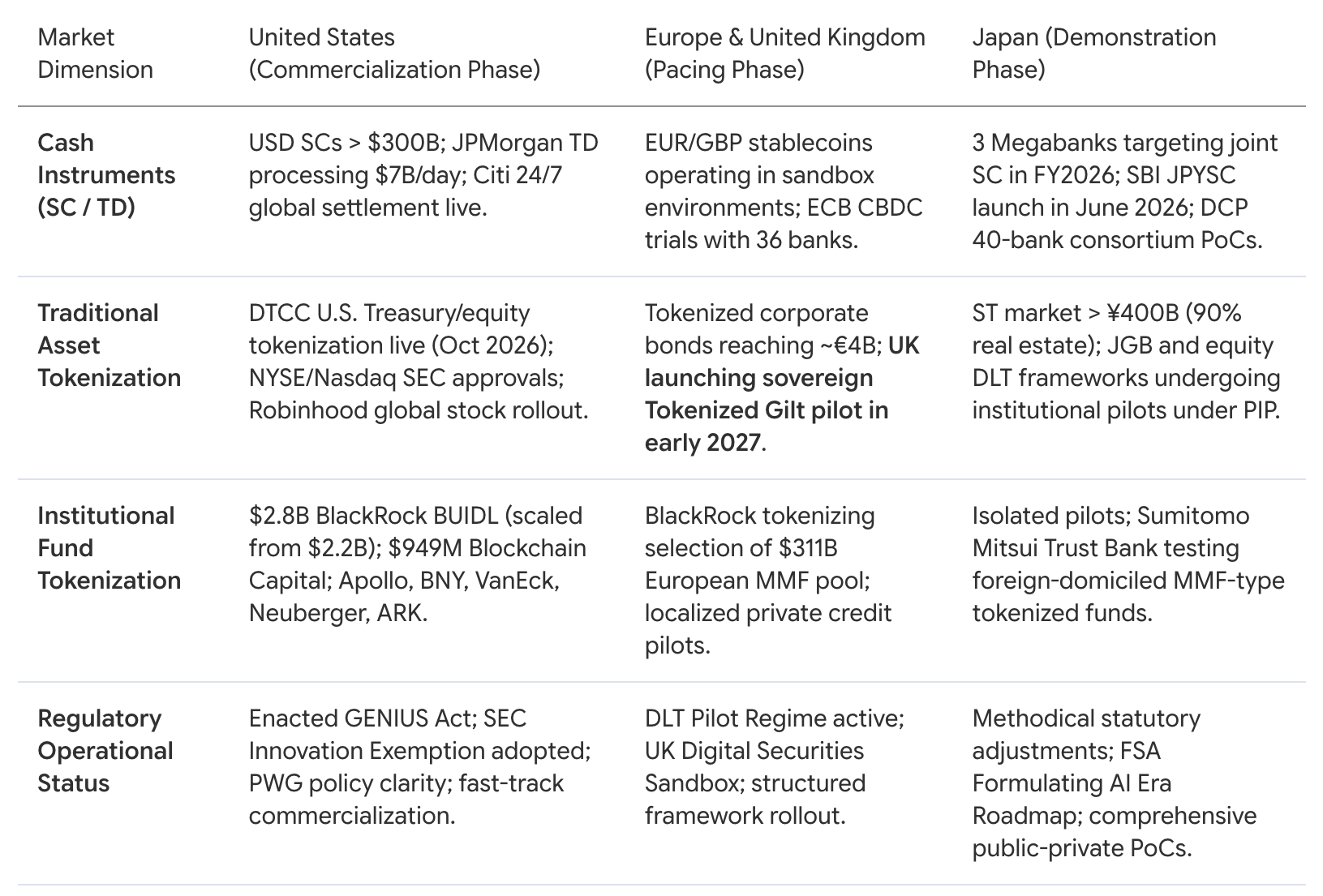
2.3 Tri-Regional Comparative Market Matrix
2.4 Strategic Implications for Japan
Japan’s operational latency in transitioning from demonstration pilots to commercial production introduces systemic capital market risks. As global liquidity standardizes around 24/7, continuous on-chain rails, financial centers operating on batch-processed, localized clearing schedules face acute "Galapagosization"—isolation from international capital flows. If sovereign debt and institutional money market liquidity concentrate on U.S. dollar-denominated DLT networks, Japanese institutions will incur elevated cross-border intermediation costs, impaired secondary market liquidity, and diminished foreign institutional investment in domestic JGB and equity markets.
To bridge this operational divide, Japanese financial institutions and regulatory authorities have established targeted public-private initiatives designed to build standardized, commercial-grade domestic infrastructure.
3. Japan’s Infrastructure Advancement: The Payment Infrastructure Advancement Project (PIP)
To counter global competitive pressures and accelerate domestic DLT commercialization, Japan's financial sector has launched coordinated public-private demonstration projects under the Payment Infrastructure Advancement Project (PIP). Operating as a structural catalyst, PIP aligns megabanks, major brokerage houses, market infrastructure providers, and technology vendors to establish standardized wholesale market infrastructure.
3.1 Breakdown of Core PIP Demonstration Projects
Case 1: Transferable Securities x Digital Currency (February 2026 Launch)
- Participants: Nomura Securities, Daiwa Securities, Mizuho Securities, MUFG, SMBC, and Mizuho FG.
- Mechanism & Structural Alignment: Operating strictly under the statutory framework of the Act on Book-Entry Transfer of Company Bonds, Shares, etc. (Transfer Act), this initiative digitizes transferable securities—including Japanese Government Bonds (JGBs), listed equities, corporate bonds, and investment trusts—without requiring fundamental legislative redrafts.
- Operational Goal: To link tokenized security transfer records on DLT directly with megabank stablecoin payment rails, enabling atomic Delivery versus Payment (DvP) settlement across a standardized interbank ledger network.
Case 2: Japanese Government Bonds (JGB) x Canton Network (April 2026 Launch)
- Participants: Mizuho FG, Nomura HD, Japan Securities Clearing Corporation (JSCC), and Digital Asset HD.
- Mechanism & Institutional Interoperability: This initiative validates on-chain JGB transactions using the Canton Network—a privacy-enabled, interoperable consortium DLT architecture selected by tier-one global institutions including JPMorgan, Goldman Sachs, BNP Paribas, Bank of America, and BNY.
- Operational Goal: To establish continuous, 24/7 cross-border collateral management capabilities for Japanese sovereign debt, integrating JGBs into international collateral pools managed by global clearing houses and custodians.
Case 3: On-Chain JGB Repo Transactions x Canton Network / Progmat (August 2026 Launch)
- Participants: MUFG, Mitsubishi UFJ Morgan Stanley Securities (MUMSS), Mitsubishi UFJ Trust and Banking (MUTB), MUFG Bank, Progmat, and Digital Asset HD.
- Mechanism & End-to-End Automation: Focusing on sovereign repo markets, this project automates the entire lifecycle of JGB repo trades—contract execution, collateral substitution, margin calls, and unwind mechanics—via smart contracts executing on synchronized Progmat and Canton ledgers.
- Operational Goal: To achieve simultaneous DvP settlement of JGB transfer entries and digital money cash legs (tokenized deposits and stablecoins), eliminating settlement latency and counterparty credit exposure in wholesale interbank lending.
3.2 Canton Architecture & Sub-Transaction Privacy Mechanics
A critical insight driving institutional adoption of the Canton Network in PIP Case 2 and Case 3 is its proprietary sub-transaction privacy architecture. Tier-one global financial institutions cannot utilize public blockchains or basic permissioned ledgers that broadcast transaction details, wallet balances, or order flows to all network nodes.
Canton resolves this institutional constraint through selective data disclosure and cryptographic sub-transaction privacy:
- Zero-Knowledge Transaction Isolation: Trade details, pricing, volume, and counterparty identities are visible only to the specific participants involved in the transaction and designated regulatory nodes.
- Non-Broadcasting Consensus: Non-participating validator nodes reach consensus on ledger state integrity without receiving or decrypting underlying transaction payload data.
- Cross-Ledger Composability: Financial institutions can execute atomic DvP settlement and short-duration (e.g., 3-hour off-hours) repo trades across disparate, independently operated sovereign ledgers without exposing portfolio holdings, counterparty risk profiles, or trading strategies to the broader public or competing network participants.
3.3 Capital & Intraday Liquidity Efficiency under Basel III
The operational shift from legacy T+1 or T+2 batch settlement to continuous, atomic DvP execution directly transforms institutional balance sheet dynamics:
- Intraday Liquidity Optimization: Under traditional clearing, financial institutions must maintain substantial intraday liquidity buffers and credit lines to cover settlement delays and time-zone mismatches. Continuous 24/7 atomic DvP allows treasury desks to execute short-duration liquidity transactions (such as 3-hour off-hours repos during Japanese non-business hours), dramatically reducing intraday liquidity buffer costs.
- Basel III Balance Sheet & RWA Capital Optimization: By eliminating principal risk (the risk that cash is delivered without receiving the security, or vice versa) and compressing settlement windows to zero, banks significantly reduce risk-weighted assets (RWA) associated with unsettled trades and counterparty exposure. This unlocks regulatory capital trapped in collateral buffers, allowing balance sheets to be deployed with far higher capital efficiency.
3.4 Strategic Value of PIP Infrastructure
The PIP demonstration projects provide the technical blueprint for modernizing domestic market infrastructure. By proving that sovereign debt can be trustlessly settled against digital fiat money in real time while maintaining bank-grade transaction privacy, PIP positions Japanese sovereign instruments to function as active, liquid collateral across global multi-chain financial ecosystems.
However, translating these technical validation pilots into commercial market production requires a comprehensive overhaul of domestic legal and regulatory frameworks.
4. Policy and Regulatory Frameworks: U.S. Acceleration vs. Japan’s Legal Overhaul
Regulatory policy serves as the ultimate determinant of commercial adoption speed. While the U.S. regulatory apparatus has adopted a proactive strategy aimed at eliminating statutory hurdles to secure market dominance, Japan is conducting a methodical overhaul of its financial laws to address deeply entrenched statutory bottlenecks.
4.1 U.S. Regulatory & Legislative Momentum (2025–2026)
U.S. administrative and legislative bodies have enacted targeted policies designed to accelerate institutional digital asset commercialization:
- GENIUS Act (July 18, 2025): Landmark federal legislation establishing a legal framework for stablecoin issuers, explicitly enacted to maintain U.S. dollar hegemony and position the United States as the undisputed global leader in digital asset infrastructure.
- White House President’s Working Group (PWG) Report (July 30, 2025): Formal policy declaration affirming that U.S. citizens and commercial enterprises possess the fundamental right to hold digital assets and utilize public/private DLT rails.
- SEC Chair Paul Atkins "Project Crypto" Address (July 31, 2025): Policy address delivered at the America First Policy Institute introducing streamlined disclosure rules, purpose-fit exemptions, and regulatory safe harbors designed to incentivize digital asset distributions within U.S. jurisdiction.
- SEC "Innovation Exemption" Adoption (September 17, 2026): Regulatory reform providing institutional market participants with streamlined compliance pathways to issue, clear, and settle tokenized securities on DLT networks.
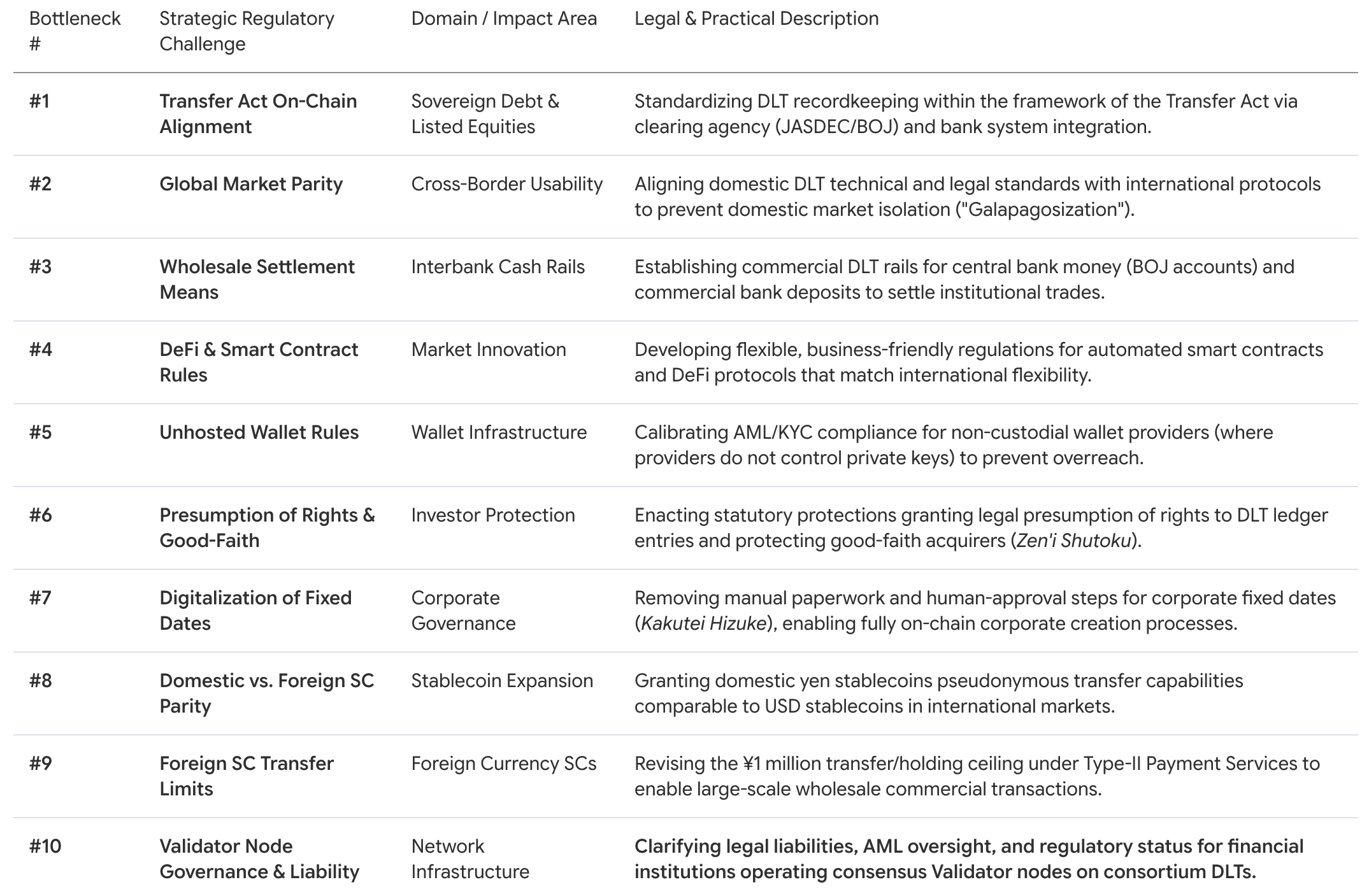
4.2 Japan’s Regulatory Agenda: Resolving the Ten Critical Bottlenecks
Through public hearings and industry surveys, Japanese regulators and financial institutions identified ten critical legal, operational, and structural bottlenecks impeding commercial on-chain deployment.
4.3 Financial Services Agency (FSA) Strategic Roadmap
To systematically address these bottlenecks, the Financial Services Agency (FSA) unveiled its "AI Era On-Chain Finance Initiative" on October 20, 2026. The FSA is establishing the "AI Era On-Chain Finance Forum" in Summer 2026, tasking it with publishing an interim report and an actionable public-private commercial roadmap by early 2027.
The FSA's strategic roadmap executes through two specialized research groups:
- Group 1 (Study Group on Digital/Decentralized Financial Systems): Focuses on statutory framework revisions, including asset tokenization rules, integrating stablecoins into public payouts and government disbursements, calibrating regulatory approaches for Decentralized Exchanges (DEXs) and DeFi protocols, and setting proportional compliance standards for unhosted wallet operators.
- Group 2 (Study Group on AI & Technical Adaptation): Evaluates emerging structural and technological risks, establishing supervisory frameworks for autonomous AI agents operating in financial markets, monitoring private credit expansion, and evaluating quantum-resistant cryptographic algorithms to secure core DLT financial infrastructure against future compute threats.
4.4 Commercial Velocity vs. Statutory Process
The structural divergence between U.S. and Japanese regulatory approaches highlights two contrasting governance models. The U.S. operates under a market-driven doctrine focused on bypassing or removing regulatory barriers, allowing commercial innovation to dictate market standards. Japan adheres to a methodical, consensus-driven process of statutory updates. While Japan's approach ensures system stability and investor protection, legislative latency carries execution risks: in global capital markets, operational liquidity standardizes around the fastest, most friction-free rails. Rapid execution of the FSA’s 2027 roadmap is therefore critical to preventing domestic market marginalization.
Securing regulatory alignment provides the legal foundation for transitioning to next-generation capital market architectures.
5. Future Architecture: AI Integration, Investor Utility, and Hybrid Blockchain Models
The long-term evolution of global finance extends beyond modernizing legacy financial assets. It points toward a paradigm shift where distributed ledgers, autonomous artificial intelligence, and composable digital assets converge to reconfigure market intermediation.
5.1 Investor Utility & User Experience (UX) Paradigm Shift
The migration to on-chain finance alters the core operating principles of global capital markets. To understand this evolution, financial market structure must be evaluated across three distinct operational paradigms.
5.2 Convergence of Artificial Intelligence and On-Chain Rails
The convergence of autonomous AI agents and programmable on-chain finance introduces a structural shift in financial execution. While legacy banking platforms rely on human authorization and siloed API connections, DLT provides open, machine-readable, 24/7 execution layers specifically suited for autonomous software agents.
In this architecture, AI-integrated wallets act as self-directed financial actors executing complex treasury and investment strategies:
- Corporate Treasury Optimization: Enterprise AI agents continuously monitor cash inflows and liabilities, automatically sweeping idle working capital into high-yielding tokenized money market funds (such as BUIDL or VBILL) or executing automated overnight repo trades.
- Automated Execution & Dynamic Rebalancing: Institutional AI agents scan multi-chain liquidity pools, executing trades, rebalancing risk exposures, and optimizing collateral utilization across cross-chain lending protocols without human delay.
- Disruption of Intermediary Ecosystems: Financial service delivery expands beyond traditional investment banks. Enterprise software vendors, ERP systems, accounting software providers, payment processors, and specialized AI developers can embed native financial execution directly into business workflows via DLT rails.
5.3 Hybrid Infrastructure: Interoperability of Consortium and Public Chains
The future architecture of global digital finance will settle into a dual-layer, hybrid network structure linking specialized institutional ecosystems with open public networks.
- Permissioned / Consortium Chains: Designed for regulated financial institutions, central banks, and sovereign asset issuers. Operating with named, verified validator nodes, these chains enforce strict data privacy and regulatory compliance. They host sovereign debt (JGBs, Treasuries), listed equities, tokenized bank deposits, and institutional funds, enabling continuous wholesale transactions within a defined legal perimeter.
- Public / Permissionless Chains: Open-access networks that drive decentralized finance (DeFi), global stablecoin liquidity, and permissionless asset innovation. They provide open capital formation, global peer-to-peer liquidity aggregation, and cross-border accessibility for Web3 enterprises, crypto-native institutions, and global investors.
- Cross-Chain Interoperability Layer: Standardized, cryptographically secure cross-chain protocols link consortium and public chains. This allows institutional assets originated on permissioned ledgers to securely interact with global liquidity pools on public networks without compromising regulatory compliance or enterprise privacy.
6. Strategic Imperative for Japan
To secure its standing as a primary global financial capital, Japan's public and private sectors must execute a clear, synchronized strategy:
- Accelerate Sovereign & Traditional Asset Tokenization: Rapidly transition Japanese Government Bonds, listed equities, and corporate debt from isolated PoCs to native DLT execution under the Transfer Act.
- Deploy Wholesale Digital Currency Rails: Commercialize wholesale settlement instruments—including tokenized bank deposits, regulated megabank stablecoins, and DLT-integrated Bank of Japan account balances—to enable continuous 24/7 atomic DvP settlement.
- Harmonize Regulatory Frameworks Globally: Fast-track the Financial Services Agency’s statutory roadmap to establish clear, balanced rules for validator node liability, unhosted wallets, smart contracts, and stablecoin parity that match international standards.
By aligning legal frameworks with technical execution, Japan can prevent capital market isolation, attract international liquidity, and establish a modern, competitive financial ecosystem engineered for the AI-driven, multi-chain era.
 Norbert Gehrke