Aichi Financial Group and San ju San Target Business Integration

The announced business integration between Aichi Financial Group and San ju San Financial Group continues the series of mergers and legal entity integrations in the Japanese regional banking sector. This absorption-type merger is very much a defensive move in the face of population decline and weakening regional businesses to realign the financial infrastructure of the Tokai region. By unifying these two institutions, the groups are creating a premier regional intermediary capable of servicing the "monozukuri" (manufacturing) ecosystem of Japan’s industrial heartland through a period of structural transformation.
Regional Economic Profile
The Aichi and Mie prefectures form the "monozukuri" core of Japan. This industrial cluster is the nation's engine, characterized by a dense, interconnected supply chain of high-tech manufacturing. The Tokai region’s strategic importance is national; its financial stability directly correlates with Japan's innovative output and export resilience.
Infrastructure-Led Growth Potential
Transformative infrastructure projects—specifically the completion of the Tokai-Kanjo Expressway and the impending launch of the Shinagawa–Nagoya section of the Linear Chuo Shinkansen—are expected to reconfigure the regional growth outlook. These developments signify a pivot from traditional retail-driven growth toward a higher-value demand for structured finance related to logistics hubs and expanded working capital for a more tightly integrated manufacturing supply chain. For a consolidated institution, this provides an opportunity to transition from volume-based lending to high-margin, specialized financial services.
While regional infrastructure provides the canvas for growth, the institutional capacity to capture this value depends on the baseline financial health and strategic capabilities of the merging entities.
1. Comparative Profile of the Merging Entities
As of late 2025, Aichi Financial Group (Aichi FG) and San ju San Financial Group (33 FG) serve as the bedrock of financial intermediation in their respective home prefectures. Their legacy of trust-based relationships provides the necessary social capital to execute a successful large-scale integration.
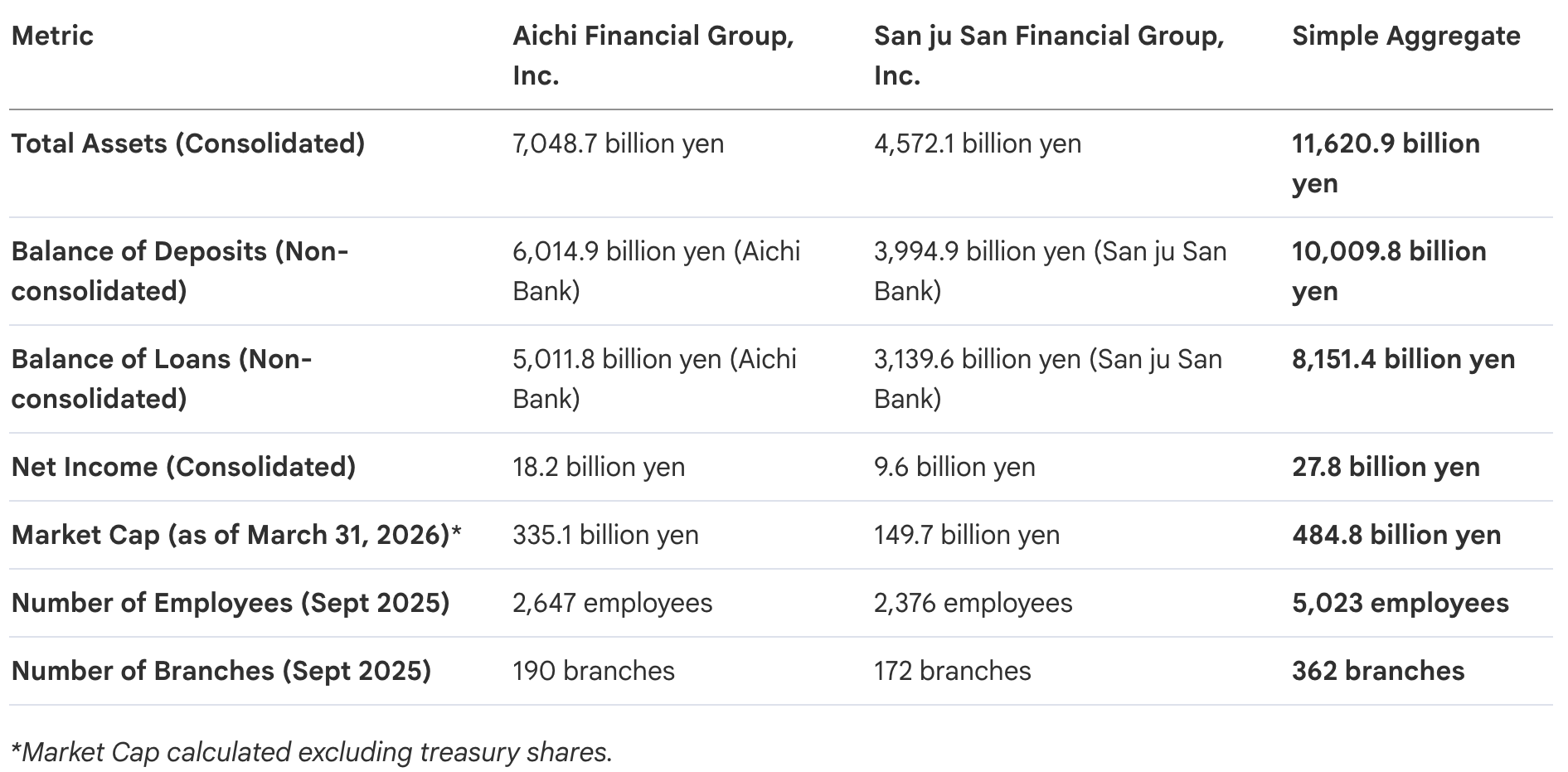
Financial Baseline Comparison
The following metrics establish the quantitative foundation for the new entity, based on data as of December 31, 2025 (unless otherwise noted), and the March 2025 fiscal year-end:
Strategic Capability Mapping
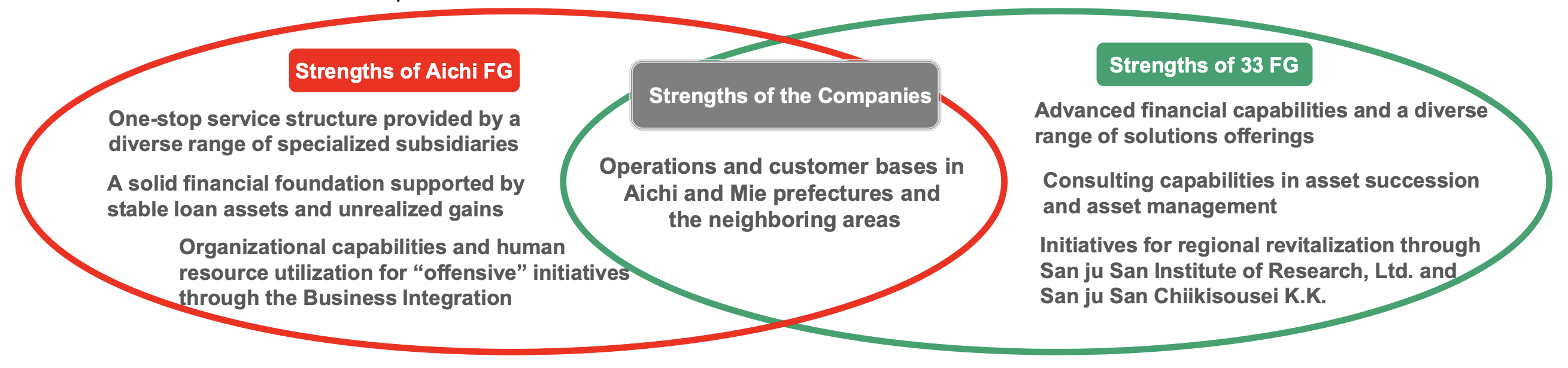
The merger represents a synergistic cross-pollination of distinct institutional strengths:
- Aichi Financial Group: Contributes a massive, stable customer base in Aichi prefecture, high unrealized gains, and specialized consulting capabilities in asset succession and asset management.
- San ju San Financial Group: Provides an "offensive" strategic edge through advanced financial solutions, regional trading expertise (via San ju San Chiikisousei K.K.), and high-level industrial analysis from the San ju San Institute of Research.
The aggregation of these balance sheets creates a formidable market participant with the scale to influence regional capital flows and the specialized capabilities to move up the value chain.
2. The "New Financial Group" Architecture
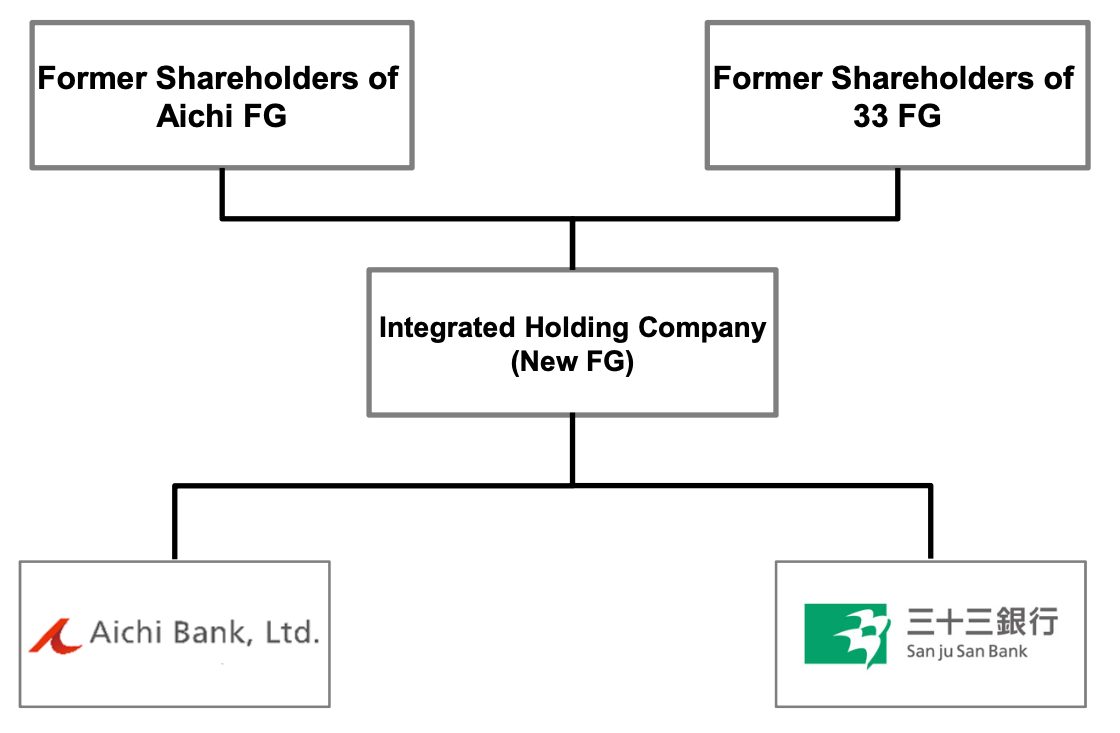
The Integrated Holding Company will be formed via an absorption-type merger, centralizing capital management while maintaining market-facing agility. The effective date is scheduled for April 1, 2027.
Aggregate Financial Power and Market Moat
With an aggregate asset base of approximately 11.6 trillion yen, the new group achieves a level of scale that serves as a competitive moat. This size allows for significantly higher capital adequacy, enabling the group to underwrite larger regional development projects and sustain the heavy IT expenditure required for modern banking.
Geographic Dominance and Network Optimization
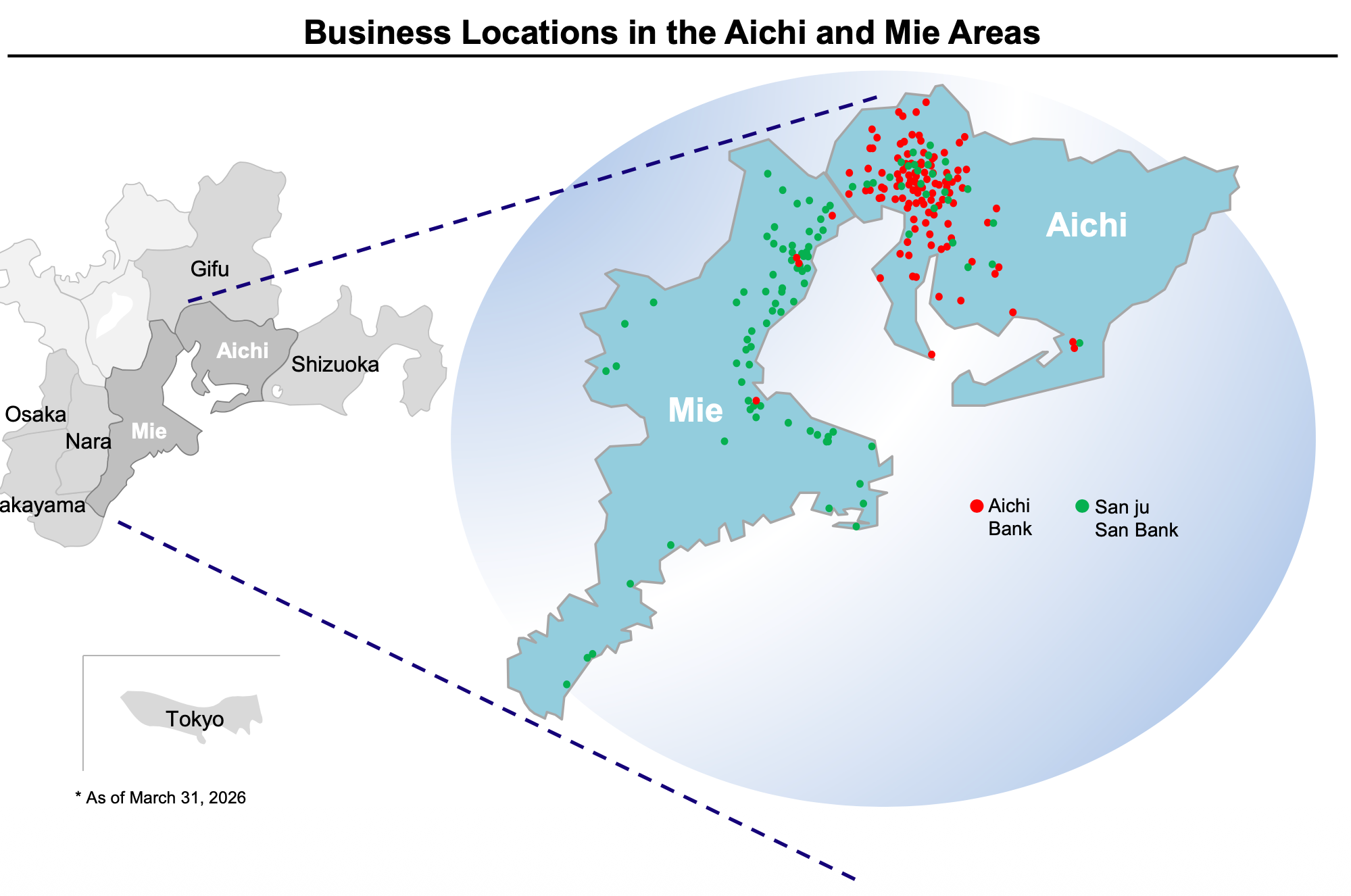
The group will implement a "two-brand structure," retaining the Aichi Bank and San ju San Bank names to preserve deep-seated local loyalty. However, the operational backbone will be unified to maximize efficiency across their 362-branch network (as of March 31, 2026).
Strategic Business Footprint (Projected March 31, 2026):
- Aichi Area: 152 locations (Deep dominance in Nagoya-shi with 83 branches).
- Mie Area: 76 locations.
- Wider Connectivity: A strategic presence in Gifu (4), Shizuoka (2), Osaka (5), Wakayama (4), Nara (2), and Tokyo (2) to facilitate the cross-prefectural logistics and supply chain needs of the monozukuri sector.
This structure allows for the "rationalization of management resources" through joint branches while expanding the group's reach into Japan's major economic hubs.
3. Synergy Evaluation and Strategic Value Creation
The integration synergy framework focuses on transitioning the business into a sustainable, high-margin model through three strategic pillars.
Pillar 1: High-Quality Service Evolution (The Cross-Sell Play)
The primary value driver is the "cross-sell play": deploying 33 FG’s advanced, "offensive" solutions—including leasing, regional trading, and specialized research—into Aichi FG’s deep, stable, and largely untapped customer base. This creates a "seamless end-to-end support" model, addressing the full lifecycle of a business from start-up through to succession and management consulting.
Pillar 2: Operational Deleveraging and Resource Optimization
By integrating indirect divisions and optimizing the branch network via joint locations, the group will achieve significant operational deleveraging. These cost-base optimizations allow for the critical re-allocation of management resources toward high-growth areas, thereby improving the group's overall ROE.
Pillar 3: Scale-Driven Investment (IT & DX)
Economies of scale enable a more aggressive investment posture in Digital Transformation (DX). Beyond improving customer convenience, this IT investment is intended to establish the bank as a solution-provider for regional issues, creating new, non-interest revenue streams that are resilient to credit cycle volatility.
The successful realization of these synergies is a mandatory requirement for survival as external economic pressures mount.
4. Mitigating Economic Pressures and Long-Term Value Proposition
The status quo for regional banking is untenable. This integration is a calculated response to a quadruple threat of market pressures:
- Demographic Shifts: Rapid population decline and aging are shrinking the traditional retail deposit and loan market, requiring a shift toward more complex, fee-based industrial services.
- The "World with Interest Rates": The transition to a positive interest rate environment offers significant Net Interest Margin (NIM) expansion opportunities for an 11.6 trillion yen balance sheet, provided the bank possesses the ALM sophistication to capture it.
- Digital Disruptors: Scale is the only viable defense against non-bank digital entrants. This merger provides the R&D budget necessary to defend the group’s competitive moat.
- Capital Market Expectations (PBR Remediation): The merger is a primary vehicle for PBR remediation. By rationalizing management resources and scaling high-margin consulting, the group aims to exceed a PBR of 1.0x, meeting the capital market’s demand for improved ROE and capital discipline.
The Long-Term Value Statement
The group’s "Basic Policy of Integration" aims for a sustainable business model where high-quality financial services drive regional economic development. By maximizing human resource value—realizing "job fulfillment" through more sophisticated and diverse roles—the institution aims to secure its position as the indispensable financial engine of the Tokai region.
5. Implementation Roadmap and Compliance
Governance of the transition is managed by a dedicated Integration Preparation Committee, focusing on the technical and cultural alignment of the two groups.
Critical Milestones Timeline
- September 2026: Execution of the Definitive Agreement and Absorption-Type Merger Agreement.
- December 2026: Extraordinary General Meetings of Shareholders (Approval Phase).
- April 1, 2027: Effective Date of the Merger and Launch of the Integrated Holding Company.
 Norbert Gehrke