SBI’s Integration Strategy: Commanding Global Stablecoin Rails and Consolidating the Domestic Gateway

SBI Group has taken two additional steps in the "on-chain" financial economy, executing a dual-track strategy designed to command both global infrastructure and domestic distribution. By securing a stake in the $222 million pre-sale for Circle’s "Arc" Layer 1 (L1) blockchain while simultaneously absorbing its NFT division into its primary crypto-asset exchange, the group continues its path to become a foundational architect of regulated digital finance. This vertical integration aims to create a closed-loop ecosystem where SBI connects the global settlement rails and the domestic gateway, effectively neutralizing competition through a formidable regulatory and technical moat.
As the digital asset sector matures, institutional leaders are abandoning retail speculation in favor of "Blockchain-as-a-Service" (BaaS) and protocol-level governance. SBI’s maneuver represents a sophisticated synthesis of capital allocation and operational streamlining. By securing governance rights on global stablecoin layers and optimizing domestic units for Real-World Asset (RWA) utility, SBI Holdings is positioning itself as the indispensable bridge between public blockchain innovation and the rigorous compliance requirements of the Japanese financial market.
1. Protocol-Level Governance: The Circle Arc Investment
SBI’s participation in the ARC Token pre-sale is a play for protocol-level influence. As the industry shifts toward stablecoin-centric settlement, ownership of the underlying Layer 1 infrastructure is a prerequisite for long-term capital efficiency and network security.
The Arc Ecosystem and Pre-sale Specifications
- The Developer: Arc is being developed by Circle Technology Services, signaling a strategic move by Circle toward a "Blockchain-as-a-Service" model for institutional settlement.
- Consortium Capital: SBI joined a consortium of elite institutional investors to raise a total of $222 million for the network’s development.
- The ARC Token: According to the technical whitepaper, the token serves as the native asset for governance, security, and network operations on the Arc L1.
- Strategic Verticalization: This follows SBI's previous $50 million investment in Circle’s NYSE listing and the 2025 formation of SBI Circle Holdings.
The "Regulatory Moat"
The significance of this investment lies in the "Circle-SBI Corridor." In 2025, SBI VC Trade achieved a "domestic-first and standalone" (国内初・単独) registration for electronic payment instrument trading, a specific regulatory license required to handle USDC in Japan. By combining this unique licensing status with a stake in the governance of the Arc blockchain—the very rails upon which Circle’s future ecosystem will run—SBI has created a regulatory monopoly. It is now the only Japanese entity with the legal authority to distribute the world’s leading regulated stablecoin while simultaneously exerting influence over its settlement protocol.
2. Operational Realignment: The Absorption of SBINFT
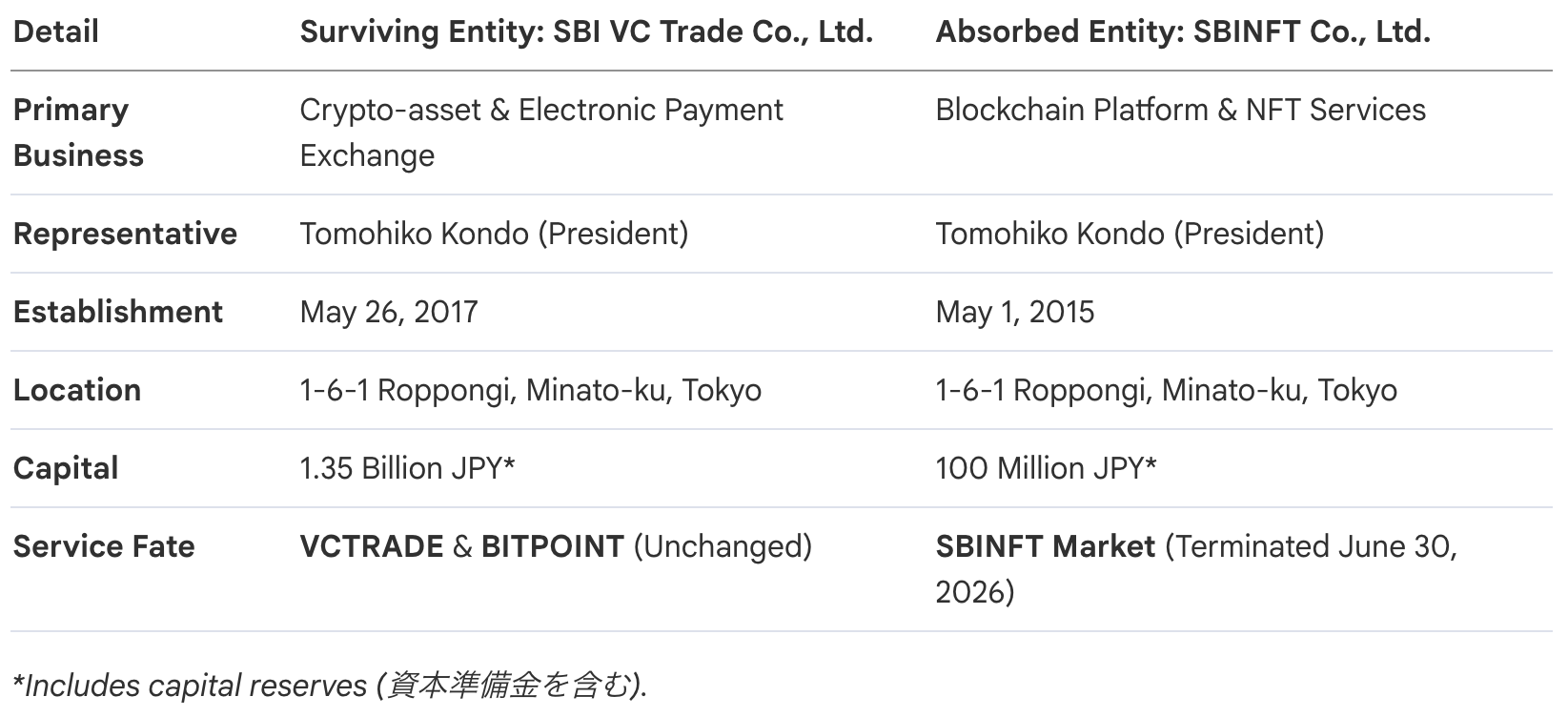
Domestically, SBI is pruning overhead to focus on the "on-chain economy." The merger of SBINFT into SBI VC Trade marks a retreat from the volatile retail NFT art market in favor of B2B digital marketing and RWA integration.
Consolidation Mechanics and Entity Overview
The merger, approved by the Board on May 13, 2026, reflects a logical finality for two units already co-located in Roppongi.
Critical Timeline for Integration
- May 14, 2026: Execution of the formal merger contract.
- June 26–30, 2026: Shareholder meetings to finalize approvals.
- July 1, 2026: Effective date of the merger.
The Shift to "On-chain" Utility
The termination of "SBINFT Market" marks the end of SBI's pursuit of speculative retail NFT volume. Instead, the group is doubling down on "SBINFT Mits," a platform dedicated to corporate digital marketing. By integrating "Mits" with the SBI Web3 Wallet and SBI VC Trade’s regulated exchange infrastructure, SBI is building a pipeline for the "real economy." This enables corporate clients to utilize NFTs as functional tools for loyalty and RWA management rather than just digital collectibles, directly supporting the goal of "consolidated reporting" and "operational efficiency" (業務効率化).
3. Conclusion: The Roadmap for a Regulated On-Chain Economy
The synthesis of the Circle Arc investment and the internal merger reveals a cohesive roadmap: SBI is the architect of the environment in which digital assets reside.
The Three Pillars of SBI’s Strategic Moat
- Infrastructure Control: By participating in the ARC pre-sale, SBI secures a seat at the table for the governance of global settlement layers.
- Regulatory Monopoly: Holding the "standalone" license for electronic payment instrument trading ensures SBI remains the exclusive gateway for USDC and regulated on-chain liquidity in Japan.
- Utility-Driven Pivot: The dissolution of SBINFT’s retail arm in favor of B2B marketing (SBINFT Mits) shifts the focus from speculative trading to high-margin, RWA-focused "On-chain Financial Services."
Ultimately, these actions fulfill SBI’s "Customer-Centric" philosophy by drastically reducing friction through service integration. By streamlining its domestic operations under a single, well-capitalized entity (SBI VC Trade) and securing the foundational rails of the future, SBI has ensured that it will capture a large share of value as the global economy moves on-chain.
 Norbert Gehrke