Blueprint for a 250 Trillion Yen Economy: Japan’s 2026 Financial Strategy

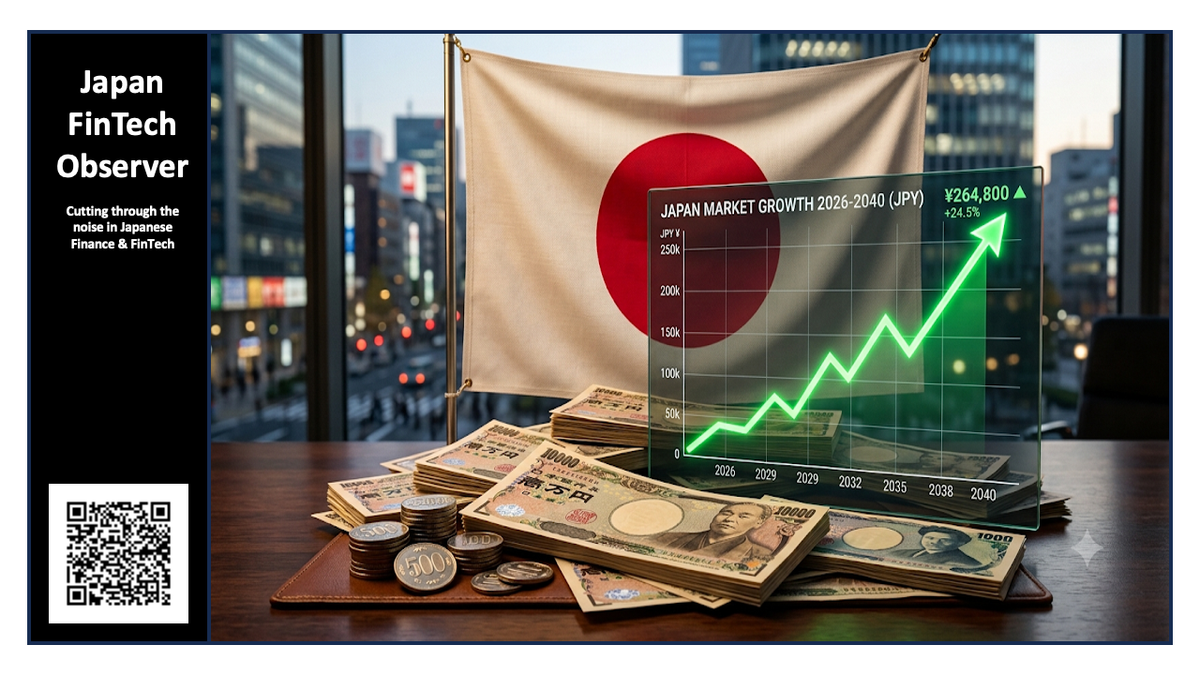
Alongside the Cabinet approval of Japan’s Growth Strategy and the Basic Policy on Economic and Fiscal Management and Reform 2026, the Japanese Cabinet formalized a sweeping mandate titled "Financial Strategy for Promoting Growth Investment," marking a decisive evolution in the nation’s economic architecture.
This manifesto is a structural "upgrade" to the 2023 "Asset Management Nation" plan, designed specifically to underpin the "Strong Economy" envisioned by the Takaichi Administration.
By targeting the entire investment chain—from household savings and institutional asset management to corporate governance and digital infrastructure—the strategy aims to transform Japan into a high-velocity capital hub. The goal is to move beyond the "cash-is-king" stagnation of the lost decades and catalyze a self-sustaining cycle of investment, growth, and wealth distribution.
The Strategic Pivot: A Four-Pillar Manifesto
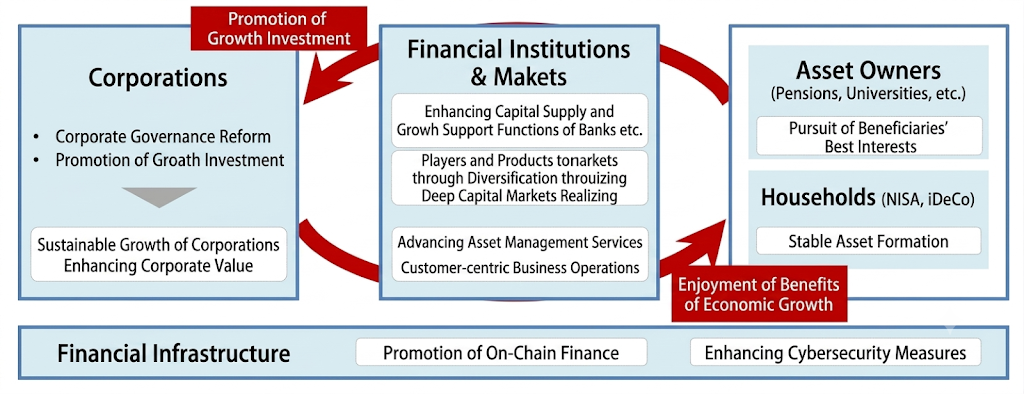
The 2026 Strategy rests on four primary pillars designed to synchronize the interests of every economic actor in the Japanese market:
- The Corporate Sector: Driving long-term value through aggressive growth investment and rigorous governance reform centered on capital cost.
- Asset Owners: Professionalizing the management of trillions in pension and university endowment funds to maximize beneficiary returns and "crowd-in" private risk capital.
- Financial Institutions: Reforming banks and markets to provide "risk money" and "hands-on support" for 17 strategic fields, transitioning from collateral-based lending to enterprise-value financing.
- Infrastructure: Building an "on-chain" financial frontier utilizing AI and blockchain to integrate commerce, logistics, and settlement into a single programmable layer.
Primary Key Performance Indicators (KPIs)
To ensure accountability, the Cabinet has established rigorous numerical targets for the 2040 horizon:

This shift in household assets—effectively doubling the proportion of risk-bearing investments—serves as a forcing function for the bureaucracy. It necessitates a total dismantling of the structural barriers that have historically discouraged Japanese citizens from participating in capital markets. Achieving a 250 trillion yen investment target demands a fundamental re-engineering of how financial institutions deploy capital.
As the administration pivots from a savings-led economy to an investment-led one, the primary burden of execution falls upon the banking sector, which must now reinvent its business model to fund Japan’s industrial modernization.
1. Reforming the Engine: Strengthening Financial Institutions and Market Depth
The 2026 strategy recognizes that for Japan to achieve its growth targets, its banking sector must move away from its historical reliance on traditional, low-margin collateral-based lending. The new mandate calls for a transition toward providing "risk money"—mezzanine and equity financing—coupled with "hands-on growth support." This is particularly critical for the 17 strategic fields identified in the "Public-Private Strategic Investment Linkage Forum," where the Development Bank of Japan (DBJ) and the Japan Investment Corporation (JIC) are now tasked with setting aggressive investment policies.
1.1 Regulatory Deregulation and the M&A Catalyst
To support the increasing scale of corporate restructuring, the government is introducing "special exceptions" to large-credit limit regulations. Historically, these limits—restricting lending to a single group to 25% of a bank's capital—have stifled the financing of mega-mergers and massive infrastructure projects like AI data centers. Under the new strategy, the Financial Services Agency (FSA) will permit:
- M&A Bridge Loans: Large-scale acquisition financing will be exempt from these limits, provided the excess is "certainly expected to be resolved in the short term" via subsequent corporate bond issuance or syndicated loans.
- SPV Lending: Loans to Special Purpose Vehicles (SPVs) for large-scale projects will be exempt if they are structured as non-recourse loans, ensuring bankruptcy-remoteness from the parent company and preventing credit contagion.
1.2 Evolution of the Banking Business Model
The strategy signals a profound shift in the regulatory philosophy surrounding the "Firewall" between banking and securities. By 2026, research will begin into the "General Holding Company" structure. This proposed framework could allow banks to operate outside current restrictive business scopes, provided they do not use deposits as their primary capital source, thereby isolating the core banking system from high-risk investment banking activities. This is a direct attempt to allow Japanese "Megabanks" to compete with global peers like JPMorgan or Goldman Sachs by providing a "total solution" of direct and indirect financing.
Furthermore, the strategy expands the scope of "Investment Special Purpose Subsidiaries." These entities can now hold up to 100% of the voting rights in firms undergoing "carve-outs" (divestitures of non-core businesses) or "going private" transactions, a major expansion from previous limits. The definition of "Venture Business Companies" eligible for bank investment is also being expanded from SMEs to include mid-sized enterprises (Chuken Kigyo), allowing banks to support firms during their most capital-intensive growth phases.
1.3 Activating the Debt Market: The Debt-as-Growth Frontier
A deeper, more liquid corporate bond market is seen as a vital catalyst. The strategy outlines several measures to remove friction from bond issuance:
- Virtual Bondholder Meetings: Legislating digital-first governance for debt holders to speed up restructuring.
- Removal of Bond Manager Requirements: Under the 2026 amendments to the Industrial Competitiveness Enhancement Act, companies meeting specific productivity and equipment investment criteria will no longer be required to appoint a "bond manager," significantly lowering the cost of issuance.
- Low-Rating Incentives: To encourage investment in higher-yield, lower-rated debt, the Japan Finance Corporation will provide government-backed liquidity to financial institutions that acquire bonds from companies making high-impact productivity investments.
1.4 Regional Financial Power
The strategy does not ignore the regional core. Through the "Regional Future Strategy," the government is promoting "Strategic Industrial Clusters." Regional banks are being encouraged to move beyond "Main Bank" compliance and adopt "Investment Banking" functions. The Regional Economy Vitalization Corporation of Japan (REVIC) will lead this effort, training regional bank staff in corporate value creation and M&A advisory, while the "Enterprise Value-based Security Interests" (introduced in May 2026) will allow regional lenders to provide loans based on a firm's future cash flows and business potential rather than physical real estate collateral.
By modernizing these institutional mechanics, the government aims to ensure that capital flows efficiently to the most productive sectors. However, the effectiveness of this capital deployment depends entirely on the governance of the corporations receiving it.
2. Governance as a Growth Driver: The 2026 Code Revisions
Corporate governance in Japan is undergoing a paradigm shift, moving from a compliance-heavy "defensive" posture to an "aggressive" strategic asset. The 2026 Strategy posits that capital efficiency is the ultimate metric of corporate health. The forthcoming update to the Corporate Governance Code in Summer 2026 will explicitly mandate that Boards of Directors take responsibility for defining "Growth Paths." Crucially, boards will be required to explain their "opportunity costs"—the potential gains lost by holding underperforming assets or excess cash rather than reinvesting in growth.
2.1 Economic Profit (EP) vs. The ROE Trap
Central to this reform is the adoption of Economic Profit (EP)—defined as Net Operating Profit After Tax (NOPAT) minus the cost of capital—as the "common language" between Japanese firms and global investors. While ROE (Return on Equity) has been the focus for years, critics argue it has been gamed through aggressive share buybacks without underlying growth. EP forces management to acknowledge the weighted average cost of capital (WACC). If a firm's ROIC does not exceed its WACC, it is destroying value, regardless of its accounting profit. The strategy seeks to make EP the standard for the "JPX-Prime" tier, forcing a shift from "Short-termism" to sustainable value creation.
2.2 Shareholder Rights and the "Best Owner" Principle
To reinforce these standards, the strategy proposes significant amendments to the Companies Act:
- Shareholder Proposal Rights: The government will review requirements for proposing agendas to prevent "short-termist" abuse while simultaneously ensuring that "real" long-term investors have the teeth to hold management accountable. This includes clarifying the rights of substantial shareholders to call extraordinary meetings.
- Reporting Unification: Merging "Securities Reports" (FSA) and "Business Reports" (Ministry of Justice) into a single, unified digital filing. This reduces the administrative burden while increasing the "depth of monitoring" for investors.
- The Best Owner Principle: The "Growth Investment Guidance" will promote the idea that assets should be held by the entity capable of maximizing their value. This serves as a mandate for the divestment of non-core businesses (carve-outs), with the expectation that "strategic buyers" or PE funds can unlock value trapped within bloated conglomerates.
This governance overhaul is intended to make Japanese companies irresistible to global capital. As corporate value grows, the next challenge is ensuring that this growth is captured and professionalized by the nation’s largest asset owners.
3. The Asset Owner Revolution: Professionalizing the Trillions
Japan’s public and private pension pools represent some of the largest concentrations of capital in the world, yet they have historically lagged behind global peers in sophisticated asset allocation. The 2026 Strategy seeks to transform these "sleeping giants" into high-alpha investment engines through a process of institutional professionalization.
3.1 GPIF and the "9 Subjects" Harmonization
The Government Pension Investment Fund (GPIF) and eight other employee pension entities—collectively known as the "9 Subjects"—will face a new regime of harmonization. These include the Federation of National Public Service Personnel Mutual Aid Associations, the Pension Fund Association for Local Government Officials, and others. To increase transparency:
- Unified Reporting: A common set of definitions for investment criteria, methods, and performance status will be mandated. This allows for direct comparison between the nine entities, shaming underperformers and highlighting best practices.
- Alternative Asset Expansion: The GPIF is currently pushing toward its 5% ceiling for alternative assets (Private Equity, Venture Capital, Infrastructure). The 2026 mandate requires a review of this 5% cap before it is reached, with a focus on "Strategic Alternative Investment" that supports domestic growth.
3.2 The "Yale/Harvard Model" for University Endowments
A major focus is the transformation of university funds. Under the strategy, "International Excellence Research Universities" must adopt the Asset Owner Principles as a condition of their certification. The government will provide "Asset Management Guidebooks" to help smaller universities navigate the transition from simple bond holding to diversified, long-term allocation. This includes:
- OCIO Services: Promoting the use of "Outsourced Chief Investment Officer" services for universities lacking internal scale.
- Joint Platforms: Enabling 国立大学 (National Universities) to form joint investment platforms to pool capital and access top-tier global PE and VC funds.
- Mark-to-Market Reform: Reviewing private university accounting standards (MEXT ordinances) to move away from "acquisition cost" valuation toward "market value" reporting, providing a clearer picture of institutional risk.
By professionalizing these institutional tiers, Japan aims to create a sophisticated domestic demand for high-quality financial products. This top-down professionalization must, however, be met from the bottom up by a newly empowered class of retail investors.
4. From Savers to Investors: Household Wealth Formation
The ultimate success of the 2026 Strategy depends on shifting the ¥2,000 trillion-plus in Japanese household assets from stagnant bank deposits into productive investments. In a "world with interest rates," the government is aggressively promoting the transition from "saving" to "investing."
4.1 Re-Engineering iDeCo for the AI Era
While NISA has seen explosive growth, the iDeCo (Individual Defined Contribution Pension) remains underutilized with only 4 million participants. The 2026/2027 reform targets include:
- Abolishing the 35-Product Limit: Currently, iDeCo plans are capped at 35 products, often leading to a "safe" but low-return lineup. This limit will be removed to allow for more diverse, high-growth options.
- Robot-Advisor Integration: The strategy clears the path for "discretionary investment contracts" (robot-advisors) within iDeCo, allowing for automated rebalancing based on an individual's risk tolerance.
- Targeting "Principal-Guaranteed" Inertia: Currently, 20% of iDeCo participants hold only principal-guaranteed products (cash/insurance). The government will now mandate that financial institutions explain the "inflation risk" of these products and offer "default investment options" that default to diversified growth funds.
4.2 J-FLEC and Regional Literacy
The Financial Literacy Education Promotion Organization (J-FLEC) will play a central role, moving beyond Tokyo to regional centers. The mandate is to ensure that financial education is "neutral and beneficiary-oriented." This is supported by the 2024 update to "Customer-Oriented Business Operations," which will be strictly monitored to ensure that banks and brokers are not "churning" accounts for commissions, but rather building long-term wealth for retirees.
This transition of household wealth provides the massive pool of liquidity needed to fund domestic growth. However, the plumbing of the financial system must be updated to handle this new era of high-frequency, AI-driven commerce.
5. Financial Infrastructure: AI and the On-Chain Frontier
The 2026 Strategy looks toward the "Agentic Commerce" era, where AI agents autonomously conduct transactions. To ensure Japan retains "Settlement Sovereignty," the government is prioritizing a blockchain-based financial infrastructure.
5.1 The On-Chain Finance Initiative
In Summer 2026, the "AI-Era On-Chain Finance Forum" will be established to create a roadmap for integrating logistics, commerce, and settlement.
- Stablecoins (SC) and Tokenized Deposits: Japan is establishing a regulatory framework for yen-denominated stablecoins to be used for 24/7/365 settlement. This includes "equal footing" dialogues with global regulators to ensure cross-border compatibility of yen SCs.
- Programmable Public Finance: The Digital Agency will explore using stablecoins for "public benefit payments," while the Ministry of Finance (MoF) is researching Tokenized JGBs to allow for instantaneous, on-chain settlement of government debt, reducing counterparty risk.
5.2 Cyber-Resilience and the Quantum Threat
As the system moves on-chain, security becomes a matter of national economic security. The strategy synthesizes the "Total Measures against Fraud 2.0," focusing on:
- Frontier AI Threats: A public-private task force will counter AI-generated "Deepfake" fraud and automated cyber-attacks.
- Quantum Readiness: Japan is one of the first nations to officially assess "Quantum危殆化" (Quantum Endangerment Risk) for its financial infrastructure. The strategy mandates the development of Post-Quantum Cryptography (PQC) standards to ensure the long-term integrity of blockchain-based settlement.
Maintaining technological sovereignty through these on-chain systems is the prerequisite for Japan's "Japan Week" offensive, as it provides the modern, secure platform global investors now demand.
6. Global Connectivity and the "Japan Week" Offensive
Japan's structural reforms are only as effective as the world’s perception of them. To attract the global talent and capital necessary to hit the 250 trillion yen target, the government is launching an aggressive international communication strategy.
6.1 The Financial Special Zones
The "Support Office for Entry" will offer a one-stop, English-language service for foreign asset managers. These efforts culminate in the "Japan Weeks" and "Japan Fintech Week," high-profile summits designed to showcase the "Special Zones for Financial and Asset Management." These zones offer a regulatory sandbox for innovative investment strategies and "Asset Management Pro" visas to attract global expertise.
6.2 The ASEAN Bridge: Transition Finance Leadership
Japan is also positioning itself as a regional leader in "Transition Finance" through the Asia GX Consortium. By exporting its technical and regulatory expertise in Green Transformation (GX) to ASEAN partners, Japan aims to create a unified regional market for sustainable investment. This "Asia Bridge" is seen as a way to "crowd-in" global capital to the entire region, with Tokyo acting as the central clearinghouse.
7. The Path to 2040
The "Growth Investment Financial Strategy" of 2026 represents a comprehensive blueprint for national renewal. By forcing financial institutions to provide risk capital, mandating boards to account for opportunity costs, and moving household wealth into the markets, the Takaichi Administration is betting that structural reform can overcome decades of inertia.
However, skepticism remains. Critics argue that without deeper labor market reform, capital efficiency gains will remain trapped on balance sheets. Furthermore, the 250 trillion yen goal—a more than doubling of current domestic investment—requires a level of private-sector participation not seen since the 1980s. Nevertheless, the strategy’s focus on "Economic Profit" and "on-chain" integration provides a credible, modern mechanism for growth. If executed with the rigor promised in this manifesto, Japan will not only achieve its domestic targets but will redefine itself as the indispensable global financial hub of the mid-21st century.
 Norbert Gehrke