Daiwa Securities to Reshape Wealth Management Landscape with ¥370 Billion Acquisition of ORIX Bank


Daiwa Securities Group has announced the ¥370 billion acquisition of ORIX Bank Corporation (OBK) in a move to immunize its earnings against market volatility. This transaction represents a decisive step in Daiwa’s "Passion for the Best 2026" management plan, shifting the group’s weight toward a stable, interest-rate-driven revenue base. By integrating OBK’s high-yield credit engine into the group’s banking arm, Daiwa Next Bank (DNB), the firm aims to optimize its balance sheet and capitalize on the Bank of Japan’s exit from its long-standing negative interest rate policy.
The deal is structured to be immediately transformative, utilizing Daiwa's substantial capital buffer to facilitate an all-cash acquisition without the dilution typically associated with equity financing.
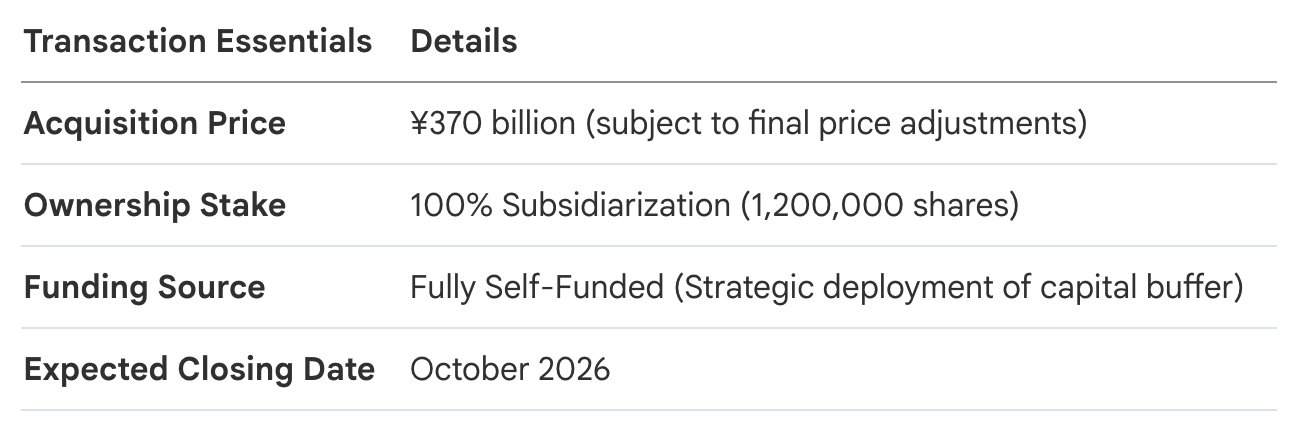
This funding strategy underscores Daiwa’s commitment to balance sheet optimization; the group is also considering the issuance of perpetual subordinated bonds to further refine its capital structure while maintaining its AA (R&I) credit profile. By eschewing equity financing, the transaction is designed to be EPS accretive over the medium term. This structural alignment marks the evolution of Daiwa’s banking operations from a simple securities gateway into a diversified, full-service powerhouse.
1. The Logic of the "Ideal Match": Complementary Strengths
This acquisition is framed as a "mutually complementary" integration of two entities whose business constraints are diametrically opposed. The transaction aims to bridge the fundamental gap between Daiwa’s liquidity-heavy balance sheet and ORIX’s high-yield lending expertise, creating a synergy that neither bank could achieve independently.
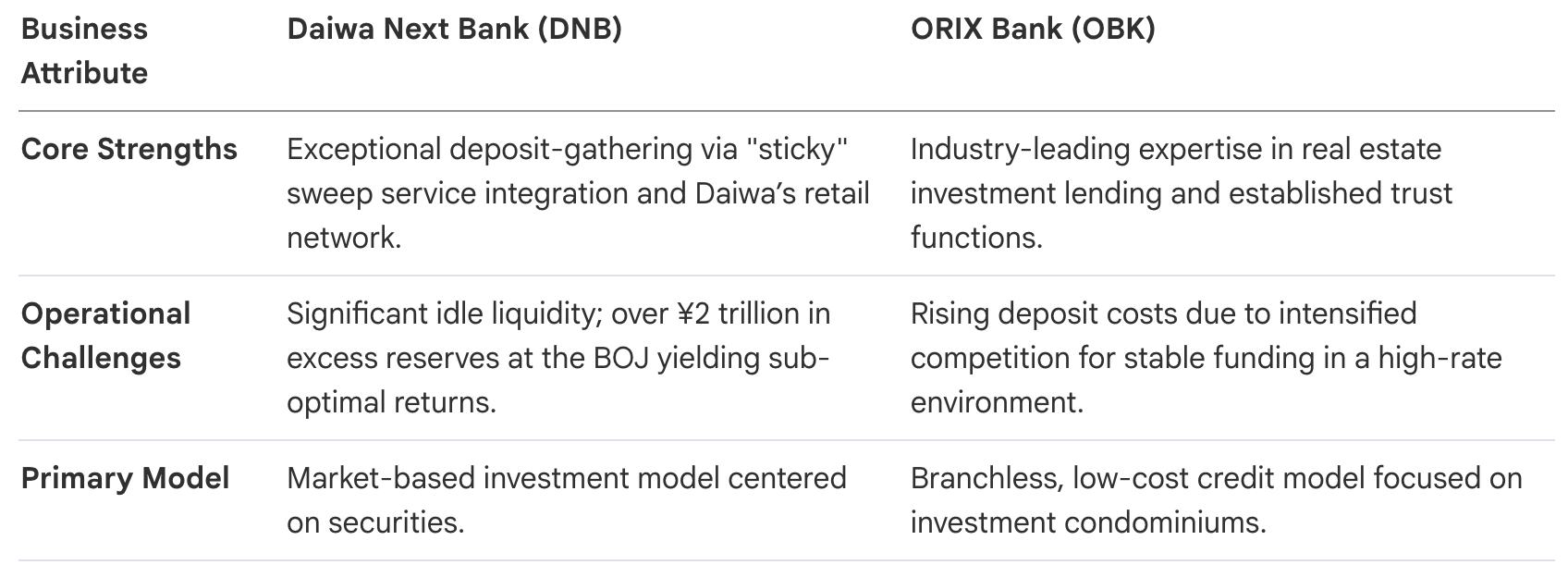
The merger of DNB’s "sticky deposits" with OBK’s "lending expertise" solves the primary capital inefficiency of both banks. Daiwa gains an immediate, sophisticated lending and trust infrastructure, allowing it to move beyond gateway functions into asset-liability management for its high-net-worth clients. Conversely, OBK is relieved of its funding pressures, gaining access to a massive, low-cost deposit base. This synergy transforms the combined entity into a high-margin lending machine.
2. Financial Engineering: Revenue Synergies and the "Virtuous Cycle"
The financial engineering behind this deal is expected to transform the combined entity’s Profit and Loss (P&L) statement. Daiwa projects a significant expansion of recurring profits, driven by a targeted ¥35 billion improvement in Net Interest Income (NII). This synergy is anchored by the redeployment of DNB’s balance sheet. While DNB maintains over ¥2 trillion in its BoJ current account, the group specifically targets the deployment of ¥1.5 trillion in available excess reserves into high-yield assets.
This liquidity, combined with a target of ¥2 trillion in new deposits accumulated over five years through competitive interest rates, creates a ¥3.5 trillion pool for high-yield asset deployment. Furthermore, the deal creates a powerful "flywheel" effect through the following three-step mechanism:
- Step 1 - Deepening Asset Consulting: Leveraging OBK’s trust functions to facilitate inheritance, gift planning, and real estate-backed financing for Daiwa’s wealth management clients.
- Step 2 - Establishing a Growth Spiral: High-yield lending enables competitive deposit rates, which attracts further "sticky" deposits, funding an expansion into real estate and securities-backed loans.
- Step 3 - Asset Management Collaboration: The bank will support the group’s Asset Management Division by providing financing to funds and SPCs managed by Daiwa’s real estate and alternative asset arms, accelerating growth across the entire corporate ecosystem.
While the amortization of goodwill will create a near-term accounting drag, the addition of OBK’s average standalone ordinary income (approx. ¥30 billion annually) and the NII synergies are expected to result in a net positive impact on ROE and EPS, driving long-term corporate value.
3. Constructing a Full-Service Powerhouse: Post-Merger Balance Sheet
The pro-forma "New Bank" will evolve into a full-service institution with approximately ¥9 trillion in total assets and ¥400 billion in equity. The following table illustrates the diversification achieved by combining DNB’s market-based assets with OBK’s credit-heavy portfolio.
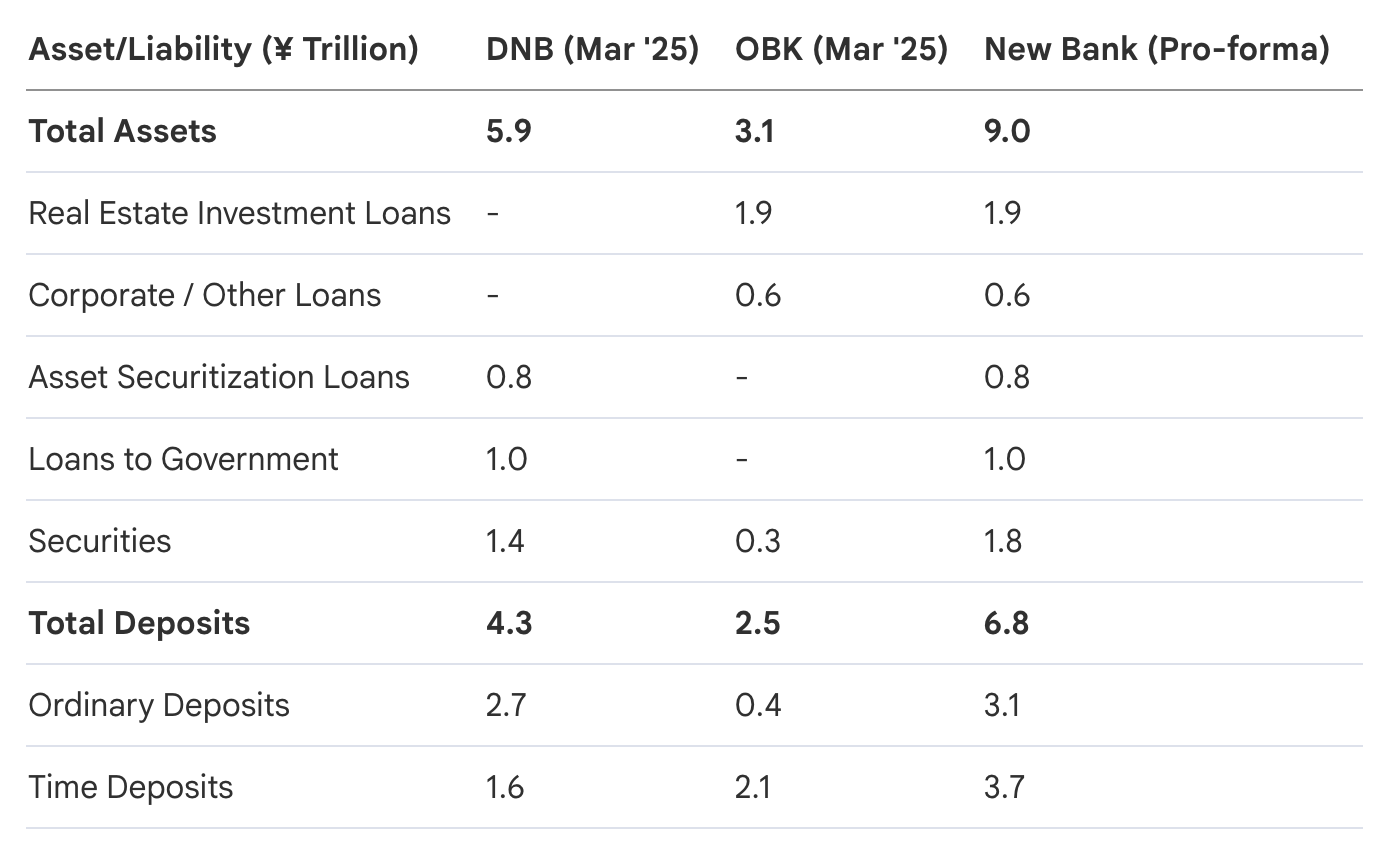
Regarding capital adequacy, the transaction will lead to a 5-percentage-point decrease in both the Consolidated Total Capital Ratio and the Common Equity Tier 1 (CET1) Ratio. However, on a "Future Basel III Finalization Fully Loaded Basis," these figures are projected to remain robust at over 14% and 12%, respectively. These levels sit comfortably above the 11% regulatory and stress buffer requirements, ensuring the group's financial resilience post-integration. The path to the October 2026 deadline now focuses on securing "Major Bank Shareholder" (銀行主要株主) status and "Bank Subsidiary Acquisition Approval" (銀行子会社取得認可) from the Financial Services Agency
4. Corporate Profiles and Implementation Timeline
The integration marks the union of two pioneers in the Japanese banking sector. ORIX Bank, established in 1993 as Yamaichi Trust Bank before joining ORIX in 1998, is a high-margin specialist in investment condominium loans led by Kanji Teramoto. Daiwa Next Bank, launched in 2011 and led by Naoto Shimomura, has served as the group’s primary liquidity gateway, utilizing its "sweep service" to build a massive deposit base.
Critical Path to Closing:
- April 27, 2026: Execution of the Share Transfer Agreement.
- Interim Phase: Pre-notification to the Fair Trade Commission (Antitrust) and formal application for FSA regulatory approvals.
- October 2026: Targeted completion of share transfer and 100% subsidiarization.
As Daiwa Securities Group CEO Akihiko Ogino noted, this is a "historical step" in establishing a competitive financial group with securities at its core. By bridging the gap between liquidity and high-yield credit, Daiwa is positioning itself to thrive in a normalized interest rate environment, signaling a new era of growth for the firm and the broader Japanese wealth management industry.
 Norbert Gehrke