FSA Overhauls Digital Asset Framework: Foreign Trust-Type Stablecoins to Enter Japan’s Payment Ecosystem

The Financial Services Agency (FSA) has finalized a regulatory amendment that effectively dismantles the legal barriers once relegating global stablecoins to the speculative fringes of the Financial Instruments and Exchange Act (FIEA). By reclassifying foreign-issued trust-type stablecoins from "Securities" to "Electronic Payment Instruments" under the Payment Services Act (PSA), the regulator is integrating these assets into Japan’s formal payment ecosystem. For years, the domestic utility of global stablecoins was stifled by legal ambiguity: assets issued by foreign trust banks were often trapped under the restrictive "trust beneficial rights" label, rendering them impractical for everyday transactions. This amendment provides the necessary legislative clarity, ensuring that foreign digital assets can function as regulated payment methods on Japan's financial rails, provided they satisfy a rigorous "Equivalence" standard.
1. Defining the New Regulatory Perimeter
The amended framework creates a dedicated regulatory lane for trust-type stablecoins issued by foreign trust companies or banks. A critical component of this perimeter is the explicit exclusion of "Specific Trust Beneficial Rights" (PSA Article 2, Paragraph 5, Item 3), which are already managed under domestic frameworks. By creating "Item 4" as a specific bridge for foreign-issued assets, the FSA eliminates regulatory duplication and clarifies that these foreign instruments are no longer shadow securities, but legitimate payment tools.
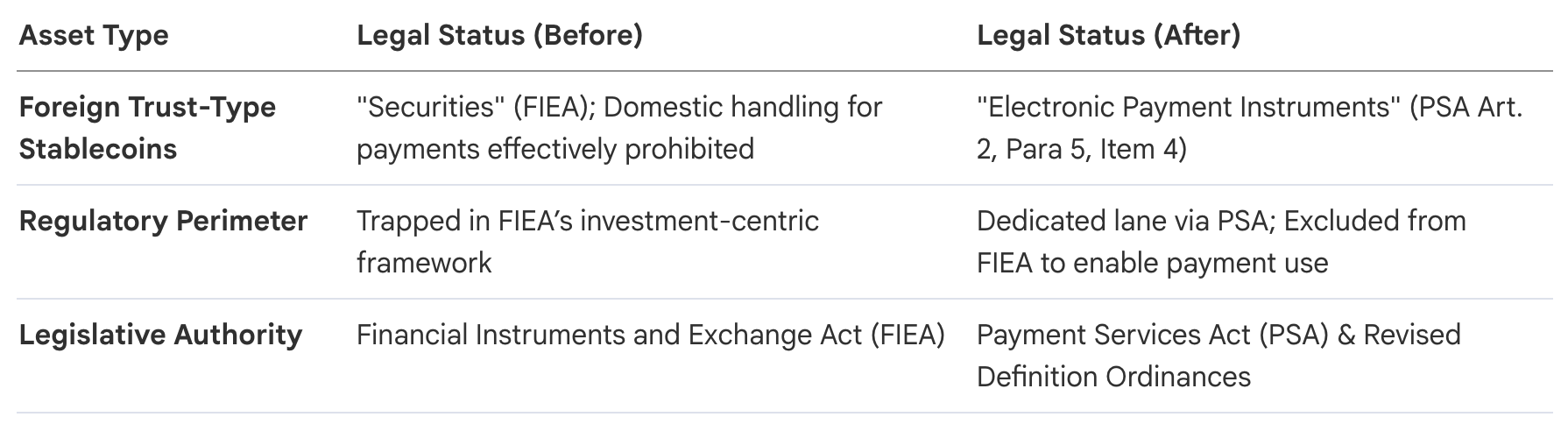
This narrow focus ensures that only assets designed specifically for payment purposes—excluding investment-heavy specific trusts—can enter the domestic market under these streamlined rules.
2. The "Equivalence" Standard: Four Pillars of Compliance
The cornerstone of the FSA’s consumer protection strategy is the "Equivalence" standard. To be recognized as Electronic Payment Instruments, foreign stablecoins must prove their home-jurisdiction regulations are functionally equivalent to Japanese law. Compliance is non-negotiable and rests on four mandatory pillars:
- Issuer Licensing and Supervision: Issuers must hold foreign licenses equivalent to Japan’s Banking Act or PSA. Crucially, they must be supervised by a foreign administrative authority capable of robust information sharing with the FSA Commissioner.
- Asset Management and Auditing: Backing assets must be managed under standards equivalent to Japanese trust laws. The management status must be verified through audits conducted by a Foreign Certified Public Accountant (as defined in the Certified Public Accountants Act) or an equivalent foreign audit firm.
- Anti-Crime and Transaction Control: Issuers must possess the operational capacity to suspend transactions or freeze assets upon notification from authorities regarding fraud, money laundering, or other criminal activities.
- Same-Currency Denomination: To mitigate foreign exchange risk and protect users during liquidation, the backing assets (trust assets) must be denominated in the same currency as the digital asset itself.
On the technical front, the FSA has adopted a "performance-based equivalence" stance regarding backing assets. While domestic specific trusts are generally bound by a 50% government bond limit, the FSA will allow flexibility for foreign issuers on a case-by-case basis. The primary metric is not the exact asset ratio, but the ability to guarantee redemption at par value. If an issuer can prove that their asset composition sufficiently limits credit, liquidity, and price risks to ensure par redemption, the FSA signals a willingness to grant approval.
3. Oversight and International Cooperation Framework
The transition is governed by the "Administrative Guidelines" (Third Volume: Financial Companies Section 17), which establish a cross-border supervisory network. This is a strategic partnership between the FSA and overseas regulators to manage systemic risk.
The FSA Commissioner is empowered to verify the "Equivalence" of foreign jurisdictions by requesting the sharing of information, knowledge, and experience from international counterparts. While the FSA builds this international supervisory net, the immediate burden of proof remains with Japanese "Electronic Payment Instrument Exchange Service Providers." These domestic intermediaries are responsible for providing supporting documentation to verify the foreign issuer’s status and the robustness of the overseas regulatory environment. Over time, as the FSA’s international cooperation framework matures, this direct burden on domestic exchanges is expected to stabilize.
4. Market Readiness and Implementation Roadmap
The regulatory rollout follows a disciplined timeline, reflecting the FSA's commitment to market readiness and legal certainty.
Key Milestones:
- Public Consultation Results: The FSA processed 16 technical comments received during the consultation window (Tuesday, February 3, 2026, to Thursday, March 5, 2026).
- Promulgation Date: The amended Cabinet Office Ordinances were officially announced on May 19, 2026.
- Effective Date: Mandatory enforcement begins on June 1, 2026.
Transitional measures included in the supplementary provisions ensure that acts committed prior to June 1 remain subject to previous penal standards, facilitating a stable transition for existing market participants.
This overhaul serves as a clear signal that Japan is "open for business" to global stablecoin issuers. By explicitly addressing architectures used by assets like USDC in the public comments, the FSA has paved a compliant pathway for the world's most liquid digital assets to operate within Japan's regulated payment rails, bridging the gap between global digital finance and the domestic economy.
 Norbert Gehrke