MUFG Hits Record Profit Trifecta as Rising Interest Rates and Strategic Pivots Drive ¥2.4 Trillion Result

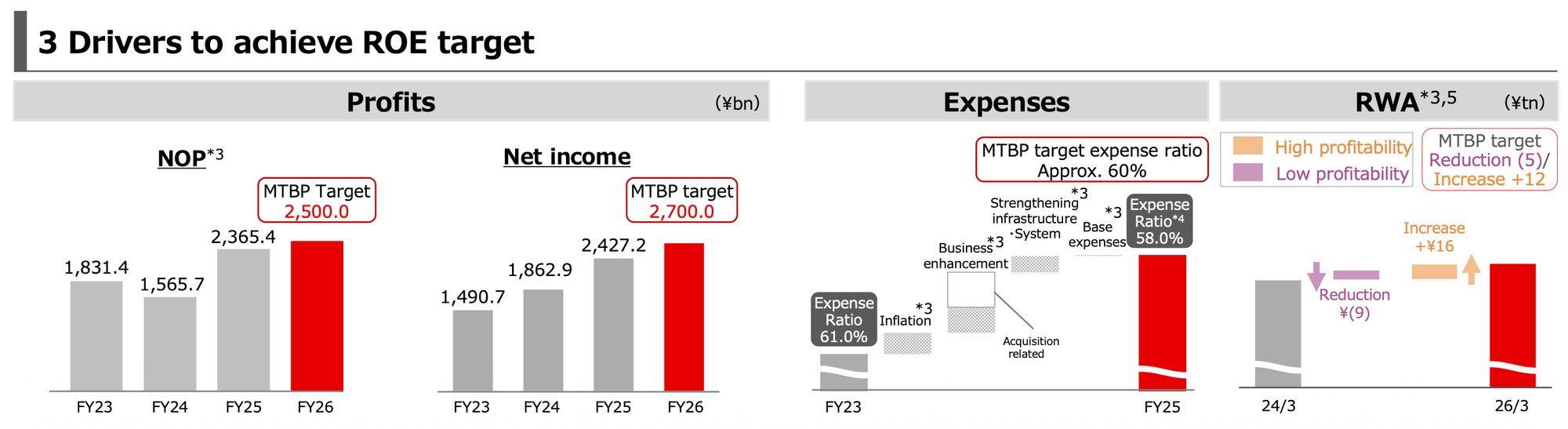
Mitsubishi UFJ Financial Group (MUFG) has capitalized on the definitive end of Japan’s negative interest rate era to post a record-high net income for the third consecutive year. The banking giant reported a net income of ¥2,427.2 billion for the fiscal year ended March 31, 2026, a 31% surge over the previous year. This historic bottom line was underpinned by a robust Net Operating Profit (NOP) of ¥2,377.2 billion, signaling that MUFG is successfully translating the Bank of Japan’s (BOJ) policy shift and its own "Medium-Term Business Plan" (MTBP) into tangible institutional value. With a Return on Equity (ROE) of 11.3%, the group is now within striking distance of its 12% target, marking a significant milestone in the bank’s structural transformation.
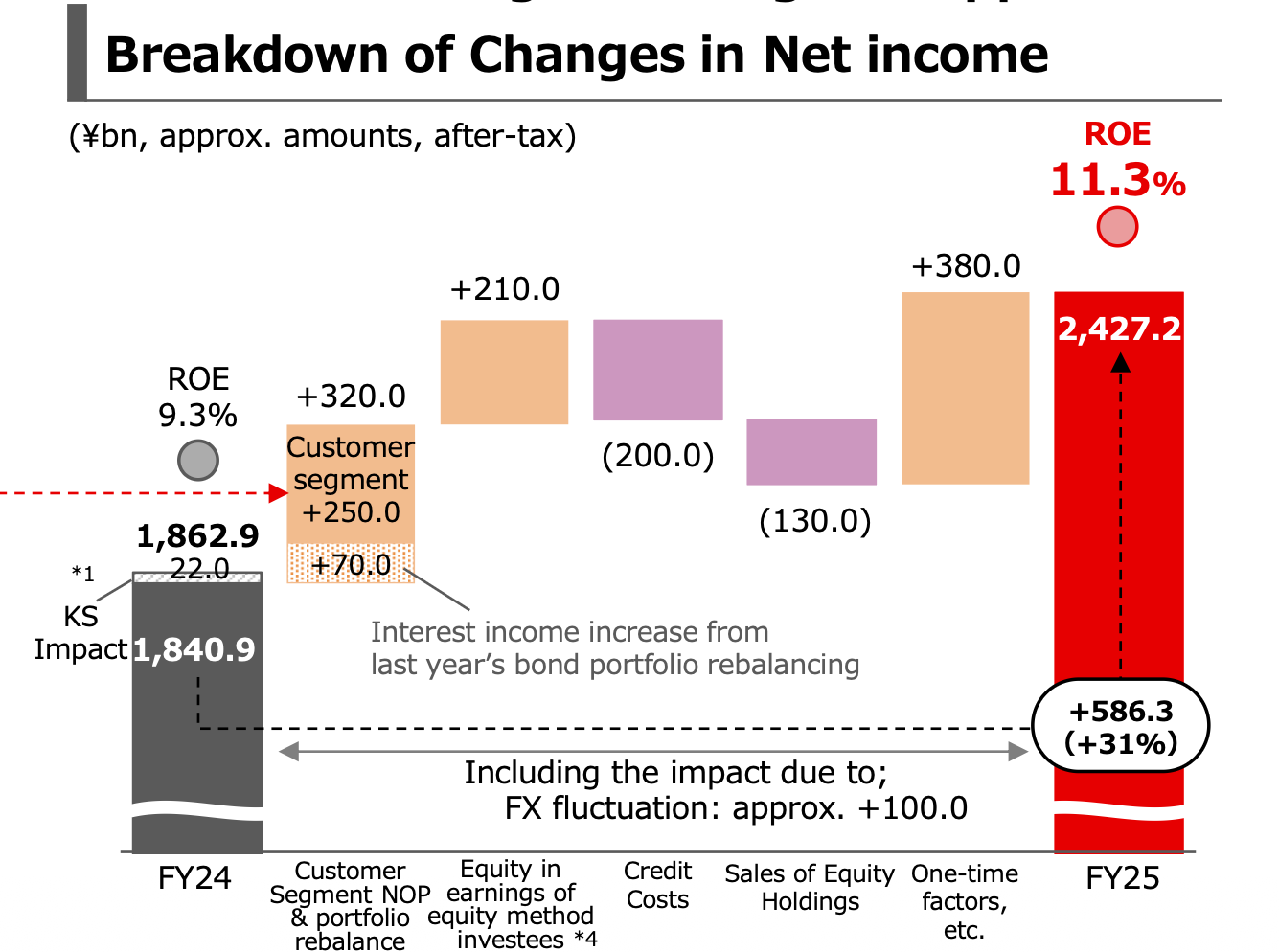
While the headline figures underscore a period of unprecedented profitability, the engine of this growth lies in a sophisticated interplay of JPY interest rate dynamics, a massive recovery in global markets, and the strategic harvesting of equity holdings.
1. Macro Drivers: Interest Rates and Portfolio Rebalancing
The primary catalyst for MUFG’s revenue surge was its ability to navigate the transition in JPY interest rates while rebounding from the previous year’s aggressive bond portfolio rebalancing. However, a sharp analytical eye reveals a "tug-of-war" between macro tailwinds and operational costs.
Market Dynamics and Analytical Contrast
- The Interest Rate Trade-off: JPY interest rate hikes provided a significant +¥170.0 billion boost to the bottom line, which comfortably offset an -¥80.0 billion drag caused by persistent inflation and rising base expenses.
- Currency Windfalls: FX fluctuations were a major driver of Gross Profits, contributing approximately +¥200.0 billion as the USD/JPY rate climbed from 149.52 at the end of FY24 to 159.88 by March 2026.
- Customer Segment Momentum: NOP within core customer segments grew by 16% YoY (+¥356.2 billion), reflecting deepened client relationships and increased lending spreads.
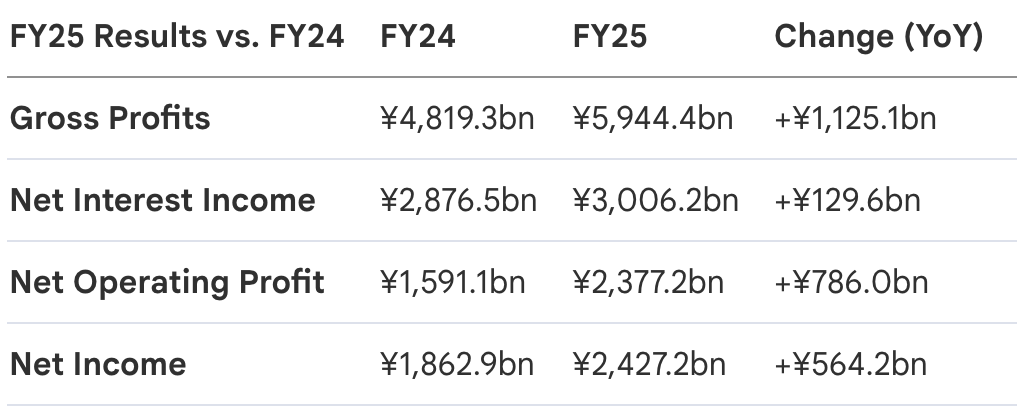
Beyond the interest income, MUFG’s bottom line was fortified by ¥845.5 billion in net gains from the sale of equity securities, reflecting an accelerated divestment of cross-shareholdings.
2. Business Segment Deep Dive: The Morgan Stanley Engine and Global Turnaround
MUFG’s diversified model has evolved into a balanced machine where institutional power and strategic alliances provide a massive profit cushion.
- The Morgan Stanley Contribution: Central to MUFG’s record result was its stake in Morgan Stanley, which contributed a staggering ¥676.4 billion to net income. This remains the group's most vital strategic equity method investment.
- Global Markets (GM) Recovery: Perhaps the most dramatic turnaround occurred in the Global Markets segment. After a bond-rebalancing-induced NOP loss of ¥649.4 billion in FY24, the segment swung back to a profit of ¥57.7 billion, a recovery of over ¥700 billion. Sales & Trading also remained resilient, capturing market movements to expand flow business.
- Retail & Digital Alliances: The "Emut" service brand has seen a 3x increase in customer referrals. Looking ahead, the bank’s strategic alliance with Google is set to enter a critical phase, with a new Digital Bank scheduled to open in FY26 and a fully integrated UI/UX with online securities slated for FY27.
- APAC Expansion: To reinforce its "Asia Platform," MUFG completed its investment in Shriram Finance, a major Indian NBFC, in April 2026. This investment temporarily pushed the CET1 ratio to 10.8%, slightly above the 9.5-10.5% target range, though a recovery is expected as RWA optimization continues.
3. The AI-Native Pivot and ESG Integration
MUFG is repositioning itself as an "AI-native" institution, moving beyond experimental use cases into enterprise-wide deployment of Generative AI, including ChatGPT Enterprise and Copilot.
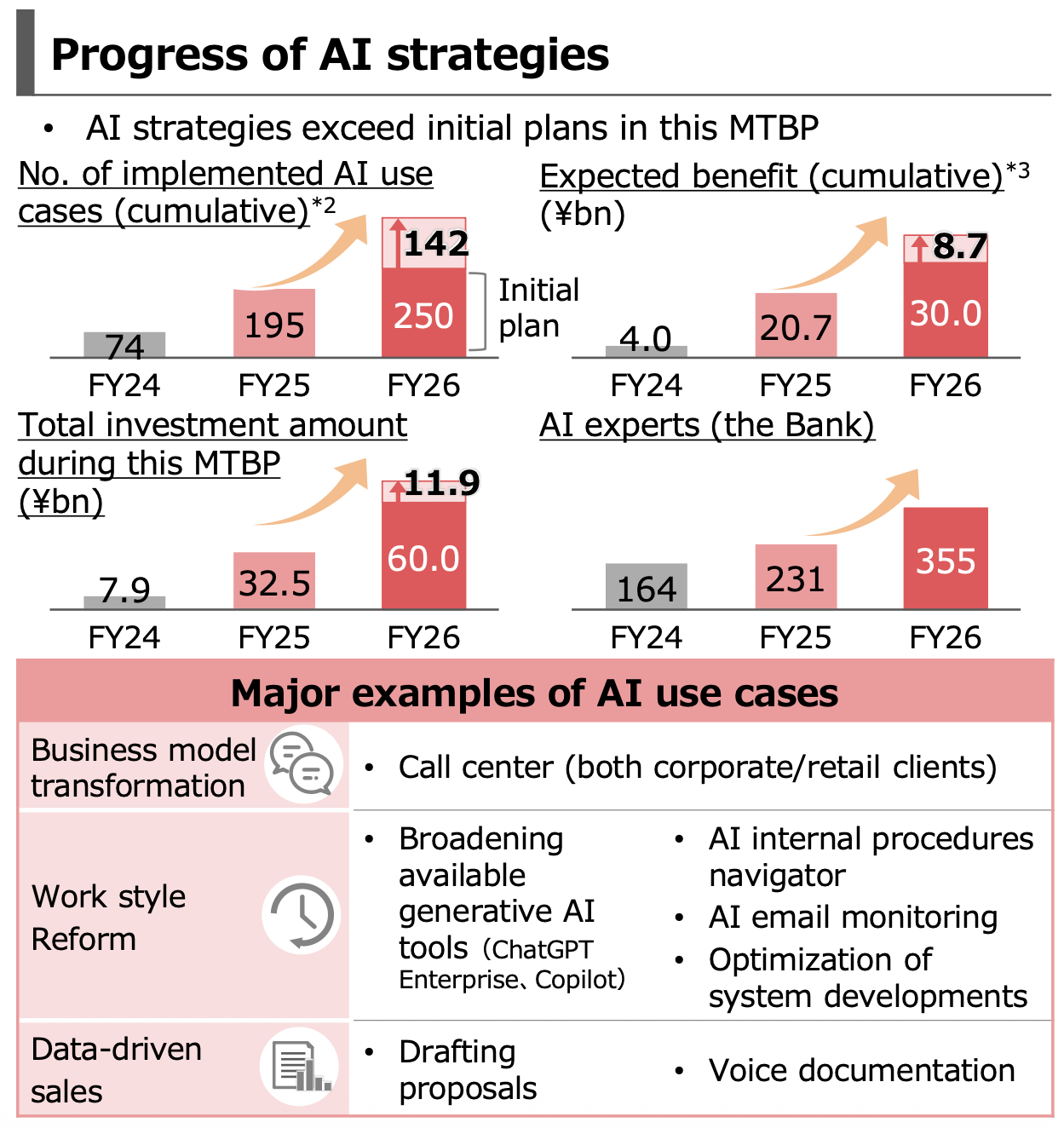
- AI Implementation: The bank has implemented 250 cumulative AI use cases, significantly outpacing its original roadmap. These initiatives, ranging from automated email monitoring to AI-driven sales proposals, are expected to yield a cumulative benefit of ¥30.0 billion.
- Sustainable Finance: Under the "Transition Progress 2026" framework, MUFG has achieved ¥56.5 trillion in sustainable finance, surpassing the halfway mark toward its ¥100 trillion FY2030 target.
4. Shareholder Returns and FY2026 Outlook
With its capital cushion expanding, MUFG has moved aggressively on shareholder returns, signaling confidence in the sustainability of its earnings.
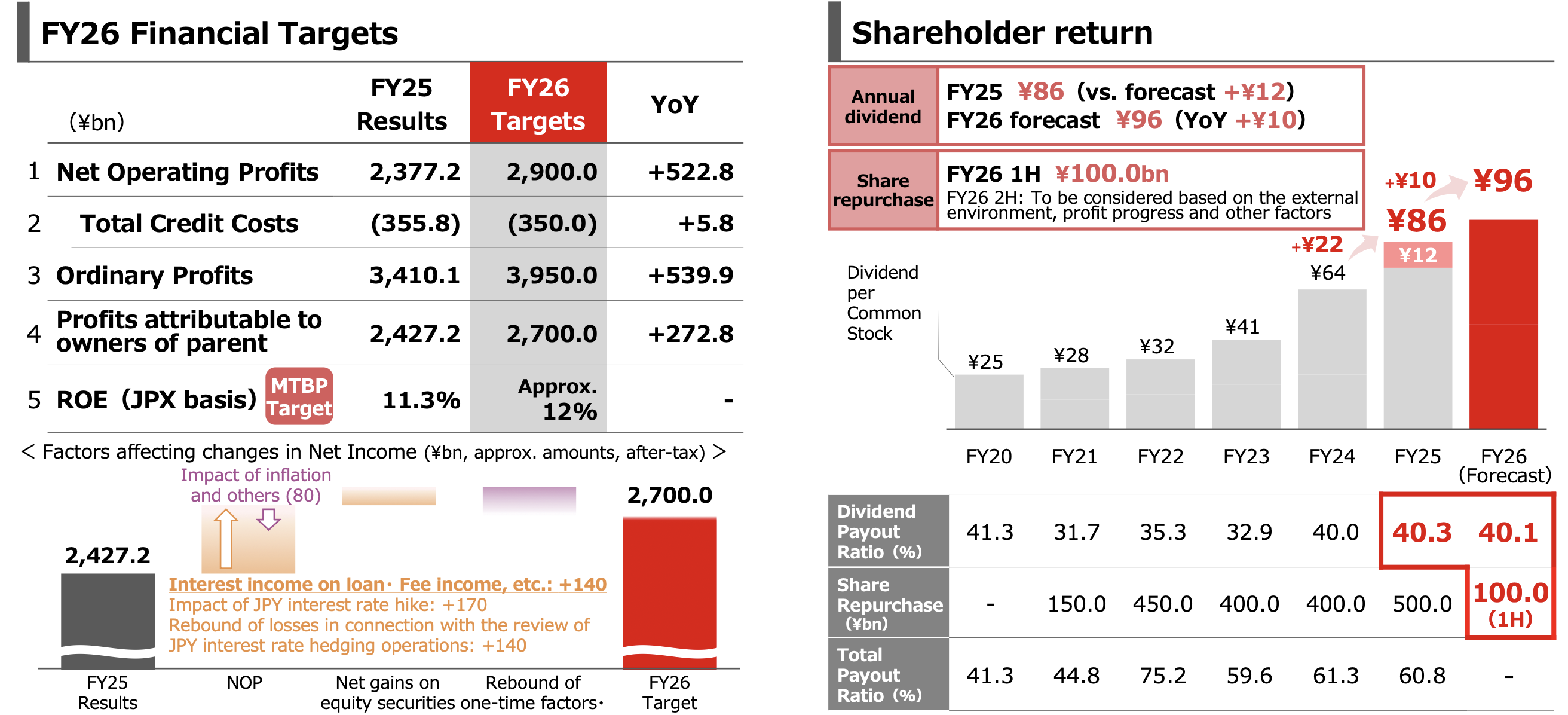
- Dividend Trajectory: The bank raised the FY25 annual dividend to ¥86 (beating previous forecasts by ¥12) and has set an FY26 forecast of ¥96.
- Capital Management: A ¥100.0 billion share repurchase has been authorized for the first half of FY26.
- Targets: For the final year of the MTBP, MUFG has set an ambitious net income target of ¥2.7 trillion. This assumes a BOJ policy rate of approximately 1% and a USD/JPY rate stabilizing in the lower-¥150s.
5. The Risk Landscape: Geopolitics and AI Security
As MUFG enters the final leg of its current business plan, management remains wary of a triad of external pressures. While the domestic environment is bolstered by wage growth and underlying inflation, the bank identifies the Middle East conflict as a primary threat to credit stability and global economic growth.
Furthermore, the bank’s shift to an "AI-native" model introduces new technical vulnerabilities. MUFG has flagged AI-driven information security threats and fraudulent transactions as rising risks that will require increased defensive expenditure. Finally, the group is closely monitoring the private credit market for signs of liquidity decline and turbulence.
Despite these caveats, MUFG’s trajectory is clear. By leveraging the end of negative rates and extracting maximum value from its Morgan Stanley partnership, the group has successfully transformed from a traditional lender into a tech-integrated, high-ROE global powerhouse.
 Norbert Gehrke