Japan FinTech Observer #173

Welcome to the one hundred seventy-third edition of the Japan FinTech Observer.
Over the last few weeks, the baton for Japan's largest market capitalization company has moved from a car maker to a chip maker to a bank.
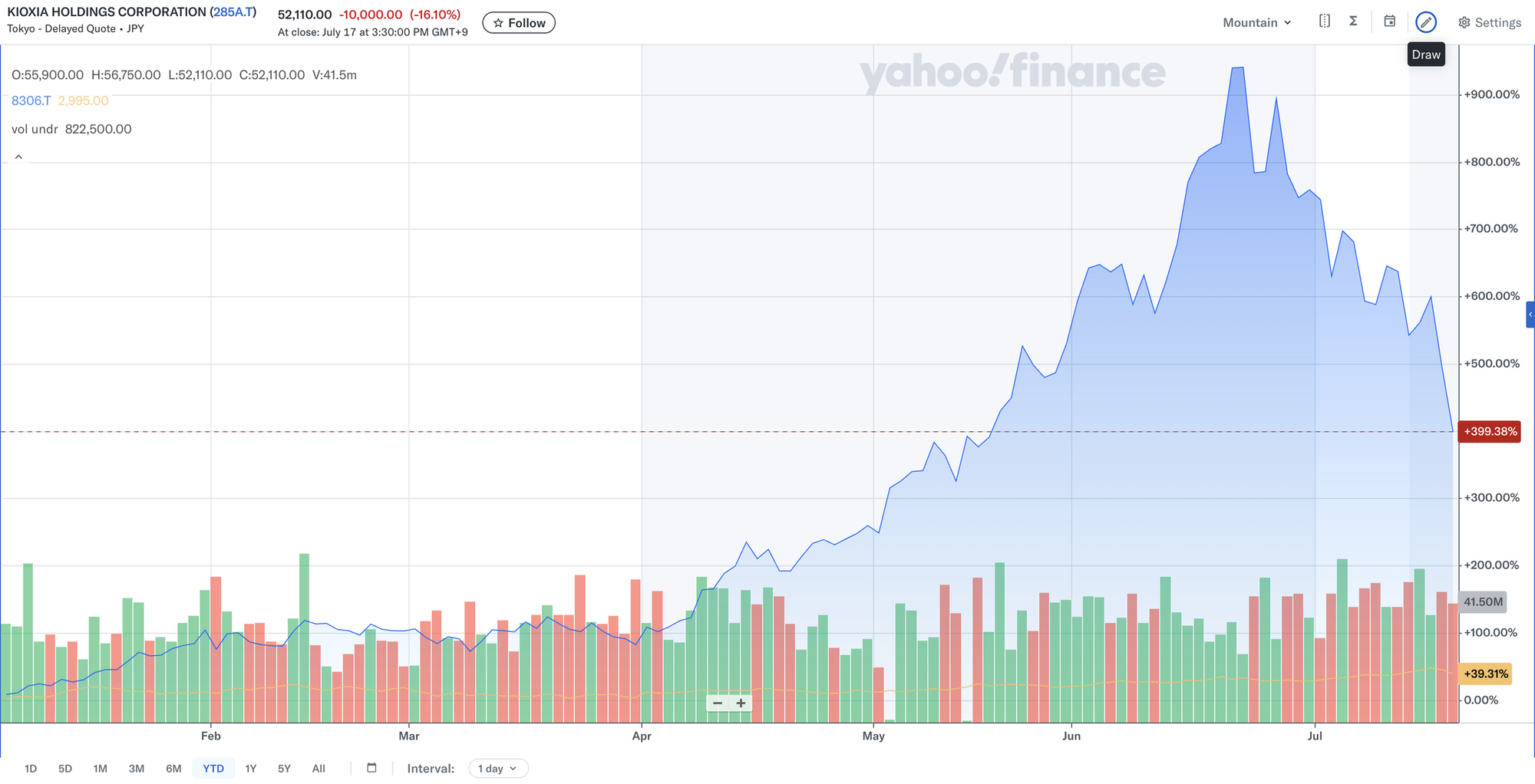
Despite retreating from an intra-day high of over JPY 113,000 on June 22, and going limit down on Friday to close more than 50% since then, Kioxia has still returned about 10x MUFG for the year-to-date stock performance, with the latter now reigning supreme as Japan's largest market capitalization company. Please fasten your seat belts!
Here is what we are going to cover this week:
- Venture Capital & Private Markets: Japan's private equity deals decline in H1 2026; enterprise AI developer Whale secures USD 40m Series C extension, bringing round to USD 100m with strong Japanese financial backing; tech giants and financial pillars unite in 44-company coalition to fund Japan's 'Sovereign AI' infrastructure
- Banking: Mizuho partners with NVIDIA to build secure, high-performance AI infrastructure for banking
- Payments: JCB eyes cross-border efficiency in new stablecoin alliance with Circle; NEC and Ava Labs partner to build biometric-secured on-chain payment infrastructure; SBI VC Trade launches Japan’s first trust-based Yen stablecoin lending service with 3% promotional yield; Infcurion and DCP partner to drive on-chain finance infrastructure for the AI era; Digital Garage subsidiary Pocket Change lands FinTech deal in JAL-Resona regional tourism campaign
- Capital Markets: Japan’s USD 1.29trn foreign reserve buffer holds firm despite heavy yen-buying interventions; Societe Generale sees $76 billion of JGB buying if GPIF rebalances assets; Japan bonds tell global repricing story
- Asset Management: Funds marks European entrance with launch of polish debt-backed yield fund; SBI Group pioneers blockchain frontier with world’s first on-chain Japanese equity fund
- Digital Assets: Progmat completes Avalanche migration, transitioning JPY 452bn in tokenized assets to EVM environment; SBI XDC Network APAC advances regional blockchain integration with TOPPAN factoring trial and DSRV partnership; SBI, Solana Foundation partner to build Japan-led on-chain financial hub; the machine keeps humming, SBI Holdings with back-to-back crypto and tokenization deals
- The Last Word: Tokyo’s Emergence as the Developed World’s Value Hub
Japan FinTech Observer Live

We are pleased to announce a joint Japan FinTech Observer & Japan Finsight webinar on investing in Japanese small- and mid-caps, scheduled for Wednesday, July 29 at noon Japan Standard Time.
Japan Finsight implements the Model Context Protocol (MCP), an open standard for AI agents to call structured tools and read structured data. Once connected, your AI agent can query Japan's official corporate disclosure data (EDINET) the same way it queries any other tool.
Questions an MCP-connected agent can answer with Japan Finsight tools:
- "Show me the past 5 years of cash flow for Toyota."
- "Which Japanese mid-cap companies have an activist holder filing in the last 12 months?"
- "Walk me through Tokio Marine's recent buybacks and capital policy."
- "What material events has Sony filed in the past 6 months?"
Founder Matt Helmer will join us to discuss the evolution of the tool, and his approach to Japan stock market research based on it.
Register for the event on LinkedIn (we will simulcast via X and YouTube if you prefer).
Venture Capital & Private Markets
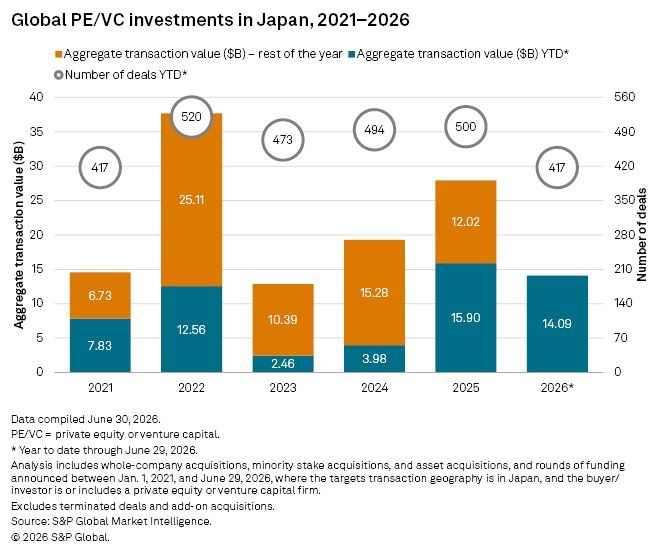
- Japan's private equity deals decline in H1 2026: Private equity and venture capital investment in Japan declined by 11.38% year over year to $14.1 billion in the first half of 2026, according to S&P Global Market Intelligence; volume declined by 16.6% to 417 transactions
- Enterprise AI developer Whale secures USD 40m Series C extension, bringing round to USD 100m with strong Japanese financial backing: Singapore-headquartered enterprise artificial intelligence developer Whale has secured a $40 million Series C3 extension, bringing its total Series C funding to $100 million; the injection of capital is earmarked to accelerate the scale-up of its global enterprise AI deployments and deepen platform integrations; the latest funding round was co-led by CMB International (via its AI and frontier technology-focused investment fund) and SMBC Asia Rising Fund, the corporate venture capital (CVC) arm of Sumitomo Mitsui Banking Corporation
- Tech giants and financial pillars unite in 44-company coalition to fund Japan's 'Sovereign AI' infrastructure: A powerful coalition of 44 Japanese corporations has capitalized Noetra, a newly established artificial intelligence research venture, to spearhead the development of home-grown multimodal foundation models; backed by a core consortium consisting of Sony Group, SoftBank, NEC, and Honda Motor—alongside a newly announced investment from financial heavyweight Mitsubishi UFJ Financial Group (MUFG)—Noetra has launched full-scale development operations; the initiative builds on Noetra's selection in June 2026 for a government-solicited AI project promoted by the Ministry of Economy, Trade and Industry (METI) and the New Energy and Industrial Technology Development Organization (NEDO); the venture aims to address a critical macroeconomic priority: establishing robust "sovereign AI" frameworks that allow Japanese industries to securely leverage proprietary data and intellectual assets without relying entirely on foreign technology platforms
- The Japan Investment Corporation has published "Research on Japanese Mid-Sized Companies: Growth Strategy with utilization of PE Funds": Mid-sized companies play a vital role in Japan’s economic growth by creating jobs and revitalizing regional economies; in response, METI has introduced initiatives such as the “Mid- sized Enterprise Growth Promotion Package,” while JIC is exploring how best to support their development; however, the lack of a clear legal definition and limited research means their actual conditions remain insufficiently understood; this study therefore aims to assess their growth ambitions, as well as the challenges and expectations related to the use of private equity funds; to achieve this, the authors conducted desktop research on TSE-listed mid-sized firms to identify High Growth characteristics, followed by a questionnaire survey of employees; they also carried out in-depth interviews with selected companies and PE funds to gain practical and investor perspectives
Banking
- Mizuho partners with NVIDIA to build secure, high-performance AI infrastructure for banking: Mizuho Financial Group has launched an initiative to upgrade its artificial intelligence capabilities, partnering with NVIDIA to explore and develop high-security AI infrastructure tailored for the financial services sector; the collaboration focuses on deploying advanced hardware and secure execution frameworks to integrate generative AI safely into the bank's daily operations
Payments
- JCB eyes cross-border efficiency in new stablecoin alliance with Circle: Japanese payments giant JCB has signed a memorandum of understanding with an affiliate of Circle Internet Group to explore the integration of stablecoin technology into its global payment network; the strategic alliance aims to merge Circle’s stablecoin and blockchain infrastructure—which includes USDC and EURC—with JCB’s extensive merchant network
- NEC and Ava Labs partner to build biometric-secured on-chain payment infrastructure: Japanese tech giant NEC Corporation has entered into a Memorandum of Understanding with Ava Labs, the developer behind the Avalanche blockchain network; the strategic alliance aims to develop a next-generation digital transaction platform integrating NEC’s proprietary biometric identity technology—specifically its "FaceVC" solution—with Avalanche’s high-speed blockchain architecture
- SBI VC Trade launches Japan’s first trust-based Yen stablecoin lending service with 3% promotional yield: SBI VC Trade, a consolidated cryptocurrency exchange subsidiary of SBI Holdings, announced the launch of "JPYSC Lending," marking Japan's first trust-based, Japanese Yen-denominated stablecoin lending service; to commemorate the launch, SBI VC Trade is offering an initial promotional annualized yield of 3% for a 12-week maturity term, a rate that positions the digital asset service competitively against standard Japanese yen fixed-term bank deposits, which currently average between 0.325% and 1%; following the introductory period, standard yields are projected to fluctuate between 1% and 3% based on market conditions
- Infcurion and DCP partner to drive on-chain finance infrastructure for the AI era: Infcurion and DCP have executed a Memorandum of Understanding to jointly explore the social implementation of new financial services utilizing tokenized deposits; the strategic partnership aims to build a robust on-chain financial infrastructure designed to support "agentic commerce"—an emerging global trend where autonomous AI agents independently manage economic activities and settle transactions; the initiative will focus on bridging existing transaction rails with next-generation digital currencies by linking Infcurion’s payment platforms, including its card-issuing platform "Xard" and cloud-based acquiring platform "Axios," with DCP’s tokenized deposit platform, "DCJPY"
- Digital Garage subsidiary Pocket Change lands FinTech deal in JAL-Resona regional tourism campaign: Tokyo Stock Exchange-listed digital payment and marketing firm Digital Garage and its subsidiary Pocket Change have announced that their proprietary digital currency platform, "Pokepay," has been selected for a new regional tourism initiative in Osaka; the platform will power digital coupons for the "Yorimichi Osaka (Vol. 1): Higashiosaka Edition" travel package; the travel product is a collaborative venture between Japan Airlines (JAL), Resona Bank, Higashiosaka City, and the Higashiosaka Tourism Association
Capital Markets
- Japan’s USD 1.29trn foreign reserve buffer holds firm despite heavy yen-buying interventions: Japan’s massive foreign currency reserves are demonstrating remarkable resilience in the face of aggressive currency market interventions by monetary authorities; as of the end of June 2026, the nation’s total foreign reserve portfolio stood at a commanding $1.29 trillion (equivalent to over 200 trillion yen), effectively maintaining a flat trajectory compared to pre-intervention levels recorded in August 2022; this structural stability persists despite the fact that the Ministry of Finance and the Bank of Japan have deployed a cumulative 36.2 trillion yen in yen-buying operations over the past four years to arrest the yen's slide—including a historic 11.7 trillion yen single-month blitz between late April and May 2026
- Societe Generale sees $76 billion of JGB buying if GPIF rebalances assets: The Government Pension Investment Fund (GPIF) has room to buy as much as ¥12.3 trillion ($76 billion) of additional government bonds without changing its asset allocation mix, according to Societe Generale, offering potential support for the debt market; the projection assumes that one of the world’s largest pension funds gradually increases its domestic bond holdings to the upper end of its existing allocation band, lifting the weighting to 31% from 26.9% as of March, strategists including Stephen Spratt said in a note; Reuters reported that Japan has no plans to alter the GPIF’s benchmark portfolio allocations but is exploring ways to encourage greater domestic investment within the existing framework
- Japan bonds tell global repricing story: According to BlackRock, government bond yields have reset higher across the U.S., Europe and Japan since 2020-21; the recent repricing of U.S. policy expectations has provided a fresh catalyst; higher Treasury yields and a stronger dollar have put renewed pressure on the yen, making the Bank of Japan's gradual normalization more challenging and pushing Japanese government bond yields higher; Japan's domestic backdrop – including rising inflation expectations and concerns over fiscal expansion – have amplified that move; long-dated forward rates implied by JGBs are now around 5%, versus roughly 6% in the U.S., 5.3% in France, 5.5% in Australia and 6.5% in the U.K; if even Japan – long an outlier because of decades of deflation and ultra-loose monetary policy - is now trading broadly in line with its developed-market peers, BlackRock analysts think that reinforces their view that the global rates reset is real and significant
Asset Management
- Funds marks European entrance with launch of polish debt-backed yield fund: Funds, a prominent Tokyo-based direct investment platform led by CEO Yuichiro Fujita, has launched its first European venture, the "Everest Leaseback Receivable-Backed Fund #1"; the launch signifies a major geographical expansion for the platform, introducing Poland as its fourth international market following previous entries into Taiwan, Hong Kong, and South Korea; the newly unveiled yen-denominated fund will extend credit to Everest Capital, the financing vehicle of the Everest Group, a dominant player in Poland's "door-to-door" and offline consumer finance sector; the deal was structured and originated by Funds IGC (FIGC), the Singapore-based overseas business arm established by Funds in June 2025 to drive its global expansion strategy
- SBI Group pioneers blockchain frontier with world’s first on-chain Japanese equity fund: SBI Global Asset Management has announced a significant expansion into digital asset markets, launching the world’s first public on-chain tokenization of a Japanese equity fund; partnering with Singapore-based digital asset exchange DigiFT Tech—an SBI capital-business ally regulated by the Monetary Authority of Singapore (MAS)—the initiative commenced tokenization on July 14, 2026; the move structures a new private placement vehicle built on the existing mother fund of the "SBI Japan High Dividend Equity Fund"; managed by SBI Asset Management, the underlying fund has amassed approximately 220 billion yen in net assets since its December 2023 launch
Digital Assets
- Progmat completes Avalanche migration, transitioning JPY 452bn in tokenized assets to EVM environment: Tokenization platform Progmat has successfully migrated its digital securities issuance and management infrastructure from the Corda 5 distributed ledger to an Avalanche L1 network; the infrastructure overhaul, dubbed "Project Keystone," transitions the entirety of Japan's leading security token platform—currently managing over ¥452 billion ($2.8 billion USD) in assets—into an Ethereum Virtual Machine (EVM) compatible environment; according to the firm, the upgrade abstracts the underlying ledger layer via a new "mediator" architecture, separating core business logic from specific blockchain dependencies; the redesign addresses the dual requirements of institutional compliance and public-network composability while accelerating transaction processing speeds by 3x to 5x; under the new Avalanche L1 architecture, transaction finality is achieved in under two seconds, enabling near-instantaneous settlement
- SBI XDC Network APAC advances regional blockchain integration with TOPPAN factoring trial and DSRV partnership: SBI XDC Network APAC, a joint venture between Japan’s SBI Holdings and UAE-based TradeFinex Tech, has completed two major initiatives aimed at accelerating enterprise blockchain adoption across the Asia-Pacific region; the company successfully executed an online trade factoring pilot utilizing digital corporate IDs with TOPPAN, while simultaneously entering a strategic partnership with South Korean blockchain infrastructure firm DSRV Labs to co-develop cross-border use cases
- SBI, Solana Foundation partner to build Japan-led on-chain financial hub: Japanese financial services giant SBI Holdings and the Solana Foundation have entered into a strategic partnership to build an on-chain financial market originating from Japan, aiming to export Japanese stablecoins and tokenized real-world assets (RWAs) to Asian and global markets; as part of the agreement, the Solana Foundation will acquire a stake in SBI R3 Japan—a joint venture currently backed by SBI Holdings and SMBC Group; following the transaction, the venture is planned to be renamed SBI Solana Global (tentative) to spearhead the new growth initiative
- The machine keeps humming, SBI Holdings with back-to-back crypto and tokenization deals: After an already busy week of announcements, SBI Holdings has further added to its next-generation digital asset footprint, announcing a major cross-border acquisition in Singapore alongside a global tokenization partnership with U.S.-based Ondo Finance; the dual announcements underscore SBI’s aggressive pursuit of building a "global corridor" for digital assets, bridging traditional capital markets with blockchain-based infrastructure
The Last Word: Tokyo’s Emergence as the Developed World’s Value Hub

The release of Deutsche Bank’s "Mapping the World’s Prices - 2026" report confirms a full inversion in the global macroeconomic landscape: the definitive redrawing of the cost-of-living map.
"Beer price: ~50% USD price drop since 2012"
Since this index began in 2012, Tokyo has transitioned from a symbol of prohibitive expense to the developed world’s most significant structural outlier in pricing. While the inaugural 2012 report captured a "Peak Yen" environment and a historically cheap US Dollar, the 2026 data presents the exact opposite.
"A meal for two is 30% of the cost of New York or Zurich."
Japan has emerged as the subject of a remarkable structural repricing, offering a value proposition that is unparalleled among tier-one financial hubs. This inversion is positioning Tokyo as a premier value destination in a world of soaring global costs.
Please follow us to read more about Finance & FinTech in Japan, like hundreds of readers do every day. Our short weekly digest, the “Japan FinTech Observer”, is published on LinkedIn, Medium, Substack, or on our own FinTech Observer website. Only the latter provides you with the option to subscribe to individual news stories as they are published.
Should you wish to further discuss the Japanese (or Asian) FinTech ecosystem, you may book a consultation via Intro - all proceeds flow towards covering the operating cost of the Tokyo FinTech Association, and research for the Japan FinTech Observer.