Japan’s 2026 Asset Management Roadmap: Overhauling the Investment Chain for a "Growth-Oriented" Economy

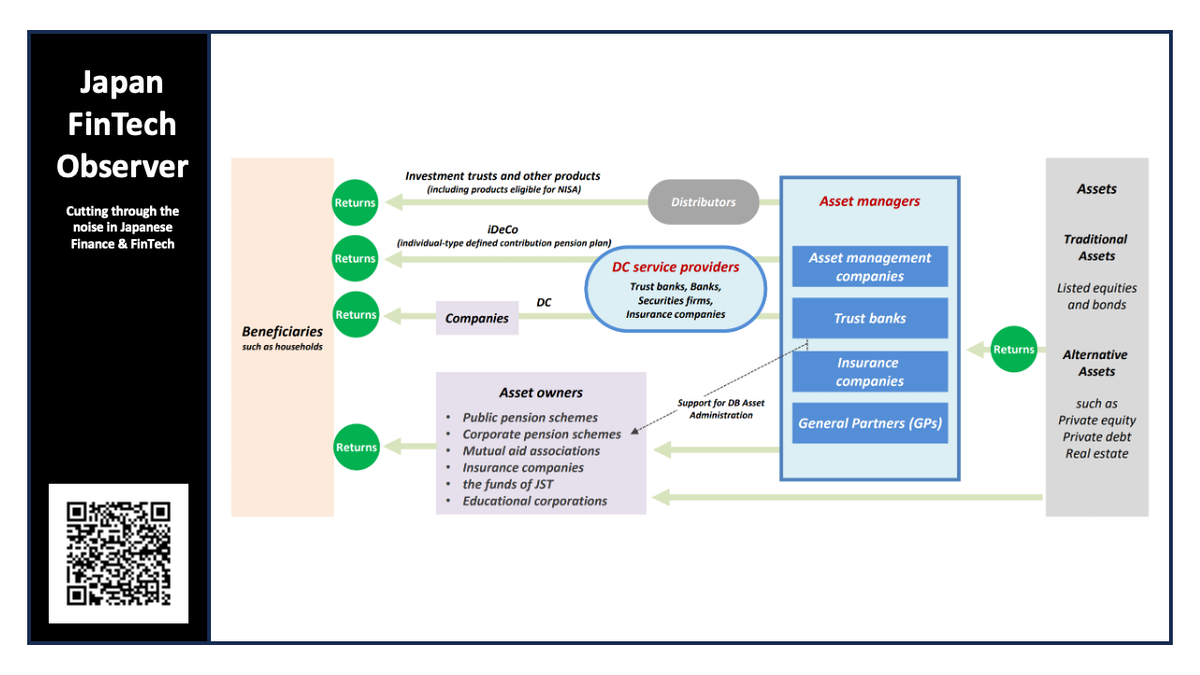
The release of the "2026 Progress Report for Advancing Asset Management Services in Japan" by the Financial Services Agency marks a transitional point in Tokyo’s financial policy, moving from the foundational "Asset Management Nation" initiative of 2023 to a comprehensive "upgrade" focused on the functional enhancement of the entire investment chain.
This shift moves beyond the mere implementation of policy measures to address the structural integrity of the financial system. The government’s ultimate objective is to catalyze a "virtuous cycle" where aggressive corporate value creation translates directly into household wealth, ensuring that Japanese citizens are no longer sidelined from the benefits of economic growth.
1. The Four Pillars of the 2026 Strategy
The "Growth Investment Financial Strategy" establishes a robust framework for this transformation via four core pillars:
- Corporate Growth & Governance Reform: Mandating aggressive investment and continuous governance improvements to drive medium-to-long-term corporate value.
- Asset Owner & Service Sophistication: Upgrading the functionality of public and private asset owners to maximize the outcomes of economic growth for individual beneficiaries.
- Market Diversification & Institutional Strengthening: Enhancing the funding and growth-support capabilities of banks and markets while diversifying the ecosystem of financial products and players.
- Digital Infrastructure & Cybersecurity: Prioritizing the implementation of stablecoins and tokenized deposits to unify logistics, commerce, and settlement, while simultaneously fortifying the industry's cybersecurity posture.
This roadmap signals that the "Asset Management Nation" is moving into its execution phase. However, for this strategic vision to take hold, the industry must first dismantle the legacy operational bottlenecks that continue to suppress efficiency.
2. Operational Modernization: Eliminating the "Middle-Back Office" Bottleneck
The Financial Services Agency (FSA) has made it clear: the "sophistication" of asset management is a non-negotiable prerequisite for global competitiveness. Japan’s industry is currently weighed down by antiquated manual processes that drain resources from core investment functions. To survive, the industry must harmonize with global custodial standards, beginning with the elimination of redundant reconciliation costs and the adoption of "Single-calculation" NAV (Net Asset Value) standards.
2.1 The Efficiency Crisis: The STP Gap and the FAX Ghost
Data from the FSA reveals a stark disparity between retail-facing investment trusts and institutional-facing investment advisors. While institutional automation is nearly universal, the retail side remains dangerously manual.
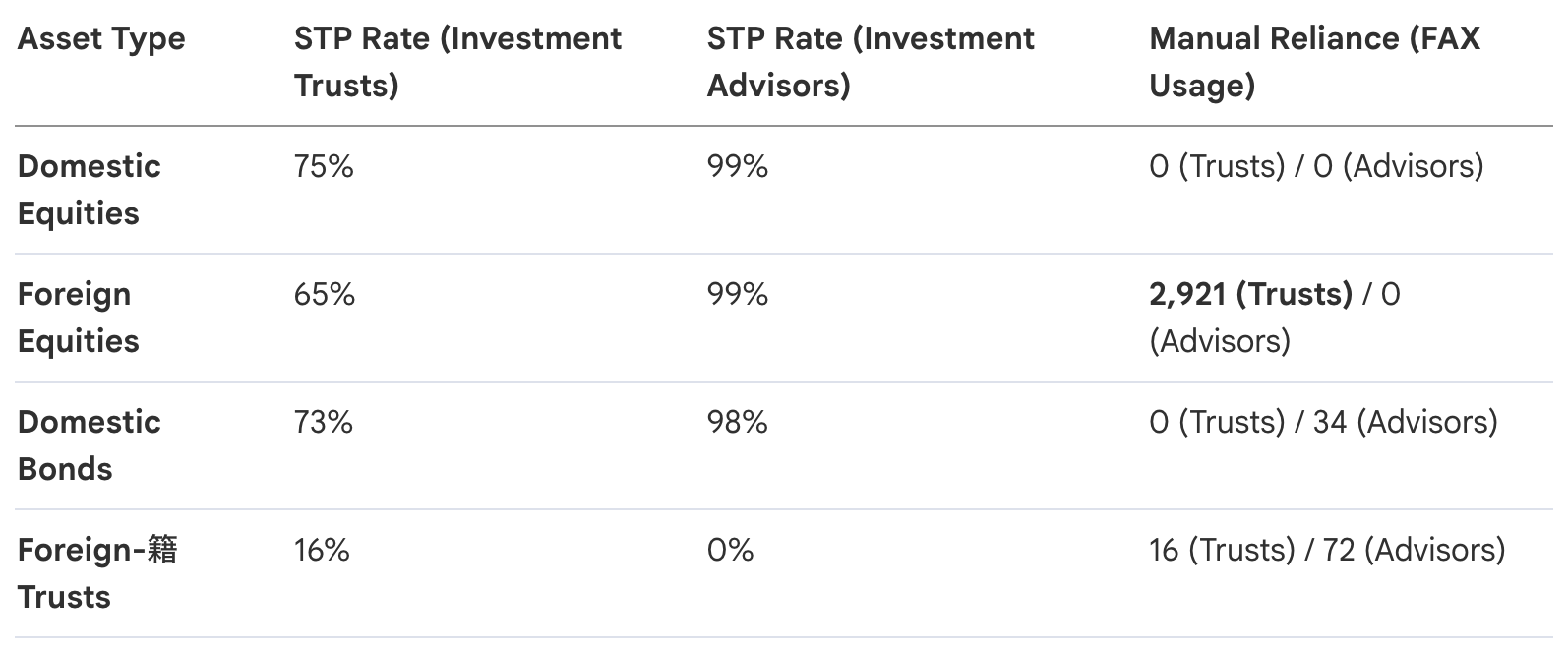
For foreign equities, the institutional segment is fully automated, yet the retail investment trust segment remains haunted by the ghost of manual FAX transmission. This inefficiency is compounded by the "Dual-Calculation" problem, where Japanese asset managers and trust banks perform redundant NAV calculations—a practice the FSA intends to replace with the global "Single-Calculation" standard to reduce costs and error risks.
2.2 The Burden of Individualized Reporting
Operational capacity is further eroded by excessive customization in reporting. The FSA’s audit of 21 major firms highlights a critical efficiency crisis in three areas:
- Prospectuses: 14 of 21 firms must create and attach individualized supplemental documents.
- Monthly Reports: 15 of 21 firms are forced into individualized formatting and logo placements for specific distributors.
- BIS Reports: A staggering 19 out of 21 firms are required to use individualized data formats for bank capital adequacy reporting. Crucially, 14 of these firms explicitly identify this as a "Recognized Challenge" (kadai).
By aggressively moving these "non-competitive" back-office tasks toward standardized platforms and BPO (Business Process Outsourcing), firms can finally pivot their capital toward true competitive advantages: Alpha generation and product innovation.
3. Institutional Service Landscape: A Group-Level Performance Audit
In a landmark shift in oversight, the FSA has analyzed the institutional service market on a group consolidated basis, revealing the massive scale and distinct archetypes of the players managing the nation’s wealth.
3.1 Market Share and Global Outliers
The top 20 major financial groups currently control 833 trillion yen in AUM and generated 1.1 trillion yen in operating revenue as of March 2025. The market is defined by four archetypes: (1) Trust Bank-led, (2) Life Insurance-led, (3) Securities/Bank-led, and (4) Foreign-affiliated.
The data reveals a critical insight regarding profitability and global reach. While "Company A" (a Trust Bank-led titan) maintains the highest domestic AUM, its revenue yield is relatively lower. Conversely, "Company B" emerges as a significant outlier; despite lower total AUM than Company A, its revenue is nearly double. The source context clarifies this discrepancy: 50% of Company B's revenue and 20% of its AUM are derived from overseas business. This proves that for Japanese groups, global reach—not just domestic volume—is the primary driver of superior profitability.
3.2 Fee Dynamics and Success Metrics
Fee structures show a widening gap between client archetypes. Public Asset Owners (AOs) benefit from a razor-thin fee of 0.02%, a rate Japanese managers accept primarily for the "presence" and reputational prestige of holding a public mandate. In contrast, Corporate Pensions pay an average of 0.27%. To align incentives, the industry is shifting toward "Performance-linked Fees," already utilized by 14 of the top 20 groups for active mandates.
4. Reforming the Retail and Alternative Frontiers: DC, iDeCo, and PE Funds
To sustain the momentum of NISA, the government is initiating a "bold reform" of Corporate Defined Contribution (DC) plans and iDeCo, positioning them as the "second engine" of household wealth formation.
4.1 The NISA Gap and Inflationary Risk
The disparity between NISA (28 million accounts) and iDeCo (4 million participants) highlights a structural failure in Japan’s pension framework. The FSA identifies a critical fiduciary risk: 20% of DC participants remain trapped in "Principal-Guaranteed Products." In the current inflationary environment, these products represent a guaranteed real-term loss. The 2026 roadmap intends to steer these participants toward growth-oriented assets to prevent the systematic erosion of retirement savings.
4.2 The PE Mandate: Restructuring the Economy
Simultaneously, the FSA is championing the growth of Private Equity (PE) funds to support necessary corporate restructuring and M&A. The roadmap addresses the fundraising hurdles faced by domestic managers and emphasizes the need for robust benchmarks to create a transparent investment environment for alternatives.
5. Future-Proofing the Industry: AI Integration and Governance Monitoring
The next decade of Japanese asset management will be defined by technological "sophistication" and rigorous product governance.
5.1 Strategic Priorities and the 2027 Ultimatum
The FSA is closely monitoring the integration of Generative AI for both research and operational automation, as well as the Emerging Managers Program (EMP), which aims to inject dynamism into the market by diversifying the manager pool.
However, the most significant "shot across the bow" for legacy institutions is the government’s explicit timeline: the industry must have a reorganized framework for operational efficiency in place by the end of FY2027. This includes the transition to Single-Calculation NAV and the substantial elimination of manual middle-office bottlenecks.
5.2 Conclusion
The FSA’s ongoing monitoring serves as a safeguard for the "Best Interests of Beneficiaries," ensuring that the industry’s transformation is not merely cosmetic. For Japan to secure its status as a leading global asset management hub, it must execute a total transformation of its legacy financial infrastructure. The transition from mere policy measures to functional enhancement is now the only path forward for the "Asset Management Nation."
 Norbert Gehrke