Japan’s "Regional Future Strategy"

The Cabinet Secretariat hosted the "Second Meeting of the Vice Ministers and Other Officials on Regional Future Strategies" in March, a further step towards the publication of the "industry cluster plans" expected during June. This "Strong Economy" initiative is moving Japan from conceptual regional revitalization to a disciplined, execution-oriented industrial architecture. Led by Minister Hitoshi Kikawada and Vice-Minister Tsushima, the "Regional Future Strategy" marks a definitive departure from traditional "aid-based" regionalism—which historically subsidized economic decline—toward a "growth-based" model centered on 17 strategic industrial clusters.
The core objective is the integration of regional production capabilities into global supply chains to secure national GDP growth and technological sovereignty. The March meeting finalized the "Basic Concept" for three distinct frameworks: "Strategic Industry Cluster Plans," "Regional Industry Growth Plans," and "Local Industry Growth Plans."
By leveraging 17 growth fields, the government aims to move from a scattered grant-based approach to a concentrated industrial policy. This shift is designed to place Japan back on a sustainable growth trajectory by maximizing the return on infrastructure and human capital investments.
1. Tier A: Strategic Industry Clusters—The Global High-Stakes Play
Tier A serves as the "National Champion" layer, designed to facilitate massive capital expenditure (CapEx) in sectors critical to Japan’s economic security. This tier is managed at the "Regional Block" level (e.g., the entirety of Kyushu) by the Regional Bureaus of Economy, Trade and Industry (地方経済産業局), rather than individual prefectures. This geographic scale is intended to replicate and expand upon the precedents set by the TSMC (Kumamoto) and Rapidus (Hokkaido) initiatives.
The strategy introduces an "Integrated Support Package" that synchronizes infrastructure development with private-sector investment. By aligning "Public-Private Investment Roadmaps" with the provision of industrial water, rail logistics, and specialized utility bases, the government seeks to provide the certainty required to attract significant Foreign Direct Investment (FDI).
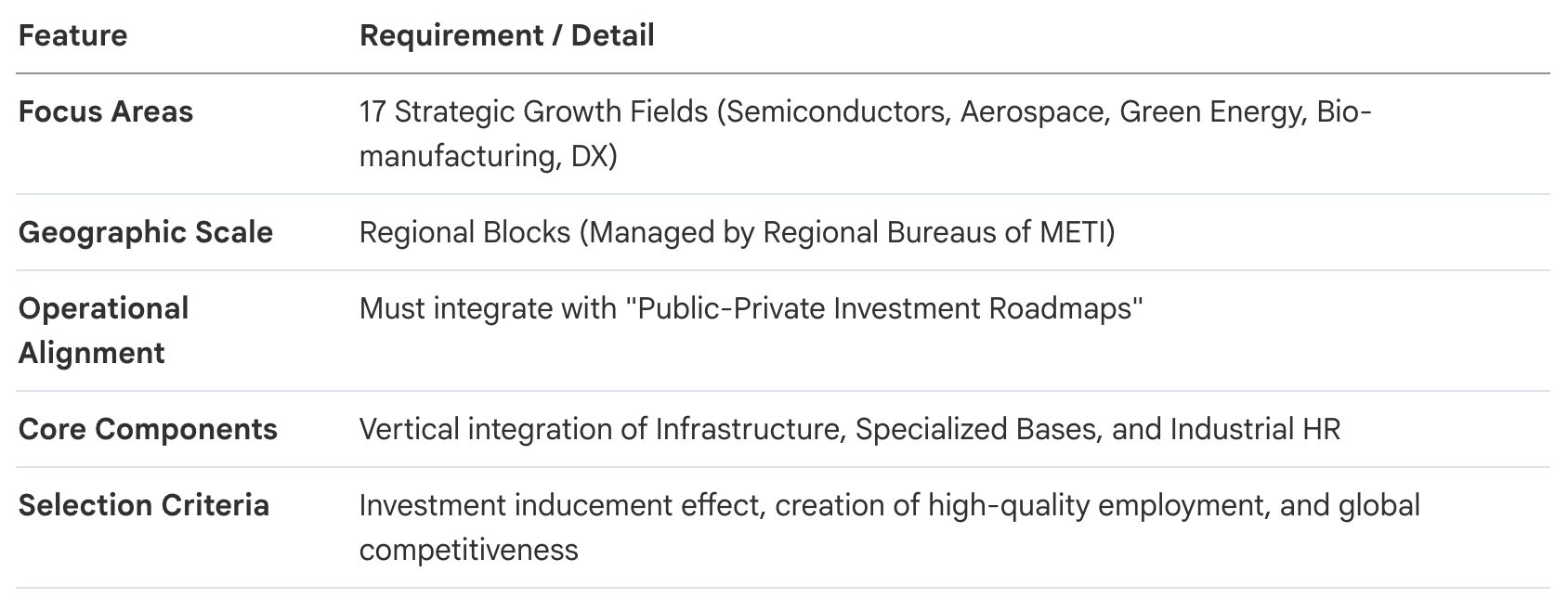
Vertical integration of infrastructure is Japan's counter-move in the global subsidy race. For C-suite executives, this reduces the "last-mile" risk of large-scale facility investment. By coordinating utility and logistics development at the Block level, the state effectively de-risks the capital outlay required for world-class manufacturing bases.
2. Tier B: Regional Industry Clusters—The "Hub & Connector" Network
Tier B identifies the "Middle-Market Engine," focusing on specialized manufacturing concentrations led by Prefectural Governors. The strategic intent is to identify "Priority Support Companies" that serve as "Connectors"—firms that anchor regional value chains by sourcing locally and selling to external markets.
To identify these firms, the government has moved away from qualitative assessments to rigorous quantitative metrics:
- Connector Degree: (Out-of-prefectural sales / Total sales of that prefectural sector). This measures a firm’s capacity to import capital into the region.
- Hub Degree: (In-prefectural procurement / Total procurement of that prefectural sector). This measures the firm’s regional economic spillover and supply chain depth.
The Aero-Industrial Cluster Case Study: Data from the aerospace blueprint illustrates the "Super-proximity" (超近接) cluster model. By establishing a "90-minute economic zone" that integrates the entire value chain—Wing Manufacturing, Engines, MRO (Maintenance, Repair, and Overhaul), and Air Cargo—the plan targets specific ROI-driven outcomes:
- Lead Time: A targeted 30% reduction in manufacturing lead times.
- Value Add: Increasing high-value-added order ratios through automated 3D printing and high-precision measurement (CMM) integration.
The mandate for "push-type" government proposals—where the state proactively identifies high-performing "Connectors" rather than waiting for applications—signals a transition toward picking regional "winners" to maximize economic multipliers.
3. Tier C: Local Industry Growth—Maximizing Latent Regional Value
Tier C, the "Local Industry Growth Plan," focuses on transforming dormant regional assets into high-margin revenue streams. This "Earth-to-Global" strategy targets agriculture, tourism, and traditional crafts, utilizing "Regional Future Delivery/Grants" (地域未来交付金) to catalyze value-added creation.
Key Components:
- Chisan-Gaisho: The "local production for outside sales" model, aimed at shifting commodities into branded, high-margin export products.
- Digital Transformation (DX): Implementing smart agriculture and DX-led tourism marketing to increase margins and operational efficiency.
The strategic goal of Tier C is to create a sustainable economic rationale for rural residency, utilizing "soft" support (branding and technology) to reverse population decline by ensuring local industries are linked to global revenue narratives.
4. The Support Ecosystem: Fiscal, Regulatory, and Human Capital Levers
The strategy’s success relies on a coordinated support apparatus intended to replace Japan's traditionally siloed ministerial approach with a "one-stop" experience.
- Fiscal:
- The 400-Billion-Yen Regional Future Fund: Explicitly defined as a "temporary, single-year measure" (単年度の措置) included in the ordinary local allocation tax (普通交付税). This provides immediate liquidity for regional industrial planning.
- Priority Subsidies: Preferential selection in existing programs, such as the "Large-Scale Growth Investment Subsidies."
- Regulatory: The use of "National Strategic Special Zones" for targeted deregulation, allowing for rapid implementation of projects within the 17 strategic sectors.
- Human Capital:
- N-E.X.T. High Schools: Focused on "Next-generation Education for X-industry Transformation."
- University-Industry Platforms: Regional hubs involving academia and regional banks for professional talent matching.
With over 160 inter-ministerial measures currently available, the government’s mandate for "one-stop" information delivery is a direct response to the "labyrinthine" nature of Japanese subsidies. Investors should view the 400-billion-yen fund as a signal of high-priority state protection for the 17 strategic sectors.
5. Stakeholder Friction & Strategic Adjustments
Top-down policy must survive bottom-up logistical realities. During the March session, significant friction points were identified by regional and business leaders.
- Network vs. Geography (Governor Nagasaki of Yamanashi): A critical warning was issued against the "forced relocation" of suppliers. Governor Nagasaki cited semiconductor equipment suppliers in Yamanashi that support makers in Hokkaido and Chubu. He argued that "Supply Chain ≠ Geography," and that forcing physical clustering could break established, high-performing technological networks.
- Administrative Barriers: Friction persists regarding administrative boundaries. The government’s move toward "Regional Blocks" is intended to bypass prefectural silos that obstruct supply chain efficiency.
- Complexity: The JCCI and Keidanren emphasized that the current support ecosystem remains too complex for effective utilization, demanding a truly "user-friendly" information portal to navigate the ministerial overlap.
6. Execution Roadmap: The Path to the Summer Policy Package
The "Regional Future Strategy" is a time-sensitive component of the "Basic Policy on Economic and Fiscal Management and Reform" (Honebuto).
Chronological Timeline (2026):
- Early March: Official issuance of requests to Prefectures and Municipalities to commence "Regional Industry Growth Plan" formulations.
- Spring: Public release of "Public-Private Investment Roadmaps" for the 17 strategic sectors and initial "Strategic Industry Cluster" drafts for regional blocks.
- Summer: Finalization of the "Honebuto" policy package and formalization of "Candidate Projects."
The introduction of EBPM and "Stage-Gates" marks a fundamental shift toward a performance-linked subsidy model. For the investor, this reduces the risk of long-term capital being tied to non-performing projects, as continued support is now contingent on meeting measurable KPIs in investment and employment.
7. Closing Analysis: Risk Factors and Market Outlook
The "Regional Future Strategy" represents a major structural shift for Japan. The "One-Point Concentration" (一点集中) directive from Advisor Inoue signals that the government has abandoned "balanced regional development"—which spread capital too thinly—in favor of a "pick the winners" strategy.
Risk Factors:
- Labor Scarcity: Despite CapEx and DX focuses, the absolute decline in the regional workforce remains a primary headwind for cluster scalability.
- Administrative Inertia: The transition to a "one-stop" support system requires local bureaus to relinquish traditional "turf," a process prone to lag.
Market Outlook: This strategy provides a clear roadmap of where the Japanese state will direct its financial and regulatory resources through 2030. By identifying high-performing "Connectors" and concentrating resources on 17 growth fields, Japan is attempting to build a middle-market strength reminiscent of the German "Mittelstand" model. The ultimate benchmark for success will be whether these clusters can generate the "Strong Economy" required to sustain Japan's aging demographic through high-value-added industrial resurgence.
 Norbert Gehrke