METI & NEDO Publish Updated "Carve-Out Practice Guidance Guidebook"


The Ministry of Economy, Trade and Industry (METI) and the New Energy and Industrial Technology Development Organization (NEDO) have published an update to their "Carve-Out Practice Guidance Handbook", originally released in 2024.
The handbook serves as a strategic manual for executing entrepreneur-led carve-outs in Japan and is divided into two primary sections. The first explains the strategic necessity for parent companies to spin off internal projects to foster rapid growth. The second part provides a practical roadmap for aspiring entrepreneurs, focusing on the tactical "how-to" of navigating complex internal corporate structures.
Key areas of focus include managing intellectual property transfers, establishing independent governance, and securing venture capital financing while maintaining healthy relationships with the original firm.
Furthermore, the text outlines essential personnel policies and capital structures designed to ensure the new startup remains competitive and autonomous. Ultimately, the sources aim to transform underutilized corporate assets into high-potential ventures through structured collaboration and specialized decision-making.
1. The Shift from Internal R&D to Independent Scaling
In April 2024, Japan’s Ministry of Economy, Trade and Industry (METI) released its initial guidance document designed to dismantle the structural inertia of the nation’s industrial giants. The framework addressed a chronic inefficiency: the "stalling" of high-potential projects due to internal resource constraints and the "parent-company drag" inherent in large bureaucracies. By optimizing for external equity financing rather than internal budget cycles, the guidance sought to liberate technologies that have long remained dormant within the vaults of Japan Inc.
The "Entrepreneur-Led Carve-out" is defined as the strategic separation of a business unit or technical seed into an independent startup, spearheaded by internal founders and fueled by external venture capital (VC). This model departs from traditional corporate spin-offs—which often suffer from overbearing parental control—by prioritizing "Venture Financeable" independence. This shift moves the needle from "dormant IP" to "active market players," allowing Japanese corporations to neutralize internal friction and leverage external talent and capital to scale at a pace the traditional corporate structure cannot sustain.
2. Technical Seeds vs. New Business Models
For a carve-out to survive the transition, management must first identify the asset’s typology. Categorization determines the risk profile and, crucially, the specific capital policy required to attract sophisticated investors.
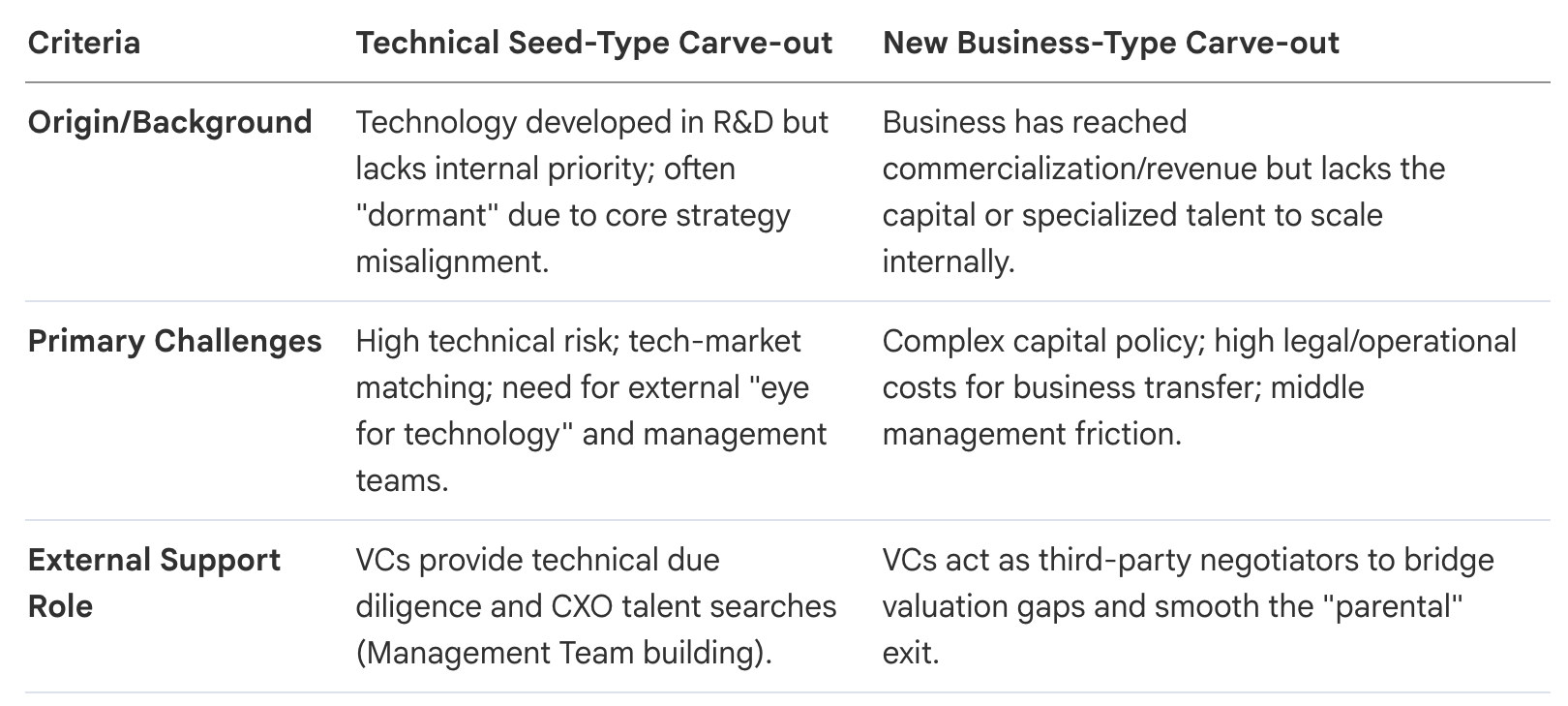
Technical seeds are speculative bets requiring VCs with deep-tech expertise to evaluate unproven potential. Conversely, New Business types—often involving existing customers—demand a higher operational investment. The critical point is the significant legal and business transfer cost associated with shifting revenue-generating contracts to a new entity, a hurdle often underestimated by corporate boards.
3. Internal Alignment and the "Catalyst" Role
The survival of a carve-out is rarely determined by the market alone; it is won or lost in the hallways of the parent company. Internal alignment is the primary friction point, where promising ventures are often killed by the logic of the status quo.
To navigate this, the guidance introduces the "Catalyst"—an essential middle-management role, specifically at the Section Manager (Kacho) level. Unlike department heads who may be too distant, the Kacho-level Catalyst serves as the operational pivot point. Their mission is to ensure the project is "officially positioned" (明確に位置づける) within the corporate mission, protecting it from being culled during standard budget cycles. They leverage existing frameworks, such as internal accelerator programs like Honda IGNITION or Ricoh TRIBUS, to provide a sanctioned path for the entrepreneur.
Top-tier Executive Commitments required to bypass bottlenecks:
- Strategic Validation: Defining the carve-out as a core component of "Intangible Asset Management" to ensure long-term legitimacy.
- Decoupled Decision Flows: Creating a fast-track approval process that is distinct from traditional, slower capital expenditure (CAPEX) reviews.
- Empowerment of the Catalyst: Granting the Section Manager the authority to negotiate directly across Legal, HR, and IP silos.
4. Mapping the Decision-Making Process
In the venture ecosystem, "time loss" is a lethal opportunity cost. A stalled internal approval process can miss a market window entirely. A successful carve-out requires a streamlined "Decision-Making Flow" that identifies all internal veto players early.
Key stakeholders must be managed through proactive "Nemawashi" (pre-explanation) to prevent late-stage derailment:
- Accounting & Finance: Managing valuation and investment ratios.
- Legal & IP: Drafting transfer agreements and managing "Conflict of Interest/Breach of Trust" (利益相反・背任リスク) risks.
- HR: Designing "Safety Nets" for transferring employees.
- Audit & Oversight (監査役) and External Directors: Critical stakeholders who must be briefed early to avoid governance-level vetos during final board reviews.
The Investment Ratio is the architecture’s linchpin; the parent company’s stake dictates the level of approval required—e.g., whether the venture can be cleared by a Management Committee or requires a full Board of Directors resolution.
5. Securing "Venture Financeable" Status
The most frequent point of failure is the "control trap"—the parent company’s desire to maintain a dominant stake. To attract third-party VCs, the entity must be "Venture Financeable."
5.1 The Strategic Alternative: Carve-out vs. M&A
For loss-making but high-potential units, a carve-out is often superior to a fire-sale M&A. It allows the parent to retain a minority "upside" stake while the unit scales on external capital, rather than selling the asset at a distressed valuation.
5.2 Red Flags for VCs and Management Safeguards
- Ownership Thresholds: Parent ownership should generally be kept below 20% to avoid "subsidiary" labeling and preserve founder incentives.
- Governance Drag: VCs will reject "Director Dispatch" clauses or veto rights that stifle management independence.
- Valuation Tools: To resolve disagreements between parent companies and founders, the use of J-KISS or Convertible Bonds (CB) is recommended. These "Convertible Equity" instruments defer formal valuation until a subsequent VC round, neutralizing initial pricing friction.
- Risk Mitigation: Objective third-party valuations are essential to neutralize the "Conflict of Interest/Breach of Trust" risks associated with transferring corporate assets to an entity led by former employees.
6. Intellectual Property (IP) and Human Capital
Modern carve-outs are essentially exercises in the sophisticated management of intangible assets.
6.1 IP Strategy: Preserving Cash Flow
A major hurdle for startups is the upfront cost of acquiring IP. The METI guidance recommends a technical solution: using "Stock Acquisition Rights" (新株予約権) as consideration for the IP transfer. This preserves the startup’s precious cash for growth while giving the parent company a stake in the eventual value creation. This is often more "Venture Financeable" than high-upfront royalties or exclusive licensing fees that suffocate early cash flow.
6.2 HR Strategy: The Circulatory Talent Model
To lower the risk for internal talent, companies are adopting "Safety Nets," such as re-employment guarantees. However, the true strategic value lies in the "Returnee" culture. When entrepreneurs return to the parent company after a carve-out experience, they act as the cure for "middle management friction," importing a high-speed innovation mindset back into the "Great Ship." This creates a "Circulatory Talent" (人材の好循環) ecosystem.
7. Case Studies in Japanese Carve-outs
Real-world precedents are now validating these frameworks, proving that Japan's legacy giants can indeed launch agile "Speedboats."
- Orbital Lasers (Sky Perfect JSAT): A high-tech carve-out from satellite giant Sky Perfect JSAT focusing on space debris removal and satellite-based laser technology. It serves as a prime example of a "Great Ship" providing the launchpad for deep-tech ventures in the aerospace sector.
- Deevec (Sumitomo Chemical / Keio University): Established on April 1, 2025, this entity commercializes Boron-Doped Diamond (BDD) electrode technology. It represents the "Technical Seed" model, born from a collaboration between Sumitomo Chemical and Keio University’s Sakae Lab, utilizing an independent structure to manufacture and sell specialized electrochemical components.
8. Toward a "Circulatory" Innovation Ecosystem
The updated METI guidance is a strategic mandate for Japan to transition toward a "circulatory" innovation ecosystem. By facilitating the flow of technology and talent out of corporate silos, Japanese enterprises can transform from stagnant repositories of IP into dynamic platforms for growth.
This framework ensures that Japan’s "Great Ships" (large enterprises) no longer serve as the final resting place for innovation, but as the fuel and stability for a new generation of "Speedboats" (carve-out startups). As these frameworks gain adoption, the relationship between legacy power and new-age entrepreneurship will be redefined, turning once-dormant assets into the driving force for Japan’s economic renewal.
 Norbert Gehrke