Cultivating "Quality" Entrepreneurship in a Labor-Constrained Economy


The Small and Medium Enterprise Agency has published the report of the "Study Group on the Ideal Form of Startup Policies for Sustainable Regional Growth", which has been meeting since December 2025 to discuss the future direction of policies. The report examines the current state of entrepreneurship and outlines future strategies for regional economic growth.
Statistics reveal that Japan’s business opening rate remains significantly lower than that of the United States and United Kingdom, primarily due to a lack of interest in starting new ventures. To combat this, the report proposes shifting focus from initial startup support to long-term growth during a company's first five years.
Key initiatives include cultivating a supportive regional ecosystem, enhancing digital literacy through AI training, and improving access to diverse financing options. The government aims to stabilize the number of new founders at 100,000 annually while doubling the number of regions with high entrepreneurial activity within five years. Ultimately, these measures seek to drive industrial renewal and address labor shortages by fostering high-quality business development.
1. Executive Brief: The State of Japanese Entry Rates and Global Standing
In the lexicon of macroeconomic policy, "industrial metabolism" serves as the vital sign of a nation’s economic health. It represents the perpetual cycle of business creation and dissolution that prevents structural stagnation and drives productivity gains. For Japan, however, the metabolic rate has remained dangerously low for over a decade. The study group report states that in an era of acute labor-supply constraints, the traditional pursuit of "quantity" in startups is no longer a viable strategy. Instead, Japan needs to pivot toward a "Quality of Growth" mandate.
The Stagnant Equilibrium
Since 2013, Japan’s business entry rate has hovered around a stagnant 5% according to Employment Insurance Statistics. While this represents a baseline of activity, it pales in comparison to the dynamic churn seen in the West. The United States, United Kingdom, and France consistently demonstrate entry rates near 10% or higher. This "low-equilibrium trap" is a symptom of a deeper cultural aversion to risk. As of the most recent cross-national data, 75.8% of the Japanese population expresses zero interest in starting a business—a stark contrast to the 21.6% observed in the U.S. This 2026 policy aims at nothing less than the "cultural engineering" of the Japanese psyche.
The Statistical Reality: A Technical Note on Data Sets
To understand the gravity of the situation, one must look beneath the headline 5% figure and distinguish between data sources. The Employment Insurance Statistics (which form the basis of the 5% figure) only track businesses with at least one employee. This inherently excludes the massive "numerator" of solo proprietors and micro-founders.
When reviewing the Economic Census—a more comprehensive measure of "Companies + Individual Proprietors"—the reality is more dire: the entry rate drops to 4.0%. Within that, the rate for companies stands at 5.9%, while the rate for individual proprietors is a mere 2.5%. This technical distinction reveals that the grassroots of Japanese entrepreneurship—the individual challenger—is the most at-risk segment of the economy.
Quantitative Breakdown: The Founder Recession
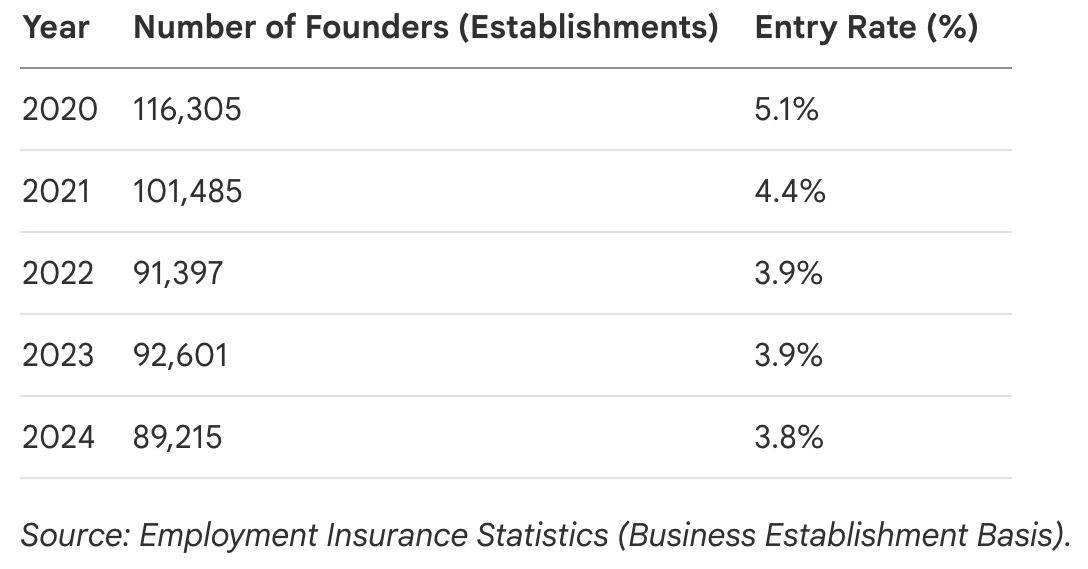
The following table highlights the steady erosion of the founder population, a trend the 2026 policy seeks to reverse by 2031.
The "Numerator" vs. "Denominator" Crisis
To diagnose the gap between Japan and its peers, we must dissect the entry rate formula. Analytical decomposition reveals that Japan’s deficit is primarily a "numerator" problem (a lack of new entries) rather than a "denominator" problem (an excess of existing businesses).
In comparison with the U.S., 64% of the gap in entry rates is attributed to Japan’s failure to generate new founders. When compared to the UK, the "numerator factor" is an overwhelming 85%. This suggests that the UK's high entry rate is driven by a massive volume of entries relative to a smaller base of existing businesses, whereas Japan’s massive base of stable, aging firms dilutes the impact of its few new entries. This lack of entry depresses wage growth by reducing the competitive pressure on incumbent firms to innovate, effectively freezing the labor market in a low-productivity state.
While the sheer volume of new entries remains historically low, Japan’s unique competitive advantage lies in how many new businesses survive. The 2026 policy framework seeks to leverage this "Post-Entry Resilience" as the foundation for a new growth model.
2. The Survival Paradox: Reconciling Low Entry with High Stability
Japan presents a fascinating macroeconomic contradiction: it is perhaps the most difficult place in the developed world to start a business, yet it is arguably the safest place to operate one. This "Japanese Paradox" features an environment where entry barriers are high, but once a firm is established, its resilience is unmatched.
The 80% Resilience Threshold
The most remarkable data point in the 2026 report is Japan’s five-year business survival rate, which stands at approximately 80%. This is nearly double the rate of the United Kingdom and significantly higher than the United States. While Western venture models follow a "fail fast" philosophy, the Japanese model appears to favor a "prepare extensively, survive long-term" approach.
Cross-National Survival Trajectories (5 Years Post-Inception)
- Japan: ~80.7% (Remaining operational after 5 years)
- United States: ~50.0%
- United Kingdom: ~40-45%
- Germany: ~40.0%
- France: ~45-50%
Sector-Specific Metabolism and Churn
The "metabolic rate" is not uniform across the Japanese economy. The report highlights sectors with high "churn" (high entry and high exit), which signifies healthy competition, and sectors characterized by "stagnant stability."
- High Churn Sectors: "Accommodations and Food Services" and "Living-related/Personal Services" see entry rates between 6% and 8%. These sectors are the frontline of consumer trends and experience the highest creative destruction.
- Low Volatility Sectors: "Composite Services" and "Mining/Quarrying" show almost zero movement, with rates often falling below 2%.
Quality vs. Creative Destruction
Does an 80% survival rate indicate high-quality business models, or does it signal a lack of disruptive "creative destruction"? If inefficient firms are preserved through low-interest environments and regional subsidies, they act as "zombie" anchors on productivity.
However, the 2026 mandate argues that this stability is a hidden asset. In a labor-constrained society, Japan cannot afford the waste of capital and human energy that comes with a 60% failure rate. The objective is to maintain this high survival rate while aggressively increasing the value-add and scale of these survivors. Japan should no longer subsidize survival for its own sake; it will invest in the scaling of the resilient.
To turn this stability into a growth engine, the government is shifting from "founding-only" subsidies to a continuous, five-year support model tailored for a labor-supply constrained reality.
3. The Quality Mandate: Policy Evolution for a Labor-Supply Constrained Society
Japan’s demographic reality is the ultimate "denominator" in every economic equation. In a society where the labor force is shrinking, the goal of creating a high volume of low-productivity startups is a strategic error. The study group report pivots toward "Quality of Growth," where success is measured by Value Added (VA) per business unit.
The "First Five Years" Strategy
For decades, Japanese startup policy was "front-loaded," offering subsidies for the act of founding but leaving firms to navigate the "Valley of Death" alone. The 2026 directive extends the support window to a continuous five-year model. This recognizes that the most existential management hurdles—scaling, digital transition, and institutional financing—only manifest after the second year of operations.
Addressing the Three Pillars of Management Hurdles
The report identifies three critical friction points for early-stage companies in the current economy:
- Labor Scarcity: The difficulty of securing specialized management talent in a shrinking pool.
- The Digital Imperative: The absolute necessity of AI and digital integration to offset the lack of manpower.
- Growth Capital: The transition from seed funding to mid-stage financing through private capital circulation.
Shifting Resources to Growth-Stage Assistance
The government’s shift from "founding subsidies" to "growth assistance" is a recognition that a business with ten highly-productive employees using AI is more valuable to the regional economy than five businesses with two employees each doing manual work. By focusing on increasing the VA per unit, the 2026 policy aims to transform the "stable 80%" of survivors into "high-growth hubs." This is a shift from passive preservation to active interventionism.
Executing this "Quality Mandate" requires a nuanced understanding of the five archetypes of founders emerging across Japan's regional landscapes.
4. A Typology of Japanese Founding: Five Archetypes of Value Creation
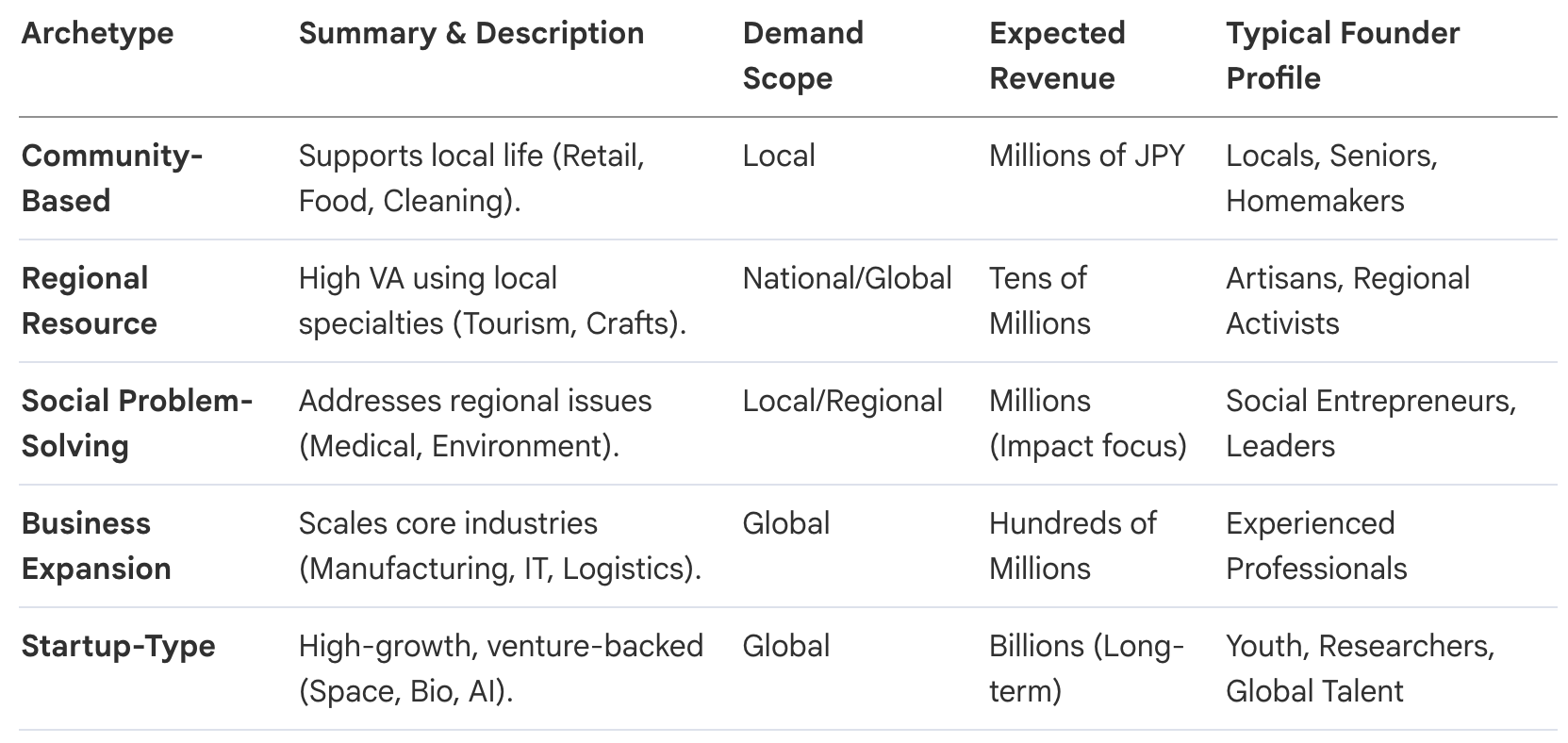
The study group report retires the "one-size-fits-all" approach, and explores five distinct archetypes of value creation that now define the Japanese entrepreneurial landscape.
The Archetype Framework
Narrative Analysis of Archetypes
I. Community-Based: The Social Safety Net
- Scenario: Imagine a "Community-Based" founder—a former homemaker in a depopulating town in Akita who opens a specialized cleaning and elder-care concierge service.
- Management Challenge: Low margins and high labor intensity.
- Digital Tooling: These founders will be supported through AI-driven scheduling and customer relationship management (CRM) tools to maximize the efficiency of a limited staff.
- Policy Shift: Support for these founders focuses on "Sustainability Subsidies" that prioritize the maintenance of local life infrastructure over rapid expansion.
II. Regional Resource: The Value-Added Artisan
- Scenario: A "Regional Resource" founder in Gifu utilizes traditional lacquerware techniques to create high-end interior components for the global luxury EV market.
- Management Challenge: Accessing global supply chains and digital marketing.
- Digital Tooling: Emphasis on cross-border e-commerce platforms and 3D modeling to prototype traditional crafts for modern industrial use.
- Policy Shift: "Specialty Export Subsidies" and branding support to turn local heritage into global "Value Added."
III. Social Problem-Solving: The Mission-Driven Architect
- Scenario: A founder in a rural "Mobility Desert" develops a shared-transportation AI that utilizes local private vehicles to provide on-demand medical transit for the elderly.
- Management Challenge: High regulatory hurdles and reliance on local government contracts.
- Policy Shift: Creation of "Regulatory Sandboxes" where these founders can test social-care models without the immediate burden of standard transportation laws. The metric for success here is "Social Impact" over raw profit.
IV. Business Expansion: The Regional Engine
- Scenario: An experienced mid-career engineer leaves a major manufacturer in Nagoya to start a specialized robotics-integration firm that automates small-scale farming operations.
- Management Challenge: Scaling capital and mid-career talent recruitment.
- Policy Shift: "Regional Core Company" support, connecting these founders with local financial institutions for "Coordinated Financing." These are the firms intended to become the new mid-sized powerhouses of the 2030s.
V. Startup-Type: The Global Challenger
- Scenario: A university research team in Sendai launches a venture focused on satellite-based crop monitoring using proprietary sensor technology.
- Management Challenge: Immense upfront R&D costs and the "Death Valley" between research and commercialization.
- Policy Shift: "Hundred-Million-Yen" scale seed funding and intensive mentorship from "Senior Founders" who have successfully exited global ventures.
These archetypes cannot thrive in isolation. They require a fertile "Soil"—a regional ecosystem that nurtures diverse forms of growth.
5. Cultivating the "Soil": The Regional Ecosystem Model
The METI report introduces the "Soil" (Dojo) metaphor to describe the foundational environment. If the "Soil" is arid, even the best seeds (founders) will wither. The policy prioritizes an "ecosystem approach" where multiple stakeholders collaborate.
The Six Pillars of "Soil" Creation
- Collaboration Systems: Success is no longer measured by individual agency performance but by the synergy between local banks, chambers of commerce, and "Coordinators." These coordinators act as "economic navigators," ensuring a Regional Resource founder isn't given a Startup-type loan product.
- Civic Engagement: Integrating entrepreneurship into local education. This isn't just about business plans; it's about fostering "Entrepreneurial Spirit" in students so that a career in a startup is viewed with the same prestige as a career in a conglomerate.
- Mentor Networks: Nurturing a "Senior Founder" class. Japan lacks the tradition of serial entrepreneurs returning to their hometowns to advise the next generation. The "Dojo" model incentivizes this through "Mentor Matching" programs.
- Small-Scale Challenges: The "Sandbox" concept. Local governments are encouraged to provide experimental zones where founders can test products (e.g., drone delivery) with zero regulatory friction for the first 12 months.
- Capital Circulation: Diversifying the funding stack. The goal is to move from 90% reliance on government subsidies to a 50/50 split with private regional capital, ensuring that the local business community has a "stake" in the success of the new entries.
- Psychological Safety: The Cultural Prerequisite. This is arguably the most critical pillar. For decades, the social cost of failure in Japan has been bankruptcy and social ostracization.
The Psychological Safety Pillar
Shifting the cultural perception of failure is a prerequisite for moving the "numerator" in the entry rate equation. The 2026 report calls for "Failure Knowledge Sharing"—a series of public forums where successful leaders and founders discuss their past collapses.
The role of local leadership (Mayors) is paramount here. A mayor who publicly celebrates a "noble failure" does more for the entry rate than a ten-million-yen subsidy. By reducing the mental barrier to entry, the government hopes to attract the 75.8% of the population who are currently "uninterested" or "fearful."
To move these pillars from theory to practice, the 2026-2031 action plan sets out demanding, quantitative metrics.
6. Action Plan and Success Metrics: The Road to 2031
The 2026-2031 period is defined by a rigorous KPI framework. The government has abandoned the "wishful thinking" of previous decades for a "data-driven" roadmap.
Strategic Objectives (2031 Targets)
- Founder Target: Halt the decline and stabilize at 100,000 new founders per year. This is a 12% increase from the 2024 low of 89,215.
- Ecosystem Density: The report defines a "High-Density Region" as one realizing 7.8 founders per 10,000 residents.
- The "30 to 60" Goal: Currently, only 30 regions in Japan meet this density threshold. The mandate is to double this to 60 regions by 2031.
Feasibility Critique: Is Doubling Possible?
One must remain skeptical. Moving from 30 to 60 high-density regions in five years is an aggressive target. It requires regional governance to move from "passive support" (processing paperwork) to "active coordination" (building venture networks).
The governance hurdle is immense: many local municipalities lack the digital literacy to implement the "AI-driven Support Seminars" mentioned in the plan. Success depends on the Entrepreneurship Alliance, a nationwide public-private partnership that must bridge the gap between Tokyo's resources and rural Akita's reality.
Concluding Summary: A Sustainable High-Value Model
The overarching message of the 2026 report is that Japan is not merely seeking more businesses, but a sustainable ecosystem that leverages its high survival rates as a springboard for regional revitalization. By focusing on the "First Five Years," addressing the "Numerator" problem through psychological safety, and bespoke support for the five archetypes, Japan aims to transform its demographic headwinds into a source of competitive advantage.
The path to 2031 is a test of "Industrial Metabolism." If Japan can successfully cultivate its "Soil," it will demonstrate that a labor-constrained society can still be a high-innovation society—not through the chaos of mass-failure, but through the precision of high-quality growth.
 Norbert Gehrke