Leveraging the TMG Digital Securities Subsidy for High-Value Token Issuance


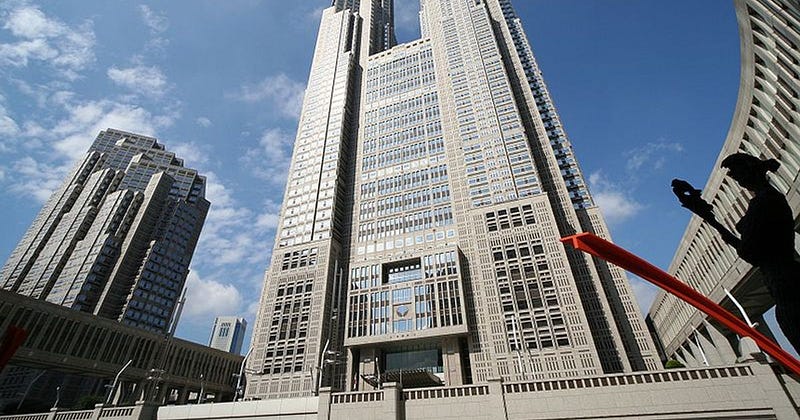
The Tokyo Metropolitan Government’s (TMG) "Digital Securities Market Expansion Promotion" project provides a window for firms to lead the structural shift from "Savings to Investment." As Tokyo aggressively pursues its mandate to become Asia's preeminent innovation and financial hub, this project provides the subsidized infrastructure required to implement Security Tokens (STs). By utilizing blockchain to bypass legacy constraints, issuers can forge a direct, high-alpha connection with a broader investor base, aligning corporate growth with Tokyo’s digital financial evolution.
For the ST issuer, this program represents a de-risked pathway to institutionalizing innovation and capturing first-mover advantage in a nascent market.
1. Evaluating the Value Proposition of Security Token Issuance
Security Tokens represent a fundamental paradigm shift in capital architecture, moving asset management from passive digitization to active value creation. For executive leadership, ST issuance is a vehicle for brand transformation and ecosystem ownership.
Based on the TMG framework, three key differentiators drive this value:
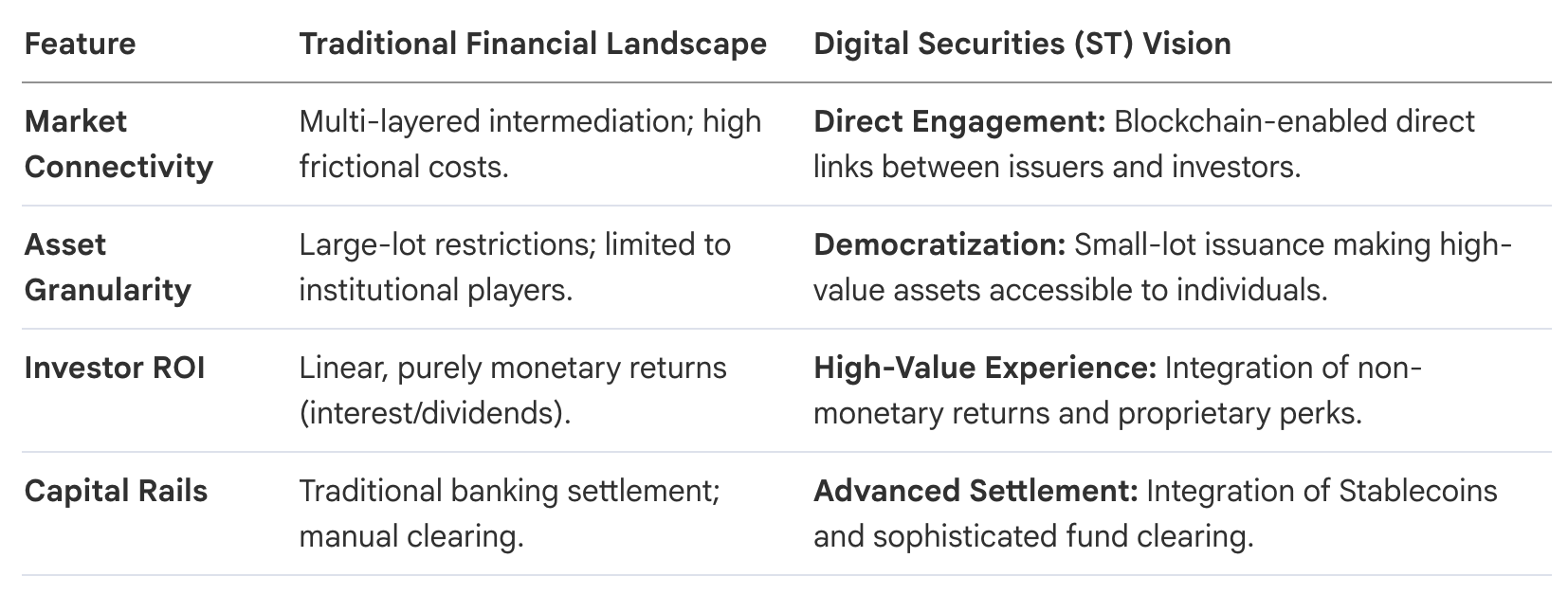
- Direct Investor Engagement: By eliminating traditional gatekeepers, issuers gain direct access to investor data and sentiment. This transparency allows for the creation of targeted loyalty programs and a more resilient, committed capital base.
- Asset Democratization: STs facilitate the "fractionalization" of assets—such as real estate or infrastructure—that were previously illiquid or high-barrier. This expands the investor pool to a digitally native demographic, increasing liquidity potential.
- High-Value Experience: Native digital issuance allows for "non-monetary returns" (e.g., service vouchers, exclusive event access). This transforms a financial instrument into a lifestyle brand, deepening the issuer's relationship with stakeholders through a sophisticated digital UX.
The TMG subsidy effectively acts as a hedge, allowing firms to absorb the initial costs of technological implementation while building long-term competitive moats.
2. Maximizing Grant Impact: Strategic Alignment with "Priority Areas"
To optimize ROI, projects must be designed to qualify for the TMG’s "Priority Areas," which elevates the subsidy ceiling from 7.5 million JPY to 10 million JPY. However, management must note a critical constraint: if the entity has received this specific subsidy in a previous fiscal year, the ceiling is strictly capped at 3 million JPY, regardless of the project's priority status.
- Priority Area A: Innovative Assets & Schemes
- Focus on tokenizing assets previously inaccessible to individuals (e.g., specialized debt, niche real estate). Issuers should design schemes that expand investor choice and create entirely new capital flows for Tokyo-based enterprises.
- Priority Area B: Advanced Investor Experience
- Focus on technological integration, specifically the use of Stablecoins or digital currencies for settlement. The goal is to provide a "revolutionary investment experience" that lowers entry barriers and increases the speed of capital circulation.
Selection Checklist
- [ ] Startup Status: Is the issuer unlisted, established <10 years, and free from "substantial control" by a large corporation? (If yes, eligibility increases to 2/3 coverage).
- [ ] Repeat Applicant Check: Has the firm received this subsidy previously? (If yes, budget for a 3 million JPY cap).
- [ ] Asset Novelty (Area A): Does the project offer a first-of-its-kind asset class to individual investors?
- [ ] Technical Sophistication (Area B): Does the roadmap include Stablecoin settlement or advanced UX features?
- [ ] Value-Add Metrics: Does the system facilitate non-monetary returns or direct issuer-investor relationship tools?
3. Financial Architecture: Optimizing Subsidized Expense Categories
The TMG covers 1/2 of eligible expenses (2/3 for startups). Capital allocation across the three pillars is essential for project viability:
- Platform Utilization Fees: Funding for blockchain infrastructure, including issuance, transfer, and redemption management fees.
- Expert Consultation (Legal/Tax): Mandatory specialized counsel to ensure compliance with the Financial Instruments and Exchange Act and the Real Estate Specific Joint Enterprise Act.
- System Development Costs: Investment in the "High Value-Add" ecosystem. Operational Alert: For any system development item exceeding 1 million JPY (excluding tax), the issuer must obtain at least two independent quotes to ensure price transparency and validity.
Non-Eligible Expenses (Excluded from ROI Calculations):
- Consumption tax and local consumption tax.
- Internal labor costs (salaries for the issuer's own personnel).
- Payments to related companies (subsidiaries, parent companies, or shared-officer entities).
- System Exclusions: Design/translation costs without technical development, labor dispatch (staffing) fees, and any software development where the copyright does not belong to the issuer.
4. Operational Roadmap and Compliance Framework
TMG selection is rigorous, focusing on projects that demonstrate immediate feasibility and long-term market scalability.
Application-to-Disbursement Lifecycle
- Application Submission: Via jGrants or physical filing (April 10, 2026 – January 29, 2027).
- Selection (Examination): An interview board evaluates the project. Requirement: Preparation of a concise A4, maximum 2-page PowerPoint presentation is mandatory.
- Implementation: Execution of development and issuance.
- Achievement Report: Submission of proof of "Completion of Payment" and legal filings.
- Fund Receipt: Final inspection and disbursement.
Winning Criteria (TMG Evaluation Perspectives)
- Novelty (先進性): Contrast the project against standard market schemes; highlight specific technological or structural innovations.
- Social Significance (社会的意義): Explicitly detail how the project diversifies funding for Tokyo-based companies or provides new opportunities for residents.
- Feasibility (実現性): Provide evidence of advanced legal/tax review and coordination with licensed financial instrument business operators.
- Future Potential (将来性): Demonstrate how this use case serves as a scalable template for the broader market.
Institutional Validation: Successful applicants must cooperate with TMG PR activities. This should be viewed as a "Tier-1 validation" signal, placing the issuer alongside previous participants like Sony Bank and Questry.
5. Risk Management and Executive Safeguards
The issuer bears the ultimate legal and financial responsibility. Management must mitigate three critical risks identified in the TMG guidelines:
- Failure to Issue (Timeline Risk): The subsidy is contingent upon the Completion of Payment. If the "payment/settlement" phase is not fully completed by March 31, 2027, the TMG may cancel the grant, leaving the issuer to bear 100% of the costs.
- Legal Compliance: The issuer must hold—or partner with—entities possessing valid licenses (Financial Instruments Business, etc.). TMG does not guarantee the legality of the scheme.
- Asset Performance: TMG provides no guarantee regarding investment quality, liquidity, or the accuracy of statutory disclosures. Price fluctuation and credit risks remain entirely with the issuer and investors.
6. Conclusion: The Path Toward a "Sustainable Global Financial Hub"
The TMG Digital Securities Subsidy is a strategic catalyst for firms ready to lead the next generation of capital markets. This is an invitation to build a proprietary financial ecosystem under the aegis of Tokyo’s institutional support. Given the competitive nature of this program, immediate action is required to secure positioning.
Executive Next Steps
- Urgent Budget Notification: The program operates on a "First-Come, First-Served" basis. The application window opens April 10, 2026, but the budget is typically exhausted well before the January 29, 2027, deadline.
- Procurement Compliance: Immediately identify two system development vendors to satisfy the "Two Quote" rule for items >1M JPY.
- Feasibility Audit: Confirm the project can reach "Completion of Payment" (investor funds collected) before the hard deadline of March 31, 2027.
- Team Mobilization: Secure legal counsel specializing in the Financial Instruments and Exchange Act to draft the necessary A4 2-page feasibility summary for the TMG examination board.
 Norbert Gehrke