JPX Group Formalizes Exclusion of Crypto-Heavy Firms from Major Indices to Safeguard Market Stability

JPX Market Innovation & Research (JPX-R), the index-governance arm of the Japan Exchange Group, has formalized its policy to suspend the inclusion of companies with dominant cryptocurrency holdings in its flagship market benchmarks. This decision, following a consultation period initiated on April 3, 2026, marks a definitive structural shift as the exchange prepares for the "Next TOPIX" era. By taking this preventative stance, JPX-R aims to insulate the broader market from extreme digital asset volatility before it can impact systemic index performance. The move underscores a strategic prioritization of index integrity over broad-market representation, ensuring that benchmark indices remain functional tools for institutional investors rather than proxies for crypto-linked funds.
With the consultation now concluded, the exchange has moved from proposal to implementation, establishing a rigid framework to identify and categorize "Digital Asset Treasury" (DAT) firms.
1. The 50% Rubicon: Establishing the Boundary for Index Eligibility
As corporations increasingly adopt "Digital Asset Treasury" (DAT) strategies—mirroring the model popularized by U.S.-based MicroStrategy—the boundary between a traditional operating company and a crypto-investment vehicle has blurred. For JPX-R, the inclusion of such firms poses a risk to the "investability" of benchmark indices. To mitigate this, the exchange has established a 50% crypto-to-total-asset threshold as the primary gauge for index eligibility.
The rationale for this specific figure is grounded in proportionality: JPX-R contends that when a single volatile asset class accounts for approximately half of a firm’s total assets, its impact on the stock price becomes "proportionately large", potentially distorting the benchmark's performance. This threshold also aligns JPX with emerging international standards for digital asset exposure.
The operational implications for constituents are categorized by their current status:
- New Candidates: For the time being, any firm not currently in an index that meets or exceeds the 50% threshold will be blocked from new inclusion, regardless of whether they satisfy liquidity or market capitalization requirements.
- Existing Constituents: While firms currently within an index will not face immediate expulsion if they breach the 50% mark, they are not permanently exempt. Their status remains under continuous review to ensure the "investment functionality" of the index is maintained, leaving the door open for future removals.
This technical demarcation was the focal point of a rigorous market consultation that highlighted the tension between index neutrality and the necessity of risk mitigation.
2. The Market Consultation: Analyzing the Debate on Index Neutrality vs. Volatility Risk
The JPX consultation revealed a polarized market. Proponents of the exclusion focused on the difficulty of valuing companies with extreme crypto-exposure, while skeptics argued that a market index should neutrally reflect the economy, regardless of a firm’s chosen asset base.
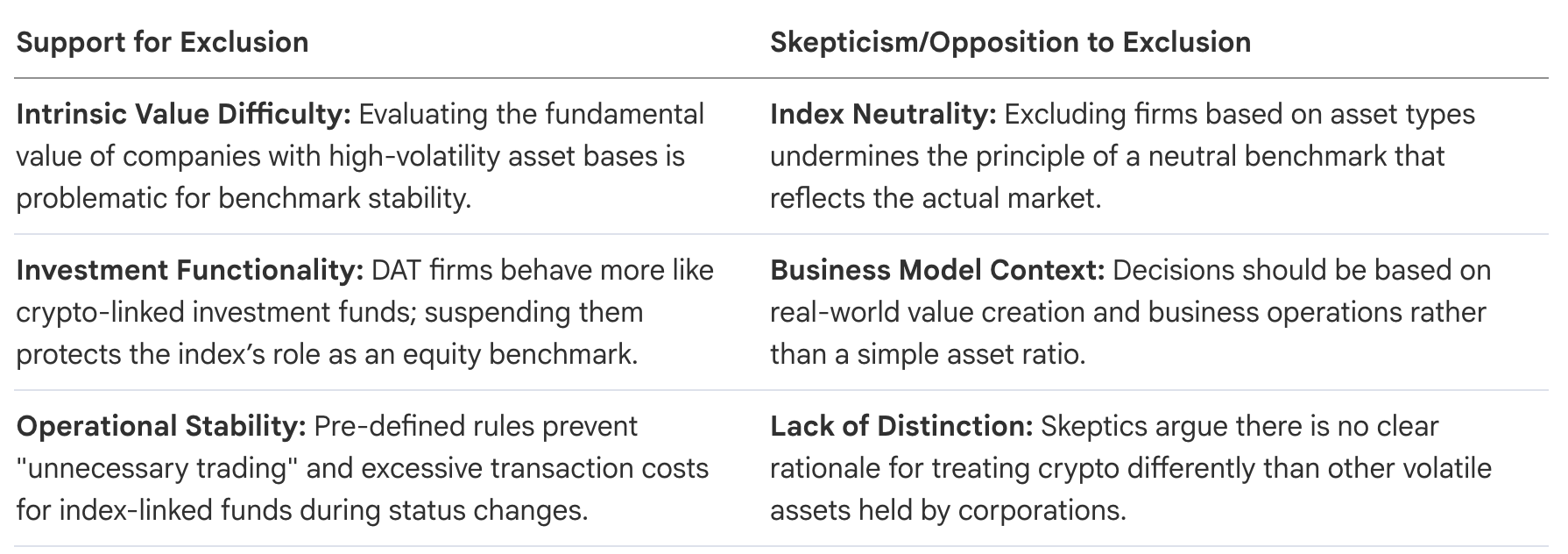
JPX-R’s final decision was driven by the pragmatic need for operational stability. A significant concern raised during the consultation involved firms that significantly alter their business or financial structure after listing—such as by repeatedly raising capital specifically to acquire cryptocurrency. By formalizing this suspension, JPX-R prevents the market impact and "entry and exit" costs that would occur if such firms were added to an index only to be removed later due to extreme volatility or structural changes. JPX-R clarified that this is not a value judgment on the legitimacy of cryptocurrency, but a necessary step to define the functionality of the index as a financial product.
3. Global Benchmarking: Contrasting the JPX and MSCI Frameworks
For institutional managers, aligning Japanese benchmarks with global standards like those of MSCI is critical for portfolio consistency. While both JPX-R and MSCI utilize a 50% threshold to define a Digital Asset Treasury Company (DATCO), their technical implementation strategies show diverging levels of maturity.
A comparative analysis reveals the following distinctions:
- Identification Methodology: While MSCI maintains a dedicated, transparent "DATCO list," JPX-R will identify affected firms on a case-by-case basis, primarily utilizing disclosure documents such as Annual Securities Reports.
- Handling of Weight Growth: MSCI has implemented stricter controls on existing constituents, "freezing" their weight by not reflecting increases in share counts or inclusion ratios. In contrast, JPX-R’s stance on weight growth for existing members remains a key monitoring point, as specific details are not yet public.
- Treatment of Size Category Transitions: MSCI explicitly "postpones" size category transitions (e.g., moving from Small Cap to Mid Cap) for DATCOs to prevent them from gaining further influence. JPX-R currently has no implemented policy regarding size transitions for these firms.
These differences suggest that while JPX-R is acting decisively on new entries, MSCI currently offers a more granular framework for managing the "index creep" of existing crypto-heavy members.
4. Future Implementation and Regulatory Outlook
The JPX-R announcement provides much-needed clarity by establishing a factual 50% benchmark, effectively ending the period of ambiguity surrounding crypto-heavy firms in Japanese indices. While the suspension of new inclusions is framed as a measure "for the time being," it creates a high barrier to entry for firms seeking to leverage their crypto-treasuries for index-driven capital inflows.
The next milestone for the market will be the publication of revised index calculation manuals. These technical details, expected to be unveiled during regular rebalancing cycles, will clarify how existing members are monitored and whether JPX will adopt the stricter weighting freezes seen in global counterparts. Ultimately, JPX-R has signaled that the stability of the index as a product takes precedence over the inclusion of digital asset-centric business models, reinforcing Japan's commitment to a predictable and stable investment environment.
 Norbert Gehrke