Megabanks Complete Joint Stablecoin Trial for Cross-Border Corporate Settlements

Japan’s three major banking institutions—Sumitomo Mitsui Banking Corporation (SMBC), Mizuho Bank, and MUFG Bank—alongside Mitsubishi UFJ Trust and Banking Corporation and systems integrator TISI, have successfully conducted a joint proof of concept (PoC) for bank-issued stablecoins and advanced cross-border settlements.
The trial stems from an initiative selected in November 2025 under the Financial Services Agency’s (FSA) "Fintech Proof of Concept Hub / Payment Modernization Project (PIP)". The demonstration tested the execution of cross-border transfers between the domestic and overseas offices of major Japanese trading house Mitsubishi Corporation, evaluating operational workflows, technical infrastructure, and regulatory compliance under Japanese financial statutes.
Under the tested architecture, the digital tokens were issued as "specified beneficial interests in trust" pursuant to Article 2, Paragraph 9 of Japan’s Payment Services Act. Mizuho Bank, MUFG Bank, and SMBC acted as joint settlors (co-trustors), while Mitsubishi UFJ Trust and Banking served as the trustee.
The model relies on a trust-based structure specifically chosen to accommodate institutional transaction scales without statutory circulation caps:
- Reserve Backing and Price Stability: The stablecoins are backed by fiat deposits held as trust assets within the banking system, ensuring value parity and depositor-grade stability.
- Permissioned Network: Circulation is strictly confined to verified corporate entities that have completed standard bank Know-Your-Customer (KYC) and identity screening procedures.
- Broad Liquidity Base: Joint issuance across the three megabanks allows the network to pool their corporate client bases, establishing wide institutional distribution.
Allocation of Roles and Technical Integration
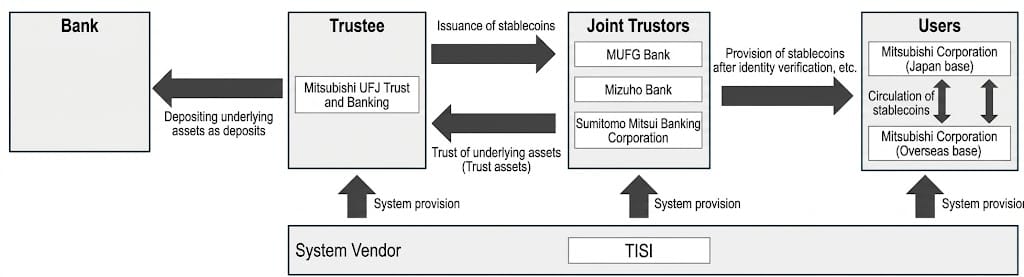
The participating firms divided operational and regulatory oversight to simulate a live multi-bank issuance environment:
- Mizuho Bank, MUFG Bank, and SMBC: Defined evaluation criteria and operational schemes, assessed business and system requirements as joint settlors, and tested the full transaction lifecycle—including issuance, distribution, transfer, and redemption. SMBC supplied the blockchain infrastructure utilized in the trial, developed in collaboration with TISI.
- Mitsubishi UFJ Trust and Banking: Handled trustee-side validation, mapping trust operations, evaluating user-protection mechanisms, and testing the administration and management of underlying reserve assets.
- TISI: Served as the primary technology provider, integrating the wallet infrastructure, stablecoin issuance mechanisms, and business operational workflows.
The consortium placed particular emphasis on verifying Anti-Money Laundering and Countering the Financing of Terrorism (AML/CFT) frameworks, multi-settlor administrative controls, and system resiliency across international transfer scenarios.
Findings and Commercial Roadmap
The consortium confirmed that the joint multi-bank issuance model demonstrated structural safety, operational reliability, and technical feasibility throughout the simulated transfer and redemption flows with Mitsubishi Corporation.
The trial advances a broader initiative announced on June 10, 2026, in which the three megabanks established a consultative council with the objective of launching live commercial transactions using a co-issued stablecoin within fiscal year 2026.
The effort dovetails with several complementary digital asset projects undertaken by the banks earlier in the year, including a February 13 trial exploring blockchain-based trading and title transfer of traditional assets, and a September 29 pilot integrating trade finance settlements with the TradeWaltz® platform.
Moving forward, the consortium plans to maintain discussions with domestic and foreign regulators, financial institutions, and corporate participants to address cybersecurity, AML/CFT mandates, and user protection as they advance toward commercial on-chain financial services and tokenized deposit structures.
 Norbert Gehrke